
The right automatic de-palletising system depends on what needs unloading. A system may transfer complete layers for further handling or separate individual packages and feed them into the next process. The choice also depends on the goods, available space and how the line operates.
Reducing manual unloading is a practical goal, but the automation should suit the load and site rather than add complexity. Box dimensions, packaging stability, pallet presentation and the required case flow all affect which handling method fits.
This guide explains the difference between layer and individual-package handling, how automation can reduce manual intervention, and the ergonomic and operational benefits to consider. It also covers site suitability and the box-size information needed to define a suitable system, helping you assess requirements before developing a specification.
Key Takeaways
- Choose layer or individual-package handling according to how cases need to enter the next stage of your process.
- Under the Manual Handling Operations Regulations 1992, hazardous manual handling must be avoided so far as reasonably practicable, assessed where it cannot be avoided, and then reduced, according to legislation.gov.uk.
- Consider ergonomic and operational effects together: the Health and Safety Executive estimates the total annual cost of workplace injuries and new cases of ill health in Great Britain at £22.9 billion.
- Assess floor space, access, pallet presentation and line flow to judge whether an automated system suits your site.
- Capture box dimensions, weight and packaging stability to help define compatible handling requirements.
Depalletising complete layers or individual packages
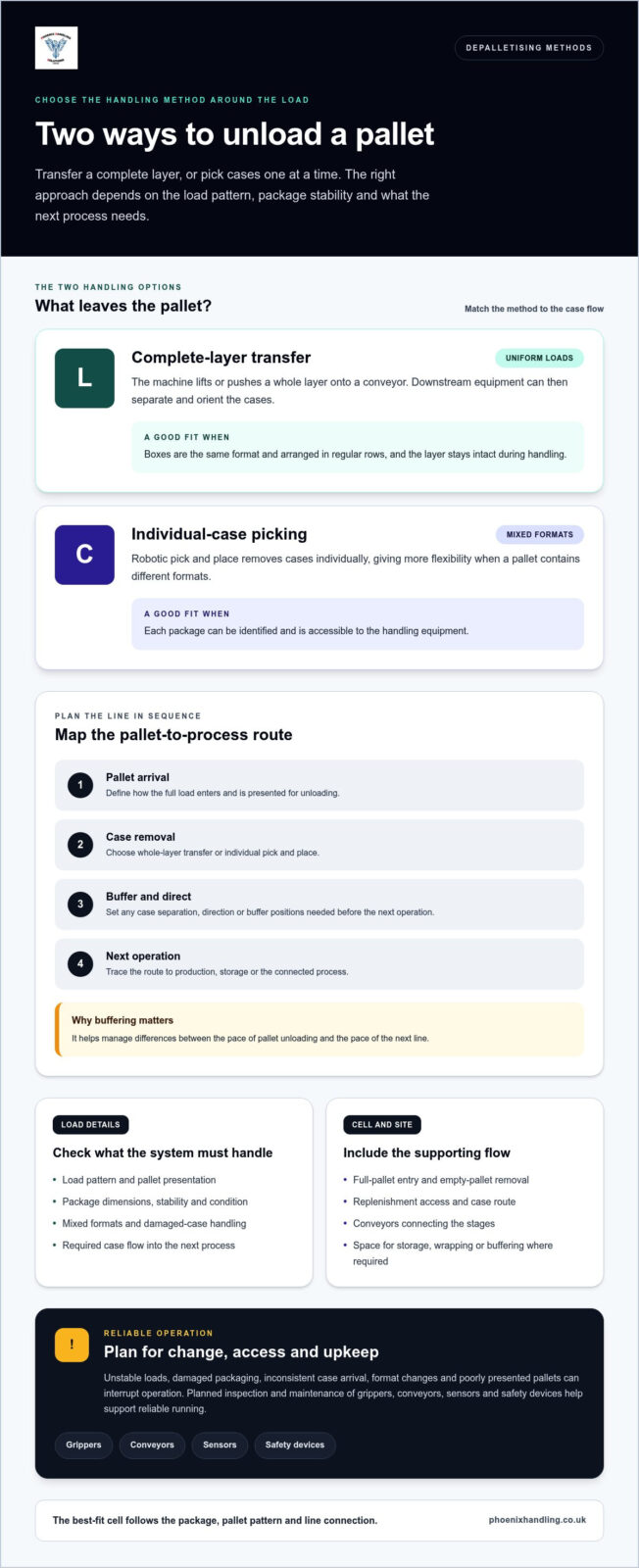
An automatic de-palletising system can remove a complete layer or handle cases individually. The right method depends on the load pattern, package stability and the next process. Common challenges include unstable loads, damaged packaging and interruptions when cases arrive inconsistently. Format changes or poorly presented pallets can also affect operation. Planned inspection and maintenance of grippers, conveyors, sensors and safety devices help support reliable running.
Layer handling suits uniform loads, such as identical cardboard boxes arranged in regular rows. A machine lifts or pushes a complete layer onto a conveyor, where downstream equipment can separate and orient the cases. Individual-package depalletising uses robotic pick and place to remove cases one at a time. This offers more flexibility when a pallet contains different formats, provided each package is identifiable and accessible to the handling equipment.
For example, a production line receiving one box format may use layer transfer for a steady flow. A mixed-case operation may need each case separated before buffering. In that setup, the layer depalletiser transfers a layer to a conveyor, then equipment separates and directs cases to buffer positions. Buffering helps manage differences between incoming pallet unloading and the pace of the next line.
Automated cells can combine pallet storage, wrapping and depalletising around a planned material flow. A stored pallet can be presented for unloading, while wrapping equipment secures outbound loads elsewhere in the cell. Conveyors connect these stages and reduce repeated manual transfers. The layout should account for pallet entry, empty-pallet removal, replenishment access and the route cases take after depalletising.
Automated depalletising works best when packages arrive in consistent dimensions and stable patterns. Cardboard boxes, crates, outer packaging and containers can be fed into production or distribution processes. If cases vary in size, surface or condition, the handling method must accommodate those differences. A robotic cell can pick individual packages, while layer transfer may suit loads where each layer stays intact.
In the UK, packaging-machinery manufacturers and automation integrators supply depalletising equipment, often as part of wider line automation. Their systems can combine robotic handling, conveyors, pallet presentation and case buffering. The required configuration follows the package, pallet pattern and connection to existing loading and production equipment.
To compare options, map the process in sequence: identify pallet arrival, decide whether cases leave by layer or individually, define the buffer needed, then trace the route to the next operation. Record mixed formats, damaged-case handling and empty-pallet movement as separate requirements. This clarifies the difference between layer transfer and individual pick and place, and helps define a suitable cell without adding equipment the line does not need.
Reducing manual handling during unloading
Unloading automation can reduce repeated lifting and carrying when pallets arrive at a fixed point. Connect pallet presentation, case removal and onward movement without introducing new manual transfers.
For UK unloading work, the Manual Handling Operations Regulations 1992 require hazardous manual handling to be avoided so far as reasonably practicable, assessed where it cannot be avoided, and then reduced, according to legislation.gov.uk. Machinery and conveyor risk assessments should also consider guarding, safe access, isolation and emergency stopping.
Pallet handling and conveyors
Pallet handling includes how full loads enter the cell, how empty pallets leave and how cases reach the next operation. A powered conveyor can transfer pallets to a depalletising position, while separate conveyors carry removed cases towards production or storage. When planning broader conveying infrastructure, specialist suppliers such as Jealco International, Inc. provide material handling systems and components designed for reliable industrial transfer. Map forklift routes, pallet stops and operator access alongside the conveyor path. This highlights pinch points and unnecessary lifting before installation.
Throughput and SKU handling
Throughput depends on the rate at which pallets arrive, cases are removed and downstream equipment accepts them. Record the required line flow alongside the number of stock-keeping units (SKUs) and changes between formats. A single, consistent crate format can support a repeatable unloading sequence. Mixed packaging may require identification, sorting or buffer space, helping the next process avoid rushed manual handling.
Autonomous mobile robots (AMRs) can move crates between a defined handover point and another part of a facility. Integration requires a clear route, suitable crate presentation and coordination with conveyor controls. For example, an AMR can collect a crate after unloading and deliver it to a packing area, reducing carrying between separate workstations. Include pedestrian routes and replenishment access in the layout plan.
Assess the depalletiser, conveyor and any mobile equipment as connected parts of the unloading process. Account for access when clearing jams, safe isolation during maintenance and visibility of operating zones. The legal duty mentioned above concerns hazardous manual handling; guarding and control arrangements should be assessed for the specific machinery and workplace.
Before specifying an integrated cell, document pallet arrival, empty-pallet removal, crate dimensions, SKU changes and downstream demand. Then identify each manual lift or carry that remains, and whether a conveyor or AMR can remove that transfer. A suitable de-palletising system should fit this mapped flow, rather than adding automation without a defined handling need.
Ergonomic and economic benefits
In a warehouse or production area, unloading often involves lifting, reaching, turning and carrying. Repeating these actions across incoming pallets places physical demands on operators. Automated handling changes the task: conveyors or a depalletising cell move cases between defined points, while staff oversee the process, replenish materials or manage exceptions. The ergonomic benefit depends on which manual movements the layout removes.
The Health and Safety Executive estimates the total annual cost of workplace injuries and new cases of ill health in Great Britain at £22.9 billion. For an individual operation, the relevant assessment starts with its own unloading tasks. Observe how workers lift cases from different pallet heights, handle awkward packaging and move loads to the next station. These observations help identify where automation can reduce exposure to repetitive or demanding movements.
Automating the lifting and movement of heavy cases can improve workplace ergonomics and reduce intermittent and repetitive injuries. For example, a conveyor can carry cases from a depalletising point to a packing line, replacing repeated carrying between workstations. A robotic cell can make case transfers that would otherwise require workers to reach across a pallet. Operators still need safe access to supervise, clear faults and replenish the process.
Assess economic benefits through operational effects rather than assumed savings. Compare the current unloading process with the proposed automated sequence, including staffing tasks, stoppages, damaged packaging and how reliably cases reach production. A system that feeds the line at the required pace may reduce manual interventions, but a downstream bottleneck can limit that benefit. Map the complete route before assessing its effect on output.
- Workload: identify lifts, carries, reaches and twists during a typical unloading cycle.
- Process flow: trace cases from pallet removal to the next operation, noting where handling stops.
- Exceptions: record how workers manage damaged cases, unstable loads or packaging that needs adjustment.
These checks connect ergonomic improvements with production performance. If operators regularly leave another task to unload incoming pallets, automation may also make work allocation more consistent. If loads vary, the system must handle that variation without shifting difficult work elsewhere. Account for maintenance access, operator training and safe procedures during stoppages.
Use a practical comparison: document current tasks, identify the transfers an automated cell would perform, then define the remaining operator duties. Review the proposed sequence with the people who unload and supervise the line. Their observations can reveal awkward access, exception handling and packaging issues that a throughput estimate alone may miss. This assessment links reduced manual handling to measurable process requirements, without treating automation as a stand-alone solution.
Assessing site suitability
Site suitability depends on the route between pallet arrival and the next operation. Trace a delivered load from the transport bay through storage, depalletising and onward packing. Mark each transfer point on a layout drawing, including forklift access, pedestrian routes and space for empty pallets. This shows whether the proposed cell suits the actual supply flow, not just the available floor area.
Measure the proposed location and record obstructions that could affect equipment positioning. Columns, doorways, low beams and existing services can restrict the handling equipment’s reach or conveyor route. Check the floor condition and the route for bringing machinery into the building. Installation access matters as much as the final footprint, particularly where large frames must pass through existing access points.
Assess the cases and pallets that will enter the cell. Record the range of box dimensions, load stability, pallet condition and packaging features that affect gripping or layer separation. A site receiving uniform cases from one production line has different handling requirements from a warehouse with mixed stock. Include damaged or incomplete loads, as exceptions can affect both equipment operation and operator access.
- Flow: map pallet supply, case discharge and empty-pallet removal.
- Interfaces: identify conveyors, control signals and nearby equipment.
- Access: note maintenance positions, operator stations and delivery routes.
- Environment: record dust, temperature variation or wash-down requirements where they apply.
Installation and commissioning typically start with a site survey and agreed layout, followed by positioning, connection to site services and integration with adjacent equipment. Commissioning then uses representative pallets and packaging to test handling sequences, safety functions, controls and case transfer to the next process.
Plan interfaces with upstream and downstream machinery before installation. For example, a conveyor may need to receive cases at a consistent height, while a packing line may require a defined orientation. Agree how production starts and stops, how faults are signalled and how operators regain access after a stoppage. These decisions shape the cell’s controls and operating procedures.
Consider future site changes alongside current production. A new packing machine, altered storage arrangement or revised transport route can change pallet presentation and case flow. Keep the layout drawing, equipment interfaces and operating sequence together as a project record. This helps maintenance teams understand the installation and supports planned changes while preserving access, material flow and safe working space.
Compatible box sizes
Box compatibility depends on more than length, width and height. A depalletiser must handle package dimensions, weight, surface and position within the pallet pattern. For example, a long, narrow carton presents different gripping and stability requirements from a shallow, broad case. Build the handling specification around the full range of boxes entering the installation.
Start by recording the smallest and largest cases, then include intermediate formats used in production or logistics. Note whether dimensions vary between packaging batches and whether flaps, tape or labels affect the gripping surface. Include full and partly filled cartons if both reach the line. These details inform machine configuration, the pick-and-place method, conveyor settings and space around each transfer point.
- Dimensions: record length, width and height for every format, including orientation on the pallet.
- Load: document case weight and whether contents shift when a carton is lifted.
- Structure: note board condition, closures, handles and surfaces that may compress or slip.
- Pattern: show how each case sits within a layer, including overhangs and gaps.
Box geometry affects whether cases can be removed by layer or individually. Uniform cartons arranged in a stable pattern can suit layer handling. Different sizes or orientations may call for individual pick and place, with the sequence adjusted for each format. Even a compact case can be difficult to grip if neighbouring boxes restrict access. Assess pallet patterns and package dimensions together.
Position matters after removal, too. A case may need to leave the depalletiser with a particular face forward or enter a conveyor in a consistent orientation. For example, a downstream packing station may need labels facing a scanner. Define the required case orientation and transfer route before installation, so the system supports both package removal and the next operation.
Use representative cartons during specification and commissioning, including formats that create demanding handling conditions. Test how the packaging responds to lifting, whether cases remain stable during transfer and whether adjacent equipment accepts each size. Record agreed dimensions and handling rules in the operating documentation, so later format changes can be assessed against the established configuration.
Prepare a box schedule with dimensions, weight, pallet arrangement and handling notes for each format. Discuss your box-handling requirements to identify the relevant depalletising configuration for your operation.
Phoenix Handling Solutions Limited: Pallet Wrapping Machines
Phoenix Handling Solutions Limited can help you consider how pallet loads are secured after handling and before storage or transport. Pallet Wrapping Machines, Strapping Machines and Stretch Hooders address different load-securing requirements, while a Bag Palletiser supports bag handling earlier in the packing process.
When reviewing a depalletising layout, consider how incoming loads connect with the end-of-line packaging machinery flow. For example, the wrapping or strapping used downstream can affect how pallets are prepared for dispatch and storage. Matching equipment to the load and process keeps the specification focused on operational needs.
To discuss pallet handling and packaging equipment for your operation, contact Phoenix Handling Solutions Limited or visit phoenixhandling.co.uk.
Plan the next step around your operating data
Before specifying an automatic de-palletising system, turn your operating observations into a concise project brief. Include representative box dimensions, pallet patterns, packaging condition, required case flow and interfaces with existing equipment. This gives the system design a practical basis and keeps decisions aligned with your site’s needs.
Consider the wider line as well as unloading. Phoenix Handling Solutions Limited offers Pallet Wrapping Machines, Strapping Machines and Stretch Hooders to secure pallet loads at later stages of the packaging process. These options can form part of a broader equipment discussion when a project includes both inbound handling and outbound load preparation.
Set out your site requirements and discuss your handling project with Phoenix Handling Solutions Limited. A clear brief is a useful starting point for evaluating suitable equipment and planning the next stage of your operation.
Frequently Asked Questions
What is an automatic depalletising system and how does it work?
An automatic de-palletising system removes goods from pallets and transfers them into a production or logistics process. It may lift complete layers, pick cases individually or move packages onto a conveyor for separation. For example, a uniform pallet of cartons can be unloaded by layer, then the cases separated before reaching a packing line. The operating sequence depends on the load pattern and what happens next.
What types of automatic depalletising systems are available?
Common types include layer depalletisers, robotic systems, pick-and-pack systems and sweep-off systems. Layer equipment removes a complete row or layer, while robotic handling can pick individual packages. A gantry arrangement moves equipment along an overhead frame when a wider working envelope is needed. The choice depends on whether loads are uniform or mixed, how cases must be presented and how the system connects with downstream conveyors.
What factors determine depalletiser throughput and capacity?
Throughput depends on how quickly pallets arrive, how cases are removed and whether the next process can accept them. Pallet pattern, package dimensions, load stability and the number of product formats also affect cycle sequencing. For instance, a line receiving varied cartons may need identification and more handling steps than one processing a consistent case. Buffer positions can help manage rate differences between unloading and downstream production.
How do robotic and layer-by-layer depalletising systems compare?
Layer-by-layer systems transfer grouped cases and suit consistent pallet patterns, with downstream equipment separating packages if needed. Robotic depalletisers pick individual cases, which can support mixed formats and different placement sequences. A robotic cell may also serve cases from more than one upstream line. Compare the flexibility required with the regularity of incoming loads, then consider how each method affects case orientation and handover to the next operation.
Which pallet, load and packaging types can automatic depalletisers handle?
Automated systems can handle uniform packages such as cardboard boxes, crates, outer packaging and containers. Compatibility depends on package dimensions, weight, stability, surface and arrangement on the pallet. A tightly grouped carton load presents different handling needs from crates with exposed edges. Pallet condition and access to the top or bottom layer matter, too, because they affect how packages can be removed without disrupting neighbouring cases.
What floor space, utilities and integration are needed for installation?
Installation space must accommodate the depalletiser, pallet presentation, case discharge, empty-pallet movement and operator access. The layout also needs room for conveyors and safe maintenance access. Site services and control connections depend on the selected equipment and its interfaces. For example, a cell feeding an existing packing line needs an agreed transfer point and operating signals, plus a route that does not obstruct nearby transport or storage activity.
What UK machinery safety regulations and standards apply to depalletisers?
The Manual Handling Operations Regulations 1992 require hazardous manual handling to be avoided so far as reasonably practicable, assessed if it cannot be avoided, and then reduced. Assess machinery risks including guarding, safe access, isolation and emergency stopping; no specific machinery standards are identified.