Getting bottles off a pallet is only half the job; the handover to the conveyor determines how consistently the filling line is fed. A de-palletiser for bottles can unload containers by layer or row: semi-automatic systems transfer one layer at a time and suit lines processing up to 150 containers per minute, whilst automatic layer-push systems suit lines processing up to 500 containers per minute. The right arrangement depends on the container format, pallet presentation and how bottles need to reach the conveyor.
A reliable feed matters because bottles must leave the pallet in a controlled way and reach the next stage without disrupting the line. The unloading method also affects operator involvement, format changes and how the system handles different containers.
This guide explains how manual, semi-automatic and automatic systems work, and how sweep-off and gripping methods transfer bottles onto conveyors in bulk or by row. It also covers gentle handling options and the practical factors that shape system selection, so you can assess which approach fits your production process. For a broader look at how product presentation, labour and upkeep influence equipment choices, see these pick and pack de-palletiser examples.
Key Takeaways
- Choose manual, semi-automatic or automatic unloading according to line demands, operator involvement and the way pallets are presented.
- Plan the conveyor handover as part of the depalletising system so bottles move steadily into the filling line.
- Match the gripping method to the container material and packaging format to support gentle, controlled handling.
- Decide whether bottles should be discharged in bulk or by row based on product stability and the next stage of the process.
- Consider pallet protection and handling equipment alongside conveyor and depalletising requirements when reviewing the wider packaging line.
Manual, semi-automatic and automatic depalletising
De-palletisers range from operator-led unloading to automatic layer transfer. The choice affects how bottles leave the pallet, how operators feed the line and how the equipment fits the production layout.
Manual and automated configurations
Manual configurations rely on an operator to remove containers and place them on a conveyor. Semi-automatic equipment mechanises layer transfer, while an operator still loads pallets or manages parts of the process. Fully automatic systems handle more of the sequence, including layer movement and discharge. Compare these options against your required line rate, container format and operator role.
Plan the installation around pallet infeed, conveyor discharge, operator access and space for format adjustments. The footprint depends on the equipment layout and how pallets reach the machine. Include access to moving parts and cleaning points in maintenance planning, so inspections and routine servicing can take place without obstructing production.
Sweep-off and semi-automatic operation
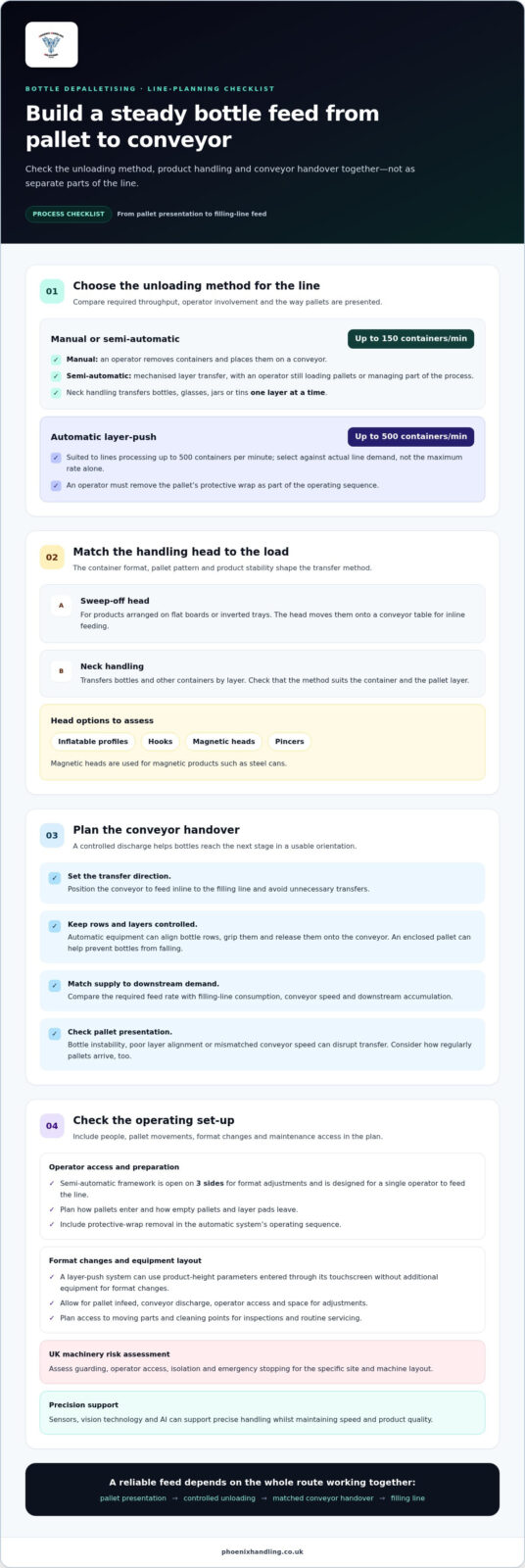
A sweep-off head suits containers arranged on flat boards or inverted trays. It moves the products onto a conveyor table, which feeds them inline to the filling line. Semi-automatic depalletisers use neck handling to transfer bottles, glasses, jars or tins one layer at a time. They can suit bottling lines, depending on the line’s requirements.
The semi-automatic framework is open on 3 sides for format adjustments and is designed for a single operator to feed the line. By contrast, an automatic layer-push depalletiser suits lines processing up to 500 containers per minute, but an operator must remove the pallet’s protective wrap. Bottle instability, poor layer alignment and mismatched conveyor speed can disrupt transfer. Reduce these risks through suitable pallet presentation, controlled discharge and a line speed matched to downstream demand.
Choosing and sizing for the production line
Choose a de-palletiser for bottles based on the line’s required throughput, container shape, pallet pattern and conveyor arrangement. Manual or semi-automatic handling suits a different operating rate from automatic layer-push equipment. Check how the head grips the product: options include inflatable profiles, hooks, magnetic heads or pincers. Magnetic heads are used for magnetic products such as steel cans.
Automatic format changes can simplify changeovers. A layer-push system can use product-height parameters entered through its touchscreen, without additional equipment for format changes. Sensors, vision technology and AI can support precise handling whilst maintaining speed and product quality. For a suitable head and line layout, match the gripping method to the container and the pallet layer, then integrate the discharge with the conveyor’s feed rate.
Depalletising bottles from pallets onto conveyors
A depalletiser removes bottles in controlled layers or rows, then transfers them to the conveyor feeding the filling line. In the UK, assess guarding, operator access, isolation and emergency stopping through a site-specific machinery risk assessment; line capacity ranges from up to 150 containers per minute for manual or semi-automatic systems to up to 500 for automatic layer-push machines.
Bottle depalletiser operation
The machine receives a pallet, separates containers from their supporting layer and directs them towards the conveyor. The unloading head must suit the load: neck handling transfers bottles by layer, while a sweep-off head handles products on flat boards or inverted trays. Match the method to the pallet pattern and container stability.
Before operation, establish how pallets enter the machine and how empty pallets and layer pads leave it. An automatic layer-push system still requires an operator to remove protective pallet wrap. Include this preparation in the operating sequence rather than treating it as a separate warehouse task.
Transfer from pallets to conveyors
In a sweep-off arrangement, the head moves containers onto a conveyor table. The table feeds them inline to the filling line, creating a direct handover between pallet unloading and production. Match the conveyor position and feed direction to the downstream line, so bottles arrive in a usable orientation without an unnecessary transfer.
Automatic equipment can align bottle rows before the gripping head arrives and keep the pallet enclosed to help prevent bottles from falling. For example, the machine can bring a row into position, grip it and release it onto the conveyor. Pallet stability, row alignment and the transfer point all affect how smoothly the sequence runs.
Speed and capacity
Manual and semi-automatic depalletisers suit bottling lines processing up to 150 containers per minute. Automatic layer-push machines suit lines processing up to 500 containers per minute. These figures distinguish the equipment categories; the production line’s actual demand should guide selection, rather than the machine’s maximum rate alone.
Compare the required feed rate with the filling line’s consumption and the time needed to prepare pallets. A faster machine cannot maintain a steady supply if pallets arrive irregularly or the conveyor cannot accept its output. Assess the complete route, from pallet presentation and unloading to conveyor speed and downstream accumulation.
For UK site planning, record the machine’s footprint, operator positions and access for cleaning and maintenance. Keep pedestrian routes and pallet movements separate where the layout allows, and include clear procedures for clearing a stoppage. These practical checks help integrate the depalletiser with the conveyor and surrounding production area.
Gentle handling using soft grippers, vacuum technology and padded clamps
Fragile containers need a gripping method suited to their shape, surface and position on the pallet. Robotic de-palletisers can be configured for different packaging types; soft grippers, vacuum technology and padded clamps can help handle fragile products gently. A glass bottle, for example, needs different handling from a lightweight plastic container or rigid jar.
Soft grippers use compliant gripping surfaces, making them an option for containers that need controlled contact. Suitability depends on the bottle profile and how securely the head can hold it during transfer. Assess the bottle body, shoulder and neck, then identify contact areas that will not interfere with the next process or destabilise neighbouring containers.
Vacuum technology uses suction to hold products during movement. The contact area and surface condition matter: a smooth, accessible face differs from a narrow neck or curved bottle body. For a mixed pallet, consider how the head will pick each format and whether the contact point stays consistent. Assess the complete pick-and-release sequence, not just the grip while the head is stationary.
Padded clamps hold a container between cushioned contact surfaces. Their pressure and position must suit the product: a secure hold should not deform light packaging or place excess force on fragile glass. Clamping a stable section of the bottle body may be more appropriate than contacting a closure or thin-walled area. The container’s shape determines the useful gripping zone.
Follow a practical selection process. First, identify the container materials and formats on the pallet. Next, note how bottles are arranged and which surfaces the head can reach. Then compare soft gripping, vacuum pick-up and padded clamping against the required transfer path. A mixed load may need adjustable tooling to handle different bottle shapes and release them in a controlled way.
Handling quality depends on the whole movement, not just the gripping head. Align the pickup with the container position, control the transfer path and release bottles in line with the receiving conveyor. A head that holds bottles securely but releases them unevenly can disrupt discharge. Assess the gripper, pallet pattern and conveyor handover as one operating sequence.
Format trials should use the containers and pallet arrangements from production. Observe bottle movement during pickup, travel and release, then adjust the head or sequence if containers shift or touch neighbouring products. Record the suitable gripping method for each format so operators can repeat the settings after a changeover.
Bulk or row-based container unloading
Bulk unloading releases a group of containers together, while row-based unloading transfers them in a more ordered sequence. The right method depends on how bottles sit on the pallet and how the next process receives them. A filling line that needs aligned rows, for example, has different handover requirements from a process that accepts a loose accumulation.
Start by checking the load pattern: are bottles held in trays, arranged on flat boards or standing loose? Shrink-wrapped trays restrain products during movement, while trays without shrink wrap can hold unstable products. This affects the gripping plate and transfer sequence. A trial with the actual pallet format can show whether containers shift during pickup or need additional stabilisation.
Row-based unloading is useful when the receiving conveyor needs bottles presented in a controlled arrangement. The machine can maintain the row pattern as containers leave the pallet, then release them towards the next operation. Consider bottle orientation, spacing and the conveyor’s receiving width. If rows arrive unevenly, adjust the transfer sequence before they reach downstream equipment.
Bulk discharge can suit a process that accepts containers together rather than in defined rows. However, loose bottles and unstable trays need controlled movement at the pallet edge and during conveyor transfer. For trays without shrink wrap, special gripper plates with a stabilising top plate can help manage unstable trays and loose products. Variable conveyor speeds can also support controlled movement from the de-palletiser.
Assess the full route, not just the gripper. First, confirm how products are supported on the pallet. Next, establish whether the line needs grouped containers or ordered rows. Then consider how the receiving conveyor controls flow. A tray that stays stable during pickup may behave differently once its support is removed, so assess release and conveyor handover too.
Product type also guides the unloading pattern. Glass bottles need a stable transfer that limits contact between containers, while loose products may need a stabilising top plate and adjusted conveyor movement. Match the release method to the downstream operation: row-based handover and bulk feed have different requirements for spacing and accumulation.
Use production trials to compare the chosen pattern across pallet formats. Observe whether trays stay steady, bottles retain their orientation and the conveyor accepts the discharge without disrupting flow. Record the appropriate gripper plate, stabilising arrangement and conveyor settings for each load. This gives operators a repeatable setup when the product or pallet presentation changes.
What is a bottle depalletiser and how does it work?
A bottle de-palletiser removes containers from a pallet and transfers them towards a production line. Its main components include the pallet position, a lifting or gripping arrangement, a discharge area and a conveyor interface. Each stage must suit the bottle format and the way products are arranged on the load.
The operating sequence begins by presenting a stable pallet at the machine. The equipment then identifies or accommodates the layer position, engages the bottles or their supporting tray, and moves them towards the discharge point. The head design depends on how the containers are packed. An inflatable-tube head is used when products are loaded into trays on pallets.
- Present the load. Position the pallet so its bottle rows and supporting trays align with the machine’s handling area.
- Engage the layer. Select a head suited to the load, such as an inflatable-tube head for products in trays.
- Transfer the products. Move the supported bottles from the pallet towards the discharge area without changing the intended grouping.
- Release to the next stage. Place containers onto the receiving surface or conveyor for onward movement.
The sequence varies with the pallet format. Bottles loaded in trays have different support from containers standing directly on a pallet layer. The tray affects where the head makes contact and how products stay stable during movement. A mixed production range also makes format compatibility important, since bottle height and arrangement influence the handling position.
The discharge point connects de-palletising with the rest of the line. Bottles can be released in a controlled pattern for the conveyor to carry onwards. If the receiving surface is poorly aligned with the transfer path, containers may arrive unevenly or lose their intended arrangement. Review pallet entry, machine movement and conveyor handover as one continuous process.
For food and beverage applications, equipment can use easy-to-clean materials such as stainless steel and minimise crevices where contaminants could collect. These design considerations affect the surfaces operators need to clean around the handling area. The pallet format, bottle material and cleaning requirements together inform equipment layout and maintenance.
During specification, document each bottle and tray format, the pallet pattern and the required discharge arrangement. These details help define the gripping head and transfer sequence before installation planning begins. To discuss a suitable bottle depalletising system, outline how containers are presented and where the conveyor receives them.
Two other configurations show how the handling method follows the load and discharge route. A sweep-off de-palletiser unloads containers onto a conveyor table that feeds them inline to the filling line. A scissor-lift de-palletising head is used when products are in a retort basket. These examples show why the load’s support arrangement and the destination for the containers matter when choosing a configuration.
Phoenix Handling Solutions Limited: Pallet Wrapping Machines
Phoenix Handling Solutions Limited helps manufacturers plan pallet protection as part of the wider packaging process. Bottle de-palletising feeds containers into production; pallet wrapping secures completed loads for handling and storage. Consider wrapping when reviewing product movement through the whole line, rather than viewing bottle unloading in isolation.
Pallet Wrapping Machines are the closest fit when finished pallets need a wrapping stage. Strapping Machines and Stretch Hooders offer other pallet-protection options, while a Bag Palletiser handles bagged products rather than bottle unloading. The right equipment depends on the load and its place in the process.
For a discussion about pallet protection alongside your production flow, contact Phoenix Handling Solutions Limited.
Plan the next step for your production line
Before selecting a de-palletiser for bottles, define how the equipment must fit the wider production flow. Consider where pallets enter, how containers transfer to the line and how completed loads leave the packing area. A clear process brief helps focus equipment discussions on your site’s practical requirements.
Phoenix Handling Solutions Limited also supplies Pallet Wrapping Machines, Strapping Machines and Stretch Hooders for finished-load handling. These options can form part of a broader packaging review when assessing incoming containers and outgoing pallets. The right arrangement depends on your production layout and load-handling requirements.
Share your process requirements with Phoenix Handling Solutions Limited to discuss suitable equipment for your operation. A considered review can help you identify the next practical step for your line.
Frequently Asked Questions
What types of bottle depalletisers are available for glass and plastic bottles?
Select a de-palletiser for bottles according to container shape, pallet arrangement and transfer method, not material alone. Neck-handling heads can transfer bottles by layer, while robotic systems can be configured for different packaging types. Tray-loaded products may use an inflatable-tube head; bottles on flat boards or inverted trays may suit sweep-off handling. For glass and plastic formats, compare contact points and how each container stays stable during release.
How do automatic and semi-automatic bottle depalletisers compare?
Semi-automatic systems retain an operator role in pallet feeding or preparation, while automatic systems handle more of the unloading sequence. This affects staffing, pallet presentation and changeovers. For example, an automatic layer-push machine still needs an operator to remove protective pallet wrap before operation. Semi-automatic equipment can suit lines where operator access and format adjustments are central to the workflow; automation suits processes seeking a more continuous mechanical handover.
What pallet sizes, bottle formats and line integrations must a depalletiser support?
Specify the pallet’s length, width and loaded height, alongside bottle dimensions, layer pattern and any trays or boards. Include the range of formats used in production, since a machine must accommodate the actual load variations. For integration, map pallet infeed, empty pallet removal, conveyor height and direction, and the receiving line’s control sequence. A site layout drawing and representative pallet pattern help define clearances and transfer points before equipment is specified.
What UK health and safety standards apply to bottle depalletisers?
For UK site planning, assess guarding, operator access, isolation and emergency stopping through a site-specific machinery risk assessment.