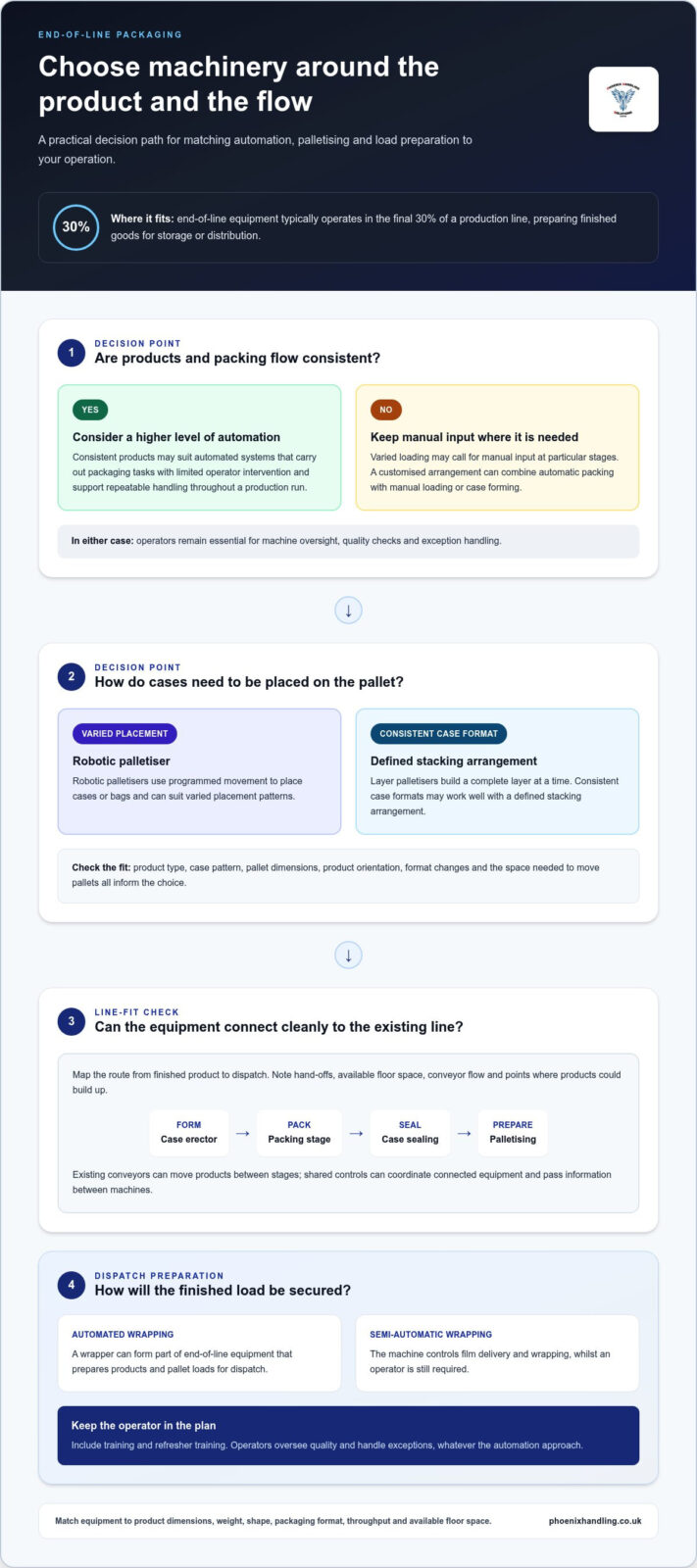
A production line’s final 30% is where finished goods are prepared for storage and distribution. End-of-line packaging machinery typically operates in this stage, using equipment such as case erectors, packers, palletisers and wrappers to form, pack and secure products for dispatch. Automation can help prevent downstream bottlenecks, but it shifts operators towards oversight, quality checks and exception handling rather than removing their role.
It’s easy to focus on production speed, but the final packaging stages must keep pace for finished goods to move smoothly through the line. This guide explains what end-of-line packaging machinery does, where it fits in production and which machines handle each task. It also covers standalone and integrated equipment, and what to consider when matching machinery to products, loads, throughput and available floor space.
Key Takeaways
- Map the steps from finished product to dispatch to identify hand-offs and potential bottlenecks.
- Match equipment to product dimensions, required throughput and available floor space.
- Consider how palletising and load stabilisation can support secure handling during storage and transport.
- Plan an automation approach that can begin with individual machines and develop as operational needs change.
End-of-line automation definition and production-line scope
End-of-line automation covers the equipment and processes that prepare finished goods for storage or distribution. It typically operates in the final 30% of a production line, downstream of product manufacture or assembly.
Manufacturing and Distribution Applications
End-of-line packaging machinery can form cases, pack products and prepare pallet loads for dispatch. A food and beverage line, for example, may use case forming and pallet wrapping to move packed products towards storage. In manufacturing and distribution, automated packing can support consistent output as product formats or order volumes vary. Start by assessing product dimensions, packaging format and material flow, then select equipment to suit those requirements.
Automation also changes how work is organised. Operators remain essential, with tasks focused on overseeing machines, checking quality and handling exceptions. Include operator training and refresher training in equipment selection and production planning.
Integration with Existing Production Lines
Integration connects packaging equipment with existing production lines, conveyors and controls. Map the route from finished product to dispatch, noting hand-offs, available floor space and points where products could build up. End-of-line automation can help address downstream bottlenecks and preserve efficiency gains made earlier in production or picking. For the wider flow of goods through receiving, storage and dispatch, see automated warehouse handling systems.
Existing conveyors can move products between stages, while shared controls can coordinate connected equipment and pass information between machines. The right configuration depends on the line layout, packaging sequence and required flow. For example, a case erector can feed a packing stage, followed by sealing and pallet preparation. Mapping each connection clarifies where new machinery fits and what operators need to oversee during normal running and exceptions.
Manufacturers should also consider the goods being protected and handled. Pharmaceutical and medical products require reliable packaging to support downstream traceability and damage prevention. Food and beverage operations depend on consistent case forming and stable loads for transport, while industrial manufacturing may need unitisation for heavy or irregular loads. In each case, review the product, packaging steps and destination before setting the equipment scope.
What Is End-Of-Line Packaging?
End-of-line packaging machinery prepares finished products for storage and distribution. It can include case erectors, case packers, sealers, palletisers and wrapping machines, arranged to suit the product and production line.
Equipment Selection and Customisation
Start with the product: its dimensions, weight, shape and packaging format determine how it can be handled. Then assess required throughput, conveyor flow and available floor space, including access for material loading and exception handling. A customised arrangement might combine automatic packing with manual loading or case forming when product variation or the existing layout makes full automation unsuitable.
Custom engineering can also address specialised products and unusual line layouts. Map each packing step, from case preparation to securing the finished load, then identify where equipment must connect with existing machinery. This keeps integration decisions specific to the operation rather than relying on a generic layout.
Automatic and Semi-Automatic Systems
Automatic systems carry out packaging tasks with limited operator intervention, supporting repeatable handling throughout a production run. Semi-automatic equipment completes selected tasks while an operator positions products, loads materials or starts a cycle. A semi-automatic stretch wrapper, for example, controls film delivery and wrapping while still requiring an operator.
Compare the approaches against product variation, packing flow and operator tasks. Consistent products may suit a higher level of automation, while varied loading may call for manual input at particular stages. In either case, operators need to oversee quality and handle exceptions.
Safety Standards and Regulations
For UK operations, assess machinery against applicable machinery and workplace safety requirements. Review guarding, access to moving parts, emergency stops, maintenance isolation and operator positions as part of the machine’s intended use and site risk assessment.
Include the complete installation in that assessment, not just the individual machine. Conveyor connections and manual loading points can introduce different access and handling considerations. Document operating procedures, maintenance tasks and operator training so safe working arrangements cover routine production and fault response.
Lead times and installation arrangements depend on equipment configuration, customisation, integration requirements and site readiness. Planning typically involves confirming the layout, preparing the installation area, positioning and connecting equipment, then commissioning the line and training operators.
What is End-of-Line Automation?
End-of-line automation links packing, palletising and load protection in a dispatch-ready process. The right equipment depends on how products reach the pallet and how the loads will be handled in storage and transit.
Palletising Systems
A palletising system transfers packed products from a conveyor onto a pallet in a planned arrangement. Robotic palletisers use programmed movement to place cases or bags, while layer palletisers build a complete layer at a time. The suitable method depends on product type, case pattern, pallet dimensions and required production flow.
Packaging and palletising equipment can operate as connected stages. For example, a case packer can feed a conveyor that presents cases to a palletiser. The line design must account for product orientation, format changes and the space needed to move pallets. Robotic palletisers can suit varied placement patterns, while consistent case formats may work well with a defined stacking arrangement.
Load Stabilisation and Wrapping
After palletising, load stabilisation helps keep cases together during handling and transport. Stretch wrapping applies film around the pallet load; controlled wrapping can improve load integrity and help products arrive intact, reducing rework or claims. Film choice and the wrap pattern should suit the load’s shape and stability.
A pallet wrapping machine can be selected for the required level of operator involvement and line flow. Semi-automatic stretch wrappers can automate film delivery, containment force and wrap patterns, whilst still requiring an operator. A stretch wrapper can be justified by processing 10-15 loads daily, according to the stated industry benchmark.
For a different form of protection, stretch hooding places a hood over the pallet instead of wrapping film around it. Choose the packaging method to suit load dimensions, handling route and storage conditions. Assess how pallets leave the wrapping station, whether by conveyor or forklift, and how protected loads enter dispatch. This final sequence connects palletising, wrapping and movement into a consistent process.
End-of-line packaging machine range
End-of-line packaging automation brings together machines that handle specific tasks between finished product and dispatch. The range can include case erectors, case packers, sealers, palletisers and wrapping equipment. The best fit is not necessarily the most automated machine: it is the equipment that addresses a specific constraint without creating a new handling or flow problem.
A case erector forms cases ready for packing, whilst a automatic case packer places products into them. Sealing equipment closes the case before palletising or further handling. Automatic case erectors produce consistent cases with little or no operator interaction, reducing manual handling and repetitive movement. A fully automatic carton sealer can complete in five minutes a task that would take one person 30 minutes in the stated comparison.
Assess the machinery as a sequence. Identify where cases are formed, products are packed and cases are sealed. Then compare existing conveyor flow, product formats and operator tasks with the proposed arrangement. A machine designed for one case format may not suit frequent changes, while a standalone unit may fit a line without space for an integrated cell. Automation can also be introduced in stages, starting with standalone or semi-automatic equipment and expanding as production requirements change.
Performance figures need context. An automated case erector has a reported return-on-investment benchmark of under 11 months, whilst a stretch wrapper can be justified by processing 10-15 loads daily. These are reference points, not universal selection rules. Actual suitability depends on handling requirements, operating patterns and the work the machine replaces. Start by recording the repeated task and its place in the production sequence; then assess equipment against that need.
For a practical assessment of the machine range and its fit with your line, discuss packaging equipment requirements.
Phoenix Handling Solutions Limited: Pallet Wrapping Machines
Phoenix Handling Solutions supplies packaging equipment for businesses preparing pallet loads for storage and transport. Its Pallet Wrapping Machines apply stretch film to secure loads, while Strapping Machines provide an alternative or additional way to restrain them. Stretch Hooders cover palletised goods with a hood, and Bag Palletisers automate placing bags onto pallets.
Consider these options when manual pallet preparation limits line flow or finished loads need to be secured consistently. The suitable equipment depends on the product, pallet load, available space and how goods move through the packaging area. Reviewing these requirements helps identify the machine type that fits the operation.
Contact Phoenix Handling Solutions Limited or visit phoenixhandling.co.uk to discuss your packaging requirements.
Plan the next step for your packaging line
Use the next planning stage to turn operational requirements into a clear equipment brief. Record the product and pallet formats, how finished loads move through the site, and where packaging creates manual handling or interrupts flow. This gives your team a practical basis for evaluating end-of-line packaging machinery against the line’s actual working conditions, rather than considering a machine in isolation.
Include the load-securing method in that brief. Phoenix Handling Solutions supplies Pallet Wrapping Machines, Strapping Machines and Stretch Hooders, offering different ways to secure palletised goods. The appropriate option depends on the load and how it will be handled in storage and dispatch.
For a discussion of equipment suited to your requirements, contact Phoenix Handling Solutions Limited. A defined brief can help make the next packaging decision more straightforward.
Frequently Asked Questions
What are the main types of end-of-line packaging machines?
The main machine types cover case and tray preparation, product packing, case closing, palletising and load securing. Case erectors prepare cartons for packing, while palletising systems arrange cases or bags onto pallets. The right combination depends on the product format and sequence of tasks. These machine groups form the core of end-of-line packaging systems, whether installed as separate units or connected stages.
Which UK suppliers manufacture or sell end-of-line packaging machinery?
Phoenix Handling Solutions Limited supplies end of line packaging machinery and material-handling equipment in the UK. Its range includes case packers, case erectors, palletising systems, conveyors and wrapping equipment. It supplies standalone machines as well as integrated systems that can connect packaging stages with material movement. For manufacturers comparing equipment, the distinction matters: a single machine addresses a defined task, whilst an integrated arrangement links several operations.
How do I choose the right end-of-line packaging machinery for my product and production volume?
Choose end-of-line packaging machinery by matching product dimensions, weight and packaging format with production throughput and available floor space. A line handling bags, for instance, may need a different setup from one packing cartons or trays. Also consider pallet configuration, format changes, existing conveyor flow and operator tasks around loading. These details help determine the suitable machinery and integration approach.
What are the benefits and risks of automating end-of-line packaging?
Automation can make repeated packing tasks more consistent, reduce manual handling and help maintain flow between production and dispatch. Poorly matched equipment, difficult format changes or integration that restricts movement can create new problems. Operators still need to monitor quality and handle exceptions. Assess the full process, including material loading, product changes and pallet removal, rather than judging a machine in isolation.