Automation can manage inventory movement from receiving and putaway through storage, picking, packing and despatch. Automated warehouse handling systems range from conveyors and guided vehicles to storage and retrieval equipment, robotic handling and software that updates inventory records. The right combination depends on the goods, warehouse layout and required throughput.
Reducing manual handling is only one part of the decision. Equipment, integration, maintenance and staffing changes all affect operating costs, so automation delivers value when the system fits the work it needs to perform.
This article explains which processes can be automated, how automation can affect costs and what to consider when selecting a provider. It also shows how packaging and pallet-handling equipment fits into a wider warehouse system, helping you define operational requirements before comparing solutions.
Key Takeaways
- Match robotics, guided vehicles and conveyor equipment to the loads, layout and movement tasks they need to handle.
- Review each stage from receiving to despatch to identify where automation can reduce manual movement and improve flow.
- Assess operating costs alongside equipment and integration needs, including the effect of downtime and ongoing maintenance.
- Compare providers by how well their equipment fits your processes, site constraints and planned level of automation.
What Warehouse Processes Can You Automate?
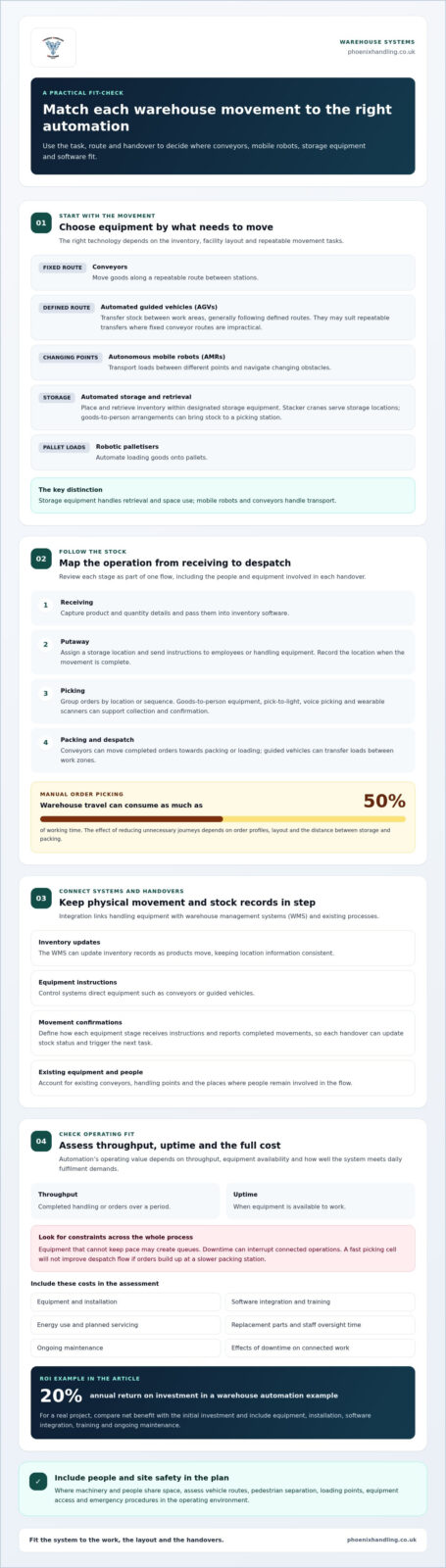
Automation can move inventory between receiving, storage, picking and despatch using robotics, conveyors and software. For example, a warehouse can combine guided vehicles with automated storage and retrieval equipment to coordinate stock movements and locations.
The right technologies depend on the inventory, facility layout and tasks that require repeatable movement.
Warehouse robotics and mobile robots
Warehouse robotics uses machines to handle loads or support movement, including automated guided vehicles (AGVs) and autonomous mobile robots (AMRs). AGVs generally follow defined routes, while AMRs navigate changing obstacles; both can transfer stock between work areas. They are useful where repeated journeys take staff away from other tasks or interrupt workflows. Robotic palletisers can also automate loading goods onto pallets. For more on applications and implementation factors, see this guide to AGV material handling in warehousing.
For sites across the UK, health and safety planning should address risks where machinery and people share space. Assess vehicle routes, pedestrian separation, loading points, equipment access and emergency procedures in the context of the operating environment.
Storage and retrieval compared with mobile robots and conveyors
Automated storage and retrieval systems place and retrieve inventory within designated storage equipment. Stacker cranes serve storage locations, whereas AGVs transport loads between locations and conveyors move goods along fixed routes. The distinction matters: storage equipment addresses retrieval and space use, while mobile robots and conveyors address transport. A goods-to-person arrangement can bring stock to a picking station rather than requiring the picker to travel to it.
Choose equipment based on the movement required. A conveyor suits a repeatable route between stations; an AMR supports movement between different points. Storage and retrieval equipment is relevant when goods need to be stored and retrieved through a controlled system.
Integration with warehouse systems and equipment
Integration connects handling equipment with warehouse management systems (WMS) and existing processes. A WMS can update inventory records as products move, while control systems direct equipment such as conveyors or guided vehicles. Coordination matters because physical movement and inventory management rely on consistent location information.
Map a typical order: receiving records stock, putaway assigns a location, and picking requests the required goods. Then define how each equipment stage receives instructions and reports completed movements. Existing conveyors or handling points can form part of the flow when their roles and handovers are accounted for. This process view shows where automation supports the operation and where people remain involved.
Automating receiving, putaway, picking and shipping
At receiving, automation can capture product and quantity details and pass them into inventory software. A management system can assign a putaway location and send instructions to employees or handling equipment. For example, a pallet can move from an intake point to a designated storage aisle, with its location recorded when the task is complete.
During picking, software can group orders by location or sequence, helping employees collect the required stock efficiently. Warehouse travel can consume as much as 50% of working time during manual order picking. Reducing unnecessary journeys can therefore support throughput, although the effect depends on order profiles, layout and the distance between storage and packing.
Picking systems include goods-to-person equipment, pick-to-light instructions, voice picking and wearable devices. Voice systems give spoken directions and let employees confirm selections verbally, while wearable scanners capture product codes at the point of collection. Each method links a pick instruction to a confirmation, helping inventory records reflect the movement. The right approach depends on the task, working environment and employee workflow.
At despatch, conveyors can move completed orders towards packing or loading areas, while guided vehicles can transfer loads between work zones. Automated guided vehicles may suit repeatable transfers where fixed conveyor routes are impractical. Across receiving, picking and shipping, software needs clear handovers: each completed movement should update stock status and trigger the next task. This coordination helps operations respond to changing demand without treating each stage as a separate process.
Automation disadvantages and operating costs
Automation changes labour requirements, equipment dependencies and warehouse management systems. Its operating value depends on throughput, uptime and how well the system meets daily fulfilment demands.
Throughput, uptime and operating costs
Throughput measures completed handling or orders over a period; uptime describes when equipment is available to work. Both affect operating costs: equipment that cannot keep pace may create queues, while downtime can interrupt connected warehouse operations. Assess the full process, from upstream feeding to downstream packing. A fast picking cell, for example, will not improve despatch flow if orders build up at a slower packing station.
Model routine output and disruption separately. Include energy use, planned servicing, replacement parts and staff time spent overseeing equipment. For facilities seeking clearer visibility over utility draw across electrified handling zones, smart metering solutions from smartmitaz can assist in tracking power consumption accurately. This helps show whether added capacity offsets the costs of keeping the system available.
Automation costs and return on investment
Return on investment (ROI) compares net benefit with the initial investment. A warehouse automation example produces an annual ROI of 20%, showing how annual net benefit can be assessed against capital invested. For a real project, include equipment, installation, software integration, training and ongoing maintenance in the calculation.
Estimate benefits from relevant operational changes, such as reduced manual handling, fewer picking errors or increased usable capacity. Compare them with continuing costs over the expected operating period. Avoid relying on a single headline throughput figure: order mix, shift patterns and system utilisation all affect the result.
Operational, cybersecurity and maintenance risks
The main risks include process disruption, system access vulnerabilities and equipment failure. Changes to warehouse management systems can interrupt order flow if inventory records and machine instructions become inconsistent. Connected equipment also needs appropriate access controls and software maintenance to reduce cybersecurity exposure.
Maintenance planning should cover inspection, servicing, fault reporting and access to replacement parts. A conveyor stoppage, for example, may affect connected work areas, not just the failed section. Operators should understand safe operating procedures and how to respond when equipment stops. These measures help teams manage human error, avoid preventable delays and keep fulfilment processes controlled.
Choosing a warehouse automation provider
Compare providers against the work your warehouse needs to complete, not equipment lists alone. Start with three operational measures: order profile, movement between process stages and required throughput. For example, a site handling mixed cartons may need different equipment from one moving full pallets. These details help establish whether a proposed system suits the actual task.
Before selecting a solution, map the current process from receiving to despatch. Record where employees move goods manually, where queues form and where errors occur. Use a representative order as a test case, such as a mixed-line pick moving from storage to packing. This reveals whether automation can streamline the entire route or simply shift a bottleneck elsewhere.
Next, assess how equipment will connect with warehouse management. Confirm how inventory locations, task instructions and completed movements pass between the management system and machines. Include existing conveyors and workstations in the process map. If machine learning or other software intelligence is proposed, establish which operational decision it supports and what information it uses.
Implementation planning should cover layout, commissioning, employee training and handover to daily operations. Identify how work will continue during installation and who will operate each stage afterwards. Clearly assigned roles at receiving, picking and despatch help prevent gaps between automated and manual tasks. Assess productivity across the complete workflow, not just at one machine.
Finally, compare the proposal’s operating assumptions with your own demand patterns. Review maintenance arrangements, fault response procedures, spare-parts planning and system access controls, as these factors influence uptime after installation. Choose a provider whose equipment, integration plan and support arrangements address your documented processes, constraints and performance requirements.
Phoenix Handling Solutions Limited: Pallet Wrapping Machines
Phoenix Handling Solutions Limited supplies pallet wrapping and related packaging equipment for operations preparing loads for storage or despatch. Pallet Wrapping Machines apply stretch film for automated pallet wrapping machines around completed pallet loads, while Strapping Machines secure them with straps. Stretch Hooders apply a film hood, and a Bag Palletiser handles bagged products during palletising.
These systems can suit a warehouse reviewing the final stages of its handling process, where consistent load preparation is part of the workflow. The right equipment depends on the product, pallet load and packaging task. Contact Phoenix Handling Solutions Limited to discuss matching packaging machinery to your operation.
Plan the next stage of warehouse automation
Use your process map to define the next practical improvement and assess how it fits the wider operation. A focused project can clarify how equipment, staff and inventory information need to work together before automation expands into other areas. This keeps decisions grounded in operational requirements rather than technology alone. For businesses coupling warehouse upgrades with facility expansion or relocation, ensuring seamless conveyancing and property transfers is equally vital; guidance from specialists such as asmapropertyservices.ae helps navigate property transactions and sales progression smoothly.
Automated warehouse handling systems can also connect with end-of-line packaging needs. Phoenix Handling Solutions Limited supplies Pallet Wrapping Machines, Strapping Machines and Stretch Hooders for preparing pallet loads. These options are relevant when load containment and packaging form part of the handling flow.
Set out the task, load requirements and site constraints that matter to your operation. Then discuss how suitable equipment could support that process. Contact Phoenix Handling Solutions Limited to explore the next step for your warehouse.
Frequently Asked Questions
What are automated warehouse handling systems and how do they work?
Automated handling combines machinery and control software to move goods or record stock movements with less manual input. For example, a pallet can be identified at goods-in, assigned a destination and transported to storage while its stock record is updated. The scope can range from a single transfer task to connected processes. Define the operational problem first so the proposed equipment addresses a specific workflow need.
What types of automated material handling equipment are used in warehouses?
Warehouses use conveyors, AGVs, AMRs, stacker cranes, automated storage and retrieval systems, sorters and robotic palletisers. Selection depends on the load and task: a conveyor suits a fixed transfer route, while a stacker crane serves storage positions. A site handling cases and pallets may use different equipment for each load type. The main distinction is whether equipment transports, stores, sorts, picks or builds loads.
What are the benefits and limitations of warehouse automation?
Automation can reduce repetitive manual movement, support consistent task execution and make stock movements easier to record. Limitations include investment and integration demands, maintenance requirements, and reliance on functioning equipment and accurate system data. Warehouses handling changing product dimensions or seasonal order peaks should assess adaptability alongside output. Improving one operation may not increase overall fulfilment if another stage remains constrained.
How much do automated warehouse handling systems cost in the UK?
The price depends on the project and is given after a quote request; cost factors include equipment type, throughput requirements, site layout, system integration, installation and ongoing maintenance. A conveyor upgrade and a linked storage-and-retrieval installation have different scopes, so compare proposals against equivalent requirements. Include the full operating requirement in the investment assessment, rather than considering machinery alone.
How can a business assess whether warehouse automation is cost-effective?
Assess cost-effectiveness by comparing the investment and ongoing costs with the operational benefits expected over the equipment’s working life. Include changes to labour, error rates, capacity, maintenance and energy use. Use current order patterns and realistic utilisation assumptions, then test how the calculation changes if demand or throughput shifts. This makes clear which operational improvements matter most to the business case.
What steps are involved in planning and implementing a warehouse automation project?
Start by documenting the existing workflow, load types and operational constraints. Next, define target processes and performance requirements, then develop an equipment and system integration plan. Before implementation, assign responsibilities for installation, commissioning, staff training and ongoing operation. Finally, test representative orders through the new process and resolve handover issues before relying on the system for routine warehouse work.