The direction of pallet flow defines the difference. A palletiser stacks finished products onto a pallet; a depalletiser removes products from an incoming pallet to feed production or packaging. A pick and pack de-palletiser handles this inbound flow by selecting products and presenting them to the next process.
Throughput matters, but it is only one part of the decision. Product presentation, pack patterns, labour requirements and maintenance all affect whether a system suits an operation. The examples in this article show how these factors shape equipment choices in practice.
You’ll learn how pick-and-pack depalletising works, how it differs from palletising and which equipment arrangements suit different product flows. The article also covers how automation can change manual handling and what to consider for upkeep, helping you assess operational fit rather than throughput alone.
Key Takeaways
- Distinguish palletising from depalletising by the direction of product flow: one builds a pallet, while the other unloads it to supply a process.
- Assess throughput alongside product presentation, pack-pattern variation and line integration to identify the right operating arrangement.
- Map which tasks remain manual to understand labour dependency and where mechanical assistance could reduce repetitive handling.
- Plan upkeep around the equipment’s operating demands, including access for maintenance and the parts and service support needed to sustain production.
- Compare robotic and other depalletising approaches against product variability, load condition and the accuracy required for pick-and-pack operations.
Throughput and labour requirements
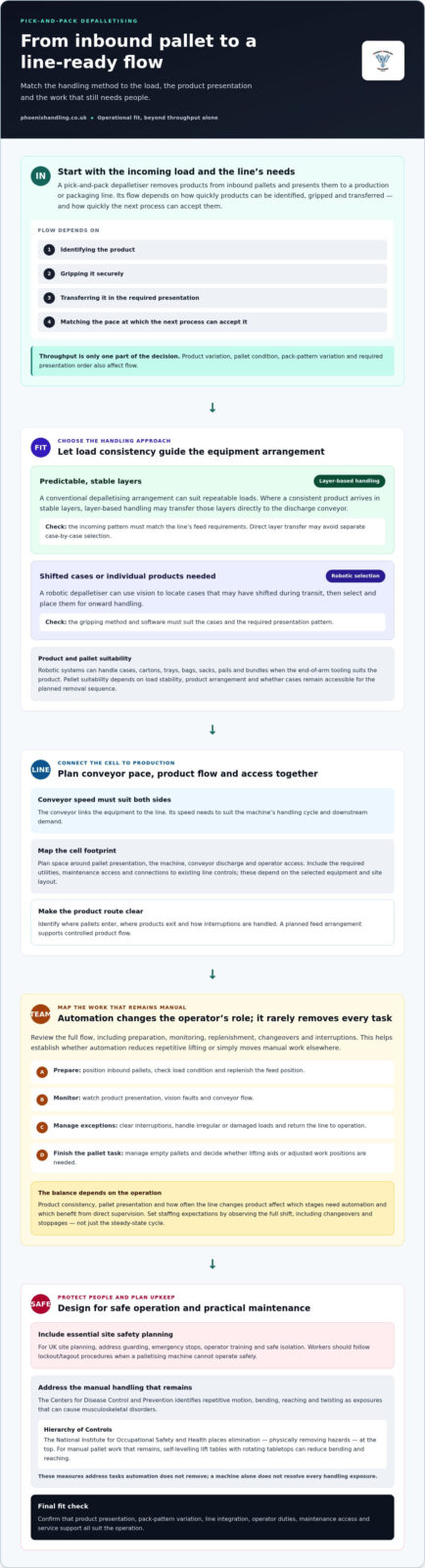
A pick and pack de-palletiser removes products from inbound pallets and presents them to a production or packaging line. Throughput depends on how quickly products can be identified, gripped and transferred, and how quickly the next process can accept them. A conveyor links the equipment to the line, so its speed must suit both the machine’s handling cycle and downstream demand. Product variation, pallet condition and the required presentation order also affect flow.
A conventional depalletising arrangement suits predictable loads and repeatable handling patterns. A robotic depalletiser can adapt to changing product positions, using vision to locate cases that may have shifted during transit. The right choice depends on pack consistency, changeover needs and required throughput.
Example, situation: A line receives a consistent product in stable, repeatable layers. Action: The operator assesses whether layer-based handling can transfer those layers directly to the discharge conveyor. Result: The process may avoid separate case-by-case selection, provided the incoming pattern matches the line’s feed requirements.
Example, situation: An inbound pallet contains cases that may shift during transport, while the line needs individual products. Action: A robotic system uses vision to locate each case, then selects and places it for onward handling. Result: The line can receive products individually, provided the robot’s gripping method and software suit the cases and presentation pattern.
Labour requirements depend on how much preparation, monitoring and replenishment remain manual. Operators may still load pallets, manage empty pallets, clear interruptions and check product flow. Automating repetitive case transfer can reduce direct handling, but staffing needs also reflect changeovers, line stoppages and the skill required to operate the system. The Centers for Disease Control and Prevention identifies repetitive motion, bending, reaching and twisting as exposures that can cause musculoskeletal disorders.
For UK site planning, address guarding, emergency stops, operator training and safe isolation. Workers should follow lockout/tagout procedures when a palletising machine cannot operate safely.
Robotic systems can handle cases, cartons, trays, bags, sacks, pails and bundles when the end-of-arm tooling suits the product. Pallet suitability depends on load stability, product arrangement and whether cases remain accessible for the planned removal sequence.
Before installation, map the cell footprint around pallet presentation, the machine, conveyor discharge and operator access. Allow for the required utilities, maintenance access and connections to the existing line controls; these depend on the selected equipment and site layout. The feed arrangement should be planned to support a controlled product flow. A clear layout helps identify where pallets enter, where products exit and how interruptions are handled.
Labour dependency
Automation changes an operator’s role; it rarely removes every labour task. In a depalletising cell, people may still receive inbound pallets, check load condition, replenish the feed position, manage empty pallets and respond to interruptions. Mapping these duties helps establish whether a system reduces repetitive lifting or simply moves manual work elsewhere.
Semi-automatic palletisers combine mechanical assistance with manual operation. They can reduce physical effort while retaining operator involvement, and may suit operations where fully automated equipment does not match the required pace. For a depalletiser, assess which handling stages need automation and which benefit from direct supervision. The balance depends on product consistency, pallet presentation and how often the line changes product.
Example, situation: A warehouse feeds a steady stream of similar cases to one packaging line, but staff currently transfer each case by hand. Action: The team maps each task, from pallet arrival through case presentation, and identifies where mechanical transfer can take over. Result: Operators can focus on pallet preparation, line monitoring and exceptions instead of repeating every transfer.
Example, situation: A facility handles mixed cases, and the manual sequence changes with each load. Action: The operation defines how vision identifies case positions and how operators manage irregular or damaged loads. It also assigns responsibility for replenishment, recovery and restart procedures. Result: Labour requirements account for both automated handling and the supervision needed for variable loads.
Installation planning should account for operator access as well as machine placement. A practical task review can include:
- Who positions inbound pallets and removes empty pallets.
- Who monitors product presentation, vision faults and conveyor flow.
- Who clears exceptions and returns the line to operation.
- Which tasks require lifting aids or adjusted work positions.
The National Institute for Occupational Safety and Health places elimination, the physical removal of hazards, at the top of its Hierarchy of Controls. For manual pallet work that remains, self-levelling lift tables with rotating tabletops can reduce bending and reaching. These measures address tasks automation does not remove, rather than assuming a machine alone resolves every handling exposure.
Set staffing expectations by observing the full shift, including changeovers and stoppages, not just the steady-state cycle. A written task map helps distinguish machine operation from manual replenishment and maintenance support. That map also gives a useful starting point for reviewing handling automation options against the actual work sequence.
Maintenance and lifecycle support
A depalletiser’s maintenance needs depend on its handling method, duty cycle and operating environment. A robotic machine has different inspection points from a layer-based system, but both rely on sound mechanical movement, functioning sensors and dependable controls. In packaging and logistics operations, maintenance planning should also account for conveyor interfaces, product changes and access around the machine. A pick and pack de-palletiser needs checks suited to its product range and gripping method.
Plan routine checks around the equipment’s actual components. Inspect grippers for wear or contamination, check conveyor belts and transfer points, and look for obstruction or misalignment in sensors. For robotic systems, include vision performance and gripping accuracy. Record faults, adjustments and replaced parts in a maintenance log to help trace recurring issues to a component or operating condition. These records can distinguish gradual wear from faults linked to a particular product or load.
Use a clear sequence for planned inspections:
- Review recent faults and downtime records before inspection.
- Isolate the machine safely before maintenance work begins.
- Inspect mechanical parts, sensors, guarding and conveyor connections.
- Test operation with the intended product and handling pattern.
Example, situation: A robotic depalletiser begins misplacing cartons after incoming loads arrive with shifted cases. Action: The maintenance team checks the vision system, gripper condition and product presentation, then records the cause and corrective work. Result: A consistent fault record helps distinguish a machine issue from inconsistent inbound loads.
Depalletising system suppliers may provide design, installation, commissioning, operator instruction, maintenance, fault diagnosis and spare parts. Support needs depend on the equipment and its connection to the surrounding line. For a pick and pack de-palletiser, define support requirements around operating demands, service access and replacement components.
Lifecycle planning should consider access to replacement parts, knowledge of the control system and the ability to diagnose faults across connected equipment. A conveyor stoppage, for example, may interrupt depalletising even when the robot remains serviceable. Keep machine documentation, fault history and maintenance records together, and assign responsibility for reviewing them. This makes it easier to track recurring problems and plan work around production.
Example, situation: A site adds new case formats to an established packaging line. Action: The operations team reviews gripping requirements, vision settings, changeover procedures and staff instruction before introducing the format. Result: Maintenance and operating procedures reflect the updated product range instead of relying on outdated settings.
During procurement, define who handles routine inspections, breakdown diagnosis and replacement parts. Clear responsibilities help maintenance staff plan work around production and preserve the information needed throughout the machine’s service life.
What is a pick-and-pack depalletiser and how does it work?
A pick and pack de-palletiser removes products from an incoming pallet and presents them to a production or packaging line. Unlike a palletiser, which stacks finished goods for dispatch, a depalletiser works at the inbound stage. It turns a palletised load into a controlled product flow, ready for processing, packing or inspection.
The operating sequence links pallet presentation, product identification and discharge. A typical cell works through these stages:
- Present the load: an operator or conveying system positions the inbound pallet within the machine’s working area.
- Locate products: sensors or vision identify case positions, particularly when transit has shifted the load.
- Pick and transfer: a robot or mechanical handling device grips products and moves them from the pallet.
- Discharge: products are placed onto a conveyor or another line interface in the required sequence.
Control software coordinates these movements with the downstream process. For single-SKU loads, predetermined stacking patterns can guide product removal. Mixed cases require the system to interpret different positions and pack patterns. Vision can help locate products and validate or adjust the handling plan, while suitable end-of-arm tooling secures products during transfer.
Example, situation: A food producer receives uniform cartons arranged consistently on each pallet. Action: The system follows a predetermined pattern and transfers cartons onto the line conveyor. Result: The packaging process receives a regular feed without operators manually unloading every case.
Example, situation: A distributor receives mixed cartons that have shifted during transport. Action: Vision detects carton positions, and the robot selects products using tooling matched to their shape and weight. Result: The cell can feed different products to the next operation, provided its handling plan accommodates load variation.
Depalletising differs from robotic palletising in both direction and purpose. Palletising builds a transport-ready load from products leaving production; depalletising breaks down incoming loads to supply a process. A robotic platform can perform either task, but depalletising may need additional vision because cases can shift in transit.
Before selecting a machine, define the product range, pallet condition, removal sequence and discharge interface. Then map how pallets enter the cell and how products reach the next process. These steps show whether the required handling pattern fits the available layout and production flow.
What types of depalletisers are used for pick-and-pack operations?
Depalletiser selection depends on product presentation, pallet condition and the required output sequence. Pick-and-pack systems commonly use robotic handling when cases must be located and removed individually. Mechanical arrangements suit defined patterns where products can be transferred consistently. The key difference is how each system accesses the load and presents products to the next process.
Robotic depalletising: A robot uses suitable gripping tooling to pick cases, cartons, trays or other packaged goods. Vision can locate products when cases have shifted during transit. This flexibility supports variable positions, but the system must recognise each product and grip it reliably.
Layer-based handling: A mechanical system removes products as a layer or defined group rather than selecting each case individually. It is most relevant when inbound pallets have consistent patterns and the receiving process can accept grouped products. A stable layer and predictable load arrangement are important for this approach.
Example, situation: A factory receives identical cartons in repeatable layers. Action: The team assesses whether grouped removal can match the downstream conveyor’s feed. Result: Layer handling can suit the process without individual robotic picks, provided the load pattern remains consistent.
Example, situation: A distribution operation receives cartons in varying positions and orientations. Action: A robotic system uses vision to locate each case and selects tooling suited to its dimensions and surface. Result: Individual cases can be presented in sequence while the control system accommodates changing positions.
Mixed-product loads require careful identification and sequencing. A robotic system can handle different pack patterns with suitable tooling and vision, while single-SKU loads can follow predetermined patterns without vision. The practical choice depends on whether the inbound pallet is uniform, mixed or liable to shift, and whether the line needs individual cases or grouped transfers.
Compare the available types against these operating conditions:
- Product range: case shape, packaging material and variation between items.
- Pallet presentation: consistent layers, mixed arrangements or shifted cases.
- Output requirement: individual picks or grouped product transfers.
- Line connection: conveyor position and the sequence required by the next process.
These criteria help narrow the system type before assessing layout and integration. To map the handling sequence against your operation, discuss your depalletising requirements.
System choice is also part of the wider material-flow plan. Depalletising commonly takes place at the beginning of a facility’s process, during the inbound phase. The receiving interface matters when deciding whether products should emerge as individual cases or grouped transfers. Conventional or layer palletisers build full layers and are often used for high throughput. Semi-automatic palletisers combine mechanical assistance with manual operation to reduce labour strain while keeping equipment costs lower. These palletising options provide context for balancing throughput and manual work across handling processes.
The cost of a robotic palletising system depends on throughput, the number of lines and SKUs, product type, pack-pattern complexity, and whether depalletising or Pick-Pack-Pal integration is required. Assessing these factors alongside pallet presentation and output needs helps align equipment selection with the wider operation.
Phoenix Handling Solutions Limited: Pallet Wrapping Machines
Phoenix Handling Solutions Limited supplies packaging and palletising machinery for operations planning the next stage after depalletising. Where products need securing for storage or dispatch, Pallet Wrapping Machines, Strapping Machines and Stretch Hooders offer different ways to stabilise completed loads. A Bag Palletiser may suit processes handling bagged products that need organised pallet loads.
The right equipment depends on the product, load pattern and packaging process. Consider these options when reviewing how goods move from production through pallet handling and dispatch. Phoenix Handling Solutions Limited can help match machinery to the operational requirement.
Contact Phoenix Handling Solutions Limited or visit phoenixhandling.co.uk to discuss your requirements.
Plan the next step for your line
Turn your findings into a practical operating brief before selecting a system. Record the inbound product range, pallet condition, required presentation sequence and connection to the receiving line. Include the tasks operators will retain and the maintenance access the installation needs. This gives the project team a clear basis for assessing whether a pick and pack de-palletiser fits the process and how it should connect to the wider packaging operation.
Consider the complete load journey, including how finished pallets are secured for storage or dispatch. Phoenix Handling Solutions Limited offers Pallet Wrapping Machines, Strapping Machines and Stretch Hooders for different pallet-stabilisation requirements. Matching downstream equipment to the handling process keeps the specification focused on the whole line rather than an isolated machine.
Use your operating brief to start a conversation about the equipment that fits your production and packaging requirements. Discuss your handling requirements with Phoenix Handling Solutions Limited, and take the next step towards a considered line specification.
Frequently Asked Questions
What is the difference between palletizing and depalletizing?
Palletising builds a load for storage or dispatch; depalletising unloads an inbound pallet to supply a process. A pick and pack de-palletiser, for example, can feed cases to inspection or repacking. The two operations occur at different points in the product journey and have different input and output arrangements. Their equipment can connect within one production system, but each machine performs a distinct handling task.
Does depalletizing require additional vision systems?
No, vision is not needed for every depalletising task. A single-SKU load with a predetermined, consistent arrangement can use a programmed pattern. Vision is useful when cases shift during transport or mixed products require position recognition. For example, a system handling cartons in varying orientations can use vision to locate each carton and adjust its pick. The need depends on load variability and the required handling sequence.
What is the throughput of these systems in cases or units per hour?
Throughput depends on the complete handling cycle, not just the robot’s movement. For a pick and pack de-palletiser, product dimensions, gripping time, pallet pattern, load condition and the receiving line’s pace all influence output. A mixed load may require more identification and pick decisions than uniform cartons. To set a target, calculate the downstream line’s sustained demand and include time to present and change inbound pallets.
What are the main safety risks and maintenance needs of depalletisers?
Manual handling risks include bending, reaching, twisting and repetitive movement. According to the Centers for Disease Control and Prevention, these exposures can cause musculoskeletal disorders. NIOSH places hazard elimination at the top of its Hierarchy of Controls. Maintain guarding and emergency stops, train operators, and follow lockout/tagout procedures when equipment cannot operate safely. Routine checks should cover grippers, sensors, conveyor interfaces and recorded faults, with maintenance completed under safe isolation.
Which UK suppliers offer pick-and-pack depalletisers and what support do they provide?
UK suppliers of depalletising systems may provide design, installation, commissioning, operator instruction, maintenance, fault diagnosis and spare parts. Support varies with the equipment and its connection to the surrounding line.