
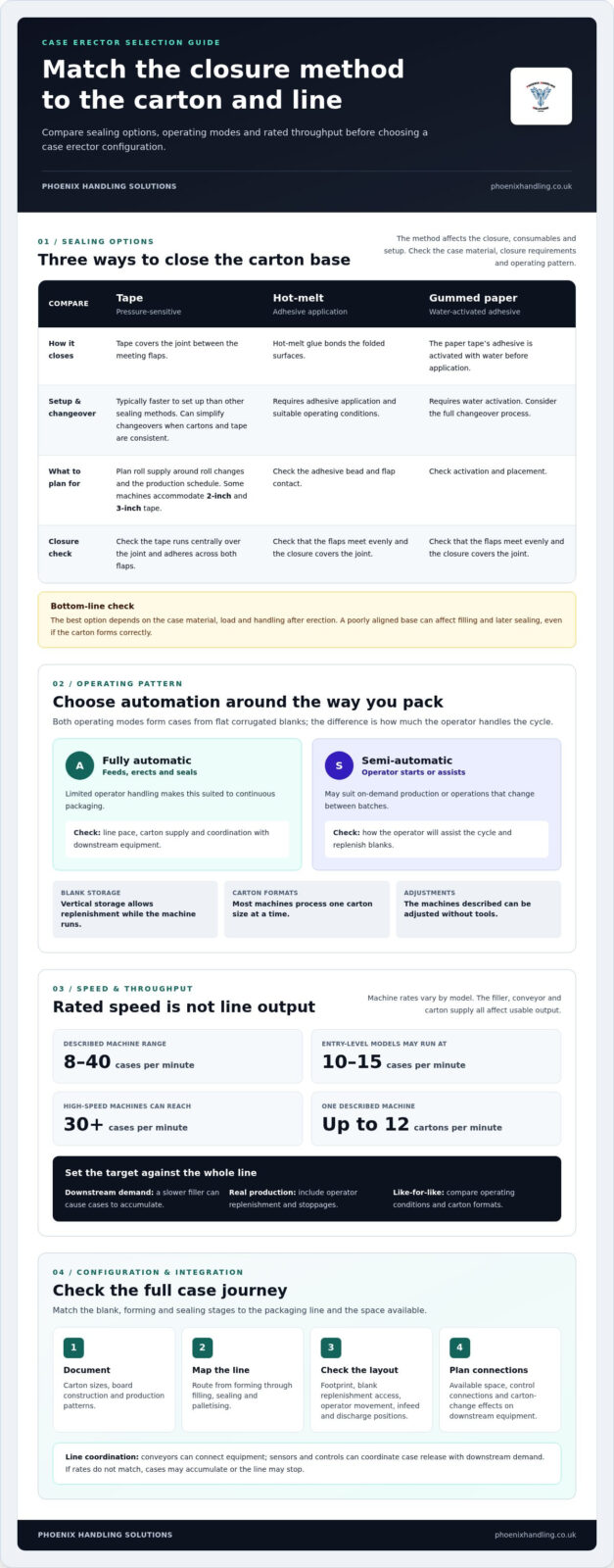
Speed is only one factor when choosing a case erector machine. Operating modes vary by machine, so check whether a model suits your production pattern. Vertical blank storage allows replenishment without stopping the machine, and operators can adjust it without tools. Most machines process one carton size at a time, so consider box dimensions and changeover needs alongside throughput.
Choosing a machine is therefore a balance between the cartons you use, the rate your line needs and the way each case is sealed. This guide explains the main features, tape and hot-melt sealing options, throughput considerations and how configuration relates to your box dimensions. It also covers the practical factors involved in integrating an erector into a production or packaging line.
Key Takeaways
- Compare automatic and semi-automatic operation against your packing pattern, carton handling and replenishment needs.
- Choose a sealing method by considering the case material, line requirements and the setup involved.
- Match the machine’s rated throughput to the pace of the full line, not just the target output at the erector.
- Assess carton dimensions, changeover needs and line layout together when planning a suitable configuration.
What are the features of Case Erector?
Match the machine’s operating mode, carton dimensions and line connections to your packaging process. A case erector machine forms flat corrugated blanks into open cases ready for filling.
Automatic and semi-automatic operation
A fully automatic model feeds, erects and seals cartons with limited operator handling, making it suited to continuous packaging. A semi-automatic model requires an operator to start or assist part of the cycle, which can suit on-demand production. Consider whether your production runs steadily or change between batches, and how operators will replenish blanks. Vertical blank storage allows replenishment while the machine runs. The machines described can process one carton size at a time and be adjusted without tools.
Machine purpose and operation
A case erector turns a flat corrugated blank into a stable, open case ready for packing. It draws a blank from the magazine, squares the carton, folds the bottom flaps and seals the base. The erected case then moves to an operator or downstream equipment. Check that the blank’s dimensions and board construction suit the forming and sealing stages. Consistent case presentation helps make the next packing step more predictable.
To integrate the erector into an automated packaging system, map the case’s route from forming through filling, sealing and palletising. Conveyors can connect equipment, while sensors and controls coordinate case release with downstream demand. For example, an erector supplying an automatic case packer needs to deliver cases at a pace the filler can accept. If the rates do not match, cases may accumulate or the line may stop, even when the erector is working correctly.
Plan installation around the machine’s footprint, access for replenishing blanks and operator movement. First, document carton sizes and production patterns. Next, identify the line’s infeed and discharge positions, available space and control connections. Finally, consider how carton changes affect machine adjustments and downstream equipment. This process helps determine whether the configuration suits your existing layout or planned packaging line.
Tape, hot-melt glue and gummed-paper sealing
The sealing method affects how the carton base closes, the consumables required and the line setup. Compare the case material, closure requirements and operating pattern before choosing an application method.
Tape and adhesive sealing options
Tape-sealing equipment applies pressure-sensitive tape across the carton joint, whilst hot-melt systems apply adhesive to close the flaps. Case erectors can seal cases using tape or hot-melt adhesive. Some machines accommodate 2-inch and 3-inch tape, so match the tape width to the carton and closure design. Gummed-paper tape provides another option; its adhesive is activated with water before application. Consider how each method fits the packaging process, including consumable storage and replenishment.
Bottom sealing methods
For bottom closure, tape covers the joint between the meeting flaps, while hot-melt glue bonds the folded surfaces. The best option depends on the case material, load and handling after erection. Check that the flaps meet evenly and the closure covers the joint. A poorly aligned base can affect filling and later sealing, even if the erector forms the carton correctly.
Tape sealing is typically faster to set up than other sealing methods. It can simplify changeovers when the line uses consistent cartons and tape. Hot-melt adhesive requires application and suitable operating conditions, while gummed paper needs water activation. Assess the full changeover process, not just application speed. Downstream demand also determines whether a faster seal can increase useful output.
Plan tape supply around roll changes and the production schedule. Roll length affects how often an operator needs to replenish the dispenser, so compare available roll formats with the expected run pattern. During setup, check that the tape runs centrally over the joint and adheres across both flaps. For glue, inspect the bead and flap contact. For gummed paper, check activation and placement. These checks help keep sealing consistent and the line running smoothly.
Packaging speed, throughput and consistency
For UK installations, set a speed target based on production demand and the capacity of connected operations. Assess safeguarding, emergency stops, access and line-level risks during installation; applicable requirements depend on the machine and its integration. When comparing suppliers, consider their machinery ranges and ability to integrate equipment into your line.
Machine speed and case throughput
Case erector speeds vary by model, with described machines ranging from 8 to 40 cases per minute. Entry-level models may run at 10-15 cases per minute, whilst high-speed machines can reach 30 or more. Treat these as machine capabilities, not guaranteed line output. The filler, conveyor and carton supply all affect how many erected cases production can use.
Set the target using actual demand across a representative production run. For example, if downstream equipment accepts cases more slowly than the erector forms them, cartons can accumulate. Include operator replenishment and stoppages in the assessment. A published rate of up to 12 cartons per minute applies to one described machine, not every configuration. Compare like-for-like operating conditions and carton formats.
High-speed and servo-driven machines
High-speed models suit operations requiring greater case volumes, provided the rest of the line can handle their output. Servo-driven options use controlled motor movement, so assess whether their settings support the required forming cycle and carton formats. Compare rated speed with normal production demand instead of choosing the highest figure alone. The right choice balances output, format requirements and integration.
Carton size can affect the forming cycle and the machine’s rated speed. Check performance against the boxes you use most often, then consider whether less common formats require slower operation or adjustment. Consistent results also depend on blanks feeding squarely and flaps forming correctly. Before comparing specifications, record your target cases per minute, carton dimensions and downstream acceptance rate.
Follow a practical selection process: establish the required volume, identify your most common carton, then compare machine rates with line capacity. Confirm how the controls coordinate with conveyors and filling equipment during starts, stops and changes in demand. This helps distinguish useful throughput from a headline speed the production line cannot sustain.
Can a box erector machine be customised to my dimensions?
Yes. The configuration depends on carton formats, blank type and production-line layout. Record each case’s length, width and height, then compare those dimensions with the machine’s working range and frame size.
A described automatic case erector accepts cartons from 250 mm long, 150 mm wide and 100 mm high, up to 450 mm long, 400 mm wide and 400 mm high. These figures describe that machine’s range, not every model. Measure cardboard blanks accurately and include the erected case’s orientation, since length and width can change with how the carton enters the machine.
Carton style also affects compatibility. The described machines can run 0201 or 0200 cases, which have different flap arrangements. Match the case style to the forming and sealing mechanism, then consider whether the same format continues through filling and closing. An automatic machine may reduce manual carton forming, but only when the blank and dimensions suit its configuration.
For Enviro-box packaging, a described machine is compatible with seven listed sizes, ranging from 254 × 254 × 254 mm to 381 × 254 × 254 mm. Treat these as specific compatible formats rather than a universal Enviro-box range. Compare the exact blank size and case construction with the machine’s format settings before planning carton erecting.
Line compatibility involves more than carton dimensions. Case erectors come in different frame sizes and can be integrated into new or existing production lines. Map the infeed and discharge points, available floor space, conveyor height and next packing step. This helps determine how the machine can connect to current equipment and whether the line layout needs adjustment.
Prepare a specification sheet with carton style, blank dimensions, board details, required formats and line interface. Include samples or drawings where available, so configuration can be assessed against the actual cases. For a project involving carton dimensions and line integration, discuss case erector configuration as part of the equipment planning process.
Phoenix Handling Solutions Limited: Pallet Wrapping Machines
Phoenix Handling Solutions Limited supplies packaging machinery for operations planning equipment beyond carton forming. After cases are filled and sealed, the next steps may include securing loads for storage or distribution. Pallet Wrapping Machines apply stretch film around pallet loads, while Strapping Machines secure them with straps. Stretch Hooders provide another load-covering option, and a Bag Palletiser handles bagged products before pallet wrapping.
Consider these systems when planning how cases and products move from packing to dispatch. The right equipment depends on the load type and packaging task at each stage. Contact Phoenix Handling Solutions Limited to discuss pallet wrapping and related packaging machinery for your operation, including a tray erector machine for forming trays within your packaging line.
Plan the next step for your packaging line
Before specifying a case erector machine, involve the people responsible for production, maintenance and packing. Their input can reveal practical constraints a machine specification alone may miss, such as access for replenishment, cleaning and routine adjustments.
Prepare a brief covering carton samples, expected production patterns, sealing preferences, line layout and planned changes to downstream equipment. Use it to compare configurations against the complete workflow, rather than assessing the erector in isolation. This gives discussions a clear basis and highlights details for further engineering consideration.
For the next stage of your packaging project, contact Phoenix Handling Solutions Limited to discuss the equipment requirements and how they relate to your wider operation. A considered specification is a practical starting point for moving towards a suitable line configuration.
Frequently Asked Questions
Q2: How to prevent common failures?
Routine cleaning and checks of wear points can help prevent common faults. Clear dust and debris, inspect suction cups and sensors, check air pressure, and test tape or glue operation as part of daily checks. Weekly, lubricate moving parts and inspect screws, controls and sealing-unit stability. Monthly, test the PLC and HMI, verify alignment, replace worn components and inspect safety devices. These checks can help identify faults before they interrupt production.
What markets can use carton erectors?
Carton erectors are used across manufacturing, food and beverage, logistics, paper and packaging, and fast-moving consumer goods. They are relevant wherever products need corrugated cases prepared for packing, from packaged foods to general manufactured goods. The right application depends on carton format, production flow and downstream equipment. A distribution operation, for example, may prioritise feeding cases to packing stations, while a manufacturer may integrate case erection into an automated line.
What types of case erector machines are available?
The main operating types are semi-automatic and fully automatic. A semi-automatic unit suits workflows where an operator handles part of the case-forming cycle or production varies. A fully automatic machine suits processes where case supply feeds a more automated packaging line. Compare operator involvement, carton changes and line controls to see how each type fits daily production, rather than relying on the label alone.
How fast can a case erector machine form and seal boxes?
Rated speeds for the described machines range from 8 to 40 cases per minute. Actual output depends on the carton format, blank presentation and whether downstream equipment can accept cases at the same pace. A useful assessment compares the machine’s rate with the filler’s sustained demand during a normal shift. Also consider interruptions for replenishment and format adjustments when estimating usable throughput.
What box sizes and styles can a case erector machine handle?
Compatible formats depend on the machine configuration and carton blank. The described equipment can run 0201 or 0200 cases, and one model’s dimensional range spans cartons from 250 × 150 × 100 mm to 450 × 400 × 400 mm. These measurements are not universal limits. Provide carton samples or drawings and identify the case style, board construction and flap arrangement when assessing suitability.
How much does a carton erector cost in the UK?
The price depends on the specification and is provided following a quotation request. Factors include automation level, carton formats, sealing method, target throughput and integration with existing packaging equipment. A standalone unit and a configured line may require different specifications. A clear brief covering carton details, production needs and layout helps define the scope for a quotation.