Film selection depends on the machine and the pallet load, not just the roll. Pallet wrapping film for automated machines must match the wrapper’s core size and stretch capability, as well as the load’s dimensions, weight and shape. Automated wrapping applies stretch film around palletised products to secure them for storage and transit.
The level of automation matters too. Semi-automatic wrappers require operator handling, while fully automatic systems can detect loads, apply film, run the wrapping cycle and cut the film without manual input. This guide explains how the systems differ and which film factors affect load containment and material use. It also covers recycling: clean, uncontaminated polyethylene machine wrap can enter specialist soft plastics recycling streams. Use the guidance to assess film against your equipment, loads and wrapping patterns.
Key Takeaways
- Compare film stretch capability with the wrapping specification: 120% suits lighter loads, whilst 150% and 240-250% options can support greater film efficiency and containment.
- Choose a turntable for stable, uniform loads; a rotary arm keeps unstable or heavy pallets stationary during wrapping.
- Use load weight as one guide to film thickness. For example, listed ratings pair 12-micron film with pallet weights below 400 kg and 23-micron film with weights below 1,200 kg.
- Separate recyclability from recycled content: clean, uncontaminated polyethylene wrap can enter specialist soft plastics recycling streams, and film containing 30% recycled material is available.
Can machine stretch film be recycled?
Yes. Clean, uncontaminated standard polyethylene machine stretch wrap can be recycled through specialist soft plastics streams. Standard machine stretch wrap is designed for semi-automatic and fully automatic stretch wrappers. Options include standard machine stretch wrap and power pre-stretch grades, with PPS film used on power pre-stretch machines.
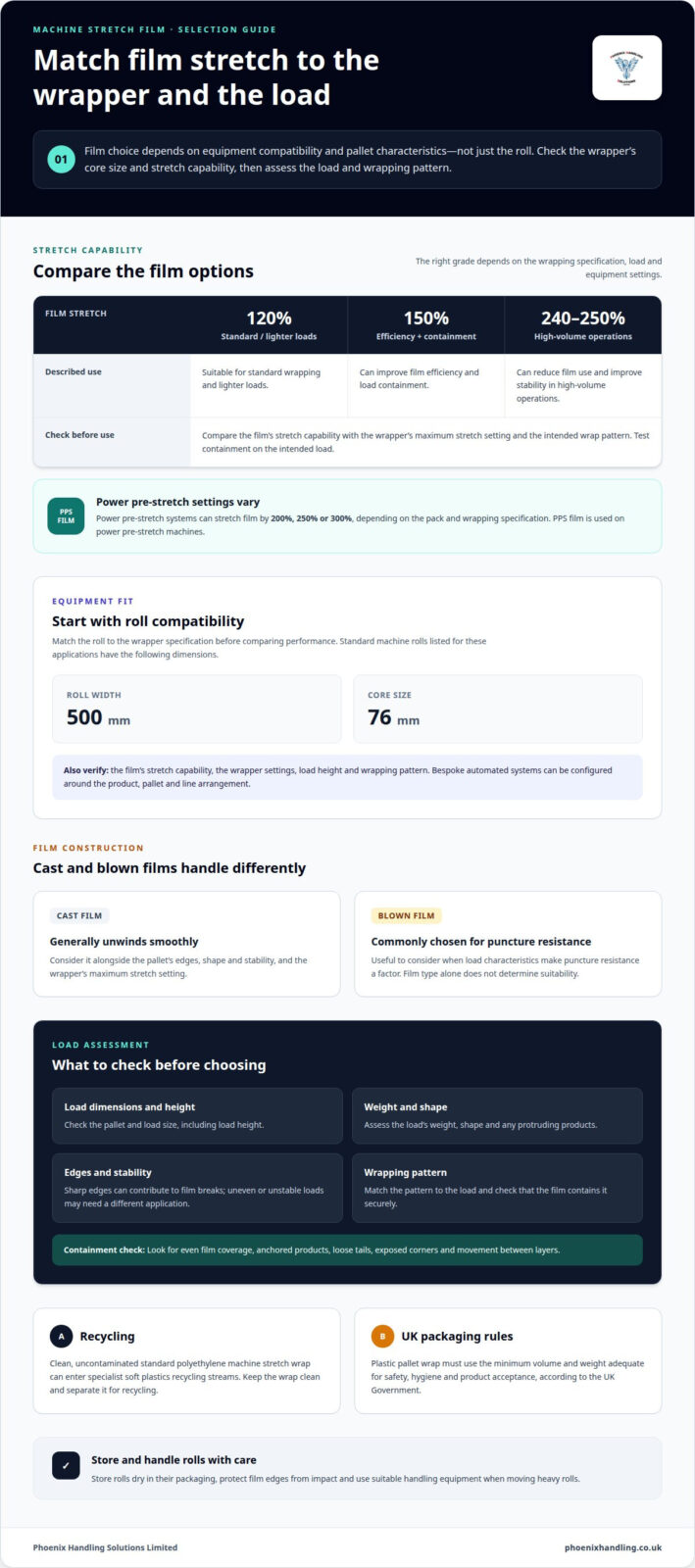
Compatibility starts with the wrapper specification. Match the film’s core size and stretch capability to the equipment, then account for load height and the wrapping pattern. Standard machine rolls listed for these applications are 500 mm wide, with a 76 mm core. Bespoke automated stretch-wrapping systems can be configured around the product, pallet and line arrangement.
Stretch performance affects film use and load containment. Machine stretch film with 120% stretch is described for standard wrapping and lighter loads; 150% can improve efficiency and containment. High-performance options at 240-250% can reduce film use and improve stability in high-volume operations. Power pre-stretch systems can stretch film by 200%, 250% or 300%, depending on the pack and wrapping specification.
Cast and blown films differ in handling and load performance. Cast film generally unwinds smoothly, while blown film is commonly chosen when greater puncture resistance is needed. Consider the pallet’s edges, shape and stability alongside the wrapper’s maximum stretch setting. Film type alone is not enough to determine suitability.
UK packaging rules require plastic pallet wrap to use the minimum volume and weight adequate for safety, hygiene and product acceptance, according to the UK Government. For recycling, keep polyethylene wrap clean and uncontaminated, then separate it for a specialist soft plastics stream.
Machine stretch film prices depend on the specification, roll format and order requirements. The price is provided after a quote request.
To match film to pre-stretch settings, compare its stretch capability with the wrapper’s ratio, then test containment using the intended wrap pattern. Store rolls dry in their packaging, protect film edges from impact, and use suitable handling equipment when moving heavy rolls.
What is Automated Pallet Wrapping?
Automated pallet wrapping applies stretch film around packaged goods to contain the load for storage and transit. Film breaks can result from poor tension or sharp edges, while unstable loads may be caused by uneven stacking or an unsuitable wrap pattern.
Load containment and stability
Containment holds cartons and other products together, limiting movement during handling and transport. Before setting the wrap pattern, assess pallet condition, load shape and any protruding products. For example, an uneven stack may need a different film application from a uniform load. Effective containment also helps protect packaging from dust and moisture during storage and transit.
Wrapping speed and load capacity
Wrapping speed depends on the cycle, film application and how pallets enter and leave the station. Ring wrappers are designed for high-speed applications and are widely used in FMCG environments. Match the wrapper’s capacity to pallet flow, load dimensions and handling requirements. A faster cycle alone will not increase throughput if upstream packaging or downstream dispatch is a bottleneck.
Load-height sensors detect pallet height, helping place film accurately and reduce waste. The wrapper can use this information to apply film across the load without continuing beyond its top edge. Fully automatic systems can detect loads, apply film, run the wrapping cycle and cut film without manual input. These functions support consistent operation when pallet heights vary.
For transit security, check that film covers the load evenly and anchors products to the pallet. Inspect the finished wrap for loose tails, exposed corners and movement between layers. Automated infeed and outfeed conveyors can connect the wrapping station to surrounding packaging equipment and help maintain material flow. Conveyor integration is useful when manual pallet transfer interrupts the line.
A line-level review can align the wrapping process with pallet flow and load requirements. Explore automated pallet wrapping system design as a next step.
Semi-automatic and fully automatic wrapper types
Choose a wrapper based on pallet volume, load weight and the level of operator involvement suited to your line. Semi-automatic machines require an operator to prepare or handle each pallet; fully automatic systems can complete wrapping stages without manual input.
A semi-automatic turntable wrapper suits stable, uniform loads because the pallet rotates as film is applied. The operator positions the pallet, attaches the film and starts the cycle, then finishes and removes the wrapped load. This arrangement accommodates a variety of pallet sizes, but manual handling remains part of each cycle. Consider operator access and the space needed to position pallets safely.
Fully automatic wrappers can detect an incoming load, apply film, run a programmed cycle and cut the film. Automated cutting and sealing remove manual finishing, while infeed and outfeed conveyors can keep pallets moving through the station. This configuration suits lines where consistent output and reduced operator involvement are priorities. The required cycle and conveyor layout depend on pallet flow and the rest of the packaging line.
The wrapper’s movement also affects which loads it can handle. A turntable rotates the pallet and suits stable, uniform loads. A rotary arm moves around a stationary pallet, making it suitable for heavy or unstable loads that should not rotate. Both arrangements can contain a load, but its shape, weight and stability determine the appropriate movement.
If your line handles a changing product range, assess pallet dimensions and load formations before choosing a machine. A consistent wrap pattern helps secure each configuration, while automated film cutting and sealing can support cycle continuity. Match automation to actual volume: semi-automatic operation requires an operator at the wrapping station, whereas a fully automatic system can integrate load detection and film handling into the cycle.
Factors in selecting pallet-wrapping film
To select pallet wrapping film for automated machines, assess the pallet load, wrapper specification and required containment. Dimensions, weight, shape and transit conditions all affect the choice. Film suitable for uniform cartons may not work as well on sharp-edged products.
Use load weight as an initial guide to thickness, then assess shape and handling conditions. Listed ratings pair 12-micron film with pallet weights below 400 kg, 15-micron below 600 kg, 17-micron below 800 kg, 20-micron below 900 kg and 23-micron below 1,200 kg. Loads below 2,000 kg are listed with 30-micron cast film or 25-micron blown high-tack film.
For pallet wrapping film for automated machines, width and roll length must suit the equipment and wrapping cycle. Listed machine rolls are 500 mm wide, with a 76 mm core; a clear cast example is 1,396 metres long and 23 microns thick. Match the core to the dispenser and confirm the roll length suits changeovers and warehouse handling. Spiral stretch film widths and applications also depend on the wrapping equipment and how each pass covers the load.
Before selecting, compare these operating factors:
- Load geometry: Record pallet height, footprint, overhang and sharp corners, which can affect film placement and puncture risk.
- Wrapper settings: Match film stretch capability to the machine’s pre-stretch system and tension settings.
- Transit conditions: Consider how the pallet load is handled between packing, storage and dispatch.
- Film use: Review the wrap pattern and containment together, rather than reducing thickness without assessing load stability.
The UK Government, via legislation.gov.uk, states that packaging, including plastic pallet wrap, must use the minimum volume and weight adequate for safety, hygiene and product acceptance. In practice, aim for the lightest film specification that still contains the load along its intended transit and handling route.
To choose film and wrapping equipment that work together, discuss your pallet loads and machine requirements with a packaging specialist.
Phoenix Handling Solutions Limited: Pallet Wrapping Machines
Phoenix Handling Solutions supplies pallet wrapping machines and pallet stretch wrap film for businesses assessing film, load and wrapper compatibility. Its team can help you consider the wrapping process alongside pallet dimensions, load stability and the required level of automation. Where the packaging specification calls for another method, strapping machines and stretch hooders are also available.
Turn to Phoenix Handling Solutions when selecting wrapping equipment or reviewing how film fits your palletising process. A clear specification of load types, line layout and handling requirements gives you a practical basis for the equipment decision.
Contact Phoenix Handling Solutions Limited to discuss your requirements, or visit phoenixhandling.co.uk.
Plan the next step around your line
Base your next review on a representative pallet, not a theoretical average. Record its footprint, height, load shape, handling route and containment requirements, then assess film performance against the wrapper’s settings. This gives production and warehouse teams a shared basis for evaluating changes to packing, pallet formats or line flow. Keep the specification practical as operating conditions change.
Phoenix Handling Solutions supplies Pallet Wrapping Machines, Strapping Machines and Stretch Hooders. These options offer different packaging approaches when stretch wrapping alone does not suit the load or process. Consider how the selected equipment will fit your existing handling sequence and packaging objectives.
Discuss your line conditions and priorities with Phoenix Handling Solutions Limited. Contact Phoenix Handling Solutions Limited to consider how pallet wrapping film for automated machines fits your operation’s next packaging decision.
Frequently Asked Questions
Why choose machine stretch wrap?
Machine stretch wrap suits operations that need a controlled cycle across repeated pallet loads. A programmed pattern can apply film consistently, while a pre-stretch system extends film before application. This can help packing teams handling recurring product formats compare film use between shifts. Assess the finished load, not just the cycle, to determine whether the settings provide suitable containment.
Is machine stretch wrap recyclable?
Yes, clean, uncontaminated polyethylene machine stretch wrap can enter specialist soft plastics recycling streams. Keep it separate from general waste, and remove labels, tape or other materials if they contaminate the film. For example, a warehouse can collect used pallet film in a dedicated stream, separate from mixed packaging waste. Film containing recycled material is also available, but recycled content and recyclability are different things.
What can it be used for?
Machine stretch wrap secures palletised goods for storage and transport. It can contain cartons, cases, bags, trays, bottles and other packaged products when the wrapping pattern suits the load. A uniform pallet of boxed goods has different wrapping requirements from bags with uneven surfaces. Apply film to group products and limit movement during handling, while keeping labels and handling information accessible.
What is the difference between hand and machine pallet wrap?
Hand pallet wrap is applied manually, with the operator controlling film tension and coverage around each load. Machine wrap is designed for the dispenser on a semi-automatic or fully automatic wrapper. For example, a site wrapping occasional mixed pallets may favour manual handling, while a regular packing line can use a machine for repeatable cycles. The film must match its application method and equipment.
Machine stretch film vs hand stretch film: what are the differences?
The main difference is the dispenser each film is designed for and how tension is applied. Machine stretch film works with a wrapping machine’s rollers or braking system; hand film is handled directly by an operator. A machine may pre-stretch film before application, while manual wrapping relies on the operator’s technique. Do not substitute one format for the other without matching roll dimensions and dispensing requirements.
How much film is needed per pallet and how to calculate cost per load?
Film use depends on pallet dimensions, load shape, wrap pattern and machine settings. To measure it, weigh a roll before a representative run, then weigh it again and divide the film used by the number of pallets wrapped. Multiply the film mass per pallet by your film cost per unit of mass to estimate material cost per load. Compare equivalent loads and containment results.