Automating internal transport does not mean automating every movement across a site. AGV material handling uses driverless vehicles coordinated by fleet-management software to move materials between planned collection and delivery points. These vehicles can support manufacturing, warehousing and distribution operations.
AGVs are relevant where pallets, containers or supplies follow repeatable routes. In hospitals, they can also deliver medicines, equipment and other supplies. Their operational fit depends on aisle access, load type, route design and how vehicle movements connect with existing processes.
This guide explains what an AGV system includes, how it differs from an autonomous mobile robot, and where it can support manufacturing, warehousing and healthcare. It also covers vehicle applications, safety considerations and the practical factors that shape implementation, helping you assess whether automated transport suits the movement patterns and layout of your UK site.
Key Takeaways
- Match vehicle type and load handling to the route, storage method and materials moving through your operation.
- Distinguish guided vehicles from autonomous mobile robots by considering how each system navigates and coordinates movement.
- Plan integration around existing workflows, material handling equipment and site layout to support reliable movement between process points.
- Assess obstacle detection, route management and safe interaction with people before introducing automated vehicles into a working environment.
AGV applications in manufacturing, warehousing and healthcare
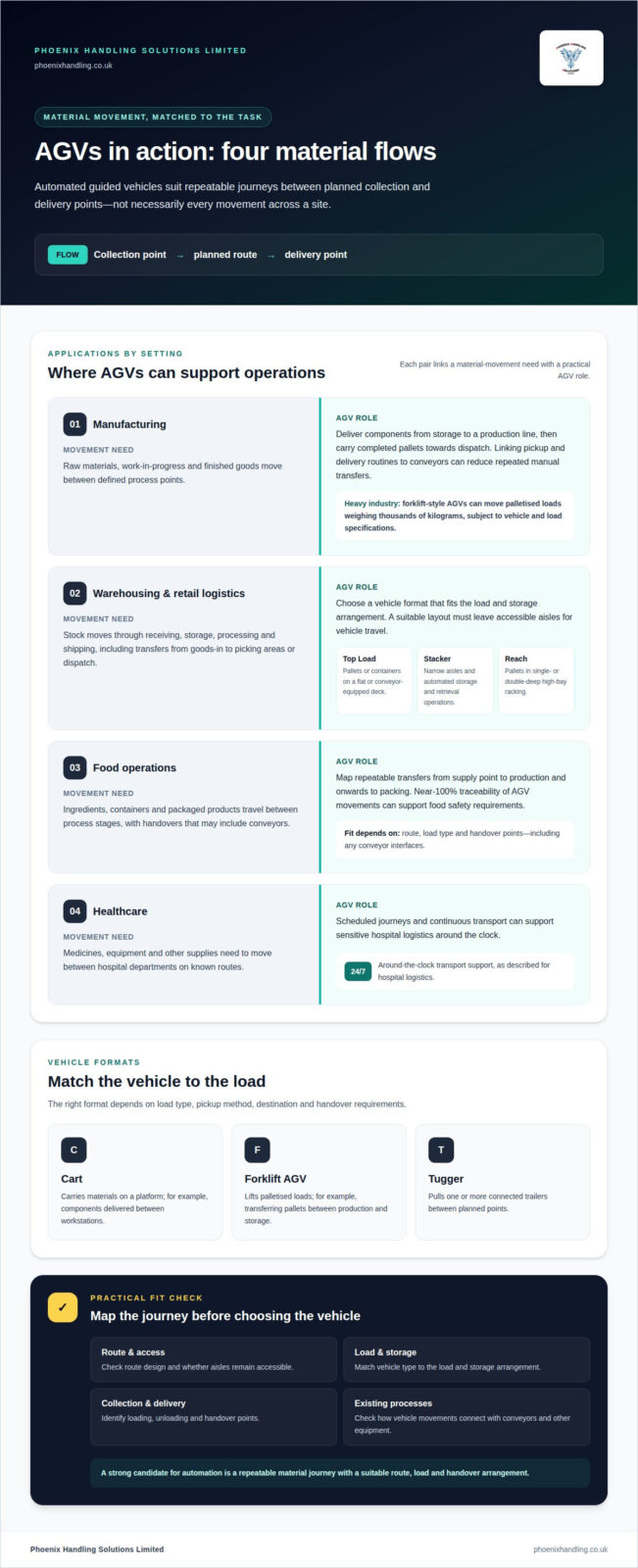
Across manufacturing, AGVs move raw materials, work-in-progress and finished goods between defined process points. A vehicle can deliver components from a storage area to a production line, then carry completed pallets towards dispatch. Linking pickup and delivery routines to conveyor systems can reduce repeated manual transfers. In heavy industry, forklift-style AGVs can move palletised loads weighing thousands of kilograms, subject to vehicle and load specifications.
Warehouses use guided vehicles for receiving, storage, processing and shipping. A Top Load AGV carries pallets or containers on a flat or conveyor-equipped deck between stations. Stacker AGVs serve narrow aisles and automated storage and retrieval operations, whilst Reach AGVs place and retrieve pallets in single- or double-deep high-bay racking. For retail logistics, these movements can support stock transfers from goods-in to storage, picking areas or dispatch. A suitable layout must leave accessible aisles for vehicle travel.
Food operations can use AGVs to move ingredients, containers and packaged products between process stages. Near-100% traceability of AGV movements can support food safety requirements. The practical application depends on the route, load type and handover points, including any conveyor interfaces. In a factory, mapping each transfer from supply point to production and onward to packing helps identify repeatable journeys for automation.
Hospitals can use AGVs to deliver medicines, equipment and other supplies between departments. Continuous transport can support sensitive hospital logistics around the clock, including scheduled movements along known routes. In warehouses, AGVs can also transport, locate and pick inventory, allowing employees to focus on other tasks. Reduced lifting of heavy items and reaching into high storage areas can address specific manual-handling demands. Before implementation, map each journey, identify loading and unloading points, and check that the route and storage arrangement suit the chosen vehicle model.
What Is the Difference Between AGVs and AMRs?
Automated guided vehicles follow defined routes, which may use magnetic tape, wires or laser guidance. Fleet-management software assigns tasks and coordinates vehicle locations and routes. Autonomous mobile robots are generally designed for more flexible navigation, so compare how each system handles route changes and traffic in your facility.
AGV formats suit different transport tasks. Carts carry materials on a platform, forklift AGVs lift palletised loads, and tuggers pull one or more connected trailers. A cart can deliver components between workstations, while a forklift model can transfer pallets between production and storage. Choose a format based on load type, pickup method, destination and handover requirements.
Compared with driver-operated forklifts, AGVs can automate repetitive journeys and deliver predictable, repeatable transport. Precise movement can minimise product damage, while reduced manual handling may lower exposure to lifting-related injury. Staffing accounts for around 80% of overall costs for manually controlled logistics vehicles. That figure is a reason to assess labour use, not a forecast of savings from automation.
Calculate payback by dividing the initial system investment by its annual net benefit. Estimate that benefit from reduced labour and damage costs, then subtract ongoing operating costs; assess ROI over the same period using the net benefit against total investment.
Before investing, map each workflow from collection to delivery, including load frequency, route length, storage points and existing equipment. Identify where manual forklifts remain useful, such as moving an oversized or irregular load that needs immediate operator judgement. AGVs, AMRs and robotics can then be assessed as complementary automation options, rather than assumed replacements for every vehicle. For repeatable pallet movements, review how automated guided vehicles could fit the facility’s material flows.
Automated guided vehicles: What are they?
An AGV system combines vehicles, navigation, a mapped facility and fleet-control software. Integration planning should cover physical routes and the data links connecting warehouse tasks with existing systems.
System components and fleet management
Vehicle type, navigation equipment and fleet software form the core. The software allocates transport jobs and manages vehicle movement across mapped routes. According to NHS, AGVs communicate their location and receive commands from a central computer over secured WiFi. Assess network coverage, pickup and delivery points, load interfaces and how the system will handle task priorities.
Interfaces with ERP and warehouse-management systems can connect stock requirements and production orders with AGV transport tasks. Map the information exchange, including what triggers a collection and what confirms delivery. For example, a warehouse transfer might start when a stock movement is recorded and close when the load reaches its destination. Define handover points with existing conveyors and other material-handling equipment.
Routing and traffic management
Navigation may use magnetic tape, wires or lasers, depending on the system and site layout. Fleet software assigns routes and can recalculate them when new tasks arrive. Before implementation, map crossings, narrow aisles, loading stations and routes shared with people or manual vehicles. Fixed-path guidance can make route changes difficult and may require infrastructure updates, so account for planned layout changes in the design.
Automated routes can support repeated movement between production, storage and distribution points. They also create dependencies: network interruptions, blocked paths or incompatible interfaces can disrupt planned journeys. Assess how the system handles task queues and route changes, and define manual processes for loads needing a different route. This helps determine whether AGVs offer enough flexibility for the facility’s operating pattern.
AGV safety features
Safe AGV operation depends on guidance, obstacle detection and controls suited to the site. Assess how vehicles will move along production routes shared with people, pallet movements and manual equipment.
Guidance and obstacle detection
Guidance technologies help each vehicle follow its planned route, while sensors detect obstructions ahead. If a person, pallet or other object blocks the path, the AGV stops and waits for clearance. During a site assessment, map blind corners, crossings and loading points, then consider how route visibility and sensor coverage address those locations.
Safety features and collision avoidance
AGVs can use safety sensors, optimised routes and collision-avoidance protocols to help manage traffic. Control software can monitor vehicle movements and enable safe slowing or stopping when conditions require it. In UK workplaces, assess AGVs against applicable machinery and workplace safety requirements through a site-specific risk assessment. Include interactions between AGVs, people, robots and manual vehicles in production areas.
For example, a route crossing a forklift aisle needs clear traffic arrangements and a defined response to obstructions. Assess how vehicles behave at intersections, near workstations and when another vehicle stops unexpectedly. Address these situations in route design and operating procedures before regular operation begins.
Safe maintenance and operation
Use the manufacturer’s maintenance instructions to plan inspections and servicing. Include installed sensors, guidance equipment, braking systems and stop controls, and record defects before returning a vehicle to operation. Staff responsible for operating or maintaining AGVs need role-specific procedures, including how to report faults and manage a blocked route.
Review procedures when production layouts, traffic patterns or pallet-handling tasks change. Trace a vehicle’s journey from collection to delivery, identify shared routes and confirm how staff respond to obstructions. This keeps maintenance and daily operation aligned with the facility’s actual layout.
Phoenix Handling Solutions Limited: Pallet Wrapping Machines
Phoenix Handling Solutions Limited supplies pallet-wrapping and other packaging machinery for operations moving goods towards storage or dispatch. If an AGV delivers a pallet to a packaging stage, a pallet-wrapping machine can secure the load before it moves on. Strapping machines and stretch hooders provide other packaging options, while a bag palletiser handles bagged products.
When reviewing equipment for your process, consider load type, packaging sequence and the space available at the handover point. Matching the packaging stage to the flow of goods helps define how AGV transport fits into the wider operation.
Contact Phoenix Handling Solutions Limited to discuss packaging machinery for your operation.
Define the next step for your operation
Turn a general interest in automation into a clear operational case. Identify the material movements that matter most, the constraints that shape them and the outcome your team needs. This gives an AGV material handling project a practical basis for comparing options and planning implementation.
Bring production, warehouse and logistics teams together to agree the process boundaries. A shared view of priorities helps align equipment decisions with the work they need to support, rather than treating vehicle selection as a standalone task. Record the requirements that will guide your decision, including load characteristics, handover points and site conditions.
Phoenix Handling Solutions Limited supplies machinery for automated handling and packaging operations. If you’re ready to discuss how equipment could fit your process, contact Phoenix Handling Solutions Limited. A focused conversation can help you take the next step with a clearer view of your operation.
Frequently Asked Questions
How does an AGV work?
An AGV receives a transport task, navigates to its pickup point and carries the load to its destination. Sensors and navigation equipment help it follow its planned route, while fleet-control software assigns jobs and coordinates vehicle movements. For example, a task might move a pallet from a production handover point to a warehouse location. The vehicle’s handling equipment and route depend on that task.
What is an AGV in material handling and how does it work?
An AGV is a driverless vehicle used to move materials within a facility. An AGV material handling project connects transport tasks with vehicle capabilities, pickup points and delivery locations. A warehouse task might require a vehicle to collect a container, carry it to a packing area and report completion. The process depends on clear handovers and suitable vehicle access.
What types of AGVs are used in warehouses and manufacturing?
Common types include carts, forklift AGVs and tuggers. Carts carry goods on a platform, forklift models lift loads, and tuggers pull connected trailers. Top-load vehicles suit transfers between process stations, while stacker and reach designs serve storage tasks. In manufacturing, a cart may supply components to work cells; in warehousing, a forklift AGV can move pallets between storage and dispatch.
What loads, speeds and operating environments can AGVs handle?
Capacity and speed depend on the vehicle design, load, route and operating conditions. A standard forklift AGV can carry up to 2,500 kg. Other models handle carts, containers or trailers. Assess floor condition, aisle width, gradients, crossings and nearby people when evaluating a site. A load’s dimensions and stability also matter, since they affect vehicle selection and safe movement through the facility.
How do AGVs compare with AMRs, forklifts and conveyor systems?
AGVs generally use defined guidance and fleet coordination, while AMRs are associated with more flexible navigation. Driver-operated forklifts allow an operator to respond to unusual loads or changing conditions. Conveyors suit repeated movement along fixed connections between stations. A distribution facility might use conveyors for a steady packing flow, with vehicles handling transfers between areas where fixed equipment would limit movement.
How do you assess and plan an AGV material handling project?
Start by recording what moves, where each load starts and ends, and how it is presented. Map routes, crossings, storage access and handover points, then identify the existing equipment and information systems involved. Include operators and maintenance staff in the review, as they understand exceptions such as blocked aisles or irregular loads. Use this operational map to define vehicle requirements and integration needs.