Palletising and depalletising can be considered as part of the same automation process. A cobot palletiser uses a collaborative robot to stack cartons, boxes or other items on a pallet, and typical rates are 6 to 12 picks per minute, depending on payload, cycle complexity and gripper design. These systems are designed for applications where people and automation work in shared or compact spaces.
Throughput is only one part of choosing a cobot palletiser. Product presentation, load characteristics, pallet patterns and end-of-arm tooling all affect performance, while workplace layout and safety measures determine how the system can be integrated.
This article explains how cobot palletising works, where it can fit in a production or warehouse environment, and how different grippers support palletising and depalletising. It also covers key application factors, including payload, product handling, changeovers and integration with surrounding equipment, so you can assess whether this approach suits your operation.
Key Takeaways
- Assess throughput alongside product weight, presentation and pallet pattern to judge whether collaborative automation suits the application.
- Plan the shared workspace around the robot’s operating speed and appropriate safety measures, rather than assuming people can always work beside it unguarded.
- Review the full cell layout, including pallet access and product flow, to understand whether a compact system can fit the available floor space.
- Match the gripper to the product’s shape, surface and stability; suitable tooling is central to reliable handling.
- Consider palletising and depalletising together, including how product changes, pallet removal and connections to surrounding equipment affect the process.
What is a Cobot Palletiser?
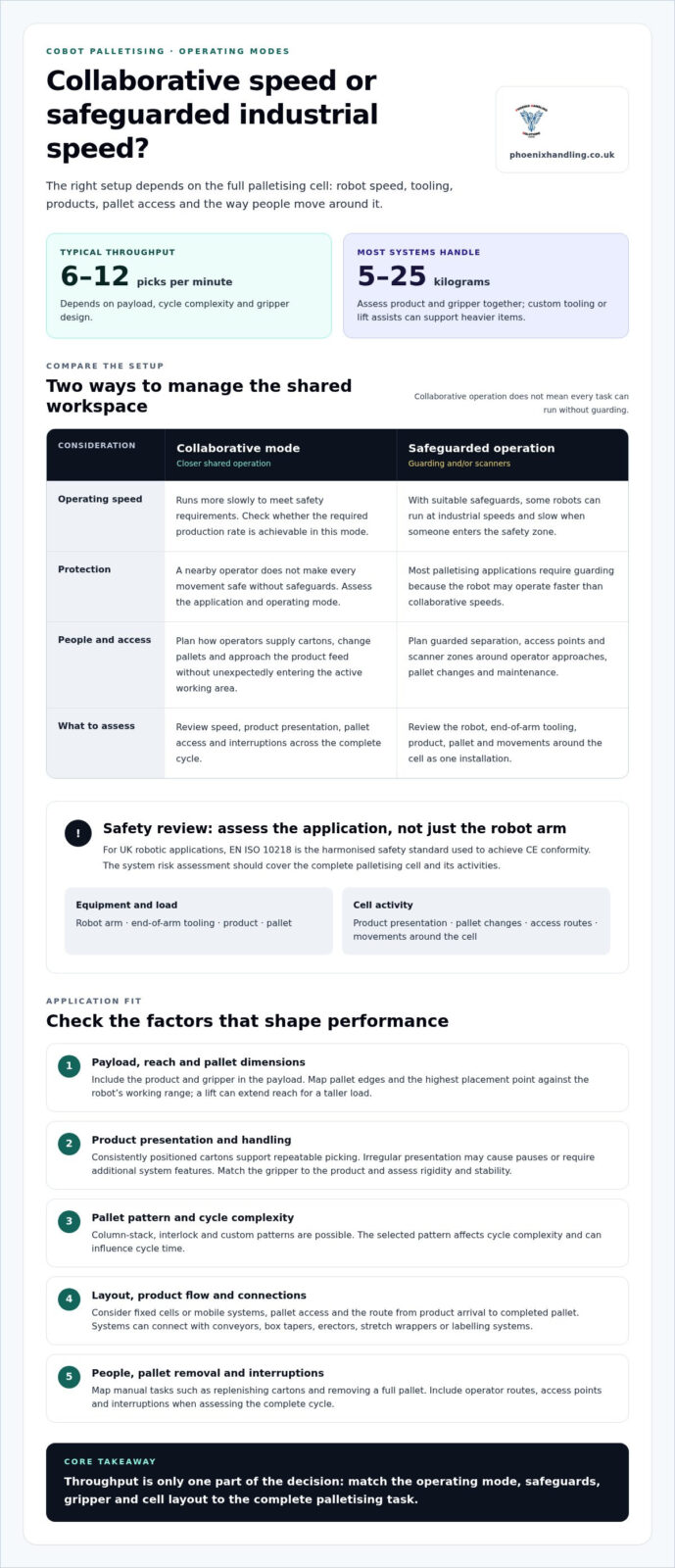
A collaborative robot stacks cartons, boxes or other products onto pallets, often in a compact production layout. Typical throughput is 6 to 12 picks per minute, depending on payload, cycle complexity and gripper design.
Collaborative Robot Operation
A collaborative robot moves products from a defined pick point to a programmed position on a pallet. Operators may work nearby, for example, to supply cartons or change pallets, but the robot’s speed and operating mode affect how people can share the workspace. In collaborative mode, robots run more slowly to meet safety requirements.
Assess the complete cycle, not just the robot arm. Product presentation, pallet access and interruptions all affect output. Consistently positioned cartons support repeatable picking, while irregular presentation may cause pauses or require additional system features. The layout should also let operators complete their tasks without unexpectedly entering the robot’s active working area.
Safety and UK Requirements
For UK robotic applications, EN ISO 10218 is the harmonised safety standard used to achieve CE conformity. A system’s risk assessment should consider the robot, end-of-arm tooling, product, pallet and movements around the cell. These factors determine suitable protective measures and operating modes.
Collaborative operation does not mean every palletising task can run without guarding. Most applications require guarding because the robot may operate faster than collaborative speeds. With safeguards such as guarding or scanners, some robots can run at industrial speeds and slow when someone enters the safety zone. Assess each operating mode and access point.
Payload, Reach and Pallet Support
Most systems handle payloads from 5 to 25 kilograms, whilst custom tooling or lift assists can support heavier items. Payload assessment must include the product and the gripper, since both contribute to the load carried by the robot. Product rigidity and stability also affect whether each pick can be placed reliably.
Reach and pallet dimensions depend on the cell layout, pallet position and required stacking pattern. Map the pallet edges and highest placement point against the robot’s working range. A lift can extend reach when the robot needs to serve a taller load. Column-stack, interlock and custom patterns are possible, and the chosen pattern affects cycle complexity.
Available Systems and Limitations
In the UK, cobot palletisers can be installed as fixed cells or mobile systems that move between lines on wheels or by pallet truck. Configurations can support column-stack, interlock or custom patterns, and connect with conveyors, box tapers, erectors, stretch wrappers or labelling systems. Choose an arrangement that suits the existing line and product flow.
Key limitations include collaborative-mode speed, payload, reach and the consistency of product presentation. A poorly matched gripper can make handling unstable, while a complex pattern can affect cycle time. Assess the entire route from product arrival to completed pallet, including pallet removal and operator access. This helps identify where safety measures or layout changes are needed.
Safety measures and shared workspaces
Shared operation depends on the machine, its programmed speed and the tasks performed nearby. A collaborative robot may work close to an operator during routine production, but that does not make every movement safe without safeguards. The risk assessment should cover the whole palletising application, including product presentation, pallet changes, access routes and any handling beside the robot.
For robotic applications, EN ISO 10218 is the harmonised safety standard used to achieve CE conformity. It provides a reference for assessing the robot application, but the cell still needs consideration as a complete installation. Include the arm, end-of-arm tooling, products, pallets and surrounding equipment in the technical review. A gripper carrying a carton, for example, can create a different hazard from the robot arm alone.
Collaborative mode runs more slowly to meet safety requirements, which can affect throughput. Assess whether the required production rate is achievable in this mode. Most palletising applications require guarding because the robot may operate faster than collaborative speeds. A guarded layout can separate people from the robot’s operating area while preserving planned access for pallet changes and maintenance.
Some systems combine scanners with guarding. With additional safety measures, certain robots can run at industrial speeds and slow to collaborative speeds when someone enters the safety zone. The protective arrangement must suit the cell’s access points and movements. For example, a scanner’s monitored zone needs to account for an operator approaching the pallet, not just the robot’s programmed path.
Workplace ergonomics also depends on how people interact with the cell. Map each manual task, such as replenishing cartons or removing a full pallet, then assess the route and working position. Keep operator and robot movements distinct where the layout allows. Unlike a standalone machine, a shared application requires clear coordination between programmed cycles and human access.
- Review the cycle: identify when operators approach the pallet or product feed.
- Assess protective measures: consider guarding, scanners and their interaction with the working area.
- Check the tooling: include the product and gripper in the hazard assessment.
- Plan access: account for pallet changes, routine tasks and maintenance routes.
These checks help define the operating mode, safeguarding and layout before installation. For a practical next step, explore palletising equipment options alongside the safety requirements of your application.
Compact footprint for space-constrained environments
A compact cell can bring palletising automation into an existing production layout, but the robot base is only part of its footprint. Account for the pallet, product feed, operator access and safety measures when assessing available floor space.
Footprint and Space Requirements
Start by mapping the complete working area, not just the robot. Mark the robot base, pallet positions, product infeed and route for removing completed pallets. For example, a layout with two pallet positions needs room for both loads and access to exchange them.
Next, account for the robot’s reach and the highest placement point. A lift can extend the robot’s reach, potentially changing the cell’s vertical requirements. Check how the arm moves between the product feed and each pallet position, then compare its working envelope with nearby conveyors, walls and walkways.
Guarding and scanners also affect the space plan. A compact footprint does not remove the need to accommodate the chosen protective measures and operator access. Draw the full cell boundary, including access points, before positioning the equipment. This helps identify conflicts with existing production routes.
Product flow matters too. If cartons arrive inconsistently, the preceding process can affect overall throughput, even when the robot fits neatly into the available space. Position the feed so products reach the pick point in a consistent orientation, and allow room for equipment connections where conveyors or other line components are part of the integration.
Mobility and Installation Footprint
Mobile cobot palletisers can move between lines on wheels or by pallet truck. This can support automation across different production areas, provided each destination has space for the robot, pallet and product feed. Plan the intended stopping positions and ensure the cell can align with each line’s product flow.
Before moving a unit, define what needs to be disconnected, repositioned and reconnected at the new station. Check the floor route for obstructions, then confirm the destination has room for the required pallet position and operator access. Mobility helps with placement, but each new position still needs a suitable working arrangement.
Relocation can also change the relationship between the robot and incoming products. For example, a feed conveyor may approach from a different direction at another line. Review the pick point, pallet positions and safeguards for each layout instead of assuming one configuration suits every station.
Use a simple site plan to compare fixed and mobile arrangements. Include the robot, pallets, feed route, guarding and access areas. The plan gives production teams a practical basis for deciding whether one relocatable cell or a dedicated installation better supports their automation requirements.
End-of-arm tooling and grippers
The end-of-arm tool determines how a robot grips and places each product. Common options include vacuum, mechanical, fork-style and custom grippers. Start selection with the item’s shape, surface, rigidity and weight, then consider the required stacking pattern. A rigid carton and a flexible bag present different handling conditions, even when their external dimensions are similar.
Vacuum grippers use suction, so contact surface and packaging condition matter. Mechanical grippers hold an item by applying contact force, while fork-style tooling supports products from beneath. Custom grippers can be designed around specific product features or handling requirements. In every case, assess how the tool contacts the item and whether it stays stable as the robot moves between the pick point and pallet.
Grip choice affects more than successful picking. Tool weight contributes to the robot’s payload, and tool size can influence access to products and pallet positions. A large gripper may obstruct nearby cartons in tight stacking patterns. Assess the complete tool-and-product combination, including how the tool approaches and lifts the load, then releases it at the programmed position.
Programming sets the sequence for picking, moving and placing products. For example, a carton application needs a defined pick location and a placement position for each layer. The gripper must release the item without disturbing neighbouring cartons or the stack below. Product presentation matters too: consistent positioning gives the robot a repeatable target, while variation can affect the handling cycle.
Frequent product changes make gripper selection a production decision. Quick setup, straightforward programming and fast changeovers are useful for short runs and frequent batch changes. If one line handles rigid cartons and flexible bags, assess whether tooling changes or separate gripper arrangements best suit the process. Consider the different gripping demands, not just the time needed to resume production.
Include end-of-arm tooling in the application’s hazard assessment. A projecting fork, moving clamp or vacuum tool can create hazards independently of the robot arm. Review the tool’s path and contact points during normal stacking, product changes and operator access. Guarding and safety measures should address the entire working cell, including the tool carrying a product.
- Match the grip: compare vacuum, mechanical, fork-style and custom options against the product.
- Review the sequence: assess pick, transfer and release positions for each stacking pattern.
- Plan changeovers: consider product variation, programming and tooling changes across production runs.
- Assess the complete tool: include its dimensions, payload and potential hazards in the application review.
Cobot palletising and depalletising
A palletising cell can place products onto pallets and remove them for downstream processing. The key design question is how product flow, pallet exchange and robot movement work together. Assess both directions of handling before selecting a solution, particularly where incoming loads vary or finished pallets need regular removal. For consistent products and repeatable patterns, a layer palletiser system may also be worth comparing with robotic handling.
Some systems can continue palletising while a full pallet is removed from the cell. This requires a layout that separates the active pallet position from the exchange task. Map where the robot places products, where the completed pallet exits and how the next empty pallet enters. Clear sequencing helps prevent pallet movement from interrupting product handling.
Depalletising reverses the process, transferring products from a pallet to a conveyor or another point on the line. Software guides each pick according to the load arrangement. A uniform column stack presents a different task from a mixed load, where cartons may occupy different positions. Vision-guided systems can detect varying product positions and adjust their picks, including in mixed-load applications.
Product stability affects both operations. A rigid carton can retain its shape during a pick, while a flexible bag may deform under gripping or stacking forces. The gripper, product presentation and programmed path must work together. During depalletising, the system must also account for gaps or changed positions as layers are removed.
Pattern flexibility supports production changes. Systems can be configured for column-stack, interlock and custom pallet patterns, then reprogrammed for different products. This can suit short runs or frequent batch changes, where setup and changeover affect line efficiency. Define each pattern alongside product dimensions and the required pallet stability.
Mounting the robot on a lift can extend its reach, helping it access higher layers or serve pallet positions within a cell. Assess the lift, robot path and load together, since each affects the working sequence. Conveyor integration can also connect palletising or depalletising with box tapers, erectors, stretch wrappers and labelling systems.
For a practical assessment, trace the process in order: incoming product, pick point, pallet pattern, completed load and pallet exit. Then identify where depalletising must feed the next operation. Two internal scanners can monitor the pallet position opposite the robot during palletising, helping the system track that position. Consider these interfaces when reviewing palletising system requirements for your line.
Phoenix Handling Solutions Limited: Pallet Wrapping Machines
Phoenix Handling Solutions Limited supplies pallet wrapping machines to secure completed loads after palletising. Its end-of-line offerings also include strapping machines and stretch hooders. A bag palletiser can suit applications handling bagged products, where the load format shapes the palletising requirement.
Consider how products move from the palletising cell to load securing, including the handover point and handling of finished pallets. Phoenix Handling Solutions Limited designs and supplies packaging machinery for manufacturers and distributors across the United Kingdom.
For equipment suited to your palletising and load-securing process, contact Phoenix Handling Solutions Limited.
Turn your palletising plan into a workable specification
Before selecting a cobot palletiser, turn the application into a practical brief. Describe the products, changeovers, available line connections and what happens to each completed pallet. This gives your team a clear basis for evaluating equipment against production needs, rather than treating the robot as a standalone purchase.
The next step may also involve equipment used after palletising. Phoenix Handling Solutions Limited offers pallet wrapping machines, strapping machines and stretch hooders, which can form part of a wider end-of-line system. The right arrangement depends on how loads move through your operation and how they need to be secured.
Share your application requirements with Phoenix Handling Solutions Limited to discuss the equipment that fits your process. Contact Phoenix Handling Solutions Limited to take the next step.
Frequently Asked Questions
Factors that Influence the Cost?
Cost depends on the specification and integration work required for the application. Key factors include payload, reach, gripper type, safety measures, pallet configuration and software. Product variety can also affect the design, particularly when several packages or stacking patterns need to be handled. Connections to conveyors and other line equipment add further requirements. Compare complete system specifications, not just the robot arm.
What is a cobot palletiser and how does it work?
A cobot palletiser uses a collaborative robot to pick products and place them in a programmed pallet pattern. The cycle connects product presentation, gripping, movement and release. For example, a carton arrives at a pick point, the robot grips it and places it in the next position in the stack. Control software coordinates this sequence with the required pattern and product flow.
How much does a cobot palletiser cost in the UK?
The price depends on the application and is provided after a quote request. Cost factors include payload, reach, end-of-arm tooling, safety equipment, pallet configuration, software and integration with existing machinery. Handling one consistent carton differs from accommodating several products and patterns. Compare quotations by reviewing the equipment, system integration and commissioning work included in each specification, rather than comparing the robot alone.
How many boxes per hour can a system handle?
Output depends on picks per minute, the number of items handled per pick and how consistently boxes arrive. Typical palletising rates are 6 to 12 picks per minute, but one pick does not always equal one box. A multi-item gripper can move several boxes in a cycle, whilst irregular presentation or complex placement can interrupt the sequence. Assess capacity using the actual product, tooling and pallet pattern.
How does collaborative palletising compare with a conventional industrial palletiser?
A collaborative system is designed for applications where people and robots share a workspace, while conventional industrial equipment typically operates in a defined automated cell. Collaborative mode runs more slowly to meet safety requirements. With additional safeguards, some robots can operate at industrial speeds, then slow when someone enters a monitored zone. Compare required output, available space, operator tasks and the safeguards each application needs.
How do you choose and install a system?
First document the products, pallet pattern, production flow and operator tasks. Then match payload, reach and gripper to the load, and plan for product infeed, pallet exchange and downstream equipment. Installation involves positioning and connecting the equipment, configuring the sequence and testing it with representative products. Include changeover tasks in the commissioning plan so operators can apply the intended settings consistently.
What is the return on investment and payback period?
A typical return on investment period for collaborative palletising is 12-18 months. The calculation compares system and integration costs with operational savings over time. Relevant inputs include current labour allocation, operating hours, product mix, changeover frequency and achieved throughput. Model different production scenarios, such as steady output and frequent batch changes, so the estimate reflects how the equipment will be used in practice.