
A robotic system is not automatically the right choice for an automated palletising line. A palletiser stacks packaged goods onto a pallet in a planned pattern to create a stable load. A layer palletiser prepares and places complete product layers, repeating the process to build the stack. The distinction matters when product variety, changeovers, throughput and available floor space shape the specification.
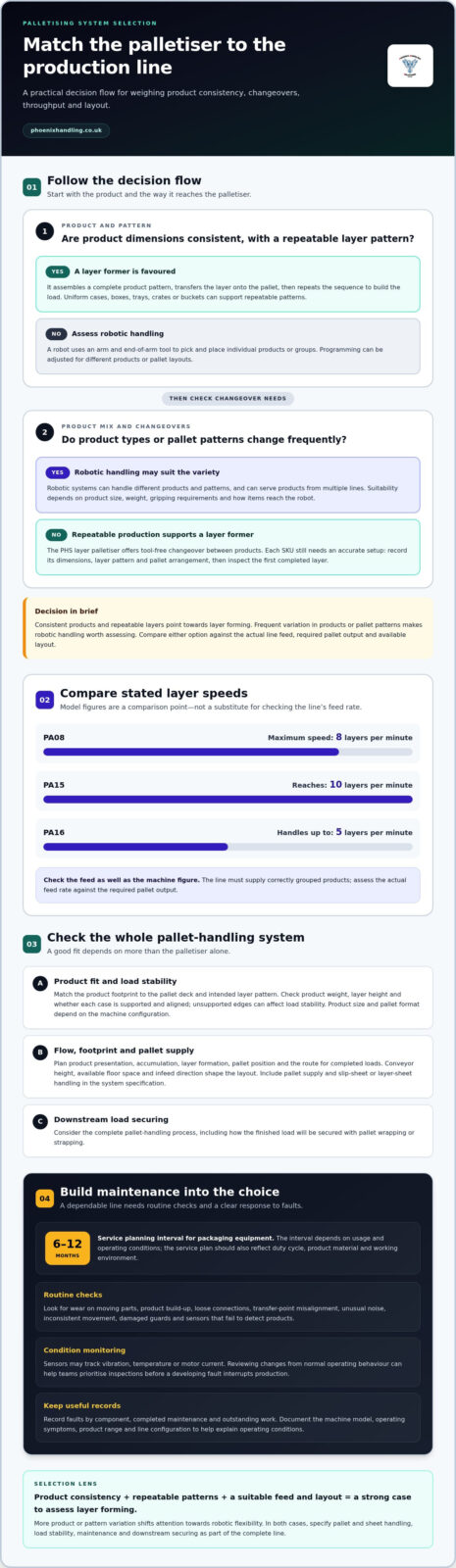
Both system types can reduce manual handling, but they suit different production conditions. Consistent products and repeatable layer patterns favour a layer former, while frequent changes in product or pallet pattern may favour robotic handling.
This guide explains how layer former palletisers build loads, manage pallets and sheets, and accommodate product changes. It also compares their operating characteristics with robotic systems to help you assess which approach, including a layer palletiser, best fits your line, packaging and layout.
Key Takeaways
- Match layer formation to consistent product dimensions and repeatable pallet patterns to support reliable load building.
- Assess product mix, changeover frequency and maintenance needs when planning for operational flexibility.
- Include pallet supply and slip-sheet or layer-sheet handling in the system specification, not as an afterthought.
- Compare robotic and layer-forming systems against your line layout, product variety and handling requirements.
- Consider downstream load securing, including pallet wrapping or strapping, as part of the complete pallet-handling process.
How layer former palletisers build product layers
A layer former assembles a complete product pattern before transferring it onto a pallet. A layer palletiser suits production where product consistency, output requirements and line layout support repeatable layer formation.
Building uniform product layers
The machine arranges products into a defined pattern, then transfers the complete layer onto the pallet. It repeats the sequence until the load reaches the required height. This approach suits uniform goods, such as same-sized cases or boxes, because consistent dimensions support repeatable patterns.
Pattern design affects the finished load. Products need support and alignment across each layer, rather than simply being placed in rows. A layer palletiser can help create a consistent stack for wrapping, transport and storage. On high-volume lines, assess whether the product feed can maintain a steady supply of correctly grouped items.
Product and pallet size compatibility
Layer systems can handle products such as boxes, cases, trays, crates and buckets. Automatically controlled systems can also handle cartons, sacks or totes. What products and pallet sizes can a layer palletiser handle? It depends on the machine configuration, product dimensions and pallet format required for the finished load.
Match the product footprint to the pallet deck and intended layer pattern. For example, a case pattern that leaves unsupported edges may affect load stability, even if every case fits on the pallet. Product weight and layer height also inform the specification, along with the conveyor and transfer method used to present each layer.
Robotic product handling
A robotic palletiser uses an end-of-arm tool to pick and place individual products or groups. It can handle cases or bags in a specified pattern, with programming adjusted for different products or pallet layouts. This makes robotic handling relevant where product types and patterns vary. For more on cell design, gripper selection and line integration, see these robotic palletiser services for end-of-line operations.
Robotic systems can handle products from multiple lines at the same time. The right arrangement depends on product size, weight, gripping requirements and how items reach the robot. By contrast, a layer palletiser generally suits a consistent product stream presented in repeatable groups.
Throughput should be assessed against the line’s actual feed rate and required pallet output. The PA08 has a maximum speed of 8 layers per minute, the PA15 reaches 10 layers per minute, and the PA16 handles up to 5 layers per minute. These model figures provide a comparison point, but the line must also supply correctly grouped products.
Plan integration around product flow: assess case presentation, accumulation, layer formation, pallet position and the route for completed loads. Conveyor height, available floor space and infeed direction shape the layout. For example, irregular product spacing may require accumulation before the layer palletiser can form complete, aligned layers.
Layer former flexibility and maintenance
Flexibility depends on the products, patterns and layouts the machine must accommodate. A layer palletiser generally suits repeatable production, while modular construction can offer different layout options. Assess infeed direction, available floor area and pallet positions together. These factors show how the equipment can fit the line and where product changes may require adjustments.
SKU changes can affect guides, stops and layer-forming settings. The PHS layer palletiser offers tool-free changeover between products, simplifying adjustments between runs. Operators still need an accurate setup for each product. Record the dimensions, layer pattern and pallet arrangement for every SKU, then follow a consistent changeover sequence and inspect the first completed layer.
Common maintenance issues include wear on moving parts, product build-up, loose connections and misalignment at transfer points. These can lead to jams, poor layer formation or stoppages. During routine checks, look for unusual noise, inconsistent movement, damaged guards and sensors that fail to detect products. Recording faults by component helps maintenance teams spot recurring problems and plan corrective work.
Packaging equipment should be serviced every 6-12 months, depending on usage and operating conditions. A service plan should reflect the machine’s duty cycle, product material and working environment. Maintenance teams can inspect mechanical assemblies, electrical connections, controls and safety devices, then record completed work and outstanding actions. The interval provides a planning guide; operators should also report faults as they arise.
Industry 4.0 condition monitoring can provide information between planned inspections. Sensors may track vibration, temperature or motor current, allowing teams to identify changes from normal operating behaviour. Predictive maintenance uses these trends to prioritise inspection before a developing fault interrupts production. Its usefulness depends on collecting relevant data, setting appropriate thresholds and assigning responsibility for reviewing alerts and taking action.
UK packaging-machine manufacturers and automation integrators supply, install and maintain layer palletisers. Support can cover a new machine, integration with an existing line, replacement components or scheduled servicing. For example, a line modification calls for layout and controls coordination, while routine servicing focuses on inspection, adjustment and planned maintenance.
To prepare a service specification, document the machine model, operating symptoms, product range and line configuration. Include fault history and changes in production demand, since these details help explain operating conditions. A stable maintenance routine also assigns operator and engineer responsibilities, with faults recorded consistently. For equipment planning, palletising system support can be considered alongside production-line requirements.
Pallet, slip-sheet and layer-sheet handling
Pallet supply is part of the operating sequence, not a separate detail. A palletiser needs an empty pallet correctly positioned before product placement begins. An integral pallet dispenser can feed pallets into position automatically, reducing interruptions for manual replenishment. Include its connection to the infeed and completed-load route in the line layout.
Slip-sheets and layer-sheets serve as separators between products or layers. A system can include optional dispensing equipment for either sheet type. The specification should identify when sheets are needed, their orientation and where each belongs in the stacking sequence. For example, a sheet between layers must sit squarely to avoid overhang that could affect load alignment.
Card handling can also be built into the arrangement. A layer-card system can load cards from two sides and has two layer-card load positions. This lets operators replenish one position while the other supplies the process. Card dimensions and placement pattern must match the product layers and pallet configuration.
Product stability matters particularly for tall, narrow or low-centre-of-gravity boxes. Uneven placement can make a stack less stable. A front containment mechanism can be fitted for unstable products, helping control the layer during transfer. Assess the product in its actual packaging, since a change in box shape can alter how securely it sits.
For each product, map the sequence from empty pallet delivery through layer placement and sheet dispensing. Include the final load transfer, since a stable stack can still shift if moved abruptly. The PHS220 can palletise up to three layers per minute, so its pallet and sheet supply must keep pace with that operating rate.
Automated palletising can reduce repetitive manual handling and the associated risk of strain-related injuries from lifting and twisting. It does not eliminate every manual task. Operators may still replenish pallets or sheets, clear faults and manage completed loads. Positioning these tasks around the machine helps limit unnecessary carrying and reaching during routine production.
Before specifying equipment, record pallet dimensions, sheet types, product stability and how empty pallets enter the cell. Then confirm the completed pallet’s route to wrapping or dispatch. These details determine whether dispensers, containment and transfer equipment work as one coordinated process, rather than creating separate handling points for operators.
Changeovers and SKU flexibility
Each SKU can have a different case footprint, weight or pallet pattern. A layer former is most efficient when products arrive in consistent formats and use the same stacking arrangement. A change from identical cartons to mixed case dimensions can require adjustments to guides, stops or layer-forming settings. Map these differences before deciding how often the line must change products.
The PHS layer palletiser offers tool-free changeover between products. This allows relevant adjustments to be made without tools, but product specifications still need to be defined. Record each SKU’s dimensions, weight, layer pattern and pallet arrangement. Operators can then select the correct setup and check the first completed layer against the intended pattern.
For a planned change, follow a consistent sequence: identify the incoming SKU, select its pattern, set the machine and verify the first layer. Include line settings that affect product presentation, such as infeed guides or accumulation. If a new case format changes how items sit together, review the pattern instead of assuming the previous arrangement will remain stable.
- Product dimensions: compare the incoming case footprint with the current guides and layer pattern.
- Pattern requirements: identify whether the pallet layout changes, including product orientation.
- Line presentation: consider how the new SKU reaches the machine and forms a complete layer.
- Verification: inspect the first layer for alignment before normal production continues.
These checks help distinguish a routine changeover from one that affects the machine’s suitability. Similar cartons with a revised label may need little mechanical adjustment, while a different case size can alter the layer arrangement. A wider product range and frequent pattern changes place greater demands on flexibility. Document the changeover method so operators follow the same sequence across shifts.
Layer formers have less flexibility than robotic palletisers when product types or stacking patterns vary. Some product changes may require manual adjustment. A robotic system can change handling patterns through programming and palletise different products from multiple lines at the same time. That flexibility may be valuable when the production schedule frequently switches between distinct case formats.
However, greater flexibility is not automatically more efficient. On a line running uniform cartons in repeatable patterns, a layer former can avoid unnecessary complexity. For mixed SKUs, compare how often and in what ways products change against the required handling method. Include adjustment, pattern selection and restart checks in the operational assessment, rather than considering product count alone.
Start with the production schedule. Group SKUs by case dimensions and pallet pattern, then identify where each group needs a different setup. If most products share a repeatable format, a layer former may suit the process. If the product mix and patterns change often, robotic programming may better accommodate those variations.
Choosing between robotic and layer former palletisers
Choose between a layer former and a robotic system by matching product variety, pattern changes, throughput and floor layout. The best fit meets production and logistics requirements without adding unnecessary handling complexity.
Robotic and layer former palletiser comparison
A layer palletiser forms and places complete layers, making it suited to repeatable patterns and consistent products. A robotic palletiser uses an arm and end-of-arm tool to pick individual items or groups, then stacks them in a programmed pattern. Compare SKU diversity, changeover frequency and whether one system must serve multiple production lines.
For a high-volume line running uniform cartons, layer formation can provide a direct, repeatable process. Robotic handling suits a wider product range or frequent pattern changes, and robots can palletise different products from multiple lines simultaneously. The decision also depends on payload, product presentation and the route for completed pallets.
Compare floor space practically. Layer-forming systems use modules for product presentation, accumulation and collation, and may offer a compact footprint at high speeds. Gantry palletising systems can handle high payloads, while jointed-arm robots can operate flexibly in different positions. Assess the full cell layout, including conveyors and pallet access.
Available layer palletiser types
Layer-forming equipment is available in configurations with different speeds, payloads and transfer methods. The PA08 has a maximum speed of 8 layers per minute and a maximum payload of 250 kilograms. The PA15 reaches 10 layers per minute, with a maximum payload of 150 kilograms using a set-down conveyor or 300 kilograms with a sliding plate.
The PA16 has a maximum speed of 5 layers per minute and a maximum payload of 200 kilograms. These figures help narrow the options, but product presentation and load requirements also matter. For example, assess whether cases arrive consistently grouped and whether the transfer method suits their dimensions and weight.
Compare models against the actual production brief, not speed alone. List the products, pallet patterns, required throughput, payload and available footprint. Then consider whether future changes could introduce different case formats or line feeds. A system sized only for current peak output may not suit a later change in production mix.
Build the comparison around the operating task: select layer formation for steady, repeatable patterns; consider robotics where product variety and pattern changes drive the specification. Include pallet access, infeed arrangement and downstream logistics in the layout review. Discuss your palletising requirements as part of that assessment.
Phoenix Handling Solutions Limited: Pallet Wrapping Machines
Phoenix Handling Solutions Limited supplies pallet wrapping machines to secure completed loads after palletising. If your line also needs another method of load restraint, its equipment range includes strapping machines and stretch hooders. The suitable option depends on the load, packaging process and how pallets move through your facility.
Considering palletising and load securing together helps define downstream handling. For example, assess how a finished pallet leaves the palletiser, reaches the wrapping stage and continues to storage or dispatch. Phoenix Handling Solutions Limited also supplies bag palletisers for applications involving bagged products.
Contact Phoenix Handling Solutions Limited to discuss your pallet-handling requirements.
Turn your palletising requirements into a practical next step
Before specifying a system, turn production needs into a clear equipment brief. Record product formats, expected changes, the pallet-handling sequence and available space, then use these requirements to guide discussions about integration and future operating needs. This helps ensure the selected layer palletiser fits the wider packaging process, rather than being assessed in isolation.
Load securing is part of that wider process. Phoenix Handling Solutions Limited supplies pallet wrapping machines, strapping machines and stretch hooders to secure completed pallet loads. The suitable approach depends on the load and how it moves through your operation.
Use your brief to discuss the palletising task and the downstream equipment requirements together. Contact Phoenix Handling Solutions Limited to take the next step in planning your line.
Frequently Asked Questions
What is a palletiser (palletizer)?
A palletiser arranges packaged goods onto pallets for storage or transport. Depending on its design, it may handle cases, bags, trays or other packaged products. Unlike a depalletiser, which removes goods from a pallet, a palletiser creates the load. For example, a factory can use one to transfer finished cartons from a production conveyor into a planned pallet configuration.
What is a layer palletiser and how does it work?
A layer palletiser organises products into a complete layer, then transfers it onto a pallet. It repeats the process to build the load to the required height. A PLC-controlled system can coordinate product presentation and machine movements. For example, a production line making identical cartons can feed them in a set arrangement, allowing the equipment to form successive layers without individual robotic picks.
What is the capacity and typical throughput of a layer palletiser?
Capacity varies by machine model, transfer method and product load. The PA08 reaches a maximum speed of 8 layers per minute and a maximum payload of 250 kilograms. The PA15 reaches 10 layers per minute, with a maximum payload of 150 kilograms using a set-down conveyor or 300 kilograms with a sliding plate. The PA16 handles up to 5 layers per minute and a maximum payload of 200 kilograms.
Layer palletiser vs robotic palletiser: which is better?
Neither is universally better; the production mix determines the suitable choice. A layer former suits repeat runs with consistent packaging, while a robotic system suits varied products or pallet patterns. For instance, a line switching regularly between different case formats may benefit from robotic programming. A line producing uniform cartons may suit layer formation. Compare the required handling, changeovers and integration with other lines.
How to choose a layer palletiser for a production line?
Start by documenting product dimensions, weight, pallet format and required output. Add the line’s infeed direction, accumulation needs, available floor area and downstream route for completed loads. Then compare those requirements with machine payload, layer rate and transfer method. For example, assess a case that needs a sliding plate against the relevant payload rating, not just the headline layer speed.
What safety standards and guarding are required for palletisers in the UK?
Design guarding around a risk assessment of the complete installation, including the palletiser, conveyors and pallet-transfer points. The assessment should consider access during normal operation, replenishment, fault clearing and maintenance. Fixed barriers, interlocked access gates and safe stopping arrangements are common protective measures, selected to suit the hazards and access needs. Document controls and operating procedures for the specific cell before production begins.