
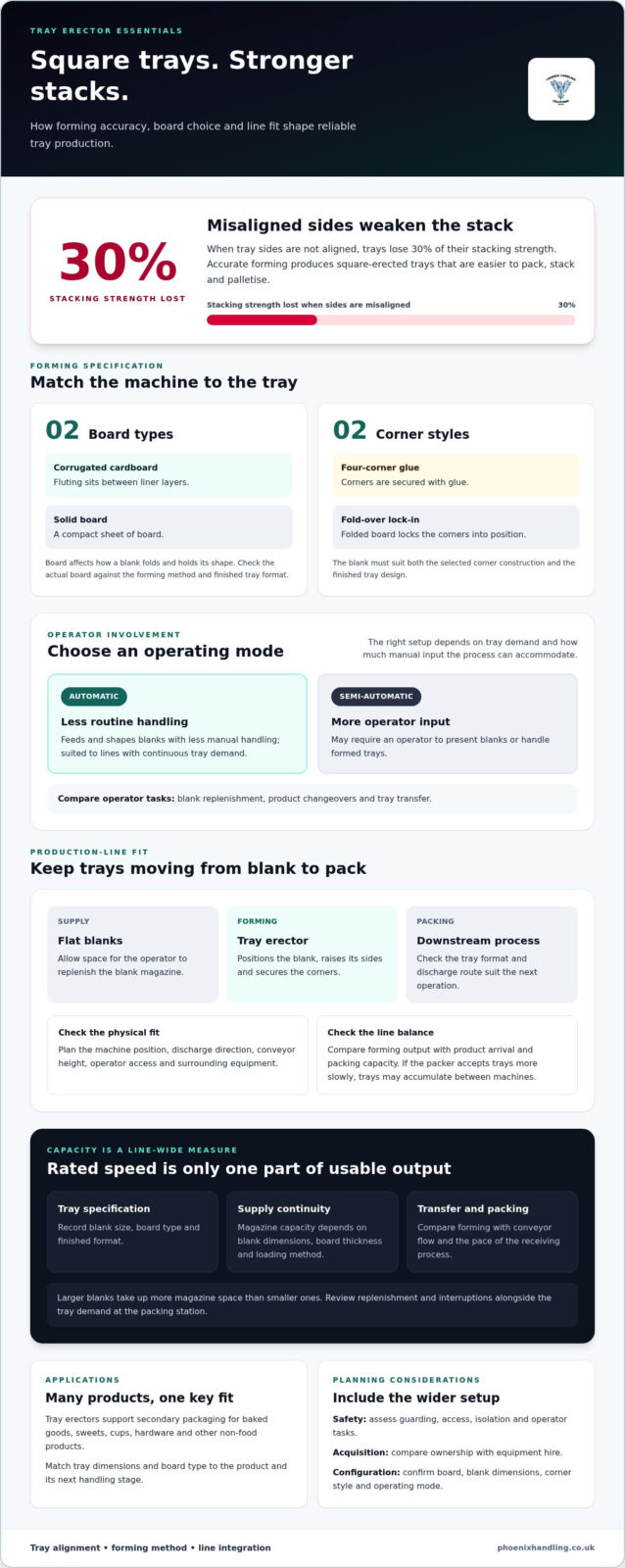
Tray alignment is a production feature, not a finishing detail: trays lose 30% of their stacking strength if their sides are not aligned. A tray erector machine forms trays using either four-corner glue or a fold-over lock-in style, producing square-erected trays that are easier to pack, stack and palletise. The forming method and the machine’s footprint both matter when fitting equipment into an existing line.
Choosing a tray erector machine involves more than checking how quickly it forms a tray. Tray format, board type, the downstream packing process and available floor space all affect whether the equipment suits your production requirements.
This guide explains the main features of tray erectors, including the materials and products they handle, how automatic forming works and why accurate tray alignment matters. It also covers footprint, line integration, service and equipment costs, and how Phoenix Handling Solutions Limited can help you plan packaging machinery around your production needs.
Key Takeaways
- Assess whether the tray format and board type suit your products, from baked goods and sweets to cups, hardware and other non-food items.
- Compare forming methods and board handling requirements to identify an appropriate setup for corrugated cardboard or solid board trays.
- Match production capacity to the wider line by considering the pace of upstream supply and downstream packing.
- Plan the machine position around access, material flow and surrounding equipment to make efficient use of available floor space.
What are the features of Tray Erectors?
Tray erectors turn flat board blanks into containers ready for packing. Their value depends on the products you handle and how well the machine fits into your line.
Applications across industries and products
Tray erectors support secondary packaging for baked goods, sweets, cups, hardware and other non-food products. A bakery may use trays to group products for onward handling, whilst a manufacturer may need trays for small hardware items. Tray dimensions and board type should suit the product and the next handling stage. If tray sides are misaligned, stacking strength falls by 30%, so accurate forming matters for stable loads.
UK machine safety requirements depend on the equipment’s design and workplace use. Assess guarding, access, isolation and operator tasks as part of the machine’s risk assessment.
Packaging machinery suppliers sell tray erectors, while hire is available from businesses that rent equipment. These are separate purchasing routes: decide whether ownership or rental better suits your production needs.
Production-Line Integration
Position the erector between the flat-blank supply point and the packing operation. Check the tray discharge direction, conveyor height and space for operators to replenish blanks. For example, a line feeding a packing station needs a clear transfer route that does not block access to other equipment. The tray format must also match the downstream process.
Tray Production Speed
Assess production speed against the rate at which trays are needed, not as an isolated machine figure. Compare the erector’s output with product arrival and the packing stage’s capacity. If the packer cannot accept trays at the forming rate, they may accumulate between machines. Specify a tray erector machine as part of the complete line.
Automatic and Semi-Automatic Operation
Automatic erectors reduce routine operator handling and suit lines with continuous tray demand. Semi-automatic equipment requires more manual input, such as presenting blanks or handling formed trays. Compare how much operator involvement each process needs, including during product changeovers, blank replenishment and tray transfer.
Automatic forming of corrugated cardboard and solid board trays
A tray erector machine turns a flat blank into a container for packing. Automatic models feed and shape blanks with less manual handling, while semi-automatic models require more operator input. Forming methods include four-corner glue and fold-over lock-in construction.
Trays can be made from corrugated cardboard or solid board, but the blank must suit the forming method and finished format. Corrugated board has fluting between liner layers, while solid board is a compact sheet. Because material affects how a blank folds and holds its shape, assess the actual board and tray design together.
To compare machine types, start with the operating mode, then match the forming process to the tray blank. Automatic and semi-automatic configurations differ in operator involvement; four-corner glue and fold-over lock-in describe how the corners are secured. These distinctions help narrow your options without assuming all tray formats are interchangeable.
During forming, the machine positions the blank, raises its sides and secures the corners through the selected method. The result should be square, with sides aligned to support consistent packing and stacking. Accurate blank positioning and corner formation help produce aligned sides that support consistent packing and stacking.
A fully automatic 500 Series tray erector should be assessed against the required board, blank dimensions and finished tray style. The name alone does not establish its forming method or suitability for a particular line. Compare the machine’s stated configuration with the production requirements, especially the chosen corner construction and the space available for blank feeding and tray discharge.
Before selecting equipment, document the tray dimensions, board type, corner style and operating mode required. Compare these requirements with the machine configuration and downstream packing process. This specification-led approach helps establish whether an automatic or semi-automatic system, and a glued or lock-in format, suits the application.
Machine speed and production capacity
A machine’s rated output is only one part of production capacity. The usable rate also depends on blank supply, tray format and the pace of the equipment receiving formed trays. A fast forming cycle cannot maintain line flow if the downstream packer pauses or accepts trays more slowly.
Compare the required tray flow with every stage of the line. Map blank feeding, forming, transfer and packing in sequence, then identify where trays might queue or the next process might wait. Changing from a small tray format to a larger one can also affect handling and blank-replenishment time.
The blank magazine affects how often an operator must intervene. Its practical capacity depends on blank dimensions, board thickness and loading method. Larger corrugated blanks, for example, take up more magazine space than smaller ones, so the same loading arrangement may provide a different running interval.
Plan replenishment as part of the production process. Record when blanks are loaded, note interruptions and compare them with tray demand at the packing station. If replenishment repeatedly stops forming, the magazine arrangement or timing of operator tasks may be limiting the line’s effective output.
For a useful capacity assessment, consider these operating factors together:
- Tray specification: record the blank size, board type and finished format.
- Line balance: compare forming with the pace of the packer and conveyor transfer.
- Supply continuity: review magazine loading and blank availability during a production run.
- Changeovers: include the time and adjustments needed when the tray format changes.
These observations distinguish the machine’s forming rate from the output the complete line can sustain. Base capacity planning on the packer’s actual demand, blank replenishment and changeover requirements, rather than relying on headline speed alone.
Compact machine footprint
A compact layout can help when an existing packaging line has limited floor space. Assess the entire working area, not just the machine frame: a tray erector also needs room for flat blanks, operator access and formed-tray discharge. A unit beside a conveyor may fit physically but still obstruct replenishment or routine cleaning.
Start with a floor plan showing the infeed, forming position and outfeed. Mark blank storage, the operator’s working position and the route to the next machine. A short, direct transfer to a packing station can reduce unnecessary conveyor length, while a turn in the line may need extra clearance.
Measure access as well as the installed footprint. Operators need a clear route to load blanks and reach the machine’s operating points. Maintenance also requires access to service areas, so avoid positioning equipment where it restricts routine intervention. Include columns, doors and existing conveyors in your layout review.
Compare possible positions against the production sequence. Placing the erector near the packing station may simplify tray transfer, while locating it near blank storage may make replenishment more direct. Choose an arrangement that supports material flow and safe access without creating a bottleneck for nearby equipment.
- Map the line: include blank storage, forming, discharge and packing.
- Check operator access: allow for loading blanks and reaching operating points.
- Review transfer routes: identify turns, obstructions and unnecessary conveyor runs.
- Keep service access: account for maintenance and cleaning around the installation.
A scaled layout makes these trade-offs easier to assess before equipment is positioned. Discuss your tray-line space requirements to consider how the equipment can fit the production area and connect with adjoining processes.
Phoenix Handling Solutions Limited: Pallet Wrapping Machines
Phoenix Handling Solutions Limited supplies packaging machinery for processes beyond tray forming. Where packed products move on to pallet loads, its pallet wrapping machines, strapping machines and stretch hooders can help secure loads. Its bag palletisers support bag palletising applications.
Consider these options when reviewing how products leave the packing line and move into storage or distribution. Suitable equipment depends on the load and the process it must support, so assess the complete packaging operation rather than treating tray forming as an isolated task.
Contact Phoenix Handling Solutions Limited to discuss your packaging machinery requirements.
Plan the next step for your packaging line
Use your equipment decision to create a practical line brief for the next production review. Set out tray formats, board types, operating requirements and available installation space, then note how formed trays move into packing and onward handling. This gives your team a clear basis for deciding how a tray erector machine should fit the wider process.
If your operation also needs to secure finished pallet loads, Phoenix Handling Solutions Limited supplies pallet wrapping machines, strapping machines and stretch hooders. These can be considered alongside tray forming when planning your packaging equipment.
To discuss the next step for your line, contact Phoenix Handling Solutions Limited. A clear production brief can help you move towards an equipment arrangement that suits your operation.
Frequently Asked Questions
What is a tray former?
A tray former is another term for equipment that turns flat blanks into formed trays. It receives a blank, folds the sides into position and secures the corners using the selected construction method. For example, a food producer may form trays from pre-cut board before loading products. The finished tray then moves to the next packaging stage for filling, closing or onward handling.
What production speeds and tray sizes can tray erector machines handle?
Speed and tray size depend on the machine’s specified configuration and blank format. For a tray erector machine, compare the stated operating range with your required tray dimensions and production schedule. If the line handles different formats, account for changeovers. Switching between shallow and deep trays, for example, may require adjustments that affect running time.
What should I consider when choosing a tray erector machine?
Match the equipment’s operating range to the tray specification and production process. Gather sample blanks and finished-tray drawings, then compare dimensions, board properties and corner construction with the machine’s capabilities. Consider how often formats change and who will make the adjustments. For a tray erector machine handling several styles, straightforward changeovers may be an important selection factor.
How do you install, operate and maintain a tray erector machine?
Install the machine according to the manufacturer’s instructions, accounting for its position, infeed and connections to adjacent equipment. Before operation, train operators in blank loading, format settings and normal start-up and stop procedures. Follow the prescribed maintenance schedule, covering wear points, forming components and any adhesive system. Record adjustments and recurring stoppages to help identify developing faults.
What are the common faults and risks of tray erector machines?
Common production faults include uneven blank feeding, trays forming out of square and corners that do not secure correctly. Damaged blanks, incorrect settings or worn forming parts may contribute. Moving mechanisms also present a physical hazard during operation or when clearing a blockage. Stop the machine and follow the manufacturer’s isolation procedure before clearing a jam. Investigate recurring faults rather than repeatedly restarting the line.