
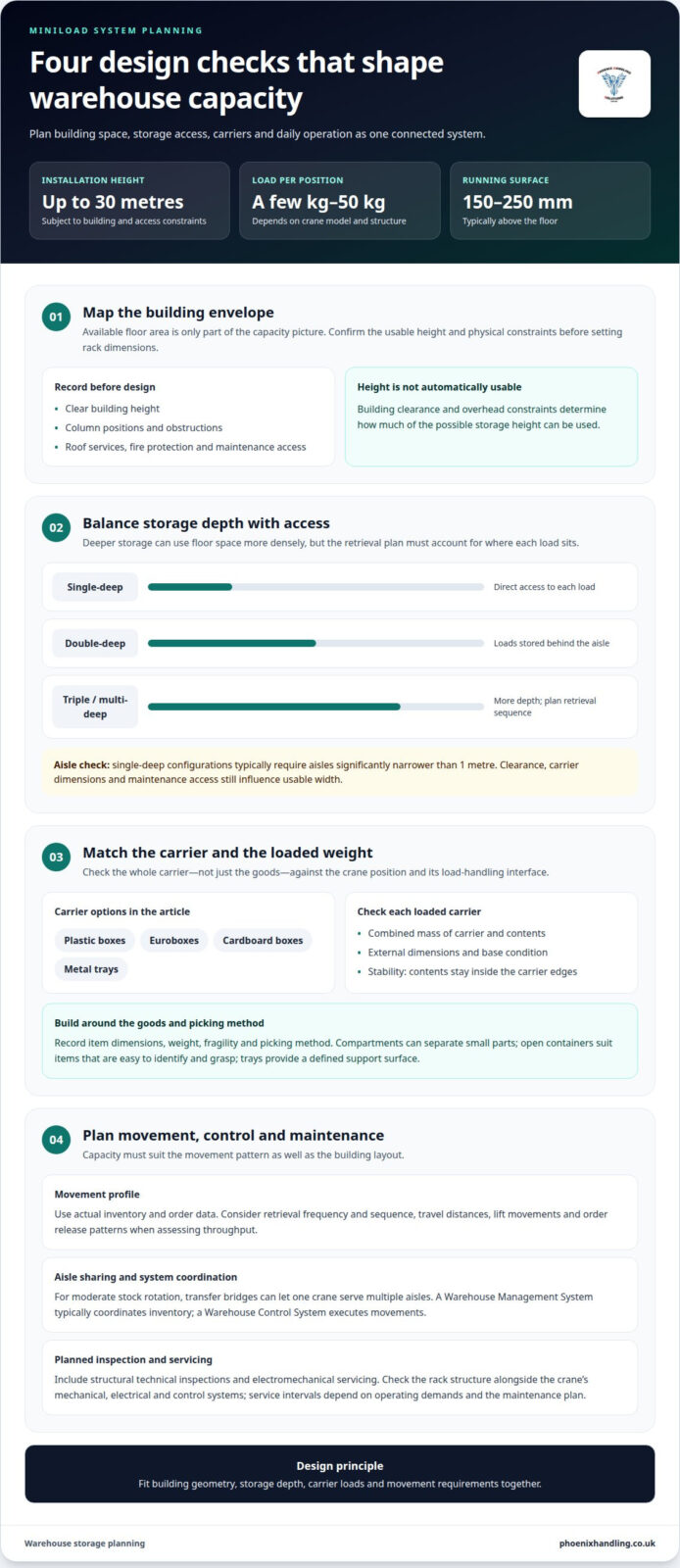
Warehouse capacity is not determined by floor area alone. A miniload stacker crane can support automated small-load storage in installations up to 30 metres high, with loads typically ranging from a few kilograms to 50 kg per position, depending on the crane model and structural configuration. Storage can be single-deep, double-deep or multi-deep.
Choosing a system involves more than matching a crane to the building’s height. Load dimensions and weight, storage density, aisle layout and movement rates all affect the installation’s configuration. The arrangement needs to fit the available space and the demands of daily operations.
This guide explains how miniload systems use warehouse height, which loads and carriers they can handle, and what to consider when planning storage and maintenance. It also explains how an engineered miniload stacker crane system can be matched to your warehouse layout and operational requirements.
Key Takeaways
- Assess building height, aisle arrangement and storage depth together to plan space use around operational needs.
- Match each load’s weight and dimensions to the carrier and crane configuration before designing storage positions.
- Choose containers, boxes or trays that suit the goods and can be handled consistently by the system.
- Include structural inspections and electromechanical maintenance in the approach to safe, reliable operation.
Warehouse space optimisation and storage height
A miniload stacker crane uses vertical storage to increase capacity without extending the warehouse footprint. Automated box-storage installations can reach up to 30 metres high. Usable height depends on building clearance, roof services, fire protection and maintenance access. These constraints need to be mapped before selecting rack height.
Storage depth affects the balance between space use and access. Single-deep positions provide direct access to each load, while double-deep, triple-deep and multi-deep layouts place more loads behind the aisle. Deeper configurations can use floor space more densely, but retrieval planning must account for each load’s position and the required movement sequence.
- Measure the building: record clear height, column positions and obstructions before setting rack dimensions.
- Plan the aisles: compare single- and multi-deep storage against access requirements and expected stock movement.
- Check the running surface: the main-wheel running surface is typically 150 to 250 mm above the floor.
For operations with moderate stock rotation, transfer bridges can let one crane serve multiple aisles. This can reduce duplicated equipment, although aisle switching becomes part of the movement plan. A Warehouse Management System typically coordinates inventory, while a Warehouse Control System executes movements. Connecting them helps align stock records with crane activity.
Maintenance includes structural technical inspections and electromechanical servicing of the automated equipment by the system integrator. The service interval depends on the installation’s operating demands and maintenance plan; inspections should cover the rack structure as well as the crane’s mechanical and electrical systems.
The main risks are a mismatch between building geometry, storage layout and load movement requirements. Structural deviations, unsuitable load positioning, or faults in mechanical, electrical or control components can disrupt operations. Design reviews and planned inspections help identify issues before they affect routine retrieval.
Load-carrier compatibility and load capacity
A miniload stacker crane must match the carrier as well as the goods it holds. The system typically handles loads from a few kilograms up to 50 kg per position, depending on the crane model and structural configuration. Treat working load as the combined mass of the carrier and its contents. A box that fits the opening can still exceed the position’s rated capacity when fully loaded.
Carrier dimensions, base condition and load stability all affect reliable handling. A consistent footprint helps the crane’s load-handling device engage and transfer each carrier correctly. Before specifying storage positions, record the external dimensions and loaded weight of representative carriers, including the heaviest expected load. Consider whether contents could shift or extend beyond the carrier during movement.
- Check the rated load: compare the carrier and contents’ combined mass with the position capacity.
- Confirm the interface: match carrier dimensions and base construction to the crane’s handling equipment.
- Map the load profile: identify variations in size, weight and stability across stored items.
Single-deep configurations typically require aisles significantly narrower than 1 metre. This can support compact storage, but aisle width is only one part of the layout. Rack geometry, crane clearance, carrier dimensions and access for maintenance all influence the usable width. Throughput also depends on the frequency and sequence of retrievals, travel distances, lift movements and how orders are released to the system. A layout designed only for narrow aisles may not suit the required movement pattern.
Use actual inventory and order data to define the operating profile, then test the proposed carrier mix against capacity and access requirements. This allows load handling and throughput to be considered together, rather than treating them as separate specifications. For a system designed around warehouse carriers and loads, explore miniload stacker crane systems.
Storage of small parts in containers, boxes or trays
Miniload systems can store plastic boxes, Euroboxes, cardboard boxes and metal trays. Choose a carrier to suit the part’s shape, handling requirements and storage conditions. For example, loose fasteners can be grouped in a box, while components that need a stable base may suit a tray. Consistent carrier dimensions help organise storage positions and support repeatable automated handling.
Start with the items, not the container catalogue. Record each part’s dimensions, weight, fragility and picking method, then group items with similar storage needs. A small component picked individually may need a compartmented carrier, while a larger part may need an open box. Keep the load stable during movement, with contents inside the carrier’s edges.
- Match the carrier: select a plastic box, Eurobox, cardboard box or metal tray for the item and its handling needs.
- Check the loaded carrier: include the container and contents when assessing the stored load.
- Standardise where practical: consistent formats simplify allocation and reduce variation in storage positions.
Carrier choice also affects how stock is presented for picking. Compartments can separate small parts within one box, while open containers suit items that are easy to identify and grasp. A metal tray provides a defined support surface for components that need to remain level. The right format depends on the item, picking process and crane’s load-handling interface.
Before adopting a new carrier, test a representative loaded example through the intended storage and retrieval process. Check that it sits securely, remains stable and can be accessed without disturbing neighbouring items. Include both empty and full carriers in the evaluation, as their handling characteristics differ. This practical assessment helps ensure the container suits accurate stock placement and efficient retrieval across the warehouse.
Storage depth is another configuration decision to consider alongside carrier choice. Miniload systems can be configured for single, double, triple or multi-deep storage. Consider the arrangement alongside how carriers are assigned to storage positions and presented for retrieval. Reviewing container format and storage depth together helps ensure the carrier works within the planned layout and suits the part and picking process.
What safety standards and regulations apply to warehouse stacker cranes in the UK?
For Miniload installations in the UK, EN 15635 guides technical inspections of the racking structure. It is relevant to the storage framework supporting automated equipment, rather than a substitute for inspecting the crane’s mechanical and electrical components. A safe inspection plan therefore considers the rack and the automated system as related, but distinct, parts of the installation.
Begin with the installation’s structural records and inspection history. Compare the racking arrangement with the current site layout, including any changes to beams, supports or equipment interfaces. Inspectors can then identify visible damage, deformation or impact marks and assess their effect on the structure. Record findings and follow-up actions so later inspections can track changes in condition.
- Inspect the racking: use EN 15635 as the guide for technical inspections of the storage structure.
- Assess the crane: include mechanical and electrical components in electromechanical maintenance.
- Record changes: document structural alterations, damage and completed remedial work.
A miniload system also needs a clear fault-reporting process. For example, an operator who notices unusual movement, a damaged rack component or a failed transfer should report it through the site procedure. The affected area or equipment can then be assessed before normal operation resumes. Give staff clear instructions for keeping people away from moving machinery and escalating faults to maintenance personnel.
Inspection timing and maintenance tasks should reflect the installation’s equipment and operating demands. Structural technical inspections and electromechanical maintenance address different failure points, so neither replaces the other. Keep records linking inspection findings, repairs and system changes. This gives maintenance teams a useful history when planning later work.
For a storage project that needs an integrated equipment solution, discuss miniload crane requirements with Phoenix Handling Solutions Limited.
Phoenix Handling Solutions Limited: Pallet Wrapping Machines
Phoenix Handling Solutions Limited supplies pallet wrapping machines for businesses preparing palletised goods for storage or dispatch. After selecting a miniload system for small-load storage, you may also need equipment to secure finished pallet loads as they move through the wider warehouse process.
The right packaging machinery depends on the load format and end-of-line process. Phoenix Handling Solutions Limited also supplies strapping machines, stretch hooders and bag palletisers. These options suit different packaging and palletising tasks, so choose according to the goods being handled and how they are prepared for onward movement.
For a warehouse project that includes pallet packaging alongside automated storage, contact Phoenix Handling Solutions Limited to discuss your requirements or visit phoenixhandling.co.uk.
Plan the next stage of warehouse automation
Connect storage design with the wider flow of goods through your site. Map how items move from receiving and automated storage to order preparation and dispatch, then identify interfaces or hand-offs that need coordination. This operational view helps define the miniload stacker crane’s role in the wider process, rather than treating it as an isolated machine.
Consider how the miniload stacker crane will interface with downstream pallet preparation. Phoenix Handling Solutions Limited supplies pallet wrapping machines, strapping machines and stretch hooders for end-of-line packaging. Select equipment to suit the load format and handling process.
For a practical discussion about your warehouse requirements and related packaging equipment, contact Phoenix Handling Solutions Limited. A clear project brief is a useful starting point for developing the next step.