
An AGV and an automated storage and retrieval system (AS/RS) solve different material-flow tasks: an automated guided vehicle system transports loads between points, whilst an AS/RS stores and retrieves them within a storage structure. AGVs navigate using guidance or mapping technologies, and ISO 3691-4 sets safety requirements and test methods for AGVs and AMRs.
Both can support warehouse automation, but the distinction matters when planning how goods move through a facility. A vehicle may suit repeatable transfers between work areas, while an AS/RS is centred on storing and retrieving loads. The right choice depends on the flow of materials, the available space and how each system must connect with existing operations.
This guide explains how AGV navigation works, which safety requirements apply in the UK, and how AGVs compare with automated storage and retrieval systems. It also covers the operational factors that affect suitability, helping you assess which type of automation fits the task.
Key Takeaways
- Match the navigation method to the facility layout, route changes and load-transfer points to understand how vehicles will move through daily operations.
- Use ISO 3691-4 as the safety reference for AGVs and AMRs, then consider how vehicle behaviour and workplace conditions affect safe operation.
- Compare vehicle types by the loads they carry and the tasks they perform, rather than treating every AGV as suited to the same movement.
- Separate transport requirements from storage and retrieval needs to decide whether mobile vehicles, an AS/RS or a combination best fits the material flow.
AGV navigation and guidance technologies
An automated guided vehicle system uses a mobile vehicle and control logic to move loads between defined points. The navigation method determines how it follows routes, detects obstacles and responds to changes on the factory floor.
Navigation methods and sensors
Navigation methods help an AGV establish its position and follow a route. Their suitability depends on the floor layout, traffic and likely route changes. Magnetic tape or embedded wires mark fixed paths, while laser navigation can use reflectors as reference points. Cameras and laser scanners can read surrounding features against a stored map. Encoders measure wheel movement, helping the vehicle estimate how far it has travelled since its last position reference.
How AGVs navigate
An AGV combines route instructions with position and sensor data to navigate. A control system assigns a destination, and the vehicle follows its planned route. Sensors detect obstacles or changes in the surroundings, allowing the vehicle to slow or stop when required by its programmed response. For example, a vehicle carrying a pallet from a production line to dispatch must follow the route, approach the transfer point and position its load for handover.
Guidance technologies
Guidance technologies provide the physical or digital references that keep an AGV on its intended path. Tape and wire guidance suit fixed routes, but changing those routes requires corresponding changes to the floor installation. Laser-based systems use reflectors to help locate the vehicle, while natural-feature navigation uses mapped details in the surroundings. Camera-based guidance can also use visible features for positioning. These differences affect how easily a route can adapt when equipment or work areas move.
Control integration also matters. VDA 5050 is an interface for communication between automated guided vehicles and a master control. In a facility with several vehicle routes, that interface helps coordinate vehicle instructions through the control layer. Selection therefore involves more than the sensor: consider route stability, floor conditions, transfer locations and how the AGV will receive movement tasks. These factors determine which guidance approach fits the operating layout.
Safety requirements and ISO 3691-4
AGV safety depends on the vehicle, its route and the people working nearby. ISO 3691-4 sets safety requirements and test methods for both AGVs and AMRs.
Obstacle detection and safety systems
Obstacle detection uses sensors to identify people, equipment or objects in a vehicle’s path and helps manage collision risks. A route that is clear during design may later be obstructed by pallets, temporary workstations or changing pedestrian traffic. A scanner can detect an object ahead, while the control logic slows or stops the vehicle according to its configured response.
Other safety measures can include warning lights, audible signals and emergency-stop controls. Their effectiveness depends on visibility, placement and how staff interact with the vehicle. For example, a blind corner near a loading point needs different attention from a straight aisle with clear sightlines. ISO 3691-4 provides the relevant framework for evaluating vehicle safety requirements and test methods.
Risks and limitations
AGV risks include collisions, blocked routes, incorrect load positioning and disruption if a vehicle cannot complete its assigned movement. Poorly defined pedestrian crossings or changes to the workplace layout can also affect safe operation. These constraints matter because a vehicle follows its programmed task and guidance rather than independently deciding how to respond to every workplace change.
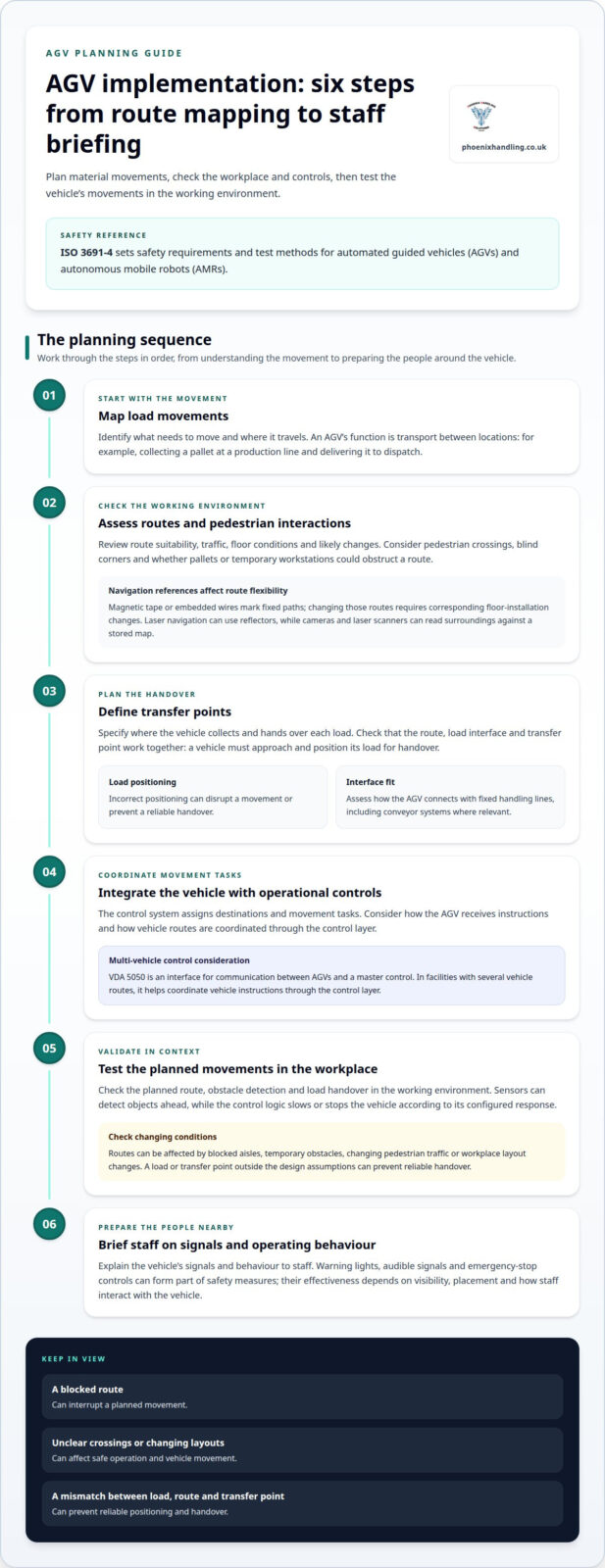
To plan and implement an AGV system, map load movements, assess routes and pedestrian interactions, define transfer points, then integrate the vehicle with operational controls. Test the planned movements in the working environment and brief staff on the vehicle’s signals and operating behaviour.
The main limitations are route suitability, traffic interaction and dependence on a functioning control system. A blocked aisle can interrupt a planned movement, while a load or transfer point outside the design assumptions can prevent reliable handover. Where AGVs feed fixed handling lines, assess how conveyor systems connect with the route and transfer points. This helps identify interface requirements alongside the vehicle’s safety needs.
What is an Automated Guided Vehicle (AGV)?
An automated guided vehicle is a driverless vehicle that carries materials along a planned route within a workplace. It receives movement tasks from a control system and uses its guidance method to travel between locations. For example, a vehicle can collect a pallet at a production line and deliver it to a dispatch point. Its function is transport, not storage or order picking.
AGVs are grouped by how they carry or move a load. The right type depends on the material, transfer method and route layout. Common examples include:
- Tugger AGVs: tow one or more carts, making them suited to repeated deliveries between work areas.
- Unit-load AGVs: carry a load directly on a platform, such as a container transferred between assembly stations.
- Forklift AGVs: lift and move palletised goods, including loads placed at floor-level pickup points.
- Pallet truck AGVs: move pallets at floor level, supporting transfers between a goods-in area and a production cell.
These types differ in their load interface and how they meet a transfer point. A tugger connects to a cart, while a unit-load vehicle needs a suitable platform or conveyor interface. A forklift AGV must approach a pallet so its forks can engage the load. These practical differences affect aisle access, pickup arrangements and handover design.
Selection also depends on the movement pattern. A tugger can serve a loop between several stations, while a unit-load vehicle can make direct point-to-point deliveries. A forklift AGV may suit pallet transfers that require lifting, but it needs access to approach and place the load. Mapping the load, origin, destination and transfer method clarifies which vehicle type fits the task.
An AGV is one component in a wider material-flow process. For example, a pallet may travel from a production line to a wrapping station before dispatch. The vehicle handles the journey; equipment at each endpoint handles the load. Defining these separate functions helps match the vehicle type to the actual transport requirement. For further context on AGV material handling across manufacturing, warehousing and healthcare, consider how repeatable routes and load types fit the operation.
AGVs compared with automated storage and retrieval systems
AGVs and automated storage and retrieval systems (AS/RS) address different parts of material flow. AGVs transport loads between locations; an AS/RS stores and retrieves them within a defined storage structure. The distinction matters when deciding whether the main requirement is movement, storage density or both.
An AGV suits transfers between operational areas, such as moving a pallet from production to dispatch. Its routes connect pickup and delivery points within the wider workplace layout. An AS/RS, by contrast, retrieves a stored load when requested and brings it to an access point. A pallet warehouse, for example, may use an AS/RS to manage storage locations, then use another method to move goods onward.
Space use can influence the choice. Cube storage AS/RS can free up to 400% of the space occupied by traditional shelving required for AGVs. This makes storage density a relevant comparison, particularly where floor area is constrained. AGVs, by contrast, provide transport between points rather than replacing the storage structure itself.
Assess the required movement before selecting either system. If goods regularly travel between workstations, an AGV may address the transport task. If the constraint is storing and retrieving inventory within a compact footprint, an AS/RS may be more relevant. Consider load dimensions, access requirements, movement routes and how goods enter or leave storage. These factors help identify the primary process need.
The systems can also work together. An AS/RS can retrieve a pallet, while an AGV transports it to a production area or dispatch point. A conveyor can connect fixed equipment with transfer locations. In this arrangement, each system has a distinct task, so the interfaces between storage, transport and handover need clear definition.
The practical takeaway is to specify the material-flow problem first, then match automation to it. Discuss AGV options for your material flow.
Phoenix Handling Solutions Limited: Pallet Wrapping Machines
Phoenix Handling Solutions Limited supplies pallet wrapping and other packaging machinery for operations that prepare loads for storage or dispatch after transport. Once an AGV delivers a pallet to a packaging area, the next step may be securing the load for onward handling. Pallet Wrapping Machines apply stretch film around palletised loads, while Strapping Machines secure them with strapping. Stretch Hooders offer another packaging option, and a Bag Palletiser handles bags at the palletising stage.
Turn to Phoenix Handling Solutions Limited to discuss how packaging equipment fits into your material flow, including processes before or after an AGV handover. Contact Phoenix Handling Solutions Limited or visit phoenixhandling.co.uk to discuss your packaging requirements.
Turn system selection into an operational brief
Before specifying an automated guided vehicle system, translate the intended result into a practical operating brief. Record the loads to be moved, their origins and destinations, handover conditions, and how the process changes during a working shift. This gives the design discussion a clear basis instead of starting with vehicle features in isolation.
Include the people and equipment that share each route. A production team, warehouse operator and maintenance lead may each identify different constraints, from access during replenishment to the space needed for load transfer. Bringing these operational details together helps establish where automation supports the process and which existing arrangements need consideration.
Phoenix Handling Solutions Limited can discuss material-handling requirements and the equipment that supports them. Use the operating brief to frame the conversation and clarify the process you want to improve. Contact Phoenix Handling Solutions Limited to discuss the next step for your operation.
Frequently Asked Questions
AGVS, AGV, AMR – what’s the difference?
AGV means automated guided vehicle; AGVS means automated guided vehicle system, including the vehicle and supporting controls. AMR means autonomous mobile robot. The practical distinction is usually how movement is managed: an AGV follows a defined guidance approach, while an AMR can plan or adjust its route using information about its surroundings. Terminology varies between suppliers, so compare navigation and control functions rather than labels alone.
How does an AGV work?
An AGV receives a transport task, moves a load and reports the task’s progress through its control arrangement. The vehicle controller coordinates driving and steering, using positioning and sensor inputs to follow the assigned movement. At pickup, its load interface engages or receives the item; at the destination, it transfers the load. For example, a tote delivery can connect a production cell with a packing station.
What does an AGVS include?
An AGVS includes the vehicles, equipment and controls needed to operate them as a transport process. Depending on the installation, this may include fleet management, navigation references, charging arrangements, safety devices and interfaces at pickup or delivery points. A conveyor handover, for example, needs compatible transfer positions and control signals. Define the system boundary around these interfaces, not just the vehicle itself.
What are the main types of AGVs and their applications?
Common types include tugger vehicles for towing carts, unit-load vehicles for carrying items on board, and forklift-style vehicles for pallet handling. Their application depends on the load format and how goods enter or leave the vehicle. A cart train can suit repeated internal replenishment, while a compact unit-load carrier may move containers between process stages. Specify the load interface and delivery point alongside the vehicle category.
What are the typical costs of an AGV system in the UK?
Project requirements determine the cost. Main factors include vehicle numbers, load capacity, navigation method, control software, charging provision, workplace changes and integration with existing equipment. A single vehicle on an established route has different requirements from a fleet serving multiple transfer points. Define the operating scope first, including shifts, loads and handovers, to make the project specification meaningful.
How do AGVs compare with autonomous mobile robots (AMRs)?
AGVs generally suit repeatable movements with well-defined routes and transfer points; AMRs are commonly selected when vehicles need more route flexibility. That distinction affects how the layout handles temporary obstructions or changing work areas. A predictable circuit between fixed stations may favour guided travel, while a variable route may benefit from adaptive navigation. Compare operational behaviour, control integration and workplace conditions before choosing an approach.