
A bag palletiser with the highest nominal speed may still be the wrong fit for your production line. Bag dimensions, contents and behaviour during handling affect how consistently products can be stacked, while the available footprint and required pallet load shape the system choice.
Throughput matters, but it is only one part of the specification. Consider the bags being handled, the line’s operating conditions, the pallet patterns required and how equipment will connect with existing conveyors and downstream machinery. Together, these factors help identify a system that supports production rather than constraining it.
This article explains what operational information you need to specify a bag palletiser and how conventional and robotic approaches differ. It also covers the effects of throughput, floor space and pallet stability on equipment selection and integration. Phoenix Handling Solutions supplies standard and custom-engineered bag palletising equipment for applications including pet food, animal feed and onions, with system selection shaped around the product, line and available space.
Key Takeaways
- Use production samples to assess bag dimensions, filled weight, surface and consistency before selecting equipment.
- Consider how bag shape and flexibility affect presentation, transfer and the stability of the finished pallet.
- Compare bag palletiser approaches against the required output, product flow and available footprint.
- Map the line from bag infeed through pallet handling to identify space limits and equipment interfaces.
- Separate current production needs from planned changes in output or product range when defining the system.
What a bag palletiser does for a production line
A bag palletiser arranges filled bags into a planned pallet load. It receives product from an upstream filling or conveying process, positions each bag and builds successive layers to a defined pattern. In practical terms, a bag palletiser is equipment that organises filled bags into a pallet load for handling, storage or despatch. This function is shared with other palletising equipment. Palletiser functions and types provide useful background on the wider process.
Because the palletiser sits at the end of the production line, the handover into and out of the system matters. Bags need to arrive in a form and orientation the equipment can handle, then be placed to create the required pallet arrangement. Suitability depends on the product, bag format and actual production conditions, not simply on the machine category.
Where bag palletising sits in the production process
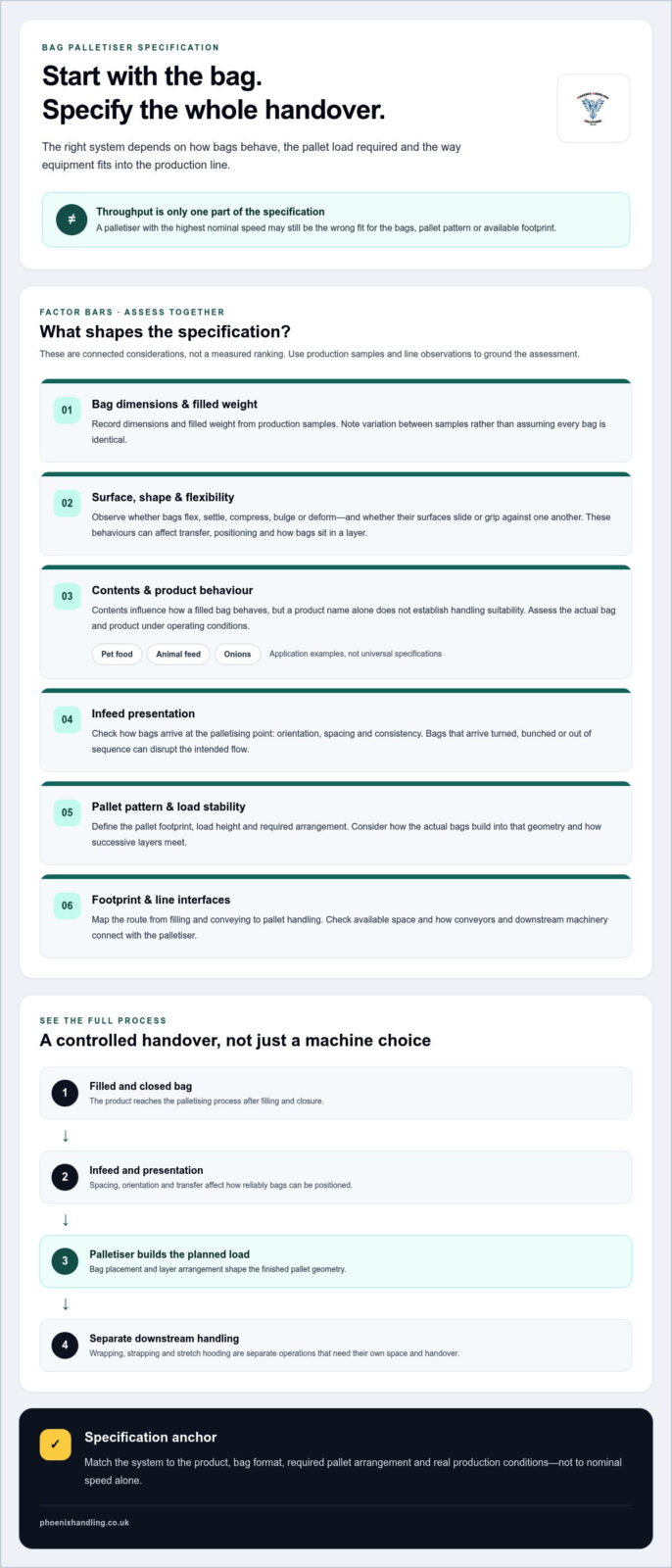
The process typically begins after a product has been filled and the bag closed. Bags may travel directly from the filling area or pass along conveyors before reaching the palletising point. Their spacing, orientation and presentation during transfer affect how reliably they can be positioned. A bag that arrives turned, bunched or out of sequence can disrupt the intended flow, so the infeed arrangement is part of the system design.
Once the pallet load is complete, it moves on for separate handling or securing. Wrapping, strapping and applying a stretch hood are downstream operations, not functions of the palletiser itself. Treating these stages separately makes it easier to define where each machine’s role ends and what space and handover are needed between them.
What a well-formed bag pallet needs to achieve
Consistent placement helps create a load with a predictable shape. The position and orientation of each bag affect the layer pattern, alignment between layers and finished pallet geometry. Bags that vary in shape or settle differently may behave differently as layers build, so the stacking approach needs to reflect the product and packaging rather than assume every filled bag presents identically.
The finished arrangement should suit the pallet dimensions and the requirements for storage and transport. Define the pallet footprint, load height and expected handling route early. These details give the palletising design practical boundaries, while the bags, pattern and operating conditions determine how the finished load behaves.
Palletising is therefore more than transferring bags onto a pallet. It is a controlled handover from product flow to a configured load, with presentation, placement and pallet geometry all contributing to the result. Establishing these requirements provides a starting point for comparing equipment approaches and assessing how a system will fit the wider line.
How bag characteristics shape palletising requirements
Assess bags as they arrive on the line, rather than assuming a standard format. Record dimensions and filled weight, then observe surface, shape and consistency across production samples. A bag that holds its shape may present differently from one that flexes or settles after filling. These differences can affect transfer, positioning and how bags sit together in a layer.
Contents matter because they influence how a filled bag behaves, but a product name alone does not define the handling requirement. Phoenix Handling Solutions’ bag palletising examples include pet food, animal feed and onions. These are application examples, not a universal specification for every product in those categories. The relevant evidence is the bag and product as produced under the actual operating conditions.
Bag format, contents and handling behaviour
Review samples from normal production, including variations in fill level or bag shape. Note whether bags arrive consistently oriented, whether their surfaces slide or grip against one another, and whether they compress or bulge when placed. These observations help identify presentation and transfer requirements. They also prevent assumptions about bag material or contents from being mistaken for proof of compatibility.
For a useful assessment, record:
- Bag dimensions and filled weight, including variation between samples.
- Surface and filled shape, noting whether bags flex, settle or deform.
- Contents and any product-specific handling considerations.
- How bags arrive at the palletising point, including their orientation and spacing.
This information gives the equipment specification a practical starting point. The system should be selected for the application, rather than against a single bag specification assumed to suit every line.
Pallet pattern, stability and load requirements
Consider bag behaviour and pallet stability together when specifying a palletising system. Placement and layer arrangement determine how bags form the intended load, while their shape and consistency affect how evenly they sit. The required pallet configuration should reflect pallet dimensions and the load’s storage, handling and transport conditions.
Define the desired footprint and overall load arrangement, then consider how the actual bags build into that geometry. If the product or bag format varies, assess whether those variations affect the intended pattern or the way successive layers meet. This keeps the design discussion focused on the finished load, without assuming that a pattern suited to one product will work equally well for another.
Samples and production observations connect the bag’s physical behaviour to the pallet requirements. Phoenix Handling Solutions specifies bag palletising equipment around product type, throughput and available floor space, with standard and custom-engineered equipment for business applications. Phoenix bag palletising equipment is considered in relation to these project requirements, rather than a universal bag format.
Bag palletiser approaches: compare the process, not just the machine type
Terms such as robotic, layer-based and collaborative describe different equipment approaches, but they do not establish which one suits a particular line. Start with the process: how bags arrive, how they are presented and transferred, the required output, and the floor space available. The same equipment label can also cover different layouts and integration requirements.
Use the points below to frame a project comparison. They are assessment prompts, not a specification or a claim that one approach will suit every bag or application.
What to compare across bag palletising configurations
Map the flow from the upstream conveyor to the pallet position. Record whether bags arrive singly or in a steady stream, how their orientation is controlled, and whether the production mix includes different bag or pallet formats. Then compare how each proposed approach would receive and arrange the bags, including the effects of product changes and changeovers.
| Approach | Points to assess |
|---|---|
| Layer palletiser systems | How bags are presented for layer formation, how the required pallet pattern is built and whether the product mix suits this operating method. |
| Robotic palletiser | How bags are transferred and placed, how patterns or product changes affect the operating sequence, and how the cell fits the available floor area. |
| Cobot palletiser | How the collaborative system is arranged within the line, what bag and pallet variations it must handle, and how its working area relates to surrounding operations. |
These categories indicate an operating method, not a guaranteed output or footprint. A label alone does not show whether the infeed, placement sequence or changeover requirements match your production. Compare the complete arrangement and required output against actual line conditions rather than ranking machine names in isolation.
When a system comparison needs project-specific detail
Floor space can affect the available layout options, particularly where conveyors, pallet positions and adjacent equipment already occupy the line. Identify access routes, existing interfaces and the space needed for pallet movement. Include downstream machinery, such as wrapping or strapping equipment, so the handover between operations is part of the layout assessment.
A useful project brief brings together bag flow, product variation, required output, pallet formats, operating pattern and physical constraints. This lets you compare proposed systems against the same practical requirements. Phoenix Handling Solutions supplies bag palletising equipment and other palletising systems, with specifications shaped around product type, throughput and available floor space. The palletising systems buying guide provides further context for organising that comparison.
How to assess throughput, layout and line integration
Assess a proposed system in sequence. Start with the route bags take through the line, establish the required output, review the available space and identify equipment interfaces. This helps separate the palletiser’s role from constraints elsewhere in production and makes comparisons more useful than relying on a headline speed or machine description alone.
Build a useful throughput and product brief
Use operational records to distinguish normal running from peak demand, including stops or gaps that affect how bags reach the palletising point. State the required output in a format the production team can verify, and record which products, bag formats and pallet types are in scope. Keep current demand separate from planned changes, such as additional products or a revised operating pattern.
Include relevant line conditions, such as how bags are conveyed and whether product changes require a different pallet arrangement. Assess the output of the complete configuration, not an isolated machine figure. Infeed flow, placement sequence, pallet exchanges and downstream handovers can all affect the rate the line needs to sustain.
Review footprint, interfaces and future operation
Map the infeed and discharge positions on the available floor plan. Include the palletiser, pallet locations, operator access and routes for moving full and empty pallets. Existing machinery, structural limits and access routes may restrict where equipment can sit, so record these constraints before settling on a layout. Consider the surrounding operation, not just the machine footprint.
Next, identify the upstream and downstream interfaces. Note how bags arrive from filling or conveying, and how completed pallets move to wrapping, strapping or other handling stages. Define the handover points and any product, output or pallet format changes the line may need to accommodate. A clear brief makes these dependencies visible before they become design assumptions.
A useful project brief records bag flow, verified normal and peak output, product and pallet formats, available space, access, interfaces and planned operating changes. This gives the equipment assessment a shared reference point and helps distinguish essential requirements from possible future needs. The palletising throughput selection checklist can support the output review, while Phoenix Handling Solutions specifies a bag palletiser around product type, throughput and available floor space.
Prepare these line details to discuss a system suited to your production requirements with Phoenix Handling Solutions.
Planning a bag palletiser project with Phoenix Handling Solutions
A project brief turns production requirements into a practical equipment specification. Phoenix Handling Solutions specifies bag palletising equipment around product type, throughput and available floor space, taking into account how the system needs to fit the wider operation. Application examples include pet food, animal feed and onions. These illustrate the range of applications featured, rather than a universal specification for every bag or product.
Preparation makes the project discussion more useful. Operational records, product details and a basic line layout clarify what the equipment needs to handle and where it must fit.
Information to prepare for a project discussion
Bring details from the production line rather than relying only on nominal or average figures. Include samples or measurements for the bags and record normal and peak output from verified operational data. Note product variation and any planned changes that could affect the system arrangement.
- Product types, bag dimensions, filled weight and observed variation in format or shape.
- Required pallet dimensions, load arrangement and any differences between pallet formats.
- Verified normal and peak output, plus the operating pattern behind those figures.
- A layout showing available floor space, access, pallet movement and adjacent equipment.
- Upstream and downstream interfaces, including conveyors and equipment handling completed pallets.
If several products or formats run on the same line, identify which are current and which are planned. This separates essential operating requirements from future possibilities and gives the specification a clear basis.
From application brief to system specification
These details inform both the equipment choice and the system arrangement around it. Product behaviour and required output shape the handling requirements, while available floor space and existing line interfaces influence how equipment can be positioned and connected. Reviewing these factors together avoids treating the palletiser as an isolated machine.
Phoenix supplies standard and custom-engineered equipment for business applications. Project requirements provide the basis for an appropriate specification, including how the bag palletising equipment relates to product flow, pallet requirements and operating conditions. Clear information supports a focused discussion of the application without assuming one configuration suits every production environment.
To discuss your requirements, discuss a bag palletising project with Phoenix.
Turn your production brief into the next step
A clear project brief gives your team a shared basis for assessing equipment and planning the next stage of production. Before progressing, align production, operations and logistics on the conditions the system must accommodate, including expected changes to products, output or pallet formats. This keeps the specification grounded in how the line needs to work, rather than an idealised operating scenario.
Phoenix Handling Solutions supplies bag palletisers as part of its packaging machinery range. Its product page features applications involving pet food, animal feed and onions. These examples show particular product contexts, while the right specification depends on the requirements of your operation.
Use your collected information to start a focused discussion about the application and the equipment arrangement it calls for. Begin with your bags, production conditions and site constraints, then consider how the system needs to fit your line. Explore Phoenix’s bag palletising solutions and discuss your production requirements with Phoenix Handling Solutions.
Frequently Asked Questions
What is a bag palletiser and how does it work?
A bag palletiser organises filled bags into a pallet load by positioning them in a planned arrangement. Bags are fed from the production process, presented for placement and built into the required load pattern. The handling sequence depends on the equipment and application. A bag palletiser is distinct from equipment that fills or seals bags, and from downstream machinery that wraps or otherwise secures the completed pallet.
Which products can a bag palletiser handle?
A bag palletiser can be specified for different products, but suitability depends on the actual bag, contents and operating conditions. Phoenix Handling Solutions’ product page features applications involving pet food, animal feed and onions. These examples illustrate particular application contexts, not compatibility with every product, bag format or production line. Assessing filled bags and the required pallet arrangement helps define the system requirements.
How do bag type and product contents affect palletising?
Bag type and contents influence the filled package’s shape, weight and behaviour as it is transferred and placed. A bag that settles or flexes, for example, may sit differently from one that retains a more consistent shape. These differences can affect how bags are presented and arranged. Use production samples, including variations in fill and format, rather than relying on assumptions about a material or product category.
What information is needed to specify a bag palletiser?
Prepare product and bag details, including dimensions, filled weight and variation between formats. Add pallet dimensions and the intended load arrangement, alongside verified output requirements and a layout of the production area. Note how bags arrive at the palletising point and identify upstream and downstream equipment. This information defines the operating brief and highlights constraints that may affect the equipment specification or its position in the line.
How do I assess the throughput required from a bag palletiser?
Use production records to establish the normal and peak rate of bags arriving for palletising, rather than relying only on an hourly average. Include pauses, surges and product changes that influence actual flow. Then consider the complete operating sequence, including bag placement and pallet movement through the line. Compare the required rate with the proposed system configuration, as an isolated equipment figure may not represent the throughput of the full process.
Can a bag palletiser be integrated with an existing production line?
Assess integration by mapping the available infeed, palletising position and discharge route alongside existing machinery. Check how bags transfer from the upstream process and how completed pallets move to downstream handling. Account for floor space, access and product or pallet format changes. These details help define the interfaces and layout for incorporating palletising equipment into an established operation.
What is the difference between a bag palletiser and a robotic palletiser?
A bag palletiser describes equipment by its task: arranging bags into pallet loads. A robotic palletiser describes an approach that uses a robot to move and position products. The terms are not necessarily alternatives: a robotic system may be configured for bag palletising, while other bag palletising arrangements use a different operating method. Selection depends on the product, required output, pattern changes and site layout, rather than terminology alone.