The most capable palletiser may still be the wrong choice if it does not suit your product flow or available floor space. A palletising systems supplier UK manufacturers can work with should base its recommendations on the products, required throughput and production layout, rather than starting with a robot category.
It is reasonable to ask whether a proposed system will handle your products reliably, fit the existing line and meet output requirements. Comparing proposals can also be difficult when they describe different equipment or rely on different assumptions. This guide explains how bag, cobot, layer and robotic palletisers differ, and what operational details to define before discussing a system.
You will learn how to prepare a practical specification covering products, throughput, pallet patterns, conveyors and available space. The guide also explains how palletising equipment fits into a wider packaging line, and why integration, spares and servicing matter to ongoing operation. Phoenix Handling Solutions Limited supplies standard and custom-engineered palletising equipment for manufacturers and distributors across the UK and Ireland, with systems specified around production requirements.
Key Takeaways
- Choose a palletising approach based on product handling needs and production flow, not a presumed ranking of technologies.
- Assess how product presentation and infeed consistency affect pallet formation and the wider line.
- Prepare for supplier discussions with details on throughput, pallet patterns, operating hours, changeovers and site layout.
- Compare a palletising systems supplier UK proposal against the line interfaces and downstream handling requirements it needs to address.
- Consider bag, cobot, layer and robotic palletisers alongside conveyor requirements, spares and servicing.
Palletising systems in the UK: what the investment needs to solve
A palletising system arranges products into planned pallet loads for storage or onward movement. Depending on the application, it may handle bags, cases or other packaged products, placing them in a defined pattern. The basic function is straightforward, but choosing equipment requires a clear view of the production process around it. For a general overview of palletiser types and their development, see What is a Palletizer?
The investment should address a defined operational need. Repetitive manual stacking, inconsistent pallet presentation, a need to meet a particular output rate, or difficulty coordinating loads with downstream handling may all prompt a review. Assess these issues together: output depends not only on the palletiser, but also on product arrival, changeovers, operating hours and what happens to a completed pallet.
A palletiser is one part of the process, not necessarily the whole end-of-line system. Upstream packaging equipment prepares products for handling, the palletiser forms the load, and downstream equipment may wrap, strap, convey or otherwise handle completed pallets. These functions can be considered as part of a wider line, but they are distinct and need not all be included in a palletising project. For a broader view of how end-of-line packaging machinery prepares products for storage and dispatch, see the guide to the wider packaging stage.
Which operational problems can palletising address?
Manual stacking involves repeated lifting and placing, while inconsistent placement can vary the presentation of finished pallets. Automation may change how these tasks are carried out, but its suitability depends on the products, required output and process conditions. Define the problem first: identify where manual work occurs, when output falls short of the operating requirement, or where load formation causes difficulty for subsequent handling. This gives the supplier practical information to assess, without assuming a particular labour, productivity or safety outcome.
What is included in a palletising system?
Product infeed brings items to the palletising point in a condition the equipment can handle. Pallet positioning establishes where the load is built, and the palletiser places products according to the planned arrangement. Conveyors can connect these stages to existing equipment or onward handling, depending on the line layout. In your specification, distinguish these core functions from optional equipment such as upstream case packing or downstream wrapping. That makes the project scope clearer and helps you compare what each proposed system is designed to do.
The right approach depends on product characteristics, operating patterns and site constraints. Product type and presentation influence handling; throughput and changeovers shape how the system must operate; available floor space and line interfaces affect where equipment can sit. A palletising systems supplier working with UK manufacturers should therefore assess the application as a whole. Phoenix Handling Solutions Limited supplies standard and custom-engineered bag, cobot, layer and robotic palletisers, specified around product type, throughput and available floor space.
How a palletising system fits into a production line
A palletising system sits between the process that presents finished products and the operation that moves completed pallets onwards. Mapping this sequence helps define the equipment boundary: where products arrive, how they are transferred, where the pallet is positioned, and how the finished load leaves the area. Conveyors may link these stages, depending on existing machinery, available space and the required production flow.
Product presentation matters. Cases arriving in a consistent orientation at regular intervals create different handling conditions from bags that arrive unevenly or require careful positioning. Infeed consistency affects how the system can pick up, orient and place each item. A proposed design should account for interruptions, accumulation points and product variation rather than assume a uniform, uninterrupted stream. The Robotics in Material Handling overview provides wider context on the use of robotic equipment in material-handling operations.
Map product flow before specifying equipment
Walk the route from the preceding process to pallet dispatch. Note where products arrive, accumulate, transfer or leave the palletising area. Existing conveyors influence interface locations, product orientation and the space available for the palletiser. Record where a line stops, slows or changes product, since these conditions affect how the equipment must work with the rest of production.
- Identify the infeed and any gaps or interruptions in product supply.
- Record conveyor direction, transfer points and the route for completed pallets.
- Note product variations, planned changeovers and any manual handling that remains.
This map gives a palletising systems supplier a practical account of the site, not just a machine requirement. It also helps distinguish a standalone palletiser from a project that needs conveyor connections or other line equipment.
Define the pallet load and operating pattern
Gather the information that determines how products can be handled and arranged. Record product dimensions and weight, packaging format, stability and any features that affect gripping or placement. Specify pallet type and dimensions, the required load height and the arrangement for each product. A pallet pattern is the planned placement of products on each layer, defining how the finished load is built.
- List each product format and its required pallet pattern.
- Describe how often products or pallets change during a normal run.
- Set the required throughput for the actual operating pattern, including breaks or interruptions where relevant.
Keep performance targets tied to the application. If a figure has not been measured, mark it for verification instead of treating an estimate as a firm requirement. This makes supplier discussions more useful and helps you compare proposals using equivalent operating assumptions. Phoenix Handling Solutions Limited can discuss palletising system options alongside conveyor requirements, with equipment specified around product, throughput and available floor space.
Layer, robotic or cobot palletiser: compare the approaches
Technology labels describe how a palletiser handles products, but they do not establish which system is suitable. Product format, required pallet arrangements, operating pattern and site layout all affect the choice. Bag, layer, robotic and cobot palletisers are distinct options. Assess each against the same production requirements rather than treating the categories as a universal ranking.
The comparison below is a starting point. The handling principle indicates what to examine, not a promise that a category will suit every product or output requirement. The NIST Robotics Program provides further context on robotics in manufacturing, including the importance of measurement and system performance.
| Approach | Handling principle | Product fit and flexibility | Integration considerations |
|---|---|---|---|
| Bag palletiser | Arranges bags into pallet loads. | Consider bag dimensions, presentation and the required load pattern. | Review bag infeed, pallet position and the route for completed loads. |
| Layer palletiser | Builds a product layer and places it onto the pallet. | Assess whether products can be presented and arranged as the planned layer. | Check product grouping, layer formation and pallet pattern requirements. |
| Robotic palletiser | Uses a robot to pick and place products onto a pallet. | Assess the product range, handling requirements and number of patterns. | Consider the working area, infeed arrangement and interfaces with the line. |
| Cobot palletiser | Uses a collaborative robot for palletising tasks. | Consider the task, product mix and how the equipment fits the work area. | Assess the complete operating environment, layout and required safety measures. |
When might a layer palletiser suit the process?
A layer palletiser forms a group of products into a layer before placing it on the pallet. Consider this approach when the product presentation and planned arrangement allow layers to be formed consistently. Product shape, packaging and the required pallet pattern still matter: not every product will form a suitable layer. For mechanism-level detail, consult the dedicated article on layer palletisers.
When might robotic or cobot palletising be considered?
Robotic and cobot palletising both use robotic handling, but the relevant question is how each fits the task and operating environment. Use product mix, required patterns, available working space and existing line interfaces to guide the assessment. A collaborative label alone does not determine how a system operates in a particular workplace. The dedicated articles on robotic and cobot palletisers explore each approach in more detail.
Assess bag palletising against bag presentation, load requirements and line arrangement rather than assuming it is interchangeable with case handling. A palletising systems supplier should compare these categories against the same application inputs. Phoenix Handling supplies bag, layer, robotic and cobot palletisers, with standard and custom-engineered equipment specified around product type, throughput and available floor space. For more detail, see bag palletisers and how to match systems to your production.
Build a palletising system specification that suppliers can assess
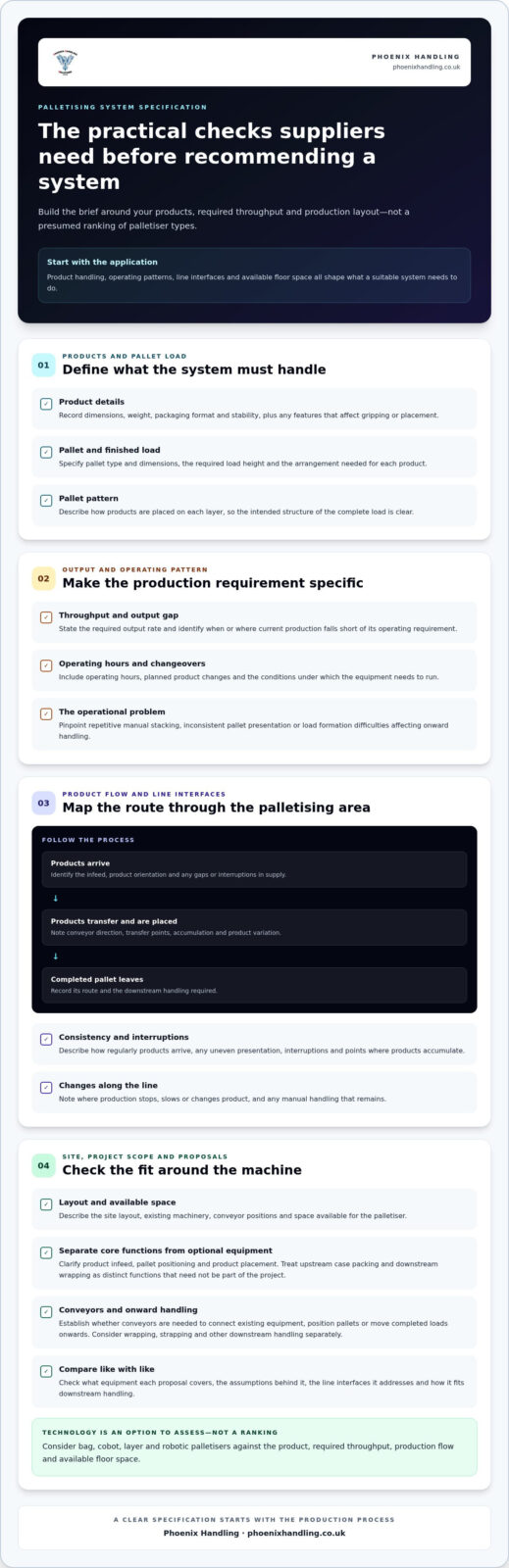
A useful equipment brief turns production requirements into information a supplier can assess. It should distinguish measured operating data from estimates, describe the products and pallet loads, and show how the system must fit the line and site. This gives suppliers a consistent basis for discussing equipment scope and comparing proposals against the same requirements.
A practical palletising brief records what is handled, how much must be processed, how each pallet is built, and where the equipment must operate.
Gather product and production data
Start with the items to be palletised and the pattern of demand. Include every product or format the system may encounter, not just the most common one. Use site measurements and operating records where available, and mark unknowns for follow-up rather than presenting estimates as confirmed targets.
- Describe the products. Record dimensions, weight, packaging format and handling constraints, including differences between product variants that could affect gripping or placement.
- Set the throughput requirement. State required output by shift or operating period, along with the measurement basis and source. Include operating hours, planned breaks and known interruptions so the target reflects actual conditions. For a practical checklist on palletising system throughput selection, see how to turn production records and shift patterns into a realistic throughput requirement.
- Define pallet loads. List pallet sizes, required load patterns and any load-height constraints. Note how pallet types or patterns vary across the product mix.
- Record variation and changeovers. Describe how often products, packaging formats or pallet patterns change, and what operator involvement those changes currently require.
Check layout, interfaces and operating requirements
Document the proposed equipment position, available floor space and access routes for products, pallets and routine operation. A simple plan with dimensions can help show obstructions and nearby equipment. Map the infeed and existing conveyor interfaces, pallet movement and downstream processes, including where a completed load is transferred for wrapping, storage or dispatch.
- Show line direction, transfer points and the space available around the proposed cell.
- Describe how empty pallets arrive and completed loads leave the area.
- Record operator tasks, changeover requirements and relevant site conditions.
Include applicable machinery safety requirements in project planning. In the UK, the Provision and Use of Work Equipment Regulations 1998 (PUWER) is relevant to work equipment. Assess the installation as a complete system, with requirements and verification considered for the specific project. Identify the operating environment and planned operator access so these factors are part of the assessment from the outset.
Before issuing the brief, separate confirmed data from assumptions and outstanding measurements. This helps buyers assess where a proposal matches the application and where further information is needed. Phoenix Handling specifies standard and custom-engineered palletising equipment around product type, throughput and available floor space. Discuss your palletising system requirements with Phoenix Handling.
Work with Phoenix Handling on a palletising system for your operation
Phoenix Handling Solutions Limited supplies standard and custom-engineered palletising equipment to manufacturers and distributors across the UK and Ireland. The range includes bag, cobot, layer and robotic palletisers, with conveyor systems considered where they form part of the required product flow. Equipment selection is based on the product and operating conditions, rather than an assumption that one machine type will suit every line.
How Phoenix Handling Solutions Limited can scope the equipment
Product type, throughput and available floor space are central to defining a suitable system. Product dimensions, packaging and handling characteristics inform how items need to be managed, while required output and operating patterns help shape the equipment scope. Site layout and existing line interfaces matter too, particularly where conveyors need to connect the palletiser to preceding or downstream processes.
These requirements help determine whether standard equipment is appropriate or whether a custom-engineered solution better fits the application. A clear specification gives the project discussion a practical starting point, including the equipment boundaries and interfaces. As a palletising systems supplier for UK manufacturers, Phoenix Handling Solutions Limited can consider the palletiser alongside conveyors and related packaging machinery where needed.
What to prepare for the next project discussion
Accurate information makes it easier to discuss the application and identify gaps in the brief. Product samples can help illustrate handling characteristics where available. Otherwise, provide reliable product and packaging data, and distinguish measured figures from estimates.
- Product dimensions, weight, packaging formats and any handling constraints.
- Throughput targets by shift or operating period, plus operating schedules and known interruptions.
- Pallet types, load patterns, product mix and the frequency of changeovers.
- A layout showing available floor space, equipment position, access routes and existing conveyor interfaces.
- Operator involvement and relevant site operating or safety requirements.
Include ongoing support in the wider operating plan. Phoenix Handling Solutions Limited provides equipment servicing and spare parts, which are relevant considerations when planning for operational continuity. These services sit alongside equipment selection and project scope, and do not replace the need to define the system around the actual production process.
Use the information you have prepared to set out the application, priorities and outstanding questions. Phoenix Handling Solutions Limited can discuss bag, cobot, layer and robotic palletising options, and how conveyors may fit the line where required. A focused project discussion can then address the requirements that matter to your operation.
Take the next step towards a suitable palletising system
A well-prepared project discussion can turn your operating requirements into a clearer equipment scope. Use your production data and layout information to focus on the decisions still to make, including how the system should fit the line and what support will help maintain it over time.
As a palletising systems supplier for businesses across the UK, Phoenix Handling supplies standard and custom-engineered machinery. Equipment servicing and spare parts can also form part of planning for ongoing operation. Consider these needs alongside the initial equipment selection.
Bring your requirements to Phoenix Handling for a practical discussion about your application and next steps. Discuss your palletising requirements with Phoenix Handling and move towards a system specified for your operation.
Frequently Asked Questions
Can a palletising system handle more than one product or pallet pattern?
Yes, a system may be specified for multiple products or pallet patterns if the handling and operating requirements are clearly defined. For example, two case sizes may need different layer arrangements or product orientations. Record each format, its pallet pattern and how often production changes between them. A supplier can use this information to assess the required scope and identify where product variation may affect operation.
Can a palletising system be integrated with an existing production line?
Yes, a palletiser can be considered as part of an existing line, with integration shaped by the equipment and available interfaces. For example, a conveyor may deliver products to the palletising area while another section carries completed loads away. Share the conveyor direction, transfer points, control interfaces and any routine line stops. These details help define how the proposed equipment relates to current production, rather than treating it as an isolated machine.
What information should I prepare before discussing a palletiser?
Prepare product and packaging details, operating data and a clear view of the site. Useful inputs include dimensions, weight, product formats, required output by shift, pallet types and the arrangements needed for each load. A layout drawing or measured sketch can show access routes, equipment positions and nearby conveyors. Note which figures come from production records and which are estimates, so the discussion can focus on verified needs and information still to collect.
Is a cobot palletiser suitable for every production operation?
No, a cobot palletiser is not automatically suitable for every operation. Its fit depends on the task, products, required operating pattern, available space and how people work near the equipment. A shared work area also requires consideration of the complete system and its safety arrangements. For instance, a process with frequent product changes may raise different design questions from a stable, single-format run. Assess the actual application before deciding on a collaborative approach.
Can a palletiser work with bagged products?
Yes, Phoenix Handling supplies bag palletisers, and bagged products can be considered for automated palletising. Bag dimensions, weight, shape and consistency of presentation all influence the application assessment. A bag that changes shape during handling may present different requirements from one that retains a consistent form. Provide representative product information and the intended pallet arrangement so the equipment discussion reflects the actual bags and operating conditions.
What is the difference between palletising and de-palletising?
Palletising builds a pallet load by placing products onto a pallet; de-palletising removes products from a pallet for further processing or handling. The product flow is reversed, but the tasks are not simply interchangeable: the infeed, product presentation and destination differ. For example, a de-palletising process may need to present individual items to a production line, whereas palletising prepares a completed load for onward movement. Phoenix Handling supplies both palletising and automatic de-palletising equipment.