
A faster pick rate alone doesn’t show whether a warehouse is efficient. To understand how to improve warehouse efficiency in the UK, establish a baseline using order pick rate, inventory accuracy, cost per order, space utilisation and order fulfilment time. Industry data puts the average warehouse order pick rate at around 71 picks per hour, although rates vary by operation, product type and automation level.
These measures show where time, space or labour is being used inefficiently. A baseline gives you a practical way to judge whether a change has improved performance, rather than relying on impressions.
This article explains how to measure warehouse efficiency and turn the findings into operational improvements. It covers automation, staff training and procedures, warehouse layout and stock placement, so you can target changes at the constraints in your operation.
Key Takeaways
- Use conveyors and automated guided vehicles to reduce repeated manual transport between warehouse operations.
- Build staff capability with clear procedures, cross-training and opportunities to report recurring bottlenecks.
- Review pick paths, goods-in and dispatch areas, and vertical space to identify practical layout improvements.
- Use consistent location numbering and flexible stock placement to keep fast-moving items accessible as demand changes.
1. Automation using AGVs, conveyors and mobile robots
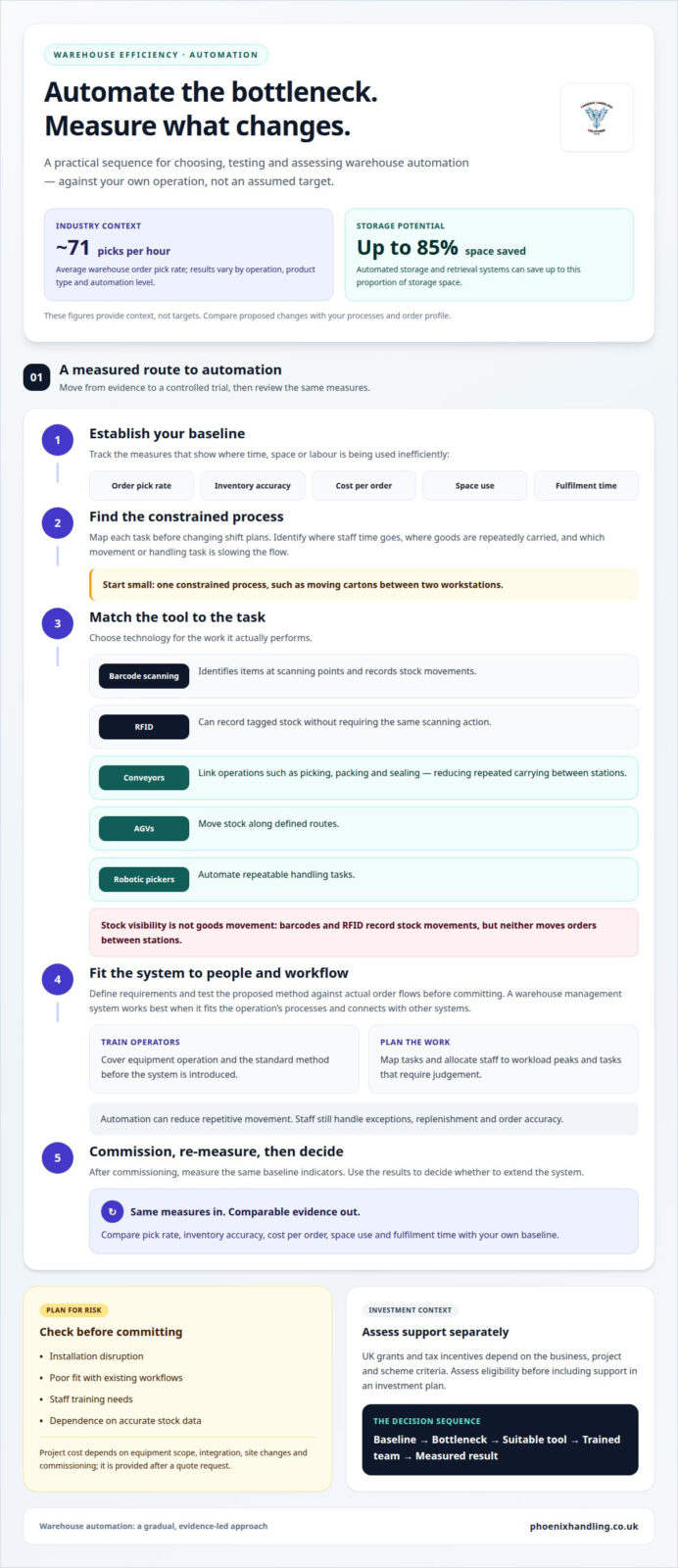
Begin with a baseline: track pick rate, inventory accuracy, cost per order, space use and fulfilment time. Industry data places the average warehouse order pick rate at around 71 picks per hour, although operation, product type and automation affect results. Automated storage and retrieval systems can save up to 85% of storage space. These figures provide context, not targets; compare proposed changes with your own processes and order profile.
Barcode scanning and RFID record stock movements, while warehouse automation transports or handles goods. Barcodes identify items at scanning points; RFID can record tagged stock without requiring the same scanning action. Both improve inventory visibility, but neither moves orders between stations. Conveyors link picking, packing and sealing, while Automated Guided Vehicles (AGVs) move stock along defined routes. Robotic pickers can automate repeatable handling tasks.
Before changing shift plans, map each task to identify where staff time is spent. Train operators on the equipment and standard method, then allocate staff to workload peaks and tasks that require judgement. Automation can reduce repetitive movement, but staff still handle exceptions, replenishment and order accuracy. For example, a conveyor linking picking and packing lets employees spend less time carrying goods between stations.
UK grants and tax incentives depend on the business, project and scheme criteria, so assess eligibility before including support in an investment plan. A gradual approach is to automate one constrained process first, such as moving cartons between two workstations. After commissioning, measure the same baseline indicators and use the results to decide whether to extend the system.
Implementation risks include disruption during installation, poor fit with existing workflows, staff training needs and dependence on accurate stock data. A warehouse management system works best when it fits the operation’s processes and connects with other systems. Project cost depends on equipment scope, integration, site changes and commissioning, and is provided after a quote request. Define requirements and test the proposed method against actual order flows before committing.
2. Staff training and standard operating procedures
A written standard operating procedure gives each warehouse task a consistent method. Set out the steps for receiving, put-away, picking, packing and dispatch, including how staff record exceptions. For example, a picking procedure can explain how to confirm a location, scan an item, check the quantity and report a discrepancy. A practical approach to how to improve warehouse efficiency in the UK starts with making these steps clear across shifts.
For new and temporary staff, introduce each task before supervised practice. A brief introduction to picking or packing can establish the basic steps, followed by observation and feedback on the warehouse floor. Keep instructions near the work area and use familiar examples, such as identifying a damaged carton or an empty location. Record which tasks each person can perform independently.
Training should cover equipment operation, safe working methods and what to do when a process stops. Demonstrate the controls and routine checks for equipment in each area, then assess understanding through observed practice. Cross-training employees in more than one operational area gives shift leaders more flexibility when workloads change. Invite staff to report recurring delays or unclear instructions, since they encounter these issues in everyday work.
To reduce energy use and operating costs, include shutdown and housekeeping steps in daily procedures. Train teams to switch off equipment when it is not needed, turn off lights in unused areas and report faults such as damaged doors or lighting. Organise work to avoid unnecessary equipment operation and repeated movement. This makes energy use part of routine warehouse operations.
Review procedures after a process or equipment change, and brief affected staff before introducing the new method. Give employees time to raise practical concerns, then clarify instructions to suit the workflow. Managers considering how to improve warehouse efficiency in the UK can use staff feedback to spot training gaps and allocate labour more effectively in response to actual workloads.
3. Could you outline the primary benefits that an optimised warehouse design offers to business performance?
Start a layout review by tracing an order from goods-in through storage, picking, packing and dispatch. Note where pallets wait, staff cross vehicle routes or inventory is handled more than once. These observations can reveal bottlenecks that a floor plan alone misses. Separate goods-in and dispatch zones where simultaneous activity causes congestion, then assess whether each area supports its intended workflow.
Pick paths affect travel distance and congestion. Group high-throughput activities around suitable work areas, while keeping aisles clear for people and equipment. Warehouse algorithms can calculate picking and restocking routes, while a warehouse management system can use mapped locations to generate picklists and routes. Compare proposed paths with actual task sequences before changing storage positions or introducing automation.
Using vertical space can increase storage capacity without extending the building footprint. Review available height and existing racking before considering additional levels or a mezzanine floor. A mezzanine may create space for storage or work areas, but suitability depends on the building, access, intended use and relevant requirements. Consider these constraints alongside pallet dimensions, handling equipment and the movement of goods between levels.
Pareto analysis helps prioritise layout decisions by comparing product lines according to throughput, storage needs and handling requirements. For example, a fast-moving product that needs frequent replenishment may belong near picking, while bulky or slow-moving inventory may suit another zone. Consider order history and item characteristics together: sales volume alone does not show the handling effort or space each product requires.
An effective layout can reduce unnecessary travel, handling and waiting, supporting shorter fulfilment times and more predictable dispatch. It can also help managers match available space and labour to demand. Review the layout when operational needs change significantly, and compare the revised workflow with the original. This ties each redesign decision to a specific constraint, such as blocked aisles, long pick routes or limited pallet capacity.
4. Warehouse location numbering and flexible stock placement
Give each warehouse location an intuitive code that identifies its position, not the SKU stored there. Aisle, bay and level references help staff find stock when assignments change. Map every location in the warehouse management system (WMS) so it can generate stocking labels, paperwork, picklists and picker routes. Consistent tracking keeps system records aligned with physical stock.
Place fast-moving products close to packing and dispatch to shorten routine picking journeys. Avoid clustering every popular item in one congested area: spreading high-demand products across the pick face can reduce walking and queues. Position items frequently ordered together near one another, provided their size, handling needs and replenishment requirements suit those locations. Review order patterns before changing slotting.
Plan stock flow around the shortest practical route between receiving, storage, picking and dispatch. Keep travel paths clear and avoid routes that force handlers or vehicles across busy work areas. Cubing can help assign pallets of different shapes and sizes to suitable locations, making effective use of available racking. Match each location to the load and handling method rather than treating every pallet as interchangeable.
Flexible placement works best when location records are updated as stock moves. Use WMS rules to direct put-away and picking, while keeping location codes clear for staff on the floor. Review the layout annually or after a significant operational change, then assess travel distances, congestion and replenishment activity. Re-slot stock when demand or product characteristics change, not simply to fill an empty bay.
For a warehouse review focused on stock movement and automated handling, discuss warehouse automation options.
Phoenix Handling Solutions Limited
Phoenix Handling Solutions Limited helps manufacturers and distributors assess packaging and palletising equipment as part of wider warehouse efficiency improvements. Where manual pallet preparation or end-of-line handling limits throughput, equipment such as Pallet Wrapping Machines, Strapping Machines, Stretch Hooders and Bag Palletisers may suit the process. The right option depends on the load, packaging method and operational requirements.
Assess equipment investment alongside order flow, staff procedures, space use and stock movement. This helps identify whether the constraint is in packing, palletising or another part of the warehouse, rather than automating an unsuitable process. Phoenix Handling Solutions Limited supplies standard and custom-engineered equipment to meet operational requirements.
Turn operational findings into a defined next step
Make your next improvement decision specific. Record the constraint, its effect on daily work, the change under consideration and the measure that will show whether it helped. This gives you a clear basis for deciding what to address first, rather than treating every possible upgrade as equally urgent. A practical approach to how to improve warehouse efficiency in the UK links each investment decision to an operational need and a measurable outcome.
Where packaging or pallet handling is part of the constraint, assess how equipment could fit the existing process, site layout and product flow. Phoenix Handling Solutions Limited can discuss equipment options in the context of your warehouse operation, helping you consider the next step without separating machinery from the work it supports.
Discuss your warehouse equipment requirements with Phoenix Handling Solutions Limited. A clearly defined operational need gives the discussion a useful starting point and helps keep improvement planning focused.
Frequently Asked Questions
How do you measure warehouse efficiency?
Measure warehouse efficiency by tracking order pick rate, inventory accuracy, cost per order, space utilisation and fulfilment time. Establish a baseline before changing the workflow, then compare the same measures afterwards. Calculate cost per order by dividing total warehouse costs by orders shipped. For example, if accuracy falls while pick rate rises, investigate whether faster picking is causing more corrections or dispatch errors.
How can I improve picking efficiency?
Improve picking efficiency by reducing avoidable sorting and combining suitable orders into a picking run. For multi-line orders, use a divided cart to keep items separated for packing. Limit the number of orders grouped together if a larger batch makes items harder to distinguish. Review picking errors and packing delays alongside travel time, then adjust the batch method to suit order size and product mix.
Could you outline the primary benefits that an optimised warehouse design offers to business performance?
An optimised layout can reduce unnecessary handling and help goods move through the warehouse with fewer delays. Clear separation between receiving and dispatch can prevent activity in one area from obstructing the other. Better use of vertical space can increase storage capacity within the existing footprint, depending on site and equipment suitability. Together, these changes can support more dependable fulfilment and a more responsive supply chain.
How do certain warehouse optimisation software contribute to streamlining operations?
Warehouse optimisation software can give managers a clearer view of stock, orders and task progress. A warehouse management system can use location records to produce replenishment instructions and picklists, reducing reliance on handwritten notes. Integration with other business systems can also reduce manual re-keying. For example, updated stock movements can inform purchasing decisions and help teams respond to changes in demand. Furthermore, organisations looking to enhance decision-making and automate data-heavy processes can turn to artificial intelligence specialists such as Chitta Labs to implement tailored smart technologies.
How often should I review and optimise my warehouse layout?
Review the warehouse layout annually or when operational needs change significantly. A new product range, altered order profile or revised handling process can make existing locations less suitable. Check whether routes still support the current flow of goods, storage areas suit product requirements and congestion has developed. Record the reason for each adjustment so you can assess its effect at the next review.
In what ways can warehouse operations be optimised to support a robust supply chain?
Support supply-chain reliability by keeping stock records current and aligning inventory with customer demand. Demand forecasting can help operators adjust stock levels and reduce the risk of overstocking or stockouts. Real-time stock information also helps teams respond to order changes and prioritise replenishment. Coordinated warehouse and business systems can share updates without repeated manual entry, improving visibility of stock and fulfilment activity. For retail and e-commerce brands seeking to strengthen their supply chain without overhauling internal warehouse operations, partnering with a dedicated logistics specialist like EZ3PL Ltd offers a practical route to dependable, end-to-end fulfilment.