Sustainable secondary packaging solutions protect products through storage and transport while reducing unnecessary material use and environmental impact. Secondary packaging surrounds a product’s primary packaging, helping to prevent damage and making goods easier to handle across the supply chain. Its sustainability depends not only on the material, but also on how much is used, whether it can be reused or recycled, and the emissions associated with its life cycle.
Choosing a lighter or recyclable material can help, but it is not automatically the best option if it compromises protection or creates waste elsewhere. Assess packaging in the context of the product, its distribution route and the end-of-life options available in the UK.
This article explains what secondary packaging does, which criteria to use when assessing its sustainability, and practical ways to reduce waste and carbon impact. It also considers how packaging choices interact with handling and palletising equipment, helping balance environmental goals with protection and operational requirements.
Key Takeaways
- Assess packaging as part of the full supply chain, balancing material use and end-of-life options with product protection.
- Use life-cycle assessment to identify where packaging creates environmental impacts and where changes may reduce emissions.
- Reduce unnecessary packaging by matching its size and format to the product, transport needs and available reuse or recycling routes.
- Consider how palletising and load-securing equipment can support packaging choices while maintaining stable loads for handling and transport.
Ways to reduce packaging’s environmental impact
Reduce packaging impact by using less material, choosing recoverable formats and protecting goods throughout distribution. UK businesses should assess packaging against local collection and recycling routes.
Environmental costs of conventional packaging
Conventional packaging can consume virgin resources and create waste when single-use materials are discarded after delivery. The Ellen MacArthur Foundation reports that 14% of plastic packaging is collected for recycling. In the UK, films and flexible plastic packaging account for nearly a quarter of post-consumer plastic packaging waste, yet less than 10% is recycled. That gap makes material choice and pack design relevant to waste management.
For e-commerce, a right-sized cardboard box with recyclable paper cushioning can reduce empty space and avoid unnecessary plastic void fill. Choose a format that fits the item and suits the carrier’s handling process.
Glass packaging has a mixed environmental balance. Disposable glass can be melted and remade repeatedly, but producing single-use glass requires substantial energy. Reuse can change the calculation if collection and return transport are practical. A heavy, fragile glass pack may also need extra protection, offsetting material savings.
Switching without compromising product protection
A lower-impact pack must still prevent damage during storage, handling and transport. Goods damaged in transit may need replacing, adding packaging and transport emissions. Start by identifying the product’s damage risks, then choose a material and structure that address them without excess.
Run a small-batch trial before a full rollout. Check how the pack performs during packing, stacking and delivery, then adjust its dimensions or protective inserts. For example, a snug cardboard carton with a suitable internal fit can limit movement without an oversized outer package. Keep the product’s protection requirements central when assessing new materials.
Map the packaging’s end-of-life route before changing the specification. A recyclable material only reduces waste when local systems can collect and process it. Compare material quantities, transport impacts, and whether the packaging can be reused or returned. This helps reduce material use while maintaining reliable delivery.
Life-cycle assessment and carbon savings
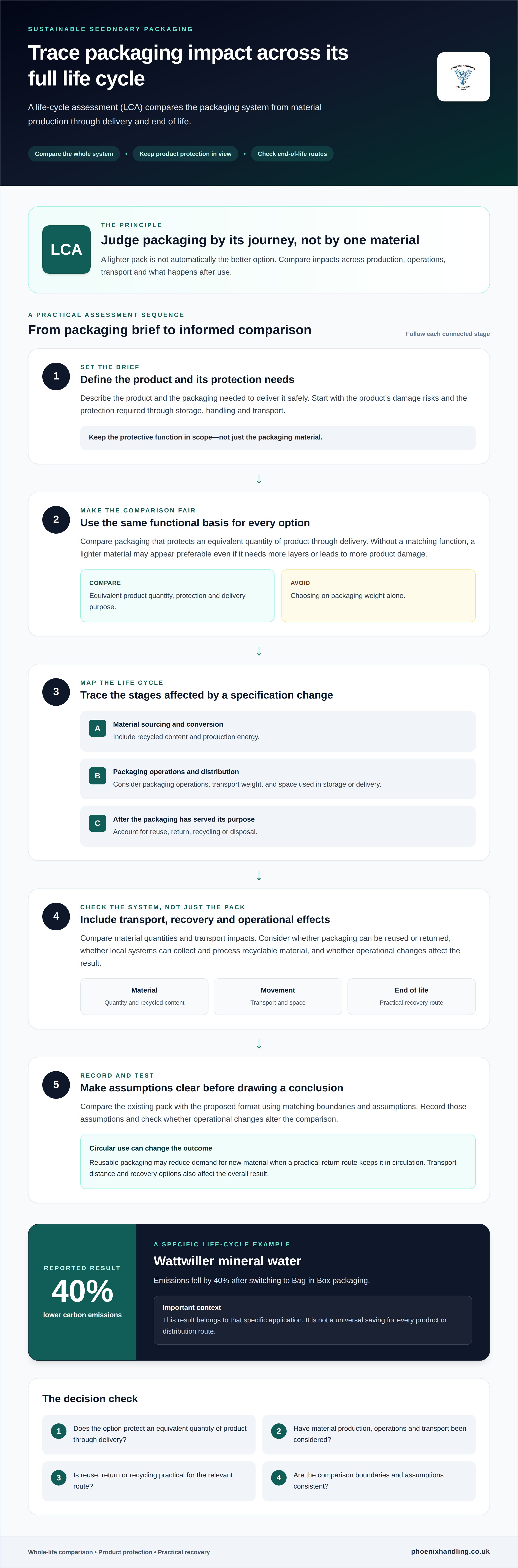
A life-cycle assessment (LCA) compares packaging impacts across its full journey, from material production to disposal or reuse. For a UK business, it can show whether a lighter pack also reduces impacts across manufacturing, transport and end-of-life processing. This replaces a judgement based on one material with a comparison of the whole packaging system.
Start by defining the product and the packaging needed to deliver it safely. Then map the stages affected by a change in specification:
- Material sourcing and conversion, including recycled content and production energy.
- Packaging operations, transport weight and space used in storage or delivery.
- Reuse, return, recycling or disposal after the packaging has served its purpose.
Use the same functional basis for each option, such as packaging that protects an equivalent quantity of product through delivery. Otherwise, a lighter material may seem preferable despite requiring more layers or leading to more product damage. Include the protective function, not just the packaging materials, in the comparison.
Wattwiller mineral water reduced carbon emissions by 40% after switching to Bag-in-Box packaging. This example shows why a format change should be assessed across its life cycle. The result belongs to that specific application; it isn’t a universal saving for every product or distribution route. A business should compare its existing pack with the proposed format using matching boundaries and assumptions.
For sustainable secondary packaging solutions, consider circular use too. Reusable packaging can reduce demand for new material when a practical return route keeps it in circulation. Recycled content may reduce reliance on virgin inputs, while transport distance and recovery options affect the overall result. Record assumptions clearly and test whether operational changes affect the comparison.
Packaging-line layout can influence material use, load stability and handling. Explore packaging-line integration as one part of assessing those operational factors.
Definition and purpose of secondary packaging
Secondary packaging surrounds a product’s primary packaging, often using cardboard or plastic. A cardboard sleeve around a bottle is one example. It groups, protects and presents packaged goods without directly containing the product itself. Its format depends on the product, handling requirements and route through the supply chain.
Secondary packaging helps limit damage and tampering during transport while making products easier to move and store. A multipack carton, for example, holds several individually packaged items together. The right specification supports handling and distribution; excess material can add waste without improving protection.
For a UK business, packaging obligations depend on its role and the packaging it supplies. Extended Producer Responsibility (EPR) requires businesses to establish whether their activities create reporting or payment duties under applicable rules. Secondary packaging may be included in the packaging data assessed. Consider each component specifically, rather than treating the complete pack as a single material.
OPRL recycling labels communicate disposal instructions for packaging components. Their usefulness depends on the material and the collection route available to the person disposing of it. A label should distinguish components where different disposal routes apply. A claim such as “100% recyclable” should not replace clear instructions about the packaging’s actual materials and recovery options.
There is no single typical UK price for sustainable secondary packaging. Price depends on material, dimensions, print requirements and order volume, and is provided after a quote request. A plain cardboard sleeve and a printed, multi-component pack have different specifications, so their prices cannot be compared on material alone.
When assessing an alternative, identify the product, its primary pack and the secondary format needed for distribution. Record the materials used, including any plastic, and how each component should be handled after use. This helps distinguish packaging that protects the product from material that contributes to avoidable plastic waste.
Sustainable packaging criteria
Assess each format against material use, product protection and its end-of-life route. The supply chain and available recovery systems affect whether a packaging choice works in practice.
Cost and environmental impact comparisons
Paperboard, recycled plastic and reusable packaging have different purchase, transport and recovery requirements. Paperboard may suit dry goods, while recycled plastic can serve applications that need moisture resistance. Reusable packaging needs a return system and sufficient repeat use to justify collection and handling. Compare each option across its supply chain, including material quantities, transport and disposal, rather than unit cost alone. The consumer’s disposal route also affects actual recovery.
Risks of packaging choices
Compostable, recyclable and reusable packaging can create problems if its disposal or return route doesn’t match local systems. According to EUR-Lex, compostable plastics can contaminate bio-waste and material-recycling streams, wasting resources and lowering the quality of secondary raw materials. Reusable formats also need dependable collection and reverse transport. If packaging is labelled recyclable but cannot enter an available recovery route, the intended outcome may not be achieved.
Check material composition and the destination after use as separate criteria. A multi-material pack, for example, may be difficult to separate even if one component is recyclable. A reusable transit pack supports repeated use only when the supply chain can collect, inspect and return it. These practical conditions matter as much as the material itself.
A useful assessment records protection needs, material quantities, reuse potential and local disposal options. Businesses can then compare alternatives against the same product and distribution requirements. This supports measurable improvements rather than decisions based on broad claims such as “green” or “eco-friendly”.
Review packaging system options alongside your material and handling criteria.
The PRESERVE project benchmarked its newly developed bio-based materials to assess whether they could be easily recycled. This illustrates why recyclability should be assessed for each material, not inferred from bio-based content alone. End-of-life performance belongs alongside protection, reuse and recovery considerations.
Phoenix Handling Solutions Limited: Pick & Pack De Palletisers
Phoenix Handling Solutions Limited supplies Pick & Pack De Palletisers for operations where products need to be handled between packing and palletising. Choose equipment to suit product formats, packaging materials and the existing line layout.
Packaging changes can also affect how loads are secured and handled downstream. Pallet Wrapping Machines, Strapping Machines and Stretch Hooders offer options for stabilising pallet loads. The suitable method depends on the load and packaging requirements. Reviewing these systems alongside material choices connects packaging decisions with operational handling.
For support assessing packaging-line equipment alongside sustainability requirements, contact Phoenix Handling Solutions Limited to discuss your application.
Set a practical direction for your next packaging review
Make the next review operational by identifying where packaging decisions meet handling, load formation and distribution. This gives teams a clear basis for progressing sustainable secondary packaging solutions while keeping material choices connected to production requirements.
Phoenix Handling Solutions Limited supplies Pallet Wrapping Machines, Strapping Machines and Stretch Hooders to secure pallet loads. Their suitability depends on the load, packaging format and handling process. Consider them as part of the wider specification, not as a standalone sustainability measure.
A defined equipment requirement can help structure the next stage of planning. Contact Phoenix Handling Solutions Limited to discuss how packaging and load-handling requirements fit your operation. A clear, application-led review is a practical way to move forward.
Frequently Asked Questions
What is Sustainable Packaging?
Sustainable packaging aims to reduce environmental impacts while performing its intended job. A business might compare its current pack with an alternative that uses less material, then assess durability, transport requirements and end-of-life options. Consider the complete packaging system, including primary, secondary and transit packaging, rather than judging one component in isolation.
What is Secondary Packaging?
Secondary packaging groups or protects products that already have primary packaging. A carton holding several sealed jars, for example, can keep them together for warehouse handling and distribution. It differs from the jar’s immediate packaging, which contains the product. Trace the packaging outwards from the product and note which components support grouping, handling or presentation.
How can businesses measure the carbon footprint and recyclability of secondary packaging?
Compare packaging options using the same quantity of product and delivery function. Record material types and weights, then assess production, transport and end-of-life impacts using consistent assumptions. To assess recyclability, separate the components and identify whether each material can be collected and sorted through the intended UK route. A mixed-material pack, such as a coated carton with plastic fittings, needs assessment component by component.