
A stable-looking beverage pallet isn’t necessarily a stable load. Bottles, cans and multipacks create different load profiles, and the way each pallet behaves during handling depends on more than the final layers of film. Stretch wrapping for beverages should be specified around the load and packaging line, rather than treated as a fixed routine.
Preventing movement and product damage is important, particularly when an unstable pallet can disrupt warehouse handling or dispatch. A suitable wrapping approach takes account of the product arrangement, pallet pattern and handling route. Film application and wrapper settings also need to suit the product and line rate, without creating avoidable delays or pack distortion.
This article explains what pallet-level stretch wrapping does and which product and process variables affect the result. It also sets out how to assess a wrapping process, including throughput, floor space and integration with the wider packaging line. Use the guidance to review an existing operation or prepare a more informed equipment specification.
Key Takeaways
- Understand how pallet-level wrapping contains a completed beverage load, and how it differs from wrapping individual packs or cases.
- See how bottle, can and case geometry, pack rigidity and pallet condition can affect the wrapping result.
- Learn why tighter wrapping or extra film alone may not resolve instability caused by an unsuitable pallet pattern or load.
- Use product format, pallet pattern, load dimensions, throughput and floor space to guide process decisions.
- Explore how stretch wrapping for beverages can fit between palletising and downstream handling, with equipment specified around the wider line.
Stretch wrapping for beverages: what it does to a pallet load
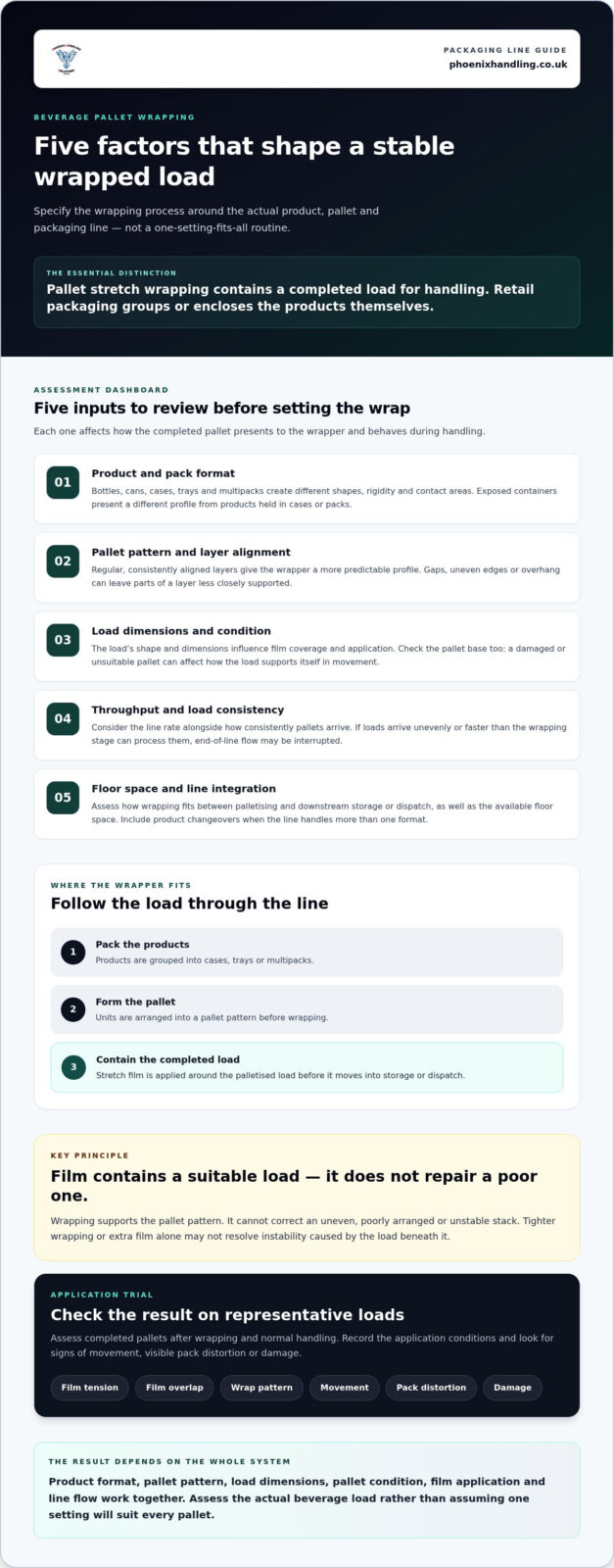
At the end of a beverage packaging process, stretch wrapping brings the completed pallet load together for movement through the warehouse and onward through distribution. Film is applied around the load and pallet to help contain cases, trays or multipacks as one unit during handling. The result depends on the load beneath the film: wrapping supports a suitable pallet pattern, but it cannot correct an uneven, poorly arranged or unstable stack.
Pallet stretch wrapping contains a completed load for handling; retail packaging encloses or groups the products themselves. This distinction matters because shrink film around a multipack and stretch film around a pallet do different jobs. The first forms part of the product’s pack format. The second is applied after palletising to help keep the completed load together.
Stretch wrap describes the material and its use around goods, but beverage operations need to consider how it is applied at pallet level. The film pattern, load dimensions and condition of the pallet all influence the wrapped unit. A secure-looking outer layer is not a substitute for sound load formation or careful handling.
How pallet wrapping fits into a beverage packaging line
Filled bottles or cans pass through the required secondary packaging stage, where products are grouped into cases, trays or multipacks. Those units are then arranged into a pallet pattern. Pallet wrapping follows palletising, before the completed load moves into storage or dispatch. The wrapper therefore receives a load that has already been formed upstream.
Line speed and load consistency affect this operation. If pallets arrive unevenly, or faster than the wrapping stage can process them, the end-of-line flow may be interrupted. Specify the wrapping process to suit both the line rate and the consistency of the loads presented to it. Include product changeovers in the assessment if the line handles more than one format.
What makes beverage pallets a distinct wrapping application?
Beverage pallets may consist of bottles, cans, cases, trays or multipacks. These formats create different shapes and load profiles. Individual containers may be grouped in retail packs or enclosed in cases, so the outer dimensions and rigidity of each unit vary. The distribution of weight across the pallet also depends on how the units are arranged.
For example, regular layers of rigid cases present a different profile from layers of multipacks with gaps or uneven edges. Pallet condition matters too: a damaged or unsuitable base can affect how the load supports itself during movement. For stretch wrapping for beverages, assess the actual product format and pallet pattern instead of assuming one setting will suit every load.
How stretch wrapping contains bottles, cans and beverage cases
Stretch film is applied around a palletised load in overlapping layers to help hold its units together. Depending on the wrapping method and settings, film may cover the lower portion of the load, travel around its sides and secure the load to the pallet. The aim is containment during handling, not to compress every pack into a rigid block.
Load stability depends on the product, pallet pattern and wrapping conditions working together. Film tension that suits a compact, rigid case load may behave differently on a pallet of lighter trays or exposed containers. Assess the relationship between load shape and film application using the actual product, rather than relying on a general setting.
Load behaviour across common beverage pack formats
Cases often create defined edges and a relatively regular profile, although case strength, orientation and layer alignment still affect how the pallet behaves. Trays may leave more of the product exposed and have less rigid sides, while shrink-wrapped multipacks can vary in shape and contact area. Loads of exposed containers create a different profile again, particularly if individual units are not held together in a secondary pack.
These formats can respond differently to handling forces. A layer that overhangs the pallet has less support at its edges; gaps between units can leave parts of a layer less closely supported. Check both conditions when reviewing movement or distortion, while recognising that their effect depends on the specific load. Consistent layer alignment helps create a predictable profile for wrapping. An inconsistent pattern can leave uneven surfaces for the film to contain.
Beverage products can be heavy, and some packaging can be vulnerable to damage, making pallet stability a practical handling concern. Palcut discusses related risks in its overview of Pallet Stability in the Beverage Industry. For wrapping, the key is to consider the whole load, including how its units are arranged and supported, rather than focusing on the outer film alone.
Containment, film application and load integrity
Containment requires a balance. Film needs to hold the load together, but excessive or poorly matched tension may distort less rigid packs or affect exposed product. Overlap and wrap pattern also influence how film is distributed across the load. The suitable combination depends on load dimensions, pack format and pallet condition, so a fixed number of wraps or one film specification cannot be assumed to suit every beverage pallet.
For a useful application trial, use representative loads and assess completed pallets after wrapping and normal handling. Record film tension, overlap and wrap pattern, alongside any visible pack distortion, movement or damage. Where practical, change one setting at a time so the effect is easier to identify. This gives you a sound basis for refining stretch wrapping for beverages, without relying on extra film to compensate for a poor pallet pattern.
Phoenix Handling Solutions supplies pallet wrapping machinery and stretch films. Its equipment can be specified around product type, throughput and available floor space, helping you match the wrapping stage to the load and line.
Beverage pallet wrapping: common assumptions versus process realities
A common assumption is that a tighter wrap automatically creates a safer pallet. It doesn’t. Film application can help contain a load, but the result also depends on how products are arranged, how well the packs support one another and whether the pallet provides a sound base. Increasing tension or adding layers without assessing those factors may use more material without addressing the cause of movement.
For stretch wrapping for beverages, the useful comparison is not simply “more film” versus “less film”. Ask whether the application provides suitable containment for the specific load while maintaining pack integrity and a repeatable process. Check any conclusion about improved stability against representative loads and normal handling conditions.
Does more film always mean a more secure beverage pallet?
Film quantity is only one part of the wrapping process. A pallet with uneven layers, unsupported edges or a weak base may remain difficult to contain, even when additional film is applied. A suitable pattern with well-aligned packs can present a more consistent profile for wrapping. The outcome depends on the complete load and how the film is applied.
There are trade-offs to consider. Greater tension or additional film could affect less rigid packs, while inconsistent settings can make results vary between shifts or load formats. Extra material may also be used without a clear improvement in containment. Assess these possibilities in the specific operation rather than assuming they apply to every beverage pallet.
Instead of adopting a fixed wrap-count rule, compare trials using the same representative product and pallet pattern. Record application settings, then inspect the wrapped load for movement, distortion or damage during normal handling. Change settings in a controlled way and check whether the result is repeatable. A setting that works for rigid, uniform cases should not automatically be carried over to trays or multipacks with a different shape or support profile.
When might a different packaging approach be relevant?
Shrink wrapping and pallet stretch wrapping serve different stages. Shrink film may be used around cases or multipacks to group or enclose products as part of secondary packaging. Pallet stretch film is applied after palletising, around the completed load, to help contain its units during handling. One does not replace the other by default.
The right combination depends on the product format and distribution requirements. A multipack may already be enclosed, but that does not secure the full pallet load by itself. Equally, pallet wrapping is not a substitute for choosing secondary packaging that suits the product and how it will be handled before palletising. Review each stage according to its purpose, then consider how the resulting pack units form a stable, consistent pallet.
Separate observed problems from assumptions when deciding what to change. Identify whether movement begins within a pack, between pallet layers or across the load as a whole. This helps direct trials towards the relevant stage, instead of relying on tighter wrapping as a universal remedy.
How to assess a stretch-wrapping process for beverage pallets
Start an assessment with the loads the line actually produces, then test how the wrapping approach performs within the available space and operating schedule. For stretch wrapping for beverages, a specification based on one product format may overlook changes in pack dimensions, pallet patterns or production rate. Gather operating information first, then use representative loads to review containment and line fit.
Specify the load and operating conditions
Build a clear picture of the products, pallets and line before comparing equipment options. Record current formats and normal variations, including the pallet base and dimensions of completed loads. Map the wrapper’s position in relation to upstream supply and downstream handling, so the specification reflects the full route through the end-of-line area.
- List the pack formats. Record whether products are presented as bottles, cans, cases, trays or multipacks. Note differences in case or tray arrangement that could affect the load profile.
- Describe the pallet build. Document the pallet type, layer arrangement, alignment, load height and footprint. Include variations between product patterns rather than relying on a single typical load.
- Measure operating demand. Set out required throughput, shift pattern and product changeovers. Note whether pallets arrive steadily or vary with upstream production, as this affects how the wrapping stage fits into the line.
- Map the available space and interfaces. Measure the proposed equipment area and identify how pallets arrive and leave. Consider conveyor connections, transfer points, operator access, equipment access for maintenance and existing handling constraints.
These inputs help define the practical boundaries for equipment selection. Phoenix Handling Solutions specifies pallet wrapping machinery around product type, throughput and available floor space. For further selection considerations, see the industrial pallet wrapping machine buying guide.
Validate the wrapping approach in operation
Trial representative loads, including formats that differ in size, rigidity or pallet pattern. Assess application settings on actual beverage pallets, then repeat the trial to see whether the process gives consistent results across normal variation. A trial on one uniform load may not show how the operation responds to a less regular pattern or product changeover.
Agree acceptance criteria before testing. These could include acceptable load movement, visible pack distortion or damage, consistency of application, and whether wrapped pallets pass through relevant handling stages without interrupting normal flow. Record the settings and observations for each trial, then review them against load-integrity and operational requirements. This creates a traceable basis for adjusting the process instead of relying on subjective judgements, such as whether a pallet simply looks secure.
To align the assessment with your line and product mix, explore pallet wrapping machinery specified for your operation.
Integrating beverage stretch wrapping with pallet handling equipment
A pallet wrapper is one stage in an end-of-line flow, not an isolated operation. It receives completed pallets after palletising, applies film, then releases them for movement into storage or dispatch. The sequence needs to suit how pallets arrive, are presented for wrapping and leave the area. For stretch wrapping for beverages, integration should account for the load as well as the equipment around it.
Where a pallet wrapper fits in an end-of-line system
The wrapper’s position depends on the line configuration. Upstream palletising determines how completed loads are delivered and whether their orientation is consistent. Conveyors or other material-handling equipment may transfer pallets to and from the wrapping point, while downstream handling determines where wrapped loads go next. Each interface needs to support the operating sequence without creating avoidable waiting or obstructing pallet movement.
Transfer points matter. A pallet must arrive in a position the wrapping process can accommodate and leave with a clear route to its next destination. Layout planning should account for operator access, routine equipment access and the space needed to move pallets safely. These considerations can affect the wrapper’s location and how it connects with existing conveyor systems or handling equipment. Fitting the available floor area is only part of the requirement: the machine also needs to work with the line’s actual flow.
From beverage load requirements to an equipment specification
Equipment selection should translate operating requirements into a practical line arrangement. Relevant details include the mix of bottles, cans, cases, trays or multipacks; pallet types and completed load dimensions; required throughput and product changes; available floor space; and the position of upstream and downstream handling. Together, these details help determine how the wrapping stage can fit the production and logistics process.
Consider variations as well as the standard load. A line handling several pack formats may need to accommodate different pallet footprints or heights while maintaining the required production flow. Accurate information about the existing line helps identify interface requirements and constraints before equipment is specified. It also provides a sound basis for deciding whether standard or custom-engineered packaging equipment better suits the application.
Phoenix Handling Solutions supplies pallet wrapping machinery, stretch films and packaging automation, with equipment specified around product type, throughput and available floor space. Its system-supply role can connect the wrapping requirement with the wider line configuration, rather than treating the wrapper as a standalone purchase. Useful project information includes representative load formats, pallet dimensions, operating demand, a layout of the available area and details of existing handling interfaces.
To discuss pallet wrapping in the context of your beverage line, contact Phoenix Handling Solutions Limited.
Plan the next step for your beverage line
A wrapping review can be a practical starting point for a wider packaging-line decision. Identify which product formats, operating changes or layout constraints should shape the specification. A clear view of these priorities helps keep equipment decisions grounded in the demands of the line, rather than assumptions based on a single load.
For stretch wrapping for beverages, bring production, packaging and logistics requirements together before defining a project. Phoenix Handling Solutions can translate product mix, throughput and available floor space into an equipment specification suited to the operation.
Prepare representative load details, pallet dimensions, throughput requirements and a layout of the wrapping area, then discuss your beverage pallet-wrapping project with Phoenix Handling Solutions.
Frequently Asked Questions
What is stretch wrapping for beverages?
Stretch wrapping for beverages applies stretch film around a completed pallet load to help hold its units together during handling. It differs from shrink wrapping, which encloses bottles, multipacks or cases as part of product packaging. For example, a pallet of shrink-wrapped multipacks may still need a separate pallet-level wrapping step. Assess each finished load in its normal condition, including any changes between product runs.
Can stretch wrapping damage bottles or cans?
An unsuitable application can contribute to pack distortion, although the outcome depends on the packaging and process. Check a representative pallet for crushed cases, deformed trays, scuffed containers or shifted layers immediately after wrapping and after relevant handling. Compare findings across formats rather than drawing conclusions from one product. Do not treat higher film tension as a reliable remedy; validate any damage or performance claim through application testing.
How many layers of stretch film should a beverage pallet have?
There is no universal layer count for beverage pallets. A load of robust cases and a pallet of lighter trays may behave differently, even if their overall dimensions are similar. Establish a suitable application through controlled trials using the intended products, pallet pattern and handling route. Record settings and inspection results, then repeat the assessment after product or process changes. Avoid copying another line’s setting without testing your load.
Does stretch wrap make a beverage pallet waterproof?
No. Stretch film should not be assumed to make a pallet waterproof or provide a specified level of moisture protection. Coverage, load shape, film properties and exposure all affect the result, and gaps may remain around or between products. If a delivery route involves rain, wash-down or other moisture exposure, assess the packaging as a whole and verify any protection claim against the actual conditions.
Is stretch wrapping suitable for both bottles and cans?
It can be used with palletised bottles and cans, but one wrapping application may not suit both formats. A pallet of cased bottles, for example, presents different pack geometry from trays of cans or shrink-wrapped multipacks. Consider how each format is arranged and supported, then assess it as a complete load. This helps identify whether a process that works for one product needs adjustment before use with another.
Can beverage pallet wrapping be integrated into an automated line?
Yes. Pallet wrapping can be incorporated into an automated end-of-line arrangement when the equipment and pallet flow are designed together. The assessment should account for palletising output, conveyor transfer points, downstream movement, required throughput and available floor space. A layout may need to accommodate product changeovers as well as movement of completed pallets. Use representative operating data and a line layout to inform the specification.