
The best stretch wrapper for irregular loads is not necessarily the one designed for the most unusual-looking pallet. The key is how the load behaves during wrapping: whether it can tolerate rotation, how stable it is and how its shape affects film application.
Loads that vary in height, footprint or weight can be difficult to contain consistently, especially when products protrude or shift. A turntable wrapper may suit an irregular load that remains stable as it rotates, while a rotary arm keeps the pallet stationary during wrapping. A rotating ring may also suit some higher-throughput lines. The right choice depends on the load and operating conditions, not shape alone.
This article compares wrapper configurations against practical factors such as load stability, dimensions, throughput and available line space. It explains which characteristics matter when selecting equipment and what production and handling information to prepare. Use these criteria to assess options against your actual pallets rather than assuming a standard wrapper will suit every load.
Key Takeaways
- Separate unusual pallet geometry from instability, fragility and variation between loads to identify the actual wrapping challenge.
- Assess how load presentation and movement during the wrapping cycle may affect containment consistency.
- Compare a stretch wrapper for irregular loads by its operating principle, load handling and fit with the production line.
- Record representative minimum, maximum and atypical load dimensions, alongside handling and output requirements.
- Phoenix Handling Solutions Limited can specify pallet wrapping machinery around product type, throughput and available floor space.
What makes an irregular load difficult to stretch-wrap?
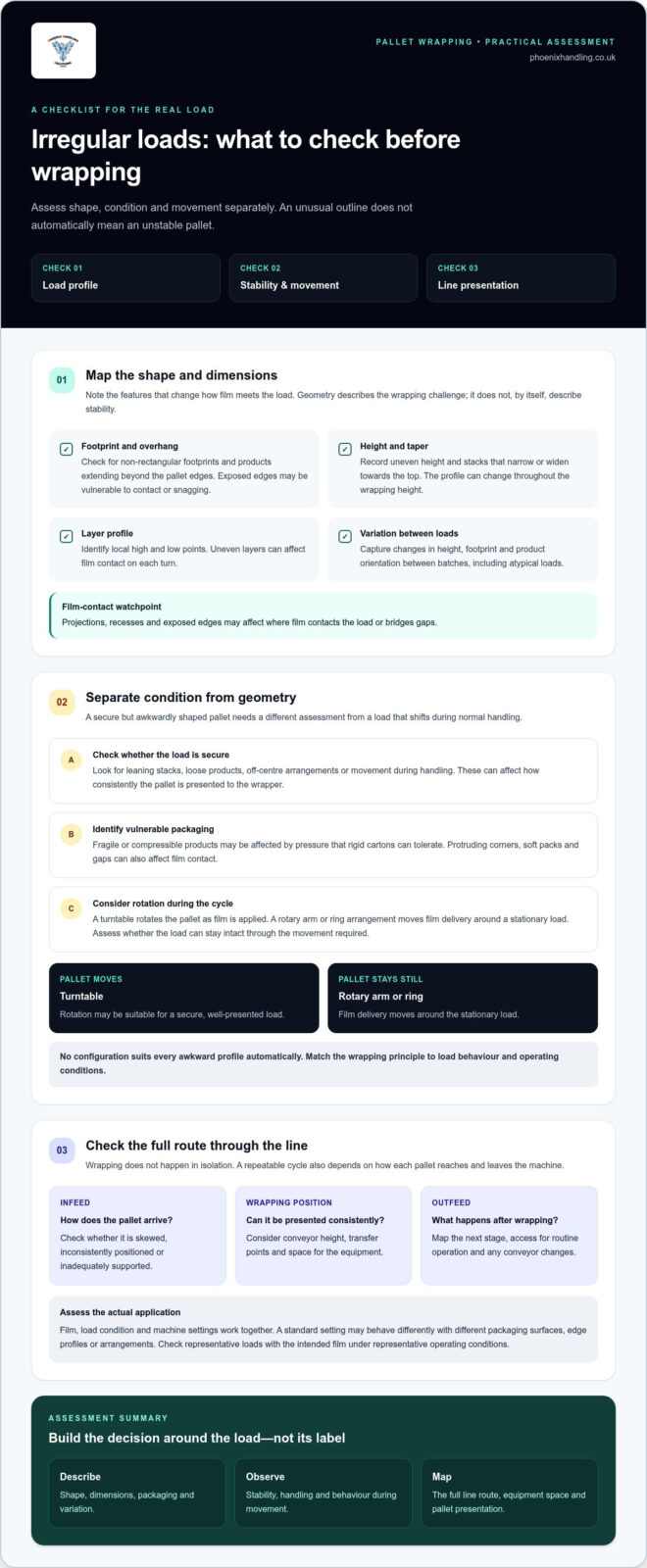
An irregular pallet load may have a non-rectangular footprint, uneven height, changing layer profiles or products that extend beyond the pallet edges. An irregular load is a palletised unit whose shape, dimensions or product arrangement varies enough to affect how wrapping film contacts and contains it. This describes geometry, not necessarily poor stability. An unusual shape can be secure, while a neatly stacked load can still shift or compress.
The distinction matters because a stretch-wrap cycle must apply film in a repeatable pattern around the load. Projections, recesses and exposed edges can affect where film contacts the load and how it bridges gaps. The challenge depends on how these features interact with load stability and the machine’s method of moving the pallet or delivering film.
Which load characteristics matter most?
Assess shape, condition and variation separately. Overhanging products extend beyond the pallet footprint, leaving edges exposed to contact or snagging. A tapered stack narrows or widens towards the top, changing its profile through the wrapping height. Uneven layer profiles create local high and low points that can affect film contact on each turn.
Dimensions may also vary between batches. Changes in height, footprint or product orientation can alter the load profile even when the pallet type stays the same. Fragile or compressible packaging adds another consideration: pressure that contains rigid cartons could deform softer packs. Record these characteristics rather than treating every non-standard pallet as one category.
Why does a standard wrapping cycle sometimes struggle?
A standard cycle follows a set path and applies film as the load is presented to the machine. If the profile changes sharply, film may bridge a void rather than follow the surface, or catch on a protruding edge. Uneven geometry can also make containment less consistent across faces or layers. These are potential application issues, not proof that a particular wrapper cannot handle the load.
Separate machine suitability from load presentation. A leaning stack, loose products or an off-centre arrangement may move during handling before the wrapper can contain it. A stable but awkwardly shaped load needs a different assessment from one that shifts during normal movement. Check how pallets are built and transferred, as well as how the wrapping cycle handles them.
Film and load condition matter too. The same setting may behave differently with different packaging surfaces, edge profiles or load arrangements. Avoid assuming that a machine change alone will resolve inconsistent containment. Assess the actual load and film combination under representative operating conditions before drawing conclusions about wrapper performance.
How do stretch wrappers interact with irregular pallet loads?
A wrapping cycle brings together three factors: how the pallet moves, how film is delivered and how consistently the load is presented. As the cycle progresses, film is laid around the load in overlapping passes. The aim is to contain the unit without damaging its products or packaging. The balance depends on the load profile, film and machine settings, so assess the actual application rather than judging it from appearance alone.
Wrapping consistency depends on the relationship between load stability and machine movement. If the pallet turns, its contents move during film application. If the film-delivery system travels around a stationary pallet, the load itself remains still. Neither approach suits every awkward profile automatically. The key question is whether the load can stay intact through the movement and handling required by the cycle.
Load stability, rotation and film application
A turntable rotates the pallet as film is applied, while a rotary-arm or ring arrangement moves the film-delivery system around a stationary load. Rotation may be acceptable for a secure, well-presented pallet. A fragile, light or top-heavy load needs closer assessment if movement could disturb its arrangement. A load can be geometrically unusual yet stable, or have a regular outline but shift during handling.
Film must contain the load without applying undue pressure to vulnerable packaging. Protruding corners, soft packs and gaps can affect film contact, but no universal setting suits every combination. Nassco’s discussion of irregular pallet loads and wrapper options also illustrates why load behaviour informs configuration choices. Assessing representative loads with the intended film helps establish how the application behaves.
Where conveyors and line layout affect the result
The wrapping stage does not operate in isolation. Consider how a pallet leaves the preceding process, reaches the wrapper and transfers to the next stage. A load that arrives skewed, inconsistently positioned or inadequately supported may be difficult to present repeatably, whatever wrapping principle is used. Conveyor height, transfer points and space for equipment and operator access can all affect the installation.
Map the full route, including infeed, wrapping position and outfeed, rather than measuring only the machine footprint. Note obstructions, access for routine operation and space for any changes to the conveyor arrangement. These conditions help determine whether a proposed system can fit the line and handle its normal flow. Phoenix Handling Solutions Limited’s industrial pallet wrapping machine buying guide covers wider considerations for assessing a wrapping application.
A stretch wrapper for irregular loads should be considered alongside the handling route and the load’s response to movement. Phoenix Handling Solutions Limited supplies pallet wrapping machinery that can be specified around product type, throughput and available floor space. Reviewing these conditions together frames the equipment discussion around the actual line, not just the wrapper. Find out more about pallet wrapping machinery for production and distribution applications.
Which stretch-wrapper configurations suit different irregular loads?
Wrapper choice depends on how the load can be handled, how film needs to reach its surfaces and how the machine fits the line. A turntable rotates the pallet; rotary-arm and ring designs move the film-delivery assembly around a stationary load. These principles help frame the comparison, but do not establish suitability by themselves. Dimensions, stability, product sensitivity and operating conditions all matter.
Configuration suitability depends on load behaviour and operating conditions, not on irregular shape alone. Use the comparison below as a starting point, then assess representative pallets and the planned line arrangement.
| Configuration | Load movement | Possible fit | Assessment caveat |
|---|---|---|---|
| Turntable | The pallet rotates as film is applied. | Loads that remain stable during rotation, including some non-standard profiles. | Assess whether turning affects the load and whether positioning is repeatable. |
| Rotary arm | The pallet remains in position as the arm travels around it. | Loads for which rotation could disturb the product arrangement. | Consider load dimensions, access and the machine’s fit with the line. |
| Rotating ring | The pallet remains in position as the ring carries film around it. | Applications where this wrapping principle suits the required process and layout. | Assess the specific machine, load profile and integration requirements. |
Turntable wrappers: when does rotating the load fit?
A turntable carries the pallet around a vertical axis while film is applied. It can suit an irregular load if products remain stable through rotation and the pallet can be positioned consistently. A protruding corner or uneven profile does not automatically rule out this arrangement, but the actual load and film application need assessment. Consider whether movement could unsettle fragile, top-heavy or loosely arranged products.
Rotary-arm and ring wrappers: when does the film move instead?
With a rotary-arm or ring arrangement, the load stays in position while the film-delivery system moves around it. This changes the movement imposed on the pallet and may matter for loads that are sensitive to rotation. The machines differ in their mechanical arrangement, so compare the specific equipment and line conditions rather than assuming the two are interchangeable. The main stretch-wrapper machine designs provide further context on these principles.
For a stretch wrapper for irregular loads, compare the load’s behaviour with the movement required by each configuration. Then consider footprint, access and how pallets enter and leave the wrapping position. Include representative load sizes and arrangements in the assessment: the most challenging pallet may set different requirements from a regular production load. Do not select a configuration on shape alone.
How should you assess a wrapper for your irregular loads?
Base the specification on representative pallets and how they move through the operation, not on a single ideal load or the wrapper cycle alone. A structured assessment distinguishes essential requirements from occasional exceptions and gives machine comparisons a consistent basis. Include awkward formats that occur less often, as they may reveal constraints that routine production loads do not.
Build a representative load profile
Measure the pallet footprint and overall load height, including overhangs. Record minimum and maximum dimensions, then note atypical formats and changes in product orientation between batches. Add weight, packaging fragility and any observed movement during handling. These details describe the application more accurately than a general label such as “irregular”.
- Record load profiles. Measure representative minimum, maximum and atypical pallets. Capture footprint, height, overhangs and differences between product formats.
- Observe handling. Follow loads through collection, transfer and positioning. Note leaning, shifting, compression or changes to the arrangement before wrapping.
- Define output needs. Set out the required throughput alongside the expected product mix and how often formats change. Include practical requirements for loading, unloading and changeovers.
- Assess the layout. Map available floor space, conveyor interfaces and the route into and out of the wrapping position. Account for operator access and room for normal tasks.
Compare operational fit, not just the machine cycle
Cycle performance is only one part of the comparison. Consider whether the arrangement works with incoming flow, downstream transfer and product changeovers. A wrapper may suit a particular pallet profile yet need adjustments to its position or conveyor connections to fit the existing process. Assess the space around the equipment as well as its footprint, including operator access.
Before finalising a specification, assess representative loads with the intended wrapping arrangement and film. Include regular pallets and less frequent formats that are most likely to challenge repeatability. Record the settings used, the load condition before and after wrapping, any film breaks or rework, and whether the result meets the operation’s containment and product-protection requirements. This provides a consistent basis for comparing options.
Define success in observable terms. For example, the load should remain in its intended arrangement after wrapping and routine handling, and the process should accommodate the expected product mix and output. Set criteria according to the goods and their journey. Assess a stretch wrapper for irregular loads against the whole application, including the line and the load, rather than a machine description in isolation.
Prepare your load measurements and operating requirements for an equipment discussion. Discuss pallet wrapping machinery for your application with Phoenix Handling Solutions Limited. Its equipment can be specified around product type, throughput and available floor space.
How can Phoenix Handling Solutions Limited support an irregular-load wrapping application?
Selecting a wrapper for irregular pallets is an application-led exercise. Phoenix Handling Solutions Limited supplies pallet wrapping machinery and specifies equipment around the load, required output and available line space. This keeps the discussion focused on how the equipment needs to work within the operation, rather than on a machine category in isolation.
From load data to an equipment specification
Start with a clear picture of the loads and the process around them. Bring together representative pallet profiles, the handling sequence, expected throughput and space available for equipment. Include less common formats as well as routine loads, and note differences in how products are positioned or transferred. This information helps define the operating conditions the system needs to accommodate.
These inputs inform the choice and specification of a stretch wrapper for irregular loads. Product type helps frame the application, throughput indicates the output requirement, and floor space affects how equipment can be arranged. Account for how pallets arrive at the wrapper and leave it, since the machine must fit the actual flow of the line.
Where the wrapping station forms part of a wider packaging process, conveyor systems may be relevant to the overall arrangement. They can connect the wrapper with upstream or downstream stages in a way that reflects the site layout and material flow. Consider the wrapping machine and its interfaces as part of the same application, rather than treating the wrapper as a standalone item.
Plan the next step around the operating requirement
Prepare a concise application brief for discussion. It can include:
- Representative load dimensions, product types and any unusual formats.
- How pallets are presented, handled and transferred through the line.
- Required throughput and the frequency of product changeovers.
- Available floor space, conveyor interfaces and operator access requirements.
- What the wrapped load needs to achieve in the operation.
This record gives the equipment discussion a practical basis and helps distinguish essential requirements from occasional exceptions. It also supports a considered comparison of standard or custom-engineered machinery, based on the application’s needs.
Servicing and spares can form part of wider equipment planning where ongoing support is relevant to the operation. The focus remains on matching the wrapping system to the product, throughput and available space, with conveyor integration considered where it contributes to the line arrangement.
To discuss your load profile and wrapping requirements, discuss your pallet wrapping application with Phoenix Handling Solutions Limited.
Make the next equipment decision evidence-led
Use the load profile as a working reference when planning a packaging investment. A clear record of the operating requirement helps production, logistics and engineering teams compare options against the same priorities, rather than relying on assumptions about what an irregular pallet needs. For a stretch wrapper for irregular loads, turn those priorities into an application brief that reflects day-to-day handling as well as exceptional formats.
Phoenix Handling Solutions supplies pallet wrapping machinery, with equipment specified around product type, throughput and available floor space. Where the application calls for a wider line view, conveyor systems, servicing and spares can also form part of the equipment discussion. The proposed arrangement should reflect the operation’s practical requirements, rather than assume one configuration suits every load.
Bring your load information and line requirements together, then discuss your pallet wrapping application with Phoenix Handling Solutions. A considered specification starts with evidence from your own operation, giving you a sound basis for the next decision.
Frequently Asked Questions
Can a stretch wrapper handle pallet loads with products overhanging the edges?
Yes, a wrapper may handle overhanging products if the load profile and wrapping method suit them. Measure the greatest projection on each side and check whether exposed packaging edges could snag or be damaged during handling. Also consider whether the overhang is consistent or changes between pallets. Assessing a representative load can show whether the film path and load presentation suit the actual product arrangement.
Is a rotary-arm wrapper better for an unstable pallet load?
It may be suitable because the pallet stays stationary while the film-delivery arm moves around it. This can avoid rotating a load that is sensitive to movement, but it does not correct loose stacking or instability during transfers. Assess the pallet from its arrival at the wrapping position through to its exit, and consider whether it remains intact during normal handling as well as during the wrapping cycle.
What happens if pallet dimensions vary between production batches?
Variation can affect whether each pallet is presented consistently and whether the wrapping cycle suits the full range of formats. Record the smallest, largest and less common dimensions, including changes in height and orientation. For example, a batch with a wider footprint needs a different assessment from a taller, narrower format. Use this range to define changeover needs and the operating limits for the equipment specification.
Can irregular loads be stretch-wrapped without rotating the pallet?
Yes. Rotary-arm and ring configurations apply film by moving the delivery system around a pallet held in position. This can be relevant if rotation risks disturbing products, but the load still needs to arrive and remain suitably positioned. Include the space around the wrapping area and the infeed and outfeed route in the assessment, as these can affect how a stationary-load arrangement fits the line.
How do you test a wrapper with an irregular load before specifying equipment?
Assess representative pallets, including a routine format and the most challenging combination of height, overhang or product arrangement. Record the film and settings used, then inspect the wrapped load for displaced products, damaged packaging, loose areas and film breaks. Repeat the assessment under normal handling conditions, not just at the wrapping position. Comparing the results helps identify whether changes to presentation, film or machine configuration are needed.
Does an irregular load always need a bespoke wrapping machine?
No. An irregular profile does not by itself require bespoke equipment. A standard machine may suit the application if its operating range and arrangement accommodate the actual loads and line conditions. Custom-engineered equipment may be considered where product formats, throughput or available space create specific constraints. Base that decision on representative load measurements and process requirements, rather than assuming unusual geometry alone determines the level of customisation needed.