Packaging lines rarely stop at a convenient time. Preventative maintenance for packaging machinery helps reduce avoidable breakdowns through scheduled inspections, cleaning, lubrication, alignment checks and replacement of worn parts. Set maintenance intervals according to the manufacturer’s recommendations and how heavily the equipment is used. Higher-volume operations may need more frequent attention.
It is easy to defer routine maintenance while production is running, but wear, residue and misaligned components can affect output and packaging quality. A documented plan gives operators and maintenance teams a consistent way to spot issues early and keep essential tasks on track.
This article explains why preventive maintenance plans matter and what to include. It covers how to organise checks around operating needs, and how cleaning, lubrication, alignment and timely parts replacement help keep packaging machinery reliable.
Key Takeaways
- Match inspection frequency to the manufacturer’s recommendations and how intensively the machinery is used.
- Include cleaning, lubrication, alignment and timely replacement of worn components in the maintenance schedule.
- Use scheduled checks to spot developing faults before they disrupt packaging quality or production flow.
- Choose packaging and palletising equipment that fits the demands of your line and the loads it handles.
Cleaning, oiling, alignment and parts replacement
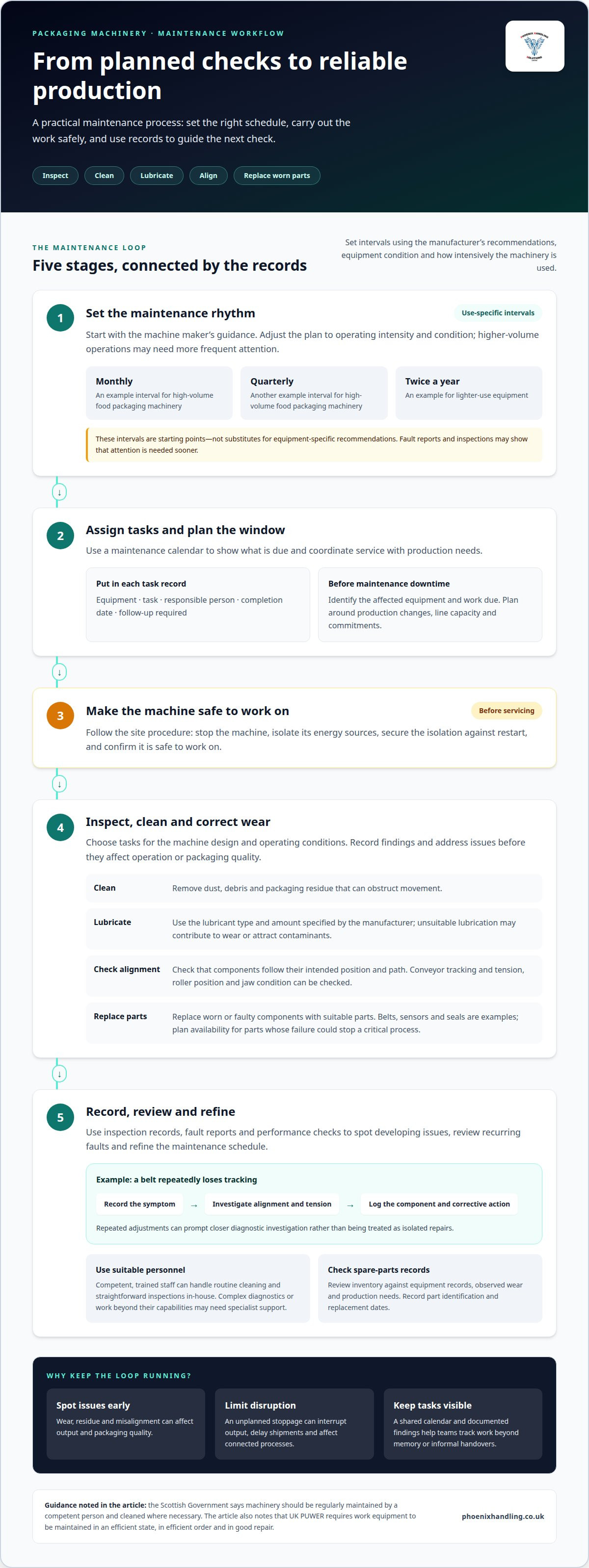
Preventative maintenance for packaging machinery combines cleaning, lubrication, alignment checks and component replacement. The right tasks depend on the machine’s design and operating conditions, as well as the manufacturer’s recommendations.
The Scottish Government says machinery should be regularly maintained by a competent person and cleaned where necessary. Assigning responsibility helps ensure tasks are recorded and recurring faults are reviewed.
Cleaning, Oiling and Alignment
Cleaning removes dust, debris and packaging residue from mechanical parts, while lubrication reduces friction at moving contact points. Alignment checks confirm that components follow their intended position and path. Residue can obstruct movement, while unsuitable lubrication may contribute to wear or attract contaminants.
Use the lubricant type and amount specified by the machine’s manufacturer. For example, maintenance teams can check conveyor tracking and tension, then adjust a belt that is drifting. Checks on packaging equipment can also cover roller and jaw position, cleanliness and condition.
Parts Replacement and Availability
Parts replacement involves removing worn or faulty components and fitting suitable replacements before they affect machine operation. Belts, sensors, pneumatic hoses and seals are examples of parts that may need replacing. Planning parts availability matters because a failed component can interrupt a line while the correct replacement is sourced, whether from standard vendors or specialist tubing and profile manufacturers such as Abbey Extrusions.
Review spare-parts inventory against equipment records, observed wear and production needs. A conveyor belt or sensor may be a priority if its failure would stop a critical process. Record part identification and replacement dates, so repeated failures can prompt closer diagnostic investigation.
Maintenance teams can use inspection records, fault reports and performance checks to spot developing issues. If a belt repeatedly loses tracking, for instance, investigate its alignment and tension rather than treating each adjustment as an isolated repair. Link the observed symptom to the component and corrective action in the records.
Records are central to preventative maintenance for packaging machinery, especially when recurring faults need investigation. Competent, trained personnel can carry out routine cleaning and straightforward inspections in-house. More complex diagnostics, alignment work or component replacements may need specialist support if they exceed the team’s capabilities. Base the decision on the task, staff competence and machinery involved.
Why Enroll in a Preventive Maintenance Plan?
A preventative maintenance plan for packaging machinery sets out inspections, cleaning, lubrication, calibration, parts replacement and system tests. Schedule tasks according to manufacturer recommendations and the machinery’s level of use.
Documented planning gives operators a shared reference for assigned tasks, recorded findings and service visits. It also helps production teams coordinate maintenance downtime with line requirements.
Maintenance Calendars and Documentation
A maintenance calendar shows when inspections and other tasks are due; records capture completed work and findings. Together, they help teams track recurring issues instead of relying on memory or informal handovers.
Include the equipment, task, responsible person, completion date and any follow-up required. For example, a record of repeated belt-tracking adjustments can prompt an inspection of alignment and tension. According to the UK Government, PUWER requires work equipment to be maintained in an efficient state, in efficient order and in good repair.
Scheduling Service Visits
Scheduled service visits put planned inspections and maintenance into the operating calendar. Set their timing according to manufacturer recommendations, production intensity and the machine’s condition.
High-volume food packaging machines may need monthly or quarterly maintenance, while lighter-use equipment may need checks twice a year. Treat these intervals as starting points, not substitutes for equipment-specific recommendations. Fault reports and inspection records can show when attention is needed sooner. Service visits can also cover planned tasks that need technical support, separate from routine operator checks.
Planning Maintenance Downtime
Planned maintenance downtime is a production window set aside for inspections, adjustments or servicing. Schedule the work around production changes, line capacity and commitments.
Before setting a maintenance window, identify the affected equipment and tasks due. A conveyor inspection, for example, may involve a different part of the line from a sealing system check. Recording the expected work helps operators coordinate material flow and avoid conflicts with production.
A schedule for preventative maintenance for packaging machinery can be refined using overdue tasks, recurring faults and completed work. Where specialist input is needed, planned service support can form part of the maintenance calendar.
Why is preventive maintenance key in industrial packaging?
Unplanned downtime can interrupt packaging output, delay shipments and disrupt connected production processes. Before servicing, stop the machine, isolate its energy sources, secure the isolation against restart and confirm it is safe to work on, following the site procedure.
Downtime and Production Disruption
Packaging machinery downtime is an interruption caused by equipment that cannot perform its assigned task. A failed conveyor, for example, can restrict product movement even if the packaging machine itself is still operational.
Disruption can spread beyond the affected machine. If packaging equipment feeds a palletising or dispatch process, a stoppage can affect material flow, operator allocation and shipment schedules. Maintenance records help teams spot recurring faults and prioritise checks on equipment whose failure could interrupt connected processes.
In the UK, the UK Government says PUWER requires work equipment to be maintained in an efficient state, in efficient working order and in good repair. Planned inspections support this maintenance duty and help identify defects before they cause a production stoppage.
Reducing Reactive Repairs and Costs
Reactive repairs address faults after equipment stops or its performance deteriorates. Planned inspections create opportunities to detect wear or repeated faults and schedule corrective work before an issue causes a wider interruption.
For example, a recurring fault report can prompt a targeted inspection of the affected assembly. Maintenance teams can then assess the cause, parts needed and suitable timing, rather than responding only after a line has stopped. Avoiding emergency work can reduce disruption, although the outcome depends on the fault and repair required.
Maintenance Costs in the UK
UK maintenance costs vary according to machine type, scope of work, service frequency, labour and replacement parts. A routine inspection differs from a repair requiring fault diagnosis or component replacement, so the work specified affects the cost.
Compare planned work with production needs and equipment condition. Grouping suitable tasks in a calendar can help coordinate labour and downtime, while service records can reveal recurring faults that need attention. These steps support cost planning without assuming every machine or visit is the same.
Preventive maintenance plans for packaging machinery
A maintenance plan organises checks around manufacturer recommendations, equipment use and packaging line requirements. A checklist should name each task, its frequency, the person responsible and the result to record.
Building a Maintenance Plan
A maintenance plan sets out the work needed to keep each machine operating as intended. Different equipment functions and workloads call for relevant tasks and intervals, not one generic schedule.
Start with the manufacturer’s recommendations, then factor in operating hours and production intensity. Assign technicians to inspect equipment regularly and review findings with operators, who can report changes in machine behaviour. If a line includes a form fill seal machine and labelling system, schedule checks for both rather than treating the line as one unit.
Set tasks by time or equipment use. Daily, weekly and monthly checks can cover cleaning, lubrication and performance, with intervals adjusted to the machinery and its workload. Record completed work and follow-up actions so recurring faults inform future planning.
Creating a Maintenance Checklist
A maintenance checklist turns the plan into specific tasks that operators and technicians can record consistently. Clear entries make missed work and developing faults easier to identify.
List each machine or system, the task, the planned interval and a space for findings. Include inspections of sealing systems, labelling and coding equipment, and volumetric fillers where these are part of the line. Add functional tests for control systems, load cells and form fill seal machinery.
Make every check specific. For example, record whether a control system performs as expected instead of simply marking “machine checked”. Include fields for faults, corrective action and follow-up, so technicians can track unresolved issues.
Review the checklist against production records and operator observations. If a fault recurs, technicians can assess whether a task or inspection interval needs adjustment. Train operators to recognise early signs of failure and report them in the same record, giving maintenance teams useful information between scheduled inspections.
For packaging lines that include pallet wrapping or strapping, discuss packaging line requirements when planning suitable equipment.
Phoenix Handling Solutions Limited: Pick & Pack De Palletisers
Phoenix Handling Solutions Limited supplies Pick & Pack De Palletisers for businesses reviewing how palletised goods are handled. This equipment may suit operations that need a de-palletising stage as part of their packaging line, alongside planned maintenance and production improvements.
For end-of-line requirements, options also include Pallet Wrapping Machines, Strapping Machines and Stretch Hooders. The right equipment depends on the task, products handled and how the system needs to fit the existing process.
To discuss your packaging machinery requirements, contact Phoenix Handling Solutions Limited.
Plan the next stage of your packaging operation
Use maintenance records to inform future decisions about line capacity, format changes and areas where manual handling creates constraints. Preventative maintenance for packaging machinery can help assess whether existing equipment remains suitable as production needs change. Consider recurring stoppages, products handled, packaging formats, throughput, available floor space and integration with adjacent processes. These practical criteria help decision-makers review the line without treating a machine issue in isolation.
If a planned change involves pallet handling or end-of-line packaging, Phoenix Handling Solutions Limited can discuss equipment options in relation to your operating requirements. Bring relevant process details and maintenance observations to the conversation, so potential changes are considered in context. The aim is a practical next step that reflects the demands of your production environment.
Contact Phoenix Handling Solutions Limited to discuss your packaging requirements. A clear plan can help you move forward with confidence.
Frequently Asked Questions
How often should packaging machines be inspected and serviced?
Follow the manufacturer’s recommendations and adjust intervals to the machine’s workload. High-volume food packaging equipment may need monthly or quarterly maintenance, while lighter-use machinery may need checks twice a year. Operators should report faults between planned visits so emerging issues can be assessed before the next scheduled inspection.
What daily, weekly, monthly and annual maintenance checks are recommended for packaging equipment?
Use daily, weekly and monthly checks for tasks such as cleaning, lubrication and performance observations, setting intervals to suit the equipment and manufacturer’s guidance. Check sealing, labelling and coding functions as applicable. Treat an annual review as an opportunity to assess maintenance records and recurring faults, rather than a universal service interval. The equipment’s operating conditions determine the plan.
What are common signs that packaging machinery needs maintenance?
Repeated jams, inaccurate packaging, material waste and damaged products can signal a developing machine fault. Inconsistent sealing or cutting may indicate problems with roller or jaw condition, position or calibration. Reports of sensor or timing issues can also help technicians locate the cause. Record the affected machine, symptom and production conditions to support diagnosis.
How can preventative maintenance reduce packaging machine downtime and production costs?
Planned inspections can identify wear or recurring faults before they stop a packaging line. Addressing a developing issue during scheduled work can reduce disruption compared with waiting for a breakdown. Improved consistency may also limit material waste and packaging defects. The effect on costs depends on the fault, repair work and production impact, making maintenance records useful for assessing patterns.
What spare parts and maintenance records should packaging machine operators keep?
Keep an inventory of parts relevant to the machinery, such as conveyor belts, sensors and seals, and review it against equipment condition and replacement history. Records should identify the machine, inspection date, work completed, faults found, parts fitted and follow-up action. For a conveyor, tracking repeated belt replacements or alignment issues can help technicians identify an underlying recurring problem.