
A labour shortage need not set the ceiling on production. Packaging automation can take repetitive packing and palletising tasks out of manual workflows, helping output increase without labour rising in proportion. For UK manufacturers, packaging automation for labour shortages can support production capacity while skilled staff oversee equipment and handle work that needs human judgement.
Recruitment pressures and seasonal peaks can make it difficult to maintain consistent throughput with manual processes. Packaging automation for labour shortages can reduce reliance on hard-to-find workers, but equipment must suit the products, packaging formats and available factory space.
This article explains how automated systems can scale production, respond to seasonal demand and change the allocation of work across a packaging operation. It also considers the role of conveyors, stretch wrapping and palletising, and why workforce training and system flexibility matter when planning an investment.
Key Takeaways
- Map labour pressure across the packaging process to identify where automation is likely to make the greatest operational difference.
- Plan capacity around seasonal peaks, while accounting for the staff skills needed to operate and maintain automated equipment.
- Match conveyors, stretch wrappers and palletising systems to product handling needs, packaging formats and available floor space.
- Consider how Pick & Pack De Palletisers and pallet-wrapping equipment could address specific handling constraints in your operation.
Scaling production without proportional labour increases
Packaging automation for labour shortages can increase output without requiring labour to rise in proportion. Its value depends on matching equipment capacity to production needs and existing processes.
Increasing packaging productivity and consistency
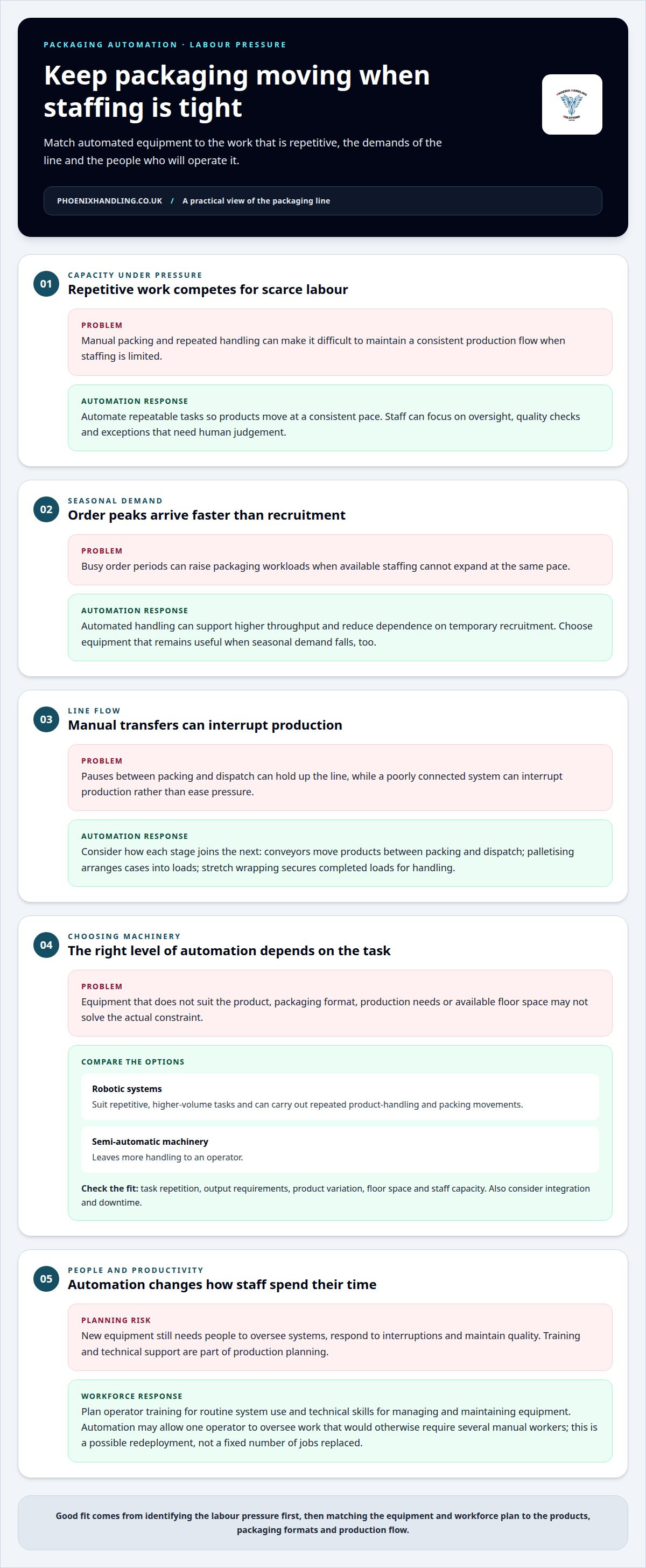
Automated equipment carries out repetitive packaging tasks at a consistent pace, helping maintain production flow when staffing is limited. For example, conveying products between packing and dispatch can reduce pauses caused by manual transfers. This matters when higher output must not create more variation in finished packs. Staff can then focus on oversight and exceptions that require judgement, rather than repeating the same handling task.
Scaling for seasonal demand
A packaging automation for labour shortages plan can help manufacturers manage seasonal peaks without increasing labour in proportion to demand. Automated handling, for example, can keep products moving during a busy order period when recruitment cannot readily fill extra shifts. Equipment must suit the products, packaging formats and available space. Integration and downtime matter too: a poorly connected line can interrupt production instead of easing pressure.
Comparing robotic and semi-automatic machinery
Robotic systems suit repetitive, higher-volume tasks, while semi-automatic machinery leaves more handling to an operator. For small and medium-sized UK businesses, the choice depends on task repetition, output requirements, product variation, floor space and staff capacity. Automated lines must meet applicable UK machinery and workplace health and safety requirements. Packaging requirements depend on the products and their use. According to the UK Government, in most cases, businesses can deduct the full cost of qualifying packaging machinery from profits before tax using the annual investment allowance.
Workforce impact and productivity gains
Automation can allow one operator to oversee work that would otherwise require several manual workers. This is a possible redeployment, not a fixed number of jobs replaced. Productivity gains depend on the task, line layout, product mix and operating conditions. Staff remain important for system oversight, interruptions and quality, so training and technical support are part of production planning.
Managing seasonal demand and workforce shortages
Seasonal peaks can increase packaging workloads when recruitment is already difficult. Automated systems help maintain production flow, while workers remain responsible for oversight and tasks requiring judgement.
Responding to seasonal staffing pressure
Automation supports seasonal demand by handling repeatable packaging work when order volumes rise and available staffing cannot expand at the same pace. This can reduce dependence on temporary recruitment and help the existing workforce manage higher throughput.
Flexibility matters beyond the peak. A system suited to changing production requirements can support regular operations when seasonal demand falls, rather than adding capacity that is difficult to use year-round. Consider which tasks to automate, the products being handled and how the system will fit the existing line.
Workforce challenges also include training and turnover. Automation changes how staff spend their time, so production planning should account for operator responsibilities during quieter periods and peak shifts alike.
Workforce activities suited to automation
Automated systems suit repetitive, predictable packaging activities that rely on consistent handling. Examples include moving products through a line and carrying out repeated packing movements. Automating these activities reduces manual intervention and gives workers more capacity for quality checks, exceptions and other work requiring human judgement.
Not every process benefits equally. Tasks involving variable products or decisions that depend on context may still need direct human involvement. Identifying where labour pressure is greatest helps focus investment on work that can be automated without disrupting other stages.
Training is part of that change. Operators need to understand routine system operation, while technical staff need skills to manage and maintain equipment. As automation develops, digital knowledge and technical capability become more valuable across the packaging industry. Pairing training with equipment deployment helps keep production adaptable and competitive.
For operations assessing how automated material movement could support seasonal staffing, review the relevant system requirements alongside the packaging process.
Stretch wrappers, conveyors and robotic palletizers
These systems automate different stages between packing and dispatch. Their combined value depends on how well each stage suits the products, packaging formats and production flow.
Robotic packing
Robotic packing uses programmable equipment to carry out repeated product-handling and packing movements. In manufacturing, this can reduce manual transfers between workstations and help products move consistently towards palletising. Automated systems can be designed for different product types and sizes, supporting production as customer requirements change. This investment is most useful when repeated tasks create bottlenecks, errors or pressure on available staff.
Robotic palletising
Robotic palletising places cases or other packaged products into planned pallet loads. It can stack products quickly and accurately without long interruptions, helping maintain flow when output is rising. A suitable arrangement depends on product dimensions, pallet patterns, load stability and the space available around the end of the line. Pallet stretch wrapping can then secure completed loads for handling and dispatch.
Conveyors connect processes by moving products between packing, palletising and wrapping stations. For example, a conveyor can carry cases from a packing point to a palletising cell, reducing repeated manual carrying. Line efficiency depends on suitable transfers and a steady supply of products. A poorly matched conveyor can cause accumulation or leave downstream equipment waiting.
Stretch wrappers apply film around a pallet load to help hold products together during movement. Consistent wrapping can reduce variation between loads, while automated packaging can help reduce defects, waste and production errors. The right wrapping approach depends on load shape, stability and the film used. Rising demand may also bring more product sizes or packaging formats, so flexibility matters when specifying equipment.
Consider the stages as one material flow rather than separate machines. Conveyors feed products forward, robotic palletising forms loads, and wrapping prepares them for dispatch. This joined-up view helps identify where repetitive handling causes delays and where investment could improve efficiency as manufacturing output grows.
Packaging automation as a response to labour shortages
Packaging operations can feel workforce pressure early because every product must pass through packing and dispatch. Machines can perform repetitive handling, reducing reliance on manual labour while staff remain responsible for oversight, quality and exceptions.
Start by identifying which production-line tasks constrain output when staffing is limited. For example, repeatedly transferring cases between packing and palletising can occupy workers needed elsewhere. Conveyors or automated handling can reduce those manual movements, while an operator monitors flow and responds to interruptions. The right level of automation depends on task repetition, product variation, available space and how equipment connects with existing processes.
Automation can also change how labour is allocated. Depending on the process and equipment, one operator may oversee work that would otherwise require several manual workers. This does not mean every role disappears. Workers can move towards line monitoring, quality checks and handling unusual products, while technicians and engineers support system operation and maintenance. Training matters because automated production still depends on people who understand the equipment.
Integration and downtime are key considerations. If a new machine cannot receive products at the required rate, or its output does not fit the next stage, the production line can become a bottleneck. Plan how packing, conveying, palletising and dispatch connect. Maintenance needs, product changes and staff capability also affect the system’s contribution. Automation works best when it addresses a defined constraint and fits the wider process.
The takeaway is to target the task where labour pressure most restricts production, then assess how equipment will connect with the full line. That keeps the focus on operational continuity, not simply replacing manual work. Discuss packaging-line automation with Phoenix Handling Solutions Limited to consider where equipment could reduce repetitive handling and support your operation.
Phoenix Handling Solutions Limited: Pick & Pack De Palletisers
Phoenix Handling Solutions Limited supplies Pick & Pack De Palletisers for businesses looking to automate pallet handling within packaging and distribution operations. These systems are relevant when manual depalletising puts pressure on available workers or interrupts product flow to packing.
The right system depends on the products handled, the existing process and how depalletising connects with downstream operations. Pallet Wrapping Machines, Strapping Machines and Stretch Hooders address different stages of load preparation. Select equipment for the specific constraint in the line rather than assuming one machine can solve every labour challenge.
To discuss Pick & Pack De Palletisers or related load-handling requirements, contact Phoenix Handling Solutions Limited.
Set a clear direction for your next investment
Before specifying equipment, define the operational constraint to address and how you will measure improvement. Assess the task causing pressure, the products handled, available floor space and how a proposed system will connect with existing production. This gives packaging automation for labour shortages a clear purpose, rather than treating machinery as an end in itself.
The next step is a focused discussion about the stage of your process that needs support. Phoenix Handling Solutions supplies Pallet Wrapping Machines, Strapping Machines and Stretch Hooders for different load-preparation requirements. The right fit depends on the application and how each machine supports your operation.
Contact Phoenix Handling Solutions Limited to discuss your packaging requirements and possible next steps. A clear brief can help turn workforce pressure into a practical equipment decision.
Frequently Asked Questions
How can packaging automation help address labour shortages in the UK?
Packaging automation helps UK manufacturers maintain packaging capacity when recruiting enough staff is difficult. It can remove defined, repeatable duties from manual workflows, allowing available workers to focus on oversight and exceptions. For example, a manufacturer can automate a constrained end-of-line stage rather than redesign the whole factory. Start by identifying where staffing gaps most directly restrict production flow.
Which packaging processes are easiest to automate when staff are hard to recruit?
Repetitive processes with predictable products and movements are generally the clearest candidates. Examples include erecting cases, packing products into cases, wrapping pallet loads and applying straps. These operations follow defined sequences, making them easier to specify than work involving frequent judgement or irregular product handling. Start with a process that is both labour-intensive and a clear constraint on output, rather than simply the easiest machine to install.
What types of packaging automation are available for UK manufacturers?
UK manufacturers can use case packers, case erectors, tray erectors, palletising and de-palletising systems, conveyors, automated guided vehicles, shrink packers, pallet wrapping machines, strapping machines and stretch hooders. Phoenix Handling Solutions supplies both individual machines and integrated systems. For instance, a line can combine case packing with conveying and palletising. Selection depends on the product, required throughput, packaging format and available floor space.
How much does packaging automation cost in the UK, including installation and maintenance?
The cost depends on the equipment, system scope, installation requirements and the level of integration with existing production. A standalone wrapper and a connected line with conveying and palletising require different specifications. Installation and maintenance requirements also affect project scope. Pricing depends on the specific project and is provided after a quote request; relevant factors include equipment choice, integration work and support requirements.
What is the typical return on investment and payback period for packaging automation?
There is no single payback period that applies across packaging projects. The financial case depends on the process being automated, labour requirements, production volume, equipment utilisation and the costs of integration and ongoing maintenance. Assess value by comparing project costs with changes in output, staffing allocation, packaging errors and downtime. These measures should reflect the specific operation and its production priorities.
What training and skills do employees need to operate and maintain packaging automation?
Operators need practical instruction in routine machine operation, production monitoring and responding to interruptions. Maintenance staff need suitable technical skills for equipment care and fault diagnosis. Phoenix Handling Solutions includes installation, commissioning and operator training with its systems. Training should match the equipment and each employee’s responsibilities, so operators can manage routine tasks and technical staff can support maintenance and system performance.