Manual handling risk in manufacturing is not confined to lifting: it also includes pushing, pulling, carrying, lowering and positioning loads, parts or equipment. The Manual Handling Operations Regulations 1992 are the main UK legislation on the subject, according to The National Archives. Employers should avoid hazardous handling wherever possible and assess tasks that cannot be avoided. Reducing manual handling risks in manufacturing starts with understanding the task, the worker, the load and the working environment.
Repeated movements, awkward postures, heavy or bulky loads and restricted workspaces can contribute to strains, sprains and other musculoskeletal problems. These risks arise not only during isolated heavy lifts, but also during routine production and packing tasks.
This article explains what counts as manual handling, the injury risks common on manufacturing floors, and how mechanical aids such as conveyors and lifting equipment can reduce carrying and repetitive handling. It also looks at how equipment fits into a wider approach based on task design and safe working conditions.
Key Takeaways
- Identify handling tasks by looking at the load, the movement, the worker’s capabilities and the conditions around the task.
- Recognise how repetitive movements, awkward postures and difficult loads can contribute to strains and other musculoskeletal injuries.
- Consider whether conveyors, lifting equipment or other mechanical aids can reduce manual carrying and repetitive handling.
- Match equipment and process changes to the specific handling demands of your production or packing operation.
What is manual handling?
In manufacturing, manual handling includes lifting, lowering, carrying, pushing, pulling and positioning loads, parts or equipment. A worker moving a component from a bench to a production line is handling a load, even over a short distance. Repetition, posture and route conditions can make routine movements hazardous.
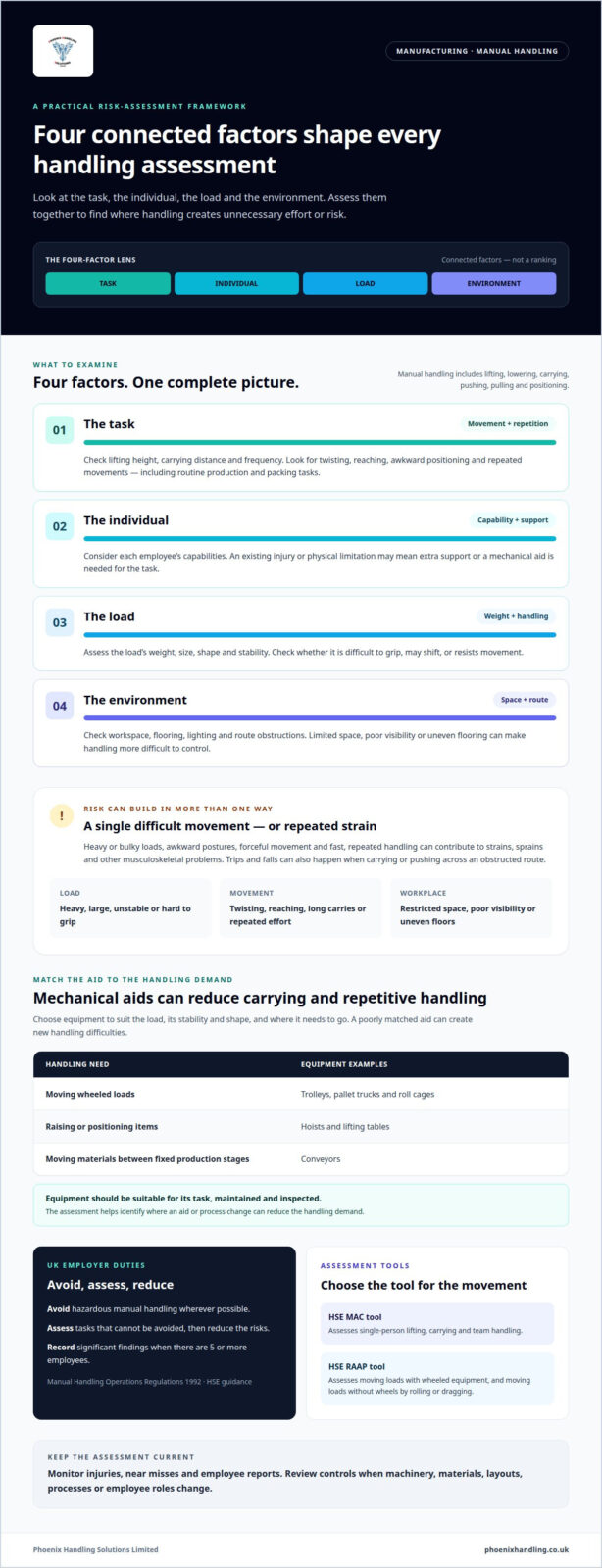
A risk assessment considers four connected factors: the task, the individual, the load and the environment. Assess lifting height, carrying distance, frequency, grip, and any twisting or reaching. Check the load’s weight, shape and stability, then consider the workspace, flooring, lighting and route obstructions. This helps reduce manual handling risks in manufacturing by identifying where a task creates unnecessary effort.
UK employers should avoid hazardous manual handling wherever possible, then assess and reduce risks from tasks that remain. The Manual Handling Operations Regulations 1992 are the main UK legislation on manual handling, according to The National Archives. UK employers with 5 or more employees must record the significant findings of their risk assessments, according to the Health and Safety Executive. These findings help prioritise reducing manual handling risks in manufacturing through suitable task changes and controls.
The Health and Safety Executive’s MAC tool helps assess single-person lifting, carrying and team handling. The HSE’s RAAP tool can assess moving loads with wheeled equipment and moving loads without wheels by rolling or dragging. Assess each employee’s capabilities against the task, including whether an existing injury or physical limitation calls for extra support or a mechanical aid.
Training should cover the hazards, equipment and procedures employees encounter in their roles. General online learning needs to be supplemented with workplace instruction when tasks involve specific equipment or practical skills. Relevant instruction helps employees recognise hazards and use aids correctly, but it does not replace suitable controls or assessment.
Monitor injuries, near misses and employee reports to spot recurring problems, such as awkward access or difficult routes. Review controls when machinery, materials, layouts, processes or employee roles change. Regular task reviews with workers help show whether existing measures still address the handling risks.
Common manufacturing handling injuries and risks
Common manual handling risks in UK manufacturing include back injuries, strains, sprains, hernias, trips and falls. These can result from a single difficult movement or build up through repeated handling.
Common injury causes
Manual handling injuries can occur when lifting, carrying, pushing or pulling places excessive force on the body. For example, a worker may strain their back lifting a bulky part from floor level, or overload their wrist by gripping a container tightly. Repeated movements can also gradually affect muscles, joints, tendons and ligaments.
These risks matter on production lines because tasks often repeat, and loads may shift or resist movement. Overexertion while lifting, pushing, pulling or stopping a heavy load can cause a hernia. Poor posture when positioning a component can strain the back or shoulders. A handling risk can also involve an immediate incident, such as tripping while carrying materials across an obstructed floor.
Manual handling risk factors
Manual handling risk increases when the load, movement or workplace makes a task difficult to control. Heavy, large, unstable or hard-to-grip loads demand more physical effort. Twisting the trunk while lifting, reaching across a bench or carrying materials over a long route adds strain. Repeating these movements at a fast pace can compound the physical demand.
Manufacturing layouts can introduce further risks. Limited space may prevent a worker from positioning their feet securely, while poor visibility can hide obstacles along a carrying route. Uneven flooring increases the chance of losing balance while pushing a wheeled load. Assess the entire movement, including where the load starts, how it is handled and where it must be placed.
Short-term injuries in manufacturing
Short-term injuries are acute problems that arise during or soon after a handling task. A sudden back strain may follow a forceful lift; a sprain may occur when a worker twists while holding a load. Overexertion can also cause a hernia, while a slip or trip may lead to a fall during carrying or pushing.
Pain, swelling, tenderness or restricted movement can make it harder to complete a shift or control later loads. A worker who develops symptoms after moving a difficult component should promptly report the incident and task conditions. Record the handling activity, load and route involved, then review whether the movement, floor or storage position contributed.
Mechanical handling equipment
Mechanical aids take some of the load or movement off the employee. A handling risk assessment helps match each aid to the activity, load and route.
Mechanical handling aids
Trolleys, pallet trucks and roll cages support wheeled loads, while hoists and lifting tables help raise or position items. Conveyors can move materials between fixed production stages, reducing carrying and repetitive handling. For organisations reviewing practical options, specialists such as springwell.com.sg demonstrate the range of industrial material handling and lifting equipment available to support workers. Select equipment based on the load’s weight, stability, shape and destination. A poorly matched aid can create new handling difficulties instead of removing the original risk.
The Lifting Operations and Lifting Equipment Regulations 1998 (LOLER) cover warehouse equipment used to lift loads, according to The National Archives. The Provision and Use of Work Equipment Regulations 1998 cover mechanical handling equipment, according to The National Archives. Equipment must be suitable for its task, maintained, and inspected so defects such as damaged wheels or faulty brakes are addressed.
Ergonomic handling solutions
Ergonomic solutions organise work around safer movements and suitable equipment. For example, positioning a lifting table beside a workstation can reduce repeated bending when components move between different heights. A conveyor can connect fixed work areas and limit manual carrying between them. The right solution depends on the load, workflow, available floor space and required production rate.
Layout changes can also reduce handling demands without adding lifting equipment. Place frequently used materials near their point of use, keep storage within easy reach and provide clear routes for moving loads. Adjusting workbench or storage positions can reduce floor-level lifting, overhead reaching and trunk twisting. Where mechanical assistance is not practical, redesign the task, load or workplace to reduce the effort involved.
Introduce aids alongside clear operating procedures and role-specific instruction. Employees need to know how to use equipment safely and report defects, such as unstable frames or damaged lifting mechanisms. Review whether the aid still suits the task when materials, machinery or production arrangements change. Mechanical support can reduce exposure to manual handling injuries, but it does not replace assessment of the whole process.
Manufacturing workers’ manual handling risks
Manufacturing work can involve repeated handling, forceful movement and awkward access around machinery. The Manual Handling Operations Regulations 1992 are the main UK legislation relating to manual handling, according to The National Archives. Employers’ workplace health and safety duties include managing these risks under the Health and Safety at Work etc. Act 1974, according to The National Archives.
Workers may face different hazards in goods-inwards, production, maintenance and packing. Lifting a component from a low pallet can require bending; positioning it on a machine may add reaching or twisting. Repeated work at pace can increase physical demands, particularly when materials are heavy, bulky or difficult to grip. The same task can carry different risks when the workspace, route or employee capability changes.
Musculoskeletal disorders can affect the back, neck, shoulders, arms, hands, hips and legs. Symptoms include pain, stiffness, swelling, reduced movement, weakness, fatigue or numbness. A worker handling parts in an awkward position may develop discomfort that affects later movements. Heavy loads and poor visibility can also increase slip or trip risks while carrying materials through a production area.
Design work to avoid hazardous manual handling where possible, then reduce the remaining demands. Position components near their point of use to limit carrying distance. Store frequently handled items within easy reach, and keep floors unobstructed with adequate space and lighting. Where mechanical help is not reasonably practicable, consider smaller loads, improved access or task changes. These controls address the movement and workplace conditions, not just the worker’s lifting technique.
Review controls when machinery, materials, production processes, layouts or employee roles change. Workers can help identify recurring problems, such as awkward access to a machine or a route blocked by stored goods. A straightforward reporting process helps managers act on concerns and spot patterns in incidents or near misses. Review manual handling risk controls as part of improving workplace safety.
Phoenix Handling Solutions Limited
Phoenix Handling Solutions Limited helps manufacturers identify where packaging and palletising machinery may reduce manual intervention in production flows. Where workers repeatedly handle finished goods during pallet preparation, a Bag Palletiser, Pallet Wrapping Machine, Strapping Machine or Stretch Hooder may suit the process. The right configuration depends on the materials, packaging requirements, available floor space and how goods move through the site.
These systems address specific packaging and palletising stages; they do not replace a wider manual handling risk assessment or controls for unrelated tasks. Consider them when repetitive handling around end-of-line operations remains a concern and machinery could fit the workflow. Contact Phoenix Handling Solutions Limited to discuss your manufacturing handling requirements.
Make the next improvement part of the process
Reducing manual handling risks in manufacturing works best when changes fit the production process, rather than treating each movement in isolation. A practical next step is to identify where repeated handling remains part of packaging or pallet preparation, then consider how equipment could change that workflow. The intended load, packaging format, available space and connection to surrounding operations all shape a suitable approach.
Keep the objective practical: reduce unnecessary manual intervention while maintaining a workable production flow. Where packaging or palletising tasks remain physically demanding, assess whether machinery could address that specific stage. The right solution depends on the operation, so define the handling problem and process requirements before selecting equipment.
Discuss your production line requirements with Phoenix Handling Solutions Limited. A clear view of the task is a constructive starting point for planning the next improvement.
Frequently Asked Questions
How should employers carry out a manual handling risk assessment under the MHOR 1992?
Employers should first consider whether hazardous handling can be avoided, then assess tasks that remain under the Manual Handling Operations Regulations 1992, according to The National Archives. In a production area, observe the full movement, including where a component is collected, transferred and placed. Record who performs it, how often it occurs, and any constraints such as restricted access or changing load stability.
What engineering controls reduce lifting, carrying, pushing and pulling in manufacturing?
Engineering controls change how materials move through the workplace. For example, a conveyor can transfer components between adjacent workstations, while a lifting table can position a load at a more accessible working height. Pallet trucks and trolleys assist with wheeled loads. Select controls based on the route, load dimensions, access points and production sequence, so equipment removes unnecessary effort without causing congestion.
When should manufacturers use lifting aids, conveyors or robotic handling?
Use a lifting aid when employees repeatedly raise or position loads, particularly if the task involves awkward access or precise placement. Conveyors suit regular transfers between fixed stages, such as moving packaged goods towards an end-of-line area. Robotic handling can suit repeated, consistent palletising movements. The decision depends on the task pattern, product range, available space and how the equipment integrates with existing operations.
How can employers assess and reduce risks from repetitive tasks and awkward postures?
Observe the task across a normal production cycle, noting repeated reaches, bends, twists and handling frequency. Ask workers where fatigue or discomfort develops, and review near misses alongside injury reports. Reduce exposure by repositioning materials, varying tasks where practical, improving access or changing the work sequence. Reassess after process or layout changes, as a control that suits one arrangement may not suit another.