
The lowest-priced packaging can still increase the total cost of packing and shipping a product. To understand how to reduce packaging operational costs, look beyond material prices to purchasing administration, freight, stock levels, product damage, waste, labour and downtime caused by unsuitable formats. The best opportunities come from improving the whole process, not simply reducing the price of one item.
Packaging materials are an obvious expense, but specifications, order patterns and the way packaging moves through production also affect total cost. Any change must protect the product and suit the packing operation. Cheaper material that causes damage or slows the line can increase costs elsewhere.
This article explains the main drivers of packaging costs and practical ways to address them. It covers consolidating suppliers and purchasing, optimising materials and packaging dimensions, and using automation when manual handling limits consistency or throughput. Together, these steps can help reduce waste and improve efficiency while keeping packaging fit for purpose.
Key Takeaways
- Assess the full cost of packaging, including purchasing, freight, storage, waste and the impact of product damage.
- Consolidate compatible specifications and coordinate purchasing to reduce duplication and administrative effort.
- Review packaging dimensions, materials and construction to remove unnecessary material without compromising protection.
- Identify repetitive manual tasks where automation could improve packing consistency and line productivity.
1. What Factors Raise the Cost of Packaging a Product?
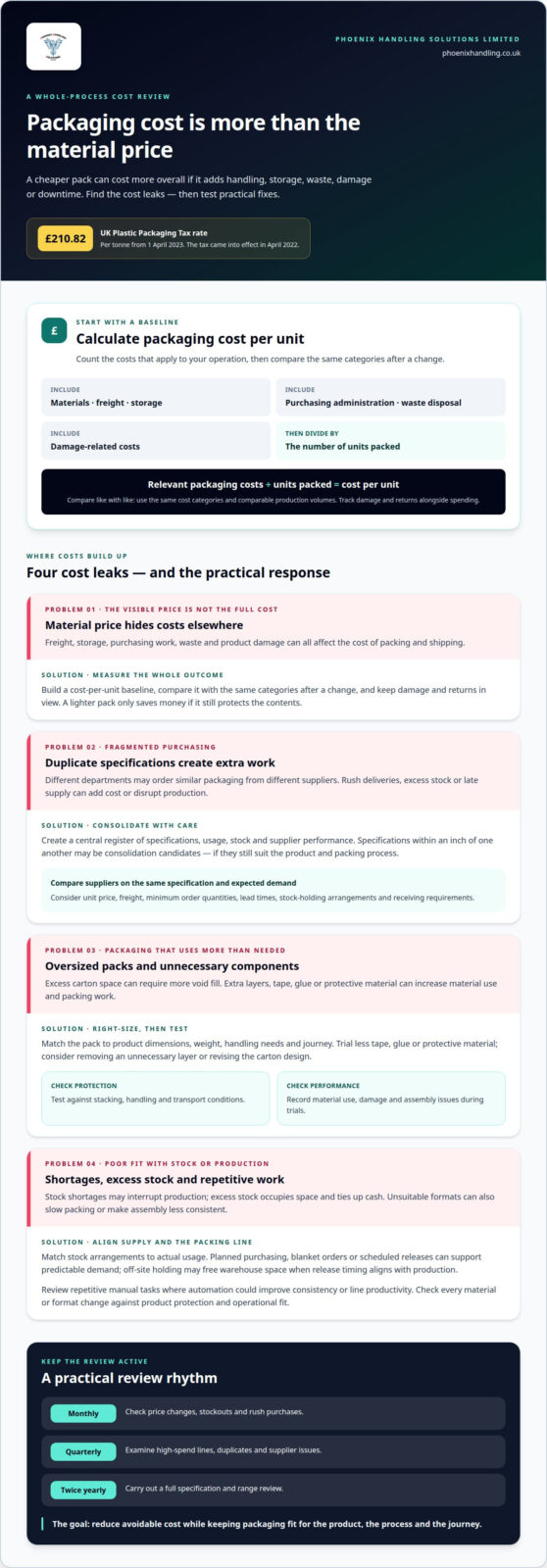
Packaging costs extend beyond the material price to purchasing, handling, storage, transport, waste and product damage. HM Revenue & Customs states that the UK Plastic Packaging Tax came into effect in April 2022. HM Revenue & Customs states the rate as £210.82 per tonne from 1 April 2023. These charges make material choice and packaging waste relevant to cost reviews.
To reduce material costs without compromising protection, assess the pack against the product’s dimensions, weight, handling needs and journey. Right-size cartons to reduce void fill, then test whether less tape, glue or protective material still secures the product. Removing an unnecessary layer or adjusting a carton’s design can also cut material use. Include damage, returns and product condition in the assessment: a lighter pack saves money only if it continues to protect the contents.
Calculate packaging cost per unit by adding relevant material, freight, storage, purchasing administration, waste disposal and damage-related costs, then dividing by the number of units packed. Compare this baseline with the same cost categories after a change, using comparable production volumes. Track damage and returns alongside spending so apparent savings do not conceal weaker protection or higher losses.
Purchasing orders and supplier management involve work beyond buying packaging. Consolidating duplicate specifications can reduce administration and coordination, while planned purchasing can help avoid rush deliveries. Stock shortages may disrupt production; excess stock occupies space and ties up cash. Freight matters too: smaller packs can allow more units per shipment, improving load efficiency and potentially reducing transport emissions.
Review waste as well as packaging purchases. Cutting unused fillers, offcuts and disposable protective materials can reduce disposal volumes. Check every proposed material change against the packing process, product protection and transport requirements. This makes cost reduction a measured improvement rather than a simple substitution that risks damage or returns.
2. Consolidating packaging procurement and suppliers
Fragmented purchasing can leave departments ordering duplicate packaging lines from different suppliers. Build a central register of specifications, usage, stock levels and supplier performance, then identify products that serve similar applications. Specifications within an inch of one another may be candidates for consolidation, provided they still suit the product and packing process. Teams asking how to reduce packaging operational costs can use this review to find duplication before changing supply arrangements.
Compare suppliers using the same specification and expected demand. Include unit price, freight, minimum order quantities, lead times, stock-holding arrangements and receiving requirements. A lower unit price may not reduce total cost if deliveries arrive late, require excess storage or disrupt production. Use existing specifications to request comparable bids, then negotiate forecast volumes, delivery schedules and agreed specification changes.
Match stock arrangements to actual usage to maintain supply continuity. Predictable demand can support annual usage planning, blanket orders or scheduled releases without requiring the full quantity to be stored on site. Off-site stock holding can free warehouse space, provided release timing and replenishment align with production. Include supplier lead times and responses to demand changes in your supply-chain review.
Keep supplier collaboration practical. Share specification changes and use an approval process to ensure revised materials or dimensions reach the production line as intended. Suppliers can help assess options to reduce weight or simplify handling. Evaluate each proposed change for product protection and operational fit.
Review performance at set intervals: check price changes, stockouts and rush purchases monthly; examine high-spend lines, duplicates and supplier issues quarterly; and conduct a full specification and range review twice yearly. These steps keep purchasing decisions tied to current demand. If procurement planning also involves packaging-line equipment, packaging machinery options can form part of the wider operational assessment.
3. How Does Packaging Material Optimization Fit In?
Packaging redesign can reduce material use and assembly work when it reflects the product’s actual protection needs. In one example, secondary packaging changed from C flute to B flute corrugated board after testing found that the primary packaging supplied stacking strength. This shows why material grade should follow pack performance, not habit. The right specification depends on the product, stacking conditions and handling through dispatch.
Start with the pack’s dimensions and construction. Right-sizing a carton can reduce empty volume and void fill, while revised geometry may remove unnecessary layers or components. A self-seal crash-lock box, for example, can eliminate the need to apply tape during packing. Fewer manual adjustments can also help a line assemble packs consistently and reduce labour or downtime.
Assess board grades against the complete load and journey. Compare the existing grade with a lighter alternative through trials that reflect stacking, handling and transport conditions. If tests show that the product’s primary pack provides sufficient strength, the outer board may not need the same specification. Record damage and assembly issues during trials, alongside material use.
Material selection affects packaging costs beyond the purchase price. Lightweight, recyclable or renewable alternatives may reduce material demand, but suitability depends on product protection, packing equipment and end-of-life handling. Replacing a foam insert with moulded pulp, for instance, can change material use and assembly requirements. Assess each option against the packaging’s function and expected supply-chain conditions.
Measure the effect across a consistent production volume. Compare material consumed, packing time, freight space and damage outcomes before and after a redesign. A lighter or smaller pack may save on materials and transport, while an awkward design can add labour. This makes material reduction a controlled engineering change, not a substitution based only on unit price.
4. Using automation to improve consistency and productivity
Automation can reduce variation in repetitive packaging tasks, including case handling, sealing and pallet movement. In manufacturing, manual packing can create uneven cycle times and leave operators balancing several tasks. For shipments using 0201 cartons, workers may spend up to 60% of their time applying tape. This makes sealing a process step worth assessing. A practical starting point for how to reduce packaging operational costs is to identify where repeated manual work constrains throughput.
Production runs affect how efficiently equipment and materials are used. Longer, predictable runs can support repeatable settings and reduce changeovers, while frequent shifts between pack formats call for flexible processes. Review the retail order mix, carton sizes and production schedule together. This helps determine whether a dedicated automated step suits the volume or a flexible line better accommodates changing requirements. For operations managing diverse product lines, sourcing on-demand labelling and finishing hardware from specialists such as OptiMediaLabs Canada can also reduce pre-printed inventory costs and streamline packaging changeovers.
Automation should remove unnecessary handling, not shift it elsewhere. Map movements from production through packing and dispatch, then identify repeated lifting, waiting or manual transfers. Automated Guided Vehicles can move loads along planned routes between work areas. Their suitability depends on traffic patterns, load requirements and integration with existing workflows. These factors help identify where targeted automation can reduce packaging operational costs.
Include packaging regulations and producer responsibility in the operating-cost review. UK Packaging Waste Regulations and Extended Producer Responsibility reforms are designed to shift more disposal and compliance costs onto producers over time. Reducing waste on the line can support material efficiency and waste management. Track packaging consumption and rejected packs alongside output to identify avoidable material use.
Assess an automation proposal against throughput, changeover demands, floor space and operator tasks. Compare current cycle times and stoppages with the intended process, then monitor the same measures after implementation. This links equipment decisions to production outcomes rather than assumed savings. To assess material movement within your operation, discuss Automated Guided Vehicles as part of the logistics flow.
Phoenix Handling Solutions Limited: Pick & Pack De Palletisers
Phoenix Handling Solutions supplies Pick & Pack De Palletisers for operations that need to depalletise palletised goods for picking or packing. They can help reduce repetitive manual handling between pallet receipt and the next production or distribution step. Select equipment to suit the loads, product formats and required workflow.
For finished pallet loads, Pallet Wrapping Machines, Strapping Machines and Stretch Hooders offer different load-securing methods. The right option depends on the packaging process and dispatch requirements. Review these stages together to see where equipment fits the operational flow.
If your packaging or pallet-handling process has recurring manual tasks, contact Phoenix Handling Solutions Limited to discuss the equipment suited to your operation.
Put the next efficiency improvement into operation
Choose a packaging process where a defined constraint limits output, then set a clear measure to assess any change. An operational owner can document the existing workflow, coordinate input from production and logistics, and review the results after implementation. This provides a practical basis for reducing packaging operational costs without treating equipment as a standalone purchase.
Match equipment to the task and load requirements. Pallet Wrapping Machines, Strapping Machines and Stretch Hooders offer different ways to secure finished pallet loads. The right configuration depends on the existing line, packaging format and dispatch process. An assessment can establish whether automation addresses the constraint or whether process changes should come first.
Use the next project to set measurable operating criteria and responsibilities before installation planning begins. A focused scope makes the decision easier to evaluate and gives the team a clear reference for ongoing improvement. Contact Phoenix Handling Solutions Limited to discuss your packaging operation and its equipment requirements.
Frequently Asked Questions
What Factors Raise the Cost of Packaging a Product?
Packaging costs rise when purchasing and production processes create extra work beyond the pack itself. For example, requiring a separate approval for each minor specification change can delay orders and add administration. Short production runs may also mean more frequent changeovers or material setups. Assess how packaging decisions create work across purchasing, production and dispatch instead of treating the material invoice as the only cost.
How Can Companies Reduce Packaging Costs and Increase Profit?
Companies can improve profit by directing savings towards costs that affect each order, while protecting product quality and customer requirements. A manufacturer supplying retail customers, for example, can assess whether packaging dimensions, presentation and handling meet agreed requirements without unnecessary complexity. Compare a change’s effect on order contribution, not just material cost, and retain the quality or service criteria that influence repeat purchasing.
How Can Design Choices Improve Packaging Productivity?
Design choices can improve productivity when they make packs easier to orient, handle and process consistently. A carton with clearly defined opening and closing panels, for example, can reduce hesitation during assembly. Consistent dimensions across related formats can simplify line settings and reduce avoidable adjustments between products. Assess the design at the packing station, where access, orientation and movement shape the operator’s workflow.
How Does Packaging Material Optimization Fit In?
Optimise materials by matching each component to its purpose. If a product uses several separate cushioning pieces, assess whether a single formed insert could provide the required positioning and separation. Compare the proposed design with the current pack using representative products and handling conditions. Consider compatibility with the packing process and disposal route, as well as the material used per finished pack.
What Are Some Real-World Packaging Reduction Examples?
A healthcare company changed its packaging configuration to fit more cases on each pallet and more pallets in each trailer. This illustrates how pack geometry can affect pallet capacity and vehicle use. The example is relevant to products shipped in regular pallet loads, but the configuration must suit the product and distribution process. Assess the complete load arrangement, not just the individual case.
What Are the Most Cost-Effective Packaging Solutions?
The most cost-effective solution depends on the task, production pattern and finished load. For repetitive pallet securing, compare Pallet Wrapping Machines, Strapping Machines and Stretch Hooders against the required load format and existing workflow. Consider how each option fits the available floor space, line operation and dispatch requirements. Choose equipment to address a defined process need, rather than adding it when the current method already meets operational requirements.