
Automation changes warehouse risks, it does not remove them. Health and safety in automated warehouses matters because people, vehicles, conveyors and stored loads can interact in ways that require clear controls. Automated equipment can reduce manual lifting and reliance on forklifts, but safe operation still depends on detecting hazards, responding promptly and separating people from moving machinery.
Automation can make some tasks less physically demanding. The practical question is how to manage the risks that remain and those created by equipment moving through shared or restricted areas. This article explains hazard detection and emergency response, how automated guided vehicles use designated routes and safety zones, and why risk assessments, staff training and clear operating procedures remain essential.
Key Takeaways
- Use automation to reduce manual handling and forklift reliance, while assessing the hazards created by moving equipment and loads.
- Plan hazard detection alongside alarms, accessible emergency stops and clear response procedures.
- Separate vehicle routes from pedestrian areas with designated safety zones and clear rules for access and restart.
- Keep risk assessments, staff training and operating procedures aligned with the equipment and its limitations.
Why is warehouse safety important?
Warehouse automation can reduce strenuous handling, but moving loads and machinery still create risks. Safe operation depends on assessing how equipment, workers and goods interact.
Manual handling and workplace injuries
Manual handling means lifting, carrying, pushing or moving material by hand. Repeated heavy lifting can contribute to musculoskeletal problems, even for trained workers. An automated mobile robot can transport a heavy load across the floor, reducing the need for an operative to carry it. Goods-to-person picking can also reduce walking and repetitive handling. The benefits depend on how tasks are redesigned around the equipment.
Risks from warehouse automation
Automated systems introduce mechanical hazards alongside manual-handling risks. Robots can strike people or goods; conveyors can trap clothing or limbs in moving parts; and automated storage and retrieval systems (AS/RS) can expose workers to moving equipment or falling loads. Someone entering a restricted area during operation may face different risks from someone working at a designated access point. Controls need to suit each task.
Assessing risks before installation and operation
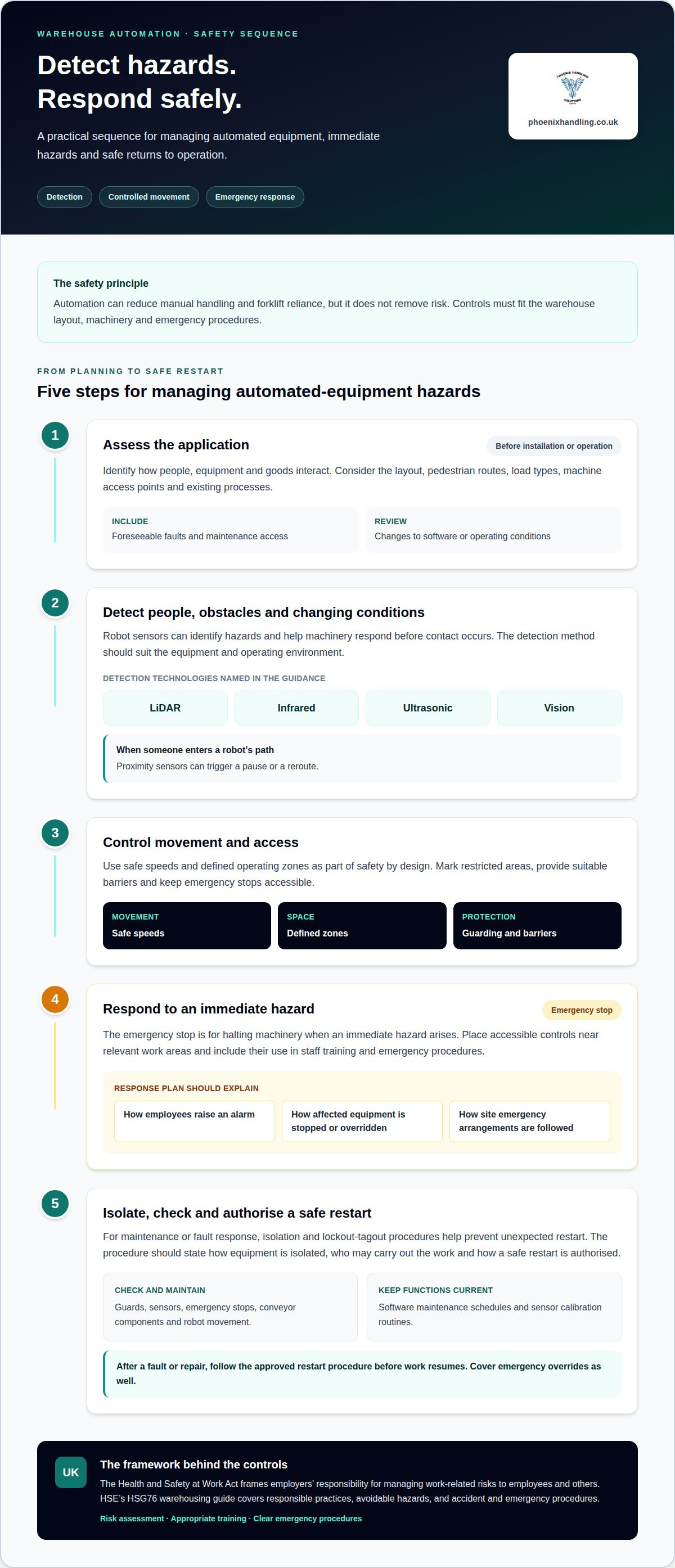
A risk assessment identifies hazards for a specific automation application and defines controls before equipment is installed or operated. Consider the layout, pedestrian routes, load types, machine access points and how automated equipment interacts with existing processes. The assessment should also cover foreseeable faults, maintenance access and changes to software or operating conditions. HSE guidance and HSG76 support responsible warehouse practice; staff training should explain equipment limits and emergency procedures.
Equipment inspections and injury statistics
Inspection and maintenance checks help identify faults before equipment returns to operation. Include guards, sensors, emergency stops, conveyor components and robot movement in planned checks. Keep software maintenance schedules and sensor calibration routines current. After a fault or repair, follow the approved restart procedure before resuming work. Use UK-specific reporting for UK injury figures, as US warehouse statistics do not establish UK rates. Recording incidents and near misses by task and equipment can reveal recurring hazards and show when controls need review.
Real-time hazard detection and emergency response
Automated safety systems can detect hazards and trigger alarms, notifications or corrective action. Their controls need to match the warehouse layout, machinery and emergency procedures.
Robot sensors and speed limits
Robot sensors identify people, obstacles or changing conditions so machinery can respond before contact occurs. LiDAR, infrared, ultrasonic and vision systems can support obstacle detection, while proximity sensors can trigger a pause or reroute when someone enters a robot’s path. Safe speeds and defined operating zones are part of safety by design. These controls matter in shared environments, where employees may cross a robot’s route during normal work.
Emergency stops and equipment isolation
An emergency stop provides a way to halt machinery when an immediate hazard arises. Place accessible stop controls near relevant work areas, and include them in staff training and emergency procedures. Isolation and lockout-tagout procedures address a different situation: maintenance or fault response when equipment must not restart unexpectedly. Procedures should state how machinery is isolated, who may carry out the work, and how a safe restart is authorised. Cover emergency overrides as well.
Employer duties and emergency response
The Health and Safety at Work Act frames employers’ responsibility for managing work-related risks to employees and others. For automated warehouses, that means planned controls, appropriate training and emergency procedures for machinery, collisions and equipment faults. HSE’s HSG76 warehousing guide addresses responsible practices, avoidable hazards, and accident and emergency procedures. Its principles apply across warehousing, regardless of facility type or size.
For robots and automated machinery, safety by design combines risk assessment, guarding, sensors, safe speeds, defined zones and clear procedures. Layouts should mark restricted areas, provide suitable barriers and keep emergency stops accessible. A response plan should explain how employees raise an alarm, stop or override affected equipment, and follow the site’s emergency arrangements. Software maintenance schedules and sensor calibration routines help keep detection functions aligned with operating conditions.
Automated guided vehicles and safety zones
Automated guided vehicles (AGVs) move goods along planned routes, changing how workers and other vehicles share warehouse space. Routes, transfer points and access rules should fit the site’s traffic plan.
Automated vehicle traffic
AGVs follow fixed navigation paths and use built-in sensors designed to avoid collisions with people, goods or infrastructure. Coordinating their routes with forklift aisles, pedestrian crossings and conveyor transfer points helps control conflicting movements. For example, a route crossing a picking area needs clear right-of-way rules and suitable visibility. Planned traffic flow can support productivity while reducing unplanned stops and interactions between workers and repetitive goods movements.
Separating pedestrian and vehicle routes
Separate routes use designated zones to keep heavy machinery away from pedestrian traffic. Mark pedestrian walkways, AGV paths and crossing points clearly, then use barriers where the layout requires physical separation. Workers should know where they may enter an automated zone and how to report a fault. This makes shared-space risks easier to identify and gives staff a consistent way to move around operating vehicles.
Fire protection also affects vehicle and conveyor routes. Where fire-resistant screens divide a warehouse or isolate higher-risk goods, fire doors may be needed for vehicles, conveyor belts and personnel. These openings need to fit the movement plan without leaving the protected boundary unmanaged. For example, a vehicle route through a fire door should be considered alongside normal traffic and emergency access arrangements.
Site procedures should cover entry into automated zones, machinery restarts and fault reporting. Define who can authorise access, how workers communicate with vehicle operators, and what happens when an AGV stops on a route. Review procedures when the layout or traffic pattern changes. Applicable safety regulations and emergency plans should inform how routes, barriers and fire doors are managed.
Automation and warehouse safety
Automation changes where warehouse risks occur rather than removing them. A conveyor, robot or automated storage system can reduce manual tasks, but introduces moving equipment, sensors and software-dependent processes. Effective safety measures account for these interactions, the work being automated and the tasks employees still perform nearby. This joined-up approach is central to health and safety in automated warehouses.
Automated goods retrieval and warehouse planning software can reduce walking distances. In a large facility, shorter routes can help limit fatigue and related risks such as accidents and joint strain. Automated equipment can also take on repetitive picking and packing, reducing repeated lifting and carrying. Remaining manual work still needs assessment, particularly when workers replenish stock or clear faults.
Automated storage and retrieval systems can keep moving parts away from operators. Safety functions at access ports can stop movement if a problem or operator error occurs. For instance, an access port opening during retrieval should trigger the relevant safety response before someone reaches into the machinery. Access design, guarding and the restart procedure should work together rather than relying on a single sensor.
Connected monitoring can provide information about conditions that machinery alone may not reveal. Internet of Things sensors can track air quality, temperature and sound, helping managers identify changes in the working environment. RFID tags can track goods in real time, supporting safe storage and helping reduce risks from overstocking or mishandling. Wearable devices, such as smartwatches, helmets and vests, can help monitor fatigue or excessive strain.
Automation also depends on operational planning. Staff need training in the system’s limitations, fault reporting and emergency response. Software maintenance schedules and sensor calibration routines help keep safety functions aligned with operating conditions. Machine-learning tools can assess fatigue, risk levels and load balancing when assigning work, but these measures must sit within updated risk assessments and clear procedures. Reviewing health and safety in automated warehouses as processes change helps keep controls relevant. Minimising injuries requires coordinated design, monitoring and human oversight.
For sites assessing vehicle movements as part of this safety plan, discuss automated guided vehicles as one element of the wider warehouse layout.
Phoenix Handling Solutions Limited: Automated Guided Vehicles
Phoenix Handling Solutions Limited supplies Automated Guided Vehicles for warehouse material movement. They can suit operations looking to organise repetitive transfers between defined areas and reduce reliance on manually operated vehicles. Consider their role alongside pedestrian routes, access points, conveyor interfaces and site procedures, so the traffic plan accounts for people and equipment together.
For projects involving pallet handling, Phoenix Handling Solutions Limited also supplies Pallet Wrapping Machines, Strapping Machines and Stretch Hooders. These systems address different stages of packaging operations and should be assessed against process requirements and site layout.
Contact Phoenix Handling Solutions Limited to discuss Automated Guided Vehicles for your warehouse.
Plan the next stage around the work
Make the next automation decision part of a wider review of warehouse operations. Map material flows, employee tasks and maintenance access together, then review the arrangements when the layout or process changes. This keeps health and safety in automated warehouses connected to how the site actually works, rather than treating safety controls as a separate exercise.
For packaging operations that also need attention, Phoenix Handling Solutions Limited supplies Pallet Wrapping Machines, Strapping Machines and Stretch Hooders. Consider these alongside the handling process when planning equipment changes, with the application and layout guiding the specification.
A defined project scope gives discussions a practical starting point: outline the movement requirements, operating environment and intended process changes. Contact Phoenix Handling Solutions Limited to discuss your warehouse requirements and identify a suitable next step.
Frequently Asked Questions
How do warehouse robots operate safely around people?
Warehouse robots use sensors and cameras to detect obstacles and respond to changes around them. A robot may pause or reroute when a worker or misplaced pallet blocks its path. Safe operation also depends on workers following site procedures, reporting faults and understanding where they can enter automated areas. For example, a blocked route should prompt the designated fault-reporting process, not an attempt to move the robot manually.
What is safety by design in robotics?
Safety by design means incorporating risk controls into a robotic system’s design and installation, rather than relying only on workers to avoid hazards. It brings risk assessment, guarding, sensors, safe speeds, defined zones and clear procedures together. For a robotic loading task, consider how the load moves, where people may need access and how maintenance can be carried out safely before the system enters operation.
What UK health and safety laws apply to automated warehouses?
The Health and Safety at Work etc. Act 1974 sets the general framework for managing workplace health and safety. Employers must consider risks created by automated equipment and protect employees and others affected by the work. HSE’s HSG76 warehousing guide provides practical guidance on preventing hazards and managing accidents and emergencies. It is guidance, not a separate Act; site arrangements should reflect the equipment and activities involved.
What training and procedures should warehouse workers receive for working near automated systems?
Training should explain how each system operates, its limitations, site safety protocols and the response to emergencies or faults. Workers need clear procedures for entering automated zones, reporting a fault and restarting machinery after a stop. For example, induction in a new picking area should explain authorised access and whom to notify if a robot stops unexpectedly. Refresher training should cover changes to equipment or working procedures.