
A warehouse can appear ready for automation and still have aisles, storage or data that make it difficult to integrate. Future proofing warehouse operations in 2026 means assessing how storage capacity, data quality, connected systems and the physical layout work together, with robot access considered from the outset.
Automation can improve material flow, but equipment needs to fit the operation and the building it serves. A practical assessment helps identify constraints before they shape investment decisions. This article explains how to review storage suitability, the accuracy and timeliness of warehouse data, integration between operational systems, and layout factors such as aisle access. It also shows how these checks inform a plan for automation that can develop alongside the warehouse’s needs.
Key Takeaways
- Use historical throughput and warehouse performance indicators to identify where labour, space or process constraints may justify automation.
- Assess inventory accuracy and the timeliness of operational data before relying on AI or automated decisions.
- Map how warehouse, enterprise resource planning and transport systems exchange information to expose integration gaps.
- Evaluate racking, aisle access and material flow together so automation can operate within the physical layout.
1. UK Warehouse Automation Guide: Ready for 2026?
Start with labour, throughput and usable storage space. Warehouse labour accounts for 50 to 70% of warehousing costs, while UK businesses have experienced wage-cost increases of 15-20% since 2021. Compare order volumes, picking rates, accuracy, cycle count variance and turnaround times across busy and quieter periods. These indicators show where manual handling, congestion or capacity limits constrain productivity.
Manual processes can respond directly to unusual orders and changing priorities, while automation can support repeatable movement of goods. The right balance depends on task consistency, volume, available space and how readily workers can take on other tasks. Automation costs in the UK depend on the equipment, layout, throughput and system integration required. The price is provided after a quote request.
Warehouse automation is an evolving part of the UK market, with adoption shaped by operational needs. More than 90% of warehouses use some form of warehouse management system (WMS), but only 25% of survey respondents actively manage labour within one. A WMS can provide operational data; connected conveyors, robots or automated storage and retrieval systems (AS/RS) can act on defined tasks.
Partial automation combines workers and machines. For example, a robot can move goods while staff handle exceptions and quality checks. Automated storage and retrieval systems (AS/RS) can make better use of vertical space, but suitability depends on stock profiles, access needs and building layout. Assess these factors alongside demand rather than treating equipment as an isolated decision.
For UK warehouse operations in 2026, the HSE Warehousing Guide is a reference for workplace standards. A plan should address safe access, equipment operation and how workers interact with automated movement. A professional can map WMS data and operational tasks to identify suitable AI or robotics applications, then assess the required integration.
When planning future-proofing, give the equipment supplier warehouse drawings, storage and product details, throughput patterns, order profiles, current system information and operational constraints. These details help connect a proposed automation system to actual workflows.
2. AI adoption and warehouse data quality
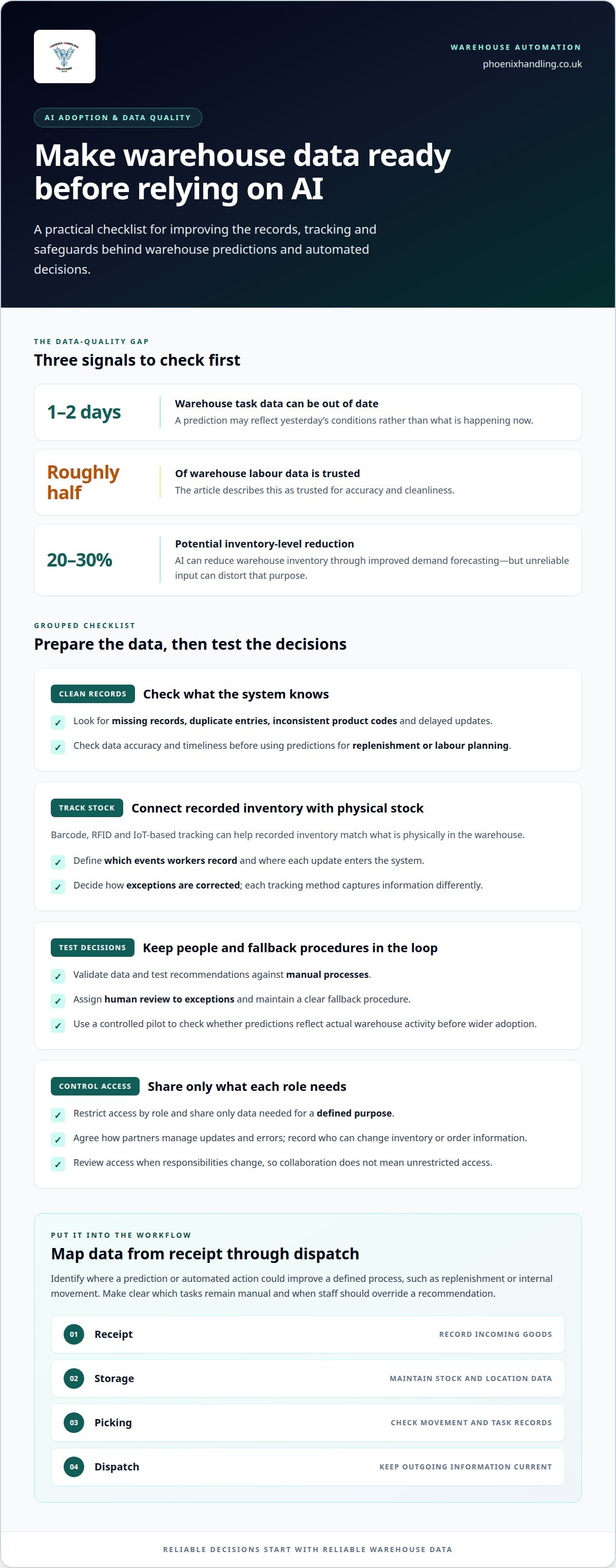
AI forecasts rely on accurate records of stock, orders and movements. Warehouse task data can be one to two days out of date, so decisions may reflect yesterday’s conditions. Roughly half of warehouse labour data is trusted for accuracy and cleanliness. Before using predictions for replenishment or labour planning, check for missing records, duplicate entries, inconsistent product codes and delayed updates.
Unified warehouse data gives forecasting tools a consistent view of supply, demand and stock movement. For example, barcode, RFID and IoT-based tracking can help recorded inventory match physical stock. Each method captures information differently, so define which events workers record, where updates enter the system, and how exceptions are corrected. AI can reduce warehouse inventory levels by 20 to 30 percent through improved demand forecasting, but unreliable input can distort that purpose.
Automation risks include incorrect AI recommendations, disrupted workflows and exposure of shared operational data. Reduce these risks by validating data, testing decisions against manual processes, assigning human review to exceptions and maintaining a clear fallback procedure. A controlled pilot can also show whether predictions reflect actual warehouse activity before wider adoption.
Sharing supply-chain data can connect warehouse teams with suppliers, carriers and planning functions, but each connection expands the flow of information. Restrict access by role, share only data needed for a defined purpose, and agree how partners will manage updates and errors. Record who can change inventory or order information, then review access when responsibilities change. These controls enable collaboration without giving every user unrestricted access.
For a leading AI or robotics plan, map data from receipt through storage, picking and dispatch. Then identify where a prediction or automated action would improve a defined process, such as replenishment or internal movement. The workforce should understand which tasks remain manual and when staff must override a recommendation. Where movement automation is relevant, automated guided vehicles can form part of an assessment of data, routes and operating requirements.
3. Integration with ERP and transport systems
Enterprise resource planning (ERP), warehouse management systems (WMS), transport management systems (TMS) and visibility platforms support different decisions. Integrating them can connect warehouse information with sourcing, planning, finance and fulfilment. For example, an order change recorded in the ERP should reach the WMS and inform transport planning. Clear data ownership helps prevent conflicting stock, order and dispatch records across the network.
A scalable WMS should support current workflows and accommodate changes in demand, product range and automation. Assess how it handles receiving, location control, picking, packing and dispatch, then map each process to the information required by connected systems. A phased upgrade can prioritise essential interfaces, such as order release and despatch confirmation, before adding further automation or reporting. This provides a practical basis for future-proofing warehouse operations in 2026.
Integration relies on consistent product, location and order records. An assessment should map where each record is created, updated and used, then identify duplicate entry or delayed transfers. Test exceptions as well as routine orders, such as partial fulfilment, a changed delivery slot or stock moved to another location. These scenarios show whether connected systems exchange useful information under operational pressure.
Technology planning should account for physical storage too. Modular racking can accommodate changes to product mix or storage configuration, provided its design suits the goods, handling methods and building. When assessing energy-efficient storage, consider equipment operation, travel distances and stock access. Coordinate layout changes with WMS locations and transport flows so a revised configuration does not disrupt established system rules.
A plan to future-proof warehouse operations in 2026 starts with mapping current processes, interfaces, storage and demand patterns. A professional can use this assessment to identify constraints, set upgrade priorities and sequence system changes around operational requirements. Each stage can then be tested against real workflows, keeping investment aligned with service needs without treating a new management system as a substitute for sound process design.
4. Robot-compatible racking and aisle design
Robot access depends on more than aisle width. Racking, floor condition, turning space, pallet dimensions and traffic routes must work together across the facility. A possible narrow-aisle width for robot access is 1.12 m, but this is not a universal specification. The required clearance depends on the robot, its load, turning movements and the tasks it performs.
A layout assessment should map the full route from storage to picking, packing or despatch. It considers how a robot approaches each bay, turns at aisle ends and passes people or other equipment. A route that allows forward travel, for example, may still need extra space for turning or transferring a load. These details affect movement, access and the risk of errors.
Racking design must suit the inventory and handling equipment. Beam levels, load positions and pallet presentation affect whether a robot can retrieve or deposit goods consistently. The assessment should also consider stock rotation and replenishment, keeping frequently picked products accessible without obstructing other movements. A change in product mix can alter these requirements.
Assess the facility against realistic operating conditions, not just a theoretical peak. Map representative picking patterns, traffic intersections, charging or parking areas, and places where manual work remains necessary. This helps anticipate congestion and identify where route changes, revised storage assignments or another automation approach may be needed. Separating people’s routes from machine routes also supports orderly operations.
For pallet handling, a robotic palletiser may suit a defined end-of-line task, while mobile robots address movement between locations. The equipment choice should follow the product, pallet pattern, throughput and available space. To assess robot-compatible pallet handling and facility flow, discuss your warehouse layout and automation requirements.
Phoenix Handling Solutions Limited
Phoenix Handling Solutions Limited designs and supplies packaging and warehouse automation equipment to match operational requirements. After assessing storage, data, system connections and layout, its equipment can support specific process stages, from palletising to load protection.
Pallet Wrapping Machines, Strapping Machines and Stretch Hooders offer different ways to secure pallet loads, while Bag Palletisers automate bag handling. The right option depends on the product, packaging process, throughput and available space. Phoenix Handling Solutions Limited also supplies custom-engineered equipment when a standard configuration does not suit the operation.
Share your warehouse requirements with Phoenix Handling Solutions Limited to discuss suitable equipment.
Make the next investment fit the operation
Future-proofing warehouse operations in 2026 is not a single equipment decision; it is a sequence of choices that should remain coherent as demand and workflows change. Turn assessment findings into a practical order of work: identify the constraint affecting flow, define what a successful change must achieve, and decide how its effect will be measured. This gives teams a clear basis for choosing whether to address processes, data connections, layout or machinery first.
Keep operational ownership at the centre of the plan. Involve the people responsible for warehouse processes, systems and equipment so decisions reflect actual handling conditions and day-to-day needs. A staged approach helps set priorities instead of treating every potential upgrade as equally urgent. A clear sequence supports considered decisions while keeping operational requirements in view.
Phoenix Handling Solutions Limited can discuss equipment requirements for pallet handling and load protection. Contact Phoenix Handling Solutions Limited to discuss a suitable next step for your operation.
Frequently Asked Questions
The Essential UK Warehouse Automation Guide: Is Your Storage Ready for 2026?
Storage is ready for automation when its locations, loads and handling routes suit the equipment and stock profile. Check whether pallet dimensions are consistent, fast-moving goods are accessible, and replenishment movements conflict with picking. Seasonal changes in stock also matter: a layout that works during steady demand may create access or capacity constraints at peak times.
What warehouse automation trends are expected in 2026?
AI applications and mobile robotics are prominent growth areas in warehouse automation. AI-powered warehouse automation solutions are growing at a 22% compound annual growth rate, while mobile robotics in the UK warehouse automation market is growing at 25%. These trends support closer attention to data quality and mobile equipment requirements. Their operational value depends on matching each system to a specific task and workflow.
How can warehouses prepare for labour shortages and changing workforce skills?
Prepare workers for changing tasks with cross-training, structured induction and practical system instruction. Training employees in both picking and receiving, for example, can help teams respond to shifts in workload. Explain how WMS tasks connect to wider workflows, and provide equipment training suited to each role. Clear role profiles should describe shift patterns, physical requirements and the technology workers will use.
What energy efficiency and sustainability measures can future-proof UK warehouses?
Prioritise measures that address energy use and material waste in everyday operations. Energy-efficient lighting, optimised equipment routes and waste-reduction programmes can all form part of an operational plan. Reusable packaging and solar power integration are other options to assess against the building and workflows. Review how equipment movement, lighting and packaging choices affect resource use, then set priorities that suit the facility.
What UK regulations affect warehouse operations and automation in 2026?
The HSE Warehousing Guide provides a reference for workplace standards. Plans should address safe access, equipment operation and how workers interact with automated movement.