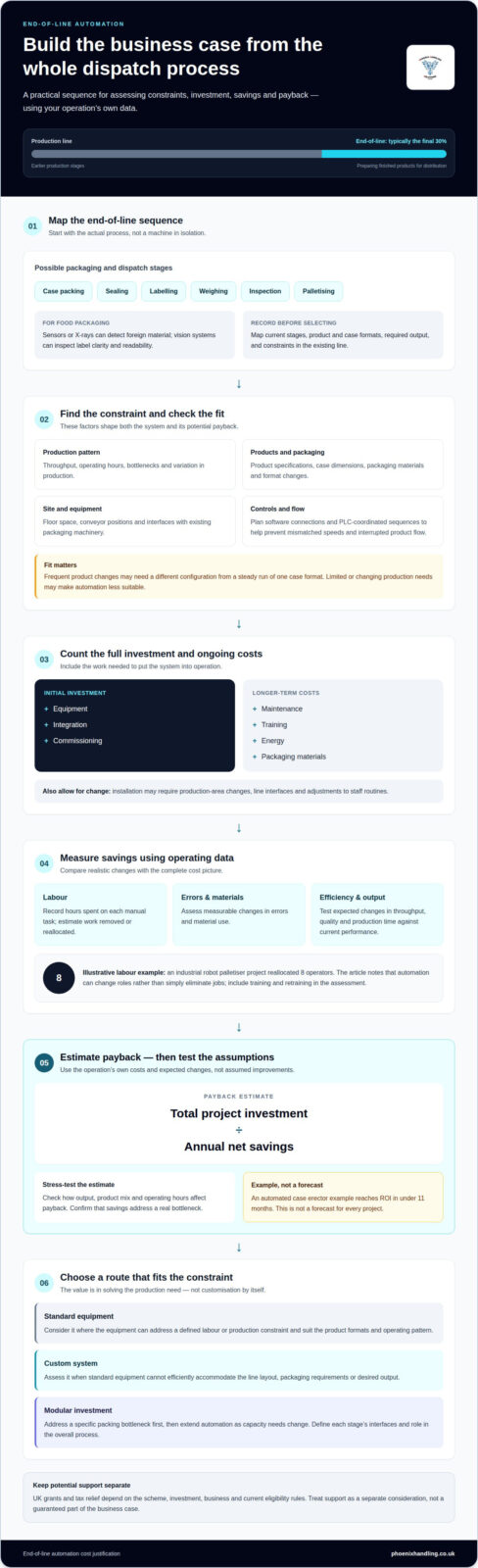
The strongest case for end-of-line automation is measured across the whole dispatch process, not by the equipment alone. It covers the final production steps of preparing, packing and palletising finished products for distribution, typically within the last 30% of a production line. A sound end-of-line automation cost justification weighs the investment against potential savings in labour, materials, errors and production time.
Justifying end-of-line automation rarely comes down to a simple comparison with today’s manual process. Throughput, packaging formats, operating patterns, floor space and integration with existing equipment all affect investment and potential payback. Automation may be less suitable when production needs are limited or change often.
This article explains what end-of-line automation can include, how to assess costs and benefits, and how to estimate payback without relying on a single headline figure. It also explains when a system designed around your production requirements may address constraints more effectively than a standard machine.
Key Takeaways
- Map the final packaging stages, from case packing to palletising, to identify where automation could address a production constraint.
- Assess ROI against both the initial investment and ongoing costs, including labour, materials, downtime and maintenance.
- Consider custom automation when existing layouts, packaging formats or operating requirements make a standard system a poor fit.
- Compare labour, throughput and quality benefits with the training and process changes needed to integrate equipment effectively.
What is End-of-Line Automation?
End-of-line automation covers the final production steps that prepare finished goods for distribution. It can combine packaging equipment, conveyors and controls so products move through these operations in a coordinated sequence.
Scope of end-of-line packaging automation
End-of-line packaging automation can include case packing, sealing, labelling, weighing, inspection and palletising. These stages protect products and prepare them for dispatch, with the equipment selected to suit the package, material and production requirements. Systems typically operate within the final 30% of a production line. For food packaging, sensors or X-rays can detect foreign material, whilst vision systems can inspect label clarity and readability.
Manual and automated operations
Manual operations rely on people for tasks such as placing products into cases, sealing cartons and building pallets. Automated equipment performs repeatable tasks in a defined sequence, helping standardise handling and reduce manual intervention. The right choice depends on actual throughput, packaging formats and process variation. For example, frequent product changes may call for a different configuration from a steady run of one case format.
Repeatable processes can support consistent packaging, while a scalable system can adapt as production needs change. Assess how product specifications, case dimensions and output levels affect the equipment configuration. Existing infrastructure matters too: conveyor positions, floor space and interfaces with packaging machinery shape how a system fits into current operations. Connected equipment communicates through software, while programmable logic controllers coordinate machine sequences and signals. Planning these connections helps prevent mismatched speeds and interrupted product flow.
UK grants and tax relief depend on the scheme, investment, business and current eligibility rules. Treat potential support as a separate consideration, not a guaranteed part of the business case. To assess readiness, map the current packaging stages, record product and case formats, define output requirements and identify constraints in the existing line. Clear, repeatable tasks and defined integration points provide a practical basis for assessing automation.
How long to see ROI from EOL automation?
Payback depends on the initial investment and the net savings automated systems deliver. An automated case erector example reaches ROI in under 11 months, but that figure is not a forecast for every project. A robust end of line automation cost justification uses the production operation’s own costs and expected changes.
Initial investment and ongoing costs
Initial investment includes equipment and the work required to put it into operation. Longer-term costs may include maintenance, training, energy and packaging materials. Compare these outgoings with measurable savings from reduced repetitive work, fewer errors and improved efficiency. Estimate payback by dividing total project investment by annual net savings. Include integration and commissioning in the investment figure, rather than considering equipment cost alone. This gives end-of-line automation cost justification a more complete financial basis.
Challenges of upfront investment
Automation requires capital before production benefits begin. Installation may also require changes to the production area, line interfaces and staff routines. First identify where bottlenecks occur and which repetitive tasks create avoidable costs. If the system does not suit product formats or production patterns, expected savings may not materialise. Base the cost model on current operating data, not assumed improvements.
Incremental investment through modular automation
Modular automation lets a business introduce equipment in stages rather than changing every end-of-line process at once. A manufacturer might first address a specific packing bottleneck, then extend automation as capacity needs change. Each stage needs defined interfaces with existing machinery and a clear role in the overall process. Conveyor systems can link equipment between stages when their capacity and controls suit the line.
A custom system may improve ROI when it addresses a production constraint that standard equipment cannot accommodate efficiently. Its value comes from matching the line layout, packaging requirements and desired output, not from customisation alone. Compare projected savings with the full investment and ongoing costs, then test how output, product mix and operating hours affect payback. This keeps end-of-line automation cost justification specific to the operation and its actual bottlenecks.
Are custom automation solutions worth the upfront costs?
Assess custom automation when standard equipment cannot address a defined labour or production constraint. The decision depends on whether the expected savings and improvements in consistency justify the investment and changes to the production line.
Labour savings and workforce reallocation
Automation can reduce labour costs by taking over repetitive tasks at the final stage, while allowing employees to move to other production work. An industrial robot palletiser example reallocated 8 operators, illustrating how a project can change roles rather than simply eliminate jobs. For manufacturers considering automated equipment across other production departments alongside packaging, automation specialists such as TME Systems Pty Ltd illustrate how collaborative robotics can take over repetitive tasks and ease labour pressures. For a custom system, map the tasks affected and identify where staff time could be used productively. Include training and retraining in the assessment, especially when operators will work with different equipment or processes.
Estimating labour, throughput and quality savings
Estimate labour savings by recording the hours spent on each manual task, then calculating which work the proposed system would remove or reallocate. Compare this with the system’s operating and support requirements. Assess throughput separately by measuring changes in line output, and estimate quality savings from fewer damaged products, packaging errors or rejected items. Vision inspection can support more consistent checks. Keep each benefit distinct to avoid counting the same improvement twice.
Labour turnover and retraining also affect the calculation. Manufacturing employee turnover is reported at 26-28% annually, so repeated recruitment and training can add to the burden of roles involving repetitive work. Treat this as an operational consideration, not an automatic saving: automation does not remove every staffing requirement, and people still need suitable training. A custom solution is more persuasive where it addresses a specific process constraint, such as difficult product handling or inconsistent packing accuracy. Compare the investment with realistic labour, throughput and quality gains, then account for ongoing training and equipment support. If those gains depend on changes to staffing, plan how responsibilities will be reassigned before installation. This gives the business a clearer basis for judging whether customisation solves a real production problem.
What labour, throughput and quality savings can end-of-line automation deliver
End-of-line automation can affect labour, throughput and quality in different ways, so assess each benefit separately. For example, a palletising system may reduce manual handling, while automated case packing can standardise how products enter cartons. The value depends on the effect on actual costs and output. A clear baseline makes the comparison meaningful.
For labour, record the time operators spend on specific tasks, such as closing cases or building pallets. Distinguish hours removed from tasks from hours reassigned to other work. Reallocation can free staff for inspection, replenishment or responding to line interruptions. Include supervision, training and ongoing support in the calculation, rather than treating every affected labour hour as a cash saving.
Throughput gains depend on the constraint being addressed. If manual packing regularly holds up a line, compare completed cases per shift before and after the change. Account for product changes, planned stops and downstream capacity: faster packing alone cannot increase dispatch output if pallet handling becomes the next bottleneck. Automated guided vehicles can support movement between production and staging areas when internal transport limits flow.
Quality savings may come from fewer packing errors, damaged products and wasted packaging material. Record the current frequency and cost of each issue, then track the same measures after implementation. For example, compare incorrect case contents and damaged cartons across equivalent production runs. Keep quality improvements separate from labour savings to avoid double-counting. Assessing task time, line output and defect records together gives a more balanced view of operational impact.
Where internal product movement is part of the constraint, discuss automated guided vehicles as one element of the material-flow assessment.
Phoenix Handling Solutions Limited
Phoenix Handling Solutions supplies packaging machinery to manufacturers, with equipment specified around production requirements, site layout and material flow. Its range includes pallet wrapping machines, strapping machines, stretch hooders and bag palletisers, as well as standard and custom-engineered equipment.
For a cost assessment, define the process constraint, required output and packaging format. These details help determine whether a particular machine or a broader system is appropriate and how it could fit existing operations. Consider the equipment’s role in the line, expected labour and quality effects, and integration requirements instead of relying on a general payback estimate.
Contact Phoenix Handling Solutions Limited to discuss your end-of-line automation requirements.
Turn the business case into a practical next step
A sound end-of-line automation cost justification starts with a clear operational objective. Before progressing a project, define the constraint the proposed change must address and how its effect will be measured. This keeps the decision connected to production priorities, not just equipment specifications.
Set out the assumptions behind the investment case, including expected operating conditions, staff responsibilities and performance measures. A practical evaluation can identify which requirements are fixed and where the system must accommodate change. The right approach depends on the operation, so allow room to refine the specification as requirements become clearer.
Phoenix Handling Solutions can discuss packaging machinery in relation to your production needs. Share the process constraint, output requirements and packaging formats to establish the next steps for assessing a suitable configuration and its place in the wider operation.
Discuss your requirements with Phoenix Handling Solutions Limited and move your assessment forward.
Frequently Asked Questions
What does end-of-line automation include in manufacturing?
End-of-line automation includes equipment and controls that prepare finished goods for dispatch after production. A line might transfer filled cartons to a case packer, close and label cases, then build them into stable pallet loads. The sequence depends on the product and packaging. Some sites also connect the packaging area with warehouse transport, moving completed loads towards storage or dispatch.
How much does end-of-line automation cost in the UK?
There is no single UK price because equipment requirements and project scope vary. The price depends on the case and is provided after a quote request; factors include throughput, packaging formats, site layout, integration work and the level of automation. A standalone machine and a connected line require different specifications. Assess the full project scope rather than treating an equipment price as the total investment.
What factors affect end-of-line automation system costs?
System costs depend on the tasks to automate, required output, and product and packaging characteristics. A line handling several carton sizes may need different changeover arrangements from one handling a consistent format. Costs also reflect equipment interfaces, controls, available floor space and any changes needed to connect machinery. Specify the system around expected production patterns, not just peak output.
How to calculate ROI and payback for end-of-line automation?
Calculate payback by dividing the total project investment by the annual net savings. Include expected labour, material and quality benefits, then subtract recurring costs such as maintenance and training. Use actual production records to estimate the effects, and keep each benefit distinct to avoid double-counting. Test the calculation against different operating conditions, such as lower output or a change in product mix.
What are the costs of integrating end-of-line automation with existing equipment?
Integration costs may include mechanical alterations, conveyor connections, control interfaces, installation and commissioning. The scope depends on how new equipment connects with existing machinery and whether production flow or floor layout needs adjustment. For example, a case packer may require changes to product infeed and downstream transfer. Include planned installation downtime in the project assessment alongside equipment and integration work.
What risks and hidden costs should be included in an automation business case?
Include costs that may arise after installation, such as staff training, planned maintenance, spare parts and production disruption during commissioning. Product format changes may also require equipment adjustments or changes to operating procedures. Assess how a stoppage in one machine could affect connected processes, and account for packaging waste or quality losses during set-up. These considerations help distinguish projected savings from costs the project must absorb.