A robotic palletiser places products onto pallets in a programmed pattern, using a suitable gripper, conveyors and controls. The benefits of robotic palletising systems include more consistent stacking, less repeated manual handling and the ability to run round the clock when designed for 24/7 production. The result depends on the products, pallet pattern, required output and how the system fits the rest of the line.
Reliable pallet loads and less repetitive lifting are clear benefits of robotic palletising systems, but automation also raises questions about safety, investment and return. This article explains how robotic palletisers work and what to consider when assessing their effect on operators, production and pallet handling. It also explores how automated operation can support end-of-line processes, while recognising that people still monitor the cell and manage pallet movement.
Key Takeaways
- Assess throughput across the complete handling cycle, including product infeed, pallet changes and changeovers.
- Plan guarding, access and maintenance clearance as part of the palletising cell layout.
- Evaluate the investment against operating scale, labour requirements, handling errors and expected productivity gains.
- Consider how pallet supply, completed-load removal and downstream equipment affect unattended operation.
What is a robot palletiser?
A robotic palletiser transfers products from an infeed conveyor to a pallet, building a programmed load one item at a time. The palletising cell combines the robot, gripper, controls and product infeed. Grippers are selected to suit the load, as cartons, bags and containers need different forms of contact and support. A programmed sequence sets each product’s position and orientation to help create a stable stack. This replaces repeated lifting and placing with controlled movements at the end of production.
The product range affects system design. A cell may handle cartons, bottles, bags, containers, retail goods or industrial parts when the gripping method suits their dimensions, weight and packaging. A modular arrangement can accommodate different product sizes and weights. Where included, vision systems can help identify product position or orientation before gripping. Floor space and access also shape the layout, including how products enter and completed pallets leave.
For mixed production, stored pallet patterns and product recipes let operators select a configuration for each SKU. Changeovers may require a different stacking pattern, gripper setting or infeed arrangement. Interlocking layers, rotated cartons and different orientations can be programmed to suit the load. Repeated stacks of identical cartons have different handling needs from mixed products with variable positions. Pallet patterns must account for packaging strength and the support products need during transfer.
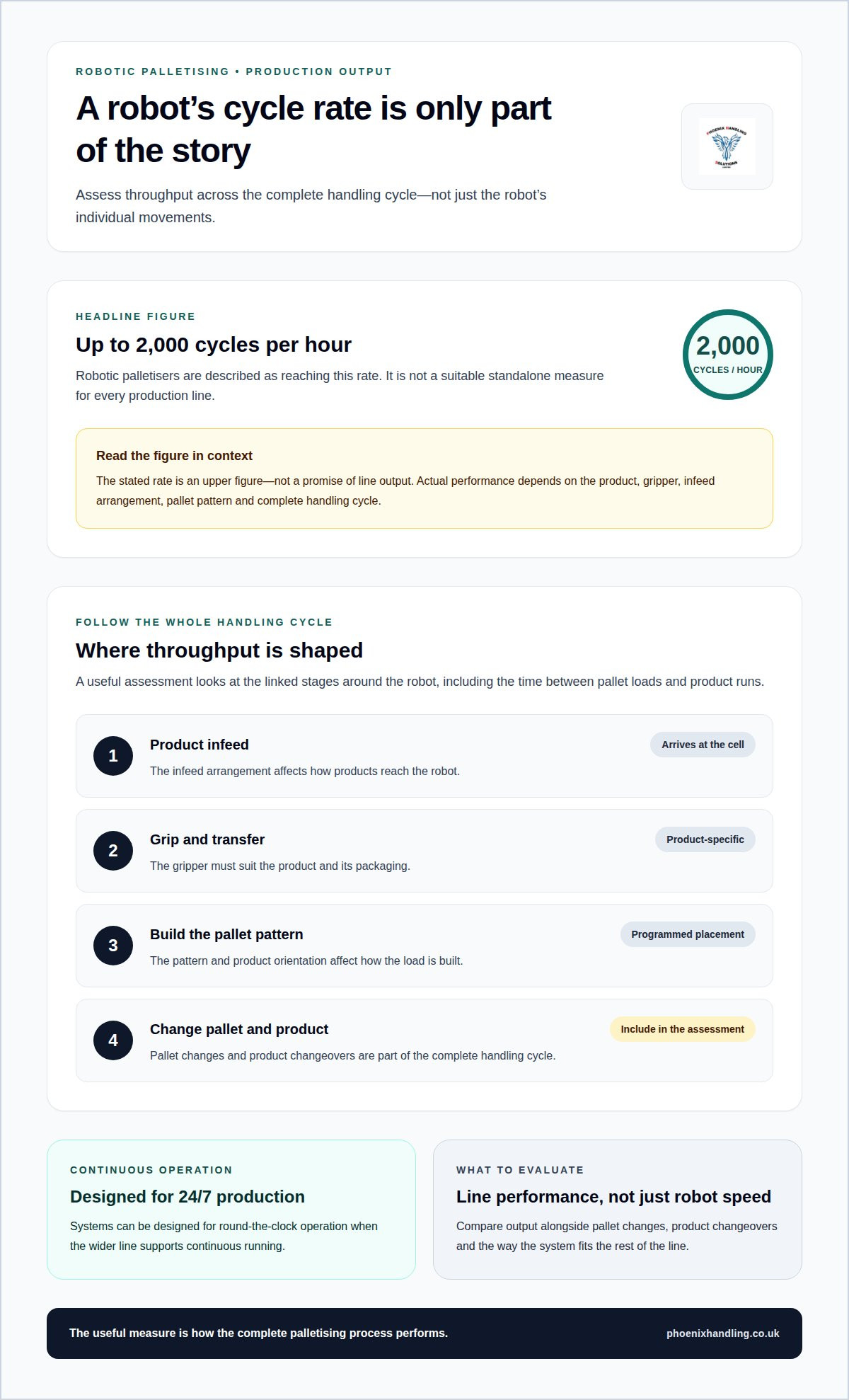
Output depends on the product, gripper, infeed arrangement, pallet pattern and complete handling cycle. Robotic palletisers are described as reaching up to 2,000 cycles per hour, but that figure is not a suitable standalone measure for every line. Assess performance alongside pallet changes and product changeovers, not only individual robot movements. Programmed cycle rates can support more predictable production during long runs. Systems can also be designed for round-the-clock operation, including 24/7 production environments, where the wider line supports continuous running.
Safety barriers, sensors and collision detection
Key risks include contact with a moving robot, trapping at the infeed or pallet position, and repeated manual lifting. In UK workplaces, safe operation depends on controls suited to the cell and its tasks, including appropriate guarding, sensors, safe access and maintenance clearance.
Protective barriers separate people from the robot’s working area, while sensors can detect entry or obstructions. Collision detection can stop movement if an obstruction is detected. For example, someone reaching into the cell to clear packaging must not be exposed to uncontrolled robot movement. The infeed, pallet positions and access points need consideration alongside the robot’s programmed patterns and operating capacity.
Guarding also shapes routine work. A well-planned cell can reduce direct involvement in stacking and repeated lifting, twisting and bending at the end of the production line. It changes the task rather than removing the need for people: operators still monitor the process, manage pallet movement and respond to interruptions. Clear access for replenishing pallets and removing completed loads helps avoid awkward handling around machinery.
Layout is part of the safety design. The cell needs room for product arrival, pallet movement, completed-load removal and maintenance access. A narrow route beside the infeed, for example, can make operator access and pallet handling more difficult. Guarding and sensor positions should account for these movements, as well as the packaging formats and stacking patterns in use. Adequate maintenance clearance also reduces the need to work in cramped positions around equipment.
Safety controls support efficiency when they fit the actual operating sequence. Sensor stops should address access and obstruction risks without causing unnecessary interruptions during normal production. Before routine operation, operators need to understand the cell’s controls and how to respond safely to a stop. The aim is a more controlled working environment, with automation handling repetitive stacking while people oversee the process.
Palletising system costs and return on investment
Investment value depends on how the system changes production, labour, quality and ongoing operating requirements. A sound assessment compares these effects with implementation and maintenance needs.
Investment and Return
A return-on-investment assessment compares implementation and operating costs with expected savings or productivity gains. It helps show whether automation suits the production scale and the work being replaced.
Required output, product dimensions and weight all shape the system design and investment. The robot’s type, lifting capacity and reach also affect its specification. Compare like with like, including cartons per run, stacking demands and quality issues. A system that improves output but creates costly changeovers may deliver a different return from one handling consistent production.
Labour Costs and Workforce Retention
Labour analysis looks at the staffing needed for repetitive palletising and how automation changes operators’ tasks. This matters both for operating costs and for the working conditions associated with a production role.
According to ManpowerGroup, 45% of manufacturing companies struggle to fill production-worker positions. A palletising system can reduce repetitive lifting and stacking, while operators remain responsible for monitoring and managing the process. This may make roles less physically repetitive, but it does not remove the need for trained staff. Assess labour savings alongside recruitment pressure, morale and retention, rather than treating reduced manual handling as an automatic staffing reduction.
Operating Costs and Labour Needs
Operating costs include the labour and support needed to keep palletising running. They matter because the initial investment alone does not show the system’s effect on production expenditure.
Allow for operator oversight, planned maintenance, product changeovers and interruptions. Labour requirements depend on the number of systems, their integration and how pallets move through the line. A steady run of identical cartons differs from frequent product or pattern changes. Quality also affects the calculation: consistent placement can reduce handling errors, while unsuitable infeed or gripping arrangements can limit output and efficiency.
Implementation and Ongoing Requirements
Implementation includes installation, integration and maintenance, all of which affect how the system fits production. Assess the product, capacity, pallet patterns, available floor space and upstream and downstream equipment.
Integration connects the palletising cell to the infeed, pallet movement and following processes, such as wrapping. The layout must allow safe access, completed-pallet removal and maintenance clearance. Ongoing requirements include operator familiarisation and servicing; modular components can be serviced or replaced. These factors influence downtime and the system’s long-term contribution, so assess them alongside labour, quality and expected output.
Pallet handling and unattended operation
Manual palletising relies on people lifting and stacking each load, while robotic systems repeat programmed movements. Conventional palletisers can handle up to 200 cases per minute, but that rate is not directly comparable with a robot’s cycles. A robotic palletiser running at 20 cycles per minute can operate for 24 hours without a break. Actual output depends on the complete handling cycle and application.
Pallet supply and removal determine whether the robot can keep working. A conveyor or pallet handling system can bring empty pallets into position and move completed loads away. Cells can have two or more pallet positions, so one pallet can be built while another is removed or prepared. The layout must account for incoming products, empty-pallet supply and connections to downstream equipment.
Gripper design affects handling performance. Cartons, bags and other packaging need tooling suited to their shape, weight and surface. A secure grip helps maintain product placement during stacking, while the programmed pattern supports stable pallet loads. Manufacturing lines with varied products may need different gripping arrangements or stored patterns, so flexibility depends on the system configuration and changeover process.
Automation reduces repeated lifting, twisting and bending, but unattended operation does not mean no oversight. Operators continue to monitor the cell and manage pallet movement. One person may be needed to oversee several palletising robots operating together, depending on the arrangement. In a warehouse, the cell’s connections to pallet conveyors, wrapping and load removal affect how continuously it can run. Discuss your pallet handling requirements to explore how a robotic palletising layout could fit your production flow.
Phoenix Handling Solutions Limited: Robotic Palletisers
Phoenix Handling Solutions Limited supplies robotic palletisers for manufacturers looking to automate pallet stacking and improve end-of-line handling. The right system depends on product dimensions and weight, required throughput, pallet patterns and available floor space. These factors also determine how the palletising cell fits the production line.
When completed pallets need further handling, Conveyor Systems can connect the palletising process to downstream equipment. Pallet Wrapping Machines and Strapping Machines can help secure loads after stacking. Considering these stages together clarifies how products and pallets move through the line, rather than assessing the robot in isolation.
Turn to Phoenix Handling Solutions Limited when assessing robotic palletising for a new line or an existing production process. Contact the team to discuss your palletising requirements.
Plan the next stage of your palletising process
The benefits of robotic palletising systems are clearest when equipment is matched to the work it must perform. Define your operating priorities: product range, stacking requirements, line layout and how completed loads move onwards. These decisions help shape a practical specification for a new installation or a change to an existing process.
The end-of-line arrangement can also include equipment to secure pallet loads. Phoenix Handling Solutions Limited supplies Pallet Wrapping Machines, Strapping Machines and Stretch Hooders, which can form part of a wider packaging process alongside palletising equipment. The right combination depends on the products and the required handling sequence.
For a discussion about your production requirements and possible equipment configurations, contact Phoenix Handling Solutions Limited. A clearly defined process is a useful starting point for planning the right next step.
Frequently Asked Questions
What are the main benefits of robotic palletising systems?
The main benefits of robotic palletising systems include consistent load placement, less repetitive manual stacking and the ability to maintain programmed production cycles. Systems can also support different product recipes, which is useful when a line handles several formats. The practical value is greatest where palletising creates a recurring bottleneck or takes operators away from other production tasks.
How much can robotic palletising systems improve throughput and cycle times?
There is no single throughput increase that applies to every line. Output depends on product arrival, gripping, stacking sequence, pallet exchange and downstream removal. Compare the current line’s completed pallets over a representative production period with the proposed system’s full-cycle capacity. Include pauses for product changes and pallet supply, as robot movement speed alone does not show how much finished output the line can deliver.
How much labour cost can robotic palletisers save in the UK?
There is no fixed UK labour saving: it depends on current staffing, operating hours and how roles change after installation. Estimate the paid hours spent on manual palletising, then assess which hours automation removes or allows operators to redeploy. Include supervision and pallet movement. Less manual stacking does not automatically mean fewer employees; teams may instead devote time to other production duties.
What types of products and pallet patterns can robotic palletisers handle?
Robotic palletisers can handle cartons, trays, cases, bags, shrink-wrapped packs, bottles, cans and other packaged goods when the gripper suits the product. Programmes can accommodate different stacking arrangements, including rotated items and product-specific patterns. For example, a mixed-format line may need separate recipes for cases and bags. Dimensions, weight, packaging condition and the required pallet configuration determine the suitable handling method.
How much floor space do robotic palletising systems require?
Floor-space requirements vary with the robot’s reach, pallet positions, guarding, infeed and the route for completed loads. The layout must also preserve operator and maintenance access. Existing conveyors or pallet handling equipment can affect the arrangement, as can the range of products and pallet patterns. Assess the cell as part of the production line, rather than measuring the robot alone.
What factors affect the return on investment and payback period of robotic palletising systems?
Payback depends on the installed system’s cost, operating and maintenance requirements, labour changes and measurable production gains. Compare these inputs with improvements such as higher usable output or fewer handling errors. Base the calculation on actual operating hours and product mix, not theoretical maximum capacity. Dividing the investment by annual net savings gives a simple payback estimate, but the quality of the inputs determines whether it is meaningful.