
The right automatic strapping machine isn’t necessarily the fastest model. It’s the one that suits your products and production line. Automation can reduce manual handling, but a poor match for package dimensions, load stability, strap material or available floor space can create new constraints rather than solve them.
Choosing equipment takes more than comparing cycle speeds. Consider how the machine will handle your packages, connect with upstream and downstream processes, and support the output you need. This guide compares common strapping machine configurations and explains how to build a practical specification. It covers product dimensions and loads, throughput, strap compatibility, line integration, layout, servicing and spare parts. You’ll also see how strapping equipment can fit alongside conveyor systems and other packaging machinery. Phoenix Handling Solutions Limited supplies strapping machines specified around product type, throughput and available floor space, helping you develop an equipment scope that fits your process.
Key Takeaways
- Compare handheld, standalone and line-integrated approaches by operator involvement, product handling and available space.
- Understand the stages in a strapping cycle and how the operating method varies by machine configuration.
- Build a specification around package dimensions, load types, strap requirements and product flow.
- Record required output and peak demand separately so average throughput doesn’t obscure production needs.
- See how Phoenix Handling Solutions Limited scopes strapping machinery around your products, throughput and floor space, alongside relevant conveyor systems.
What an automatic strapping machine does in a packaging process
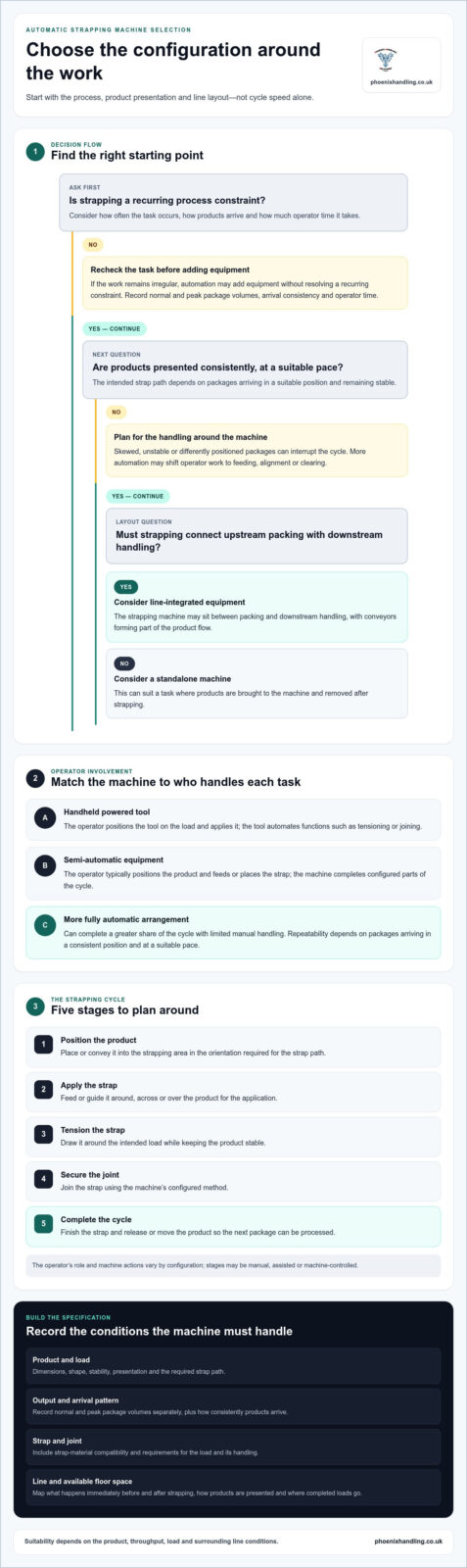
An automatic strapping machine carries out configured strapping operations with less manual handling than an operator-led task. Depending on its design, it can feed or position strap, apply tension and secure the joint as part of a repeatable cycle. The term describes a level of automation, not one standard machine or operating method. A handheld powered tool, a standalone machine and equipment integrated with conveyors each automate different parts of the task.
Start by identifying the work that needs to be repeated and the conditions it must handle. A business securing a consistent run of cartons may need a different arrangement from one strapping varied products or pallet loads at intervals. Record the number of packages processed during normal and peak periods, how consistently products arrive, and how much operator time each task takes. This helps show whether automation addresses a recurring process constraint or adds equipment to a task that remains irregular.
Product and load conditions matter as much as output. Dimensions, shape, stability and presentation affect how a package can be held and strapped consistently. The strap and joint also need to suit the load and its handling requirements. Strapping (packaging) provides background on strapping materials, joining methods and equipment. Ultimately, suitability depends on the product, throughput, load and surrounding line conditions, not the automation label alone.
Automatic, semi-automatic and handheld strapping compared
With semi-automatic equipment, an operator typically positions the product and feeds or places the strap before the machine completes configured parts of the cycle. A handheld powered tool automates functions such as tensioning or joining, but the operator still positions and applies it to the load. More fully automatic arrangements can complete a greater share of the cycle with limited manual handling. Greater automation can support repeatability when packages arrive in a consistent position and at a suitable pace. If not, operator work may simply shift to feeding, alignment or clearing the process.
Where automatic strapping fits in end-of-line packaging
Strapping is one stage in preparing products or loads for handling, storage or despatch. A standalone machine can serve a packaging task where products are brought to it and removed after strapping. In a production line, the equipment may sit between upstream packing and downstream handling, with conveyors forming part of the product flow. Map what happens immediately before and after strapping: whether products arrive individually or in batches, how they are presented, and where completed loads go. That flow helps determine the configuration and identify space or handling constraints early.
How an automatic strapping machine completes and supports the strapping cycle
A strapping cycle follows a recognisable sequence, although the operator’s role and machine actions vary by configuration. An automatic strapping machine may carry out several stages with limited intervention, while a handheld tool still needs an operator to position it on the load. Consistent product presentation matters in either case. If packages arrive skewed, unstable or in different positions, the cycle may not follow the intended strap path.
A useful general sequence is: position the product, apply the strap, tension it around the load, secure the joint and complete the cycle. The precise method depends on the equipment and application.
- Position the product. Place or convey the package into the strapping area in the orientation required for the strap path.
- Apply the strap. Feed or guide strap around, across or over the product according to the application.
- Tension the strap. Draw it around the intended load to the set operating condition, while keeping the product stable.
- Secure the joint. Join the strap using the machine’s configured method.
- Complete the cycle. Finish the strap and release or move the product so the next package can be processed.
This sequence is a planning aid, not a description of every machine’s exact operation. Some stages may be manual, assisted or machine-controlled. For line equipment, the cycle also needs to fit the pace and handover points of the surrounding process. For example, if a conveyor presents a carton before it is correctly aligned, the strapping stage may be interrupted even when the machine cycle is repeatable.
The main stages from strap application to completed cycle
Strap placement should follow the load’s shape and the purpose of the restraint. Tension draws the strap around the intended load, while the securing stage forms the joint and finishes the strap. These actions must suit the product. Excessive or poorly positioned tension can affect a vulnerable package, while inconsistent placement can produce uneven results. Define the required strap path before comparing cycle functions.
Strap material and load presentation affect the process
Polypropylene and polyester are distinct strap material categories, but their names alone don’t establish compatibility with a machine or suitability for a particular load. Include material compatibility in the equipment specification. Then consider package shape, stability and surface: a smooth carton, an irregular bundle and a pallet load may each need a different strap position or degree of support during tensioning.
Repeatability depends on the complete process, not just the machine cycle. Record how products arrive, how they are held in position and where they go after strapping. These details help align the strapping stage with adjacent handling equipment and show where product presentation needs attention. Phoenix Handling Solutions Limited scopes strapping machinery requirements around product type, throughput and available floor space, so the cycle can be considered within the wider packaging process.
How to compare automatic strapping machine configurations
Compare configurations against the task and surrounding process, rather than treating “automatic” as a complete specification. Record what is being strapped, how products are presented, how much operator input remains, and whether the machine works independently or as part of a packaging line. The table outlines broad approaches. Operating functions, compatible materials and machine features depend on the selected configuration.
| Format | Product application | Operator involvement | Line fit | Space considerations |
|---|---|---|---|---|
| Handheld powered tool | Loads or bundles that can be reached by an operator | Operator positions the tool and applies it to the strap path | Can suit a task away from a fixed machine, but does not itself establish a conveyor flow | Requires working and movement space around the load |
| Standalone machine | Products brought to a defined strapping point | Operator may present and remove products; machine actions vary by configuration | Operates as a separate packaging work area | Needs room for the machine, product handling and operator access |
| Line-integrated machine | Products moving through a planned packaging sequence | Handling and strapping actions depend on the level of integration | Positioned within product flow, with upstream and downstream stages considered | Requires space for the machine and associated flow, access and transfers |
Standalone equipment or a line-integrated machine
A standalone work area can be assessed as a distinct task: how products arrive, where staff position them and how completed packages leave. A line-integrated arrangement must also account for upstream presentation and downstream handling. Consider conveyor direction, transfer points, operator access and available floor space together. Scope conveyor integration against the actual layout and product flow, rather than assuming it follows from an automation label.
For an automatic strapping machine, separate fixed requirements from configuration-dependent features. Package size range, load type, required output and available footprint describe the process requirement. The precise operating sequence, degree of operator involvement, strap handling method and integration functions belong in the selected equipment specification. Keeping these categories distinct makes comparisons clearer and avoids treating a feature on one configuration as standard across all machines.
Cartons, bundles and pallet loads need different assessments
Assess cartons and bundles by their dimensions, shape, surface and intended strap position. Pallet loads need a separate review of load geometry, stability, access around the load and planned strap placement. A machine arranged for individual cartons may not accommodate the size, presentation or handling needs of a pallet load. Likewise, don’t assume one strap material or machine format suits every package. Base comparisons on representative products and loads, including variations that occur in normal production.
Before selecting a format, note whether products arrive singly or in groups, whether their orientation is consistent, and how the strapped item moves to the next stage. These details help establish whether a separate work area or a position within the line is more practical. Phoenix Handling Solutions scopes strapping machinery around product type, throughput and available floor space, and can consider it alongside conveyor systems where they form part of the packaging process.
What to specify before selecting an automatic strapping machine
A useful specification starts with operating evidence, not a preferred machine format. Record the products and loads that need strapping, how they move through the work area, and the output the process must support. Include normal operating conditions and exceptions. A system suited to a standard carton may handle the largest or least stable load in the product range differently.
Measure products, loads and operating demand
Gather details for representative products and note outliers separately. Include package dimensions, weight, load configuration, orientation and intended strap position. Describe handling constraints, such as products that arrive unevenly or need support to remain stable during strapping. This information establishes the working range the equipment needs to accommodate.
Record volumes across the operating pattern, including shifts, batches and periods of higher demand. Keep required output and peak demand separate from average throughput. An average can conceal short periods when product flow is substantially higher, as well as differences between product types that affect the cycle. Note expected changes in production so the specification reflects the task the equipment needs to support.
Check the layout and the wider packaging line
Map the available floor area, including space for infeed, outfeed, product movement and operator access. Show where staff load, monitor or clear products, and identify access routes around the equipment. If conveyors or other packaging stages are already in place, record their positions and how they affect product presentation and onward handling. This grounds the equipment scope in the actual layout.
- Products and loads: record representative and outlier dimensions, weights, shapes, stability and strap placement.
- Operating demand: document volumes by product, shift and batch, then note required output and peak demand separately.
- Product flow: describe orientation and presentation before strapping, plus how completed products move to the next stage.
- Floor layout: map available space, access routes, operator positions, infeed and outfeed, and potential conveyor interfaces.
- Strap supply: state the material and width currently used or required, and how strap is supplied to the task. Treat compatibility as a machine-specific requirement rather than assuming a material name guarantees suitability.
If pallet wrapping is another end-of-line stage, consider its position and handling needs alongside strapping. The industrial pallet wrapping machine buying guide can help you assess that adjacent equipment within the wider process.
With these details assembled, Phoenix Handling Solutions can scope strapping machinery around product type, throughput and available floor space. Discuss your strapping machine requirements to develop a project specification around the operating task and line layout.
How Phoenix Handling Solutions can scope your automatic strapping machine
Equipment selection is most useful when it follows the operating process rather than a generic machine category. Phoenix Handling Solutions Limited supplies strapping machines to manufacturers and distributors across the UK, with equipment scoped around product type, throughput and available floor space. A clear project brief connects those requirements to the packaging task and wider production-line layout.
Turn process information into an equipment specification
Start with the project details: product and load dimensions, weights, variations, strap path, operating volumes and peak demand. Add the shift pattern, product presentation and any constraints that affect handling, such as limited access or inconsistent orientation. This gives Phoenix Handling Solutions Limited a practical basis for scoping equipment around the work, rather than relying on broad assumptions about what automation should achieve.
The project can then progress through a defined sequence:
- Share process requirements. Describe the products, load types, operating pattern, required output and current strapping task.
- Scope the equipment. Use those requirements to identify a machinery approach suited to the product and operating conditions.
- Review line fit. Consider floor space, product movement, operator access and the relationship with adjacent packaging stages.
- Agree the specification. Bring the equipment and layout requirements together as a project-specific scope.
This process separates essential requirements from configuration details. Product range, output and available space establish the operating brief. The resulting specification defines the machine arrangement and its functions, rather than relying on the word “automatic”. If products vary significantly in size or presentation, include those differences in the brief so the scope reflects the actual task.
Plan for integration and ongoing equipment support
Strapping equipment can operate as a separate packaging station or be considered alongside conveyors and other machinery, depending on how products move through the site. Review infeed and outfeed, transfer points, operator access and available equipment space. Conveyor systems and other packaging stages can be included in the scope where they support the project requirements, including palletising systems.
Operational planning also includes servicing and spare parts. Consider how these support the equipment’s role in the process and the site’s maintenance approach. Phoenix Handling Solutions Limited provides servicing and spare parts for packaging and handling equipment.
To define practical next steps, share your product, throughput and layout requirements with Phoenix Handling Solutions Limited. Discuss an automatic strapping machine for your process.
Turn your requirements into a practical next step
A considered specification gives production, operations and maintenance teams a shared basis for evaluating an automatic strapping machine. Use it to compare options against today’s workload and likely changes in product mix, output or line arrangement. This helps separate essential operating requirements from features that don’t address a defined need.
Look beyond the strapping point itself. The project may need to account for how products reach the machine, how they leave it and how adjacent packaging equipment works together. Phoenix Handling Solutions supplies strapping machines, conveyors and other packaging machinery, with servicing and spare parts available for equipment planning.
The next step is to turn your process information into a project discussion. Bring together representative product details, demand patterns and a clear view of the available layout. Phoenix can use these requirements to scope machinery around the application, throughput and floor space. Discuss an automatic strapping machine for your process and move towards a specification grounded in the way your operation works.
Frequently Asked Questions
Can an automatic strapping machine handle different package sizes?
Yes, if the package sizes fall within the machine’s specified operating range and suit its strap path. List the smallest, largest and most common formats, including irregular shapes. Also consider how often sizes change. Frequent format changes may affect set-up and operator tasks, so assess changeover requirements alongside the stated size range rather than assuming one machine will handle every format equally.
How do I know what strapping machine speed my production line needs?
Set the target against the output the whole line needs to sustain, not a machine’s headline cycle speed. Record actual production during representative periods and busy runs, including pauses caused by product accumulation or delays at adjacent stages. A machine that cycles faster than the rest of the line may not increase completed output. Compare expected demand with the rate at which the surrounding process can supply and clear products.
What information should I prepare before discussing a strapping machine project?
Prepare representative package dimensions and weights, including unusual formats, and clear photographs or product samples where practical. Note current strap material and width, how products are presented, and how many are processed across a typical shift and a busy period. A simple floor plan showing the work area, access routes and nearby equipment can make layout constraints easier to explain and focus the project discussion.
Can an automatic strapping machine be connected to a conveyor?
Yes, a machine can be considered as part of a conveyor-based packaging line when the equipment and product flow are scoped together. Review how products transfer onto the strapping stage, their spacing and orientation, and how completed packages move onwards. For example, a closely spaced flow may need different handling considerations from products presented individually. The actual layout and operating sequence determine the integration requirements.
How often does an automatic strapping machine need maintenance?
There isn’t one interval that suits every machine. Maintenance frequency depends on the equipment’s instructions, duty and operating conditions, so follow the schedule provided for the selected configuration rather than applying a generic timetable. Keep a record of maintenance activity and recurring operating issues to support planning. Phoenix Handling Solutions provides servicing and spare parts for packaging and handling equipment as part of operational support planning.
What affects the choice of strapping material for a machine?
Consider the load’s weight, shape, stability and handling route, as well as the package surface and strap position. The machine must also be compatible with the selected material and its dimensions, including width. Polypropylene and polyester are different material categories, but neither is automatically suitable for every task. Base the choice on load requirements and equipment compatibility, not the material name alone.