
Could a faster wrapping machine slow the line down? An automatic pallet wrapper may have an impressive stated cycle rate, but that figure alone won’t show whether it can handle your actual pallet mix, connect with upstream and downstream equipment, or fit the available space. The useful measure is how the complete wrapping process performs under everyday operating conditions.
Before investing in automation, define the requirements that matter to your operation. Throughput, load stability and variation, film requirements, operator involvement and line layout all affect whether an automatic system is suitable and how it should be specified. Comparing headline capabilities without considering these details can leave important constraints undiscovered.
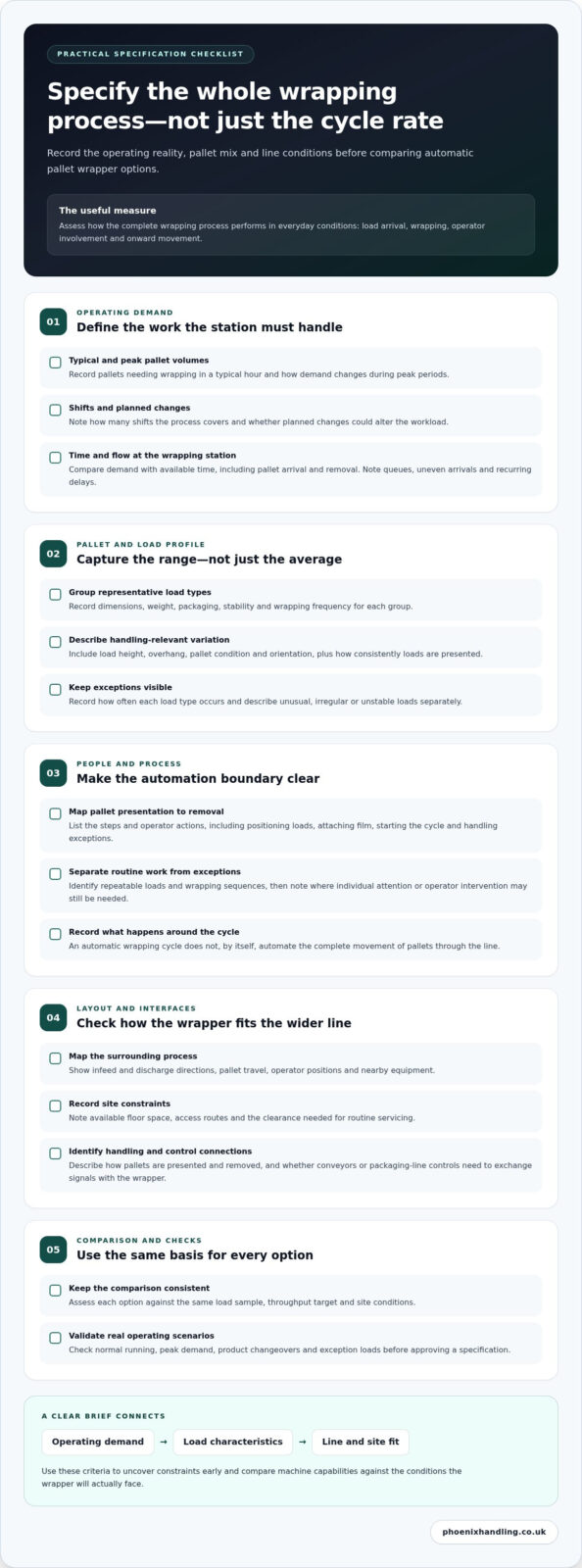
This practical assessment checklist sets out what to define before requesting a specification. It covers pallet volumes, load dimensions and consistency, line interfaces, floor space, safety and operational support. Phoenix Handling Solutions Limited supplies pallet wrapping machinery specified around product type, throughput and available floor space, with wrapping considered alongside conveyor and wider packaging-line equipment. Use the criteria to build a clear brief and compare options on a consistent, measurable basis.
Key Takeaways
- Assess repeatability, operator involvement and the wider process to establish whether automation fits your operation.
- Record throughput, peak demand and pallet characteristics to define the requirements an automatic pallet wrapper must meet.
- Compare machine options against the same load sample, throughput target and site conditions for a consistent assessment.
- Validate normal running, peak demand, product changeovers and exception loads before approving a specification.
- Build a clear brief covering layout and line interfaces so wrapping machinery can be matched to your process.
When does an automatic pallet wrapper make operational sense?
Automation is worth assessing when wrapping is a repeated, defined task within a wider process, not simply because pallet volumes appear high. Consider how consistently loads arrive, how much their dimensions and stability vary, how wrapping affects the line’s pace and how operators currently handle each pallet. A system that suits a regular stream of similar loads may be less appropriate where presentation is unpredictable or loads need individual attention.
An automatic pallet wrapper automates some or all of the wrapping cycle; it does not, by itself, automate the complete movement of pallets through the line. This distinction matters when interpreting machine descriptions. A wrapping cycle can be automatic while load supply, transfer and removal still rely on operators or connected equipment.
What makes a pallet wrapper automatic?
An automatic system may receive a presented load, apply film through a programmed sequence and release the wrapped pallet for onward movement. The exact boundary depends on the configuration. Pallets may arrive and leave by conveyor, or an operator may still position loads, attach film or manage exceptions. Stretch wrap, also known as pallet wrap, is a highly stretchable plastic film used to secure items. The wrapping task can therefore be automated without automating the surrounding handling.
Semi-automatic equipment generally requires more direct operator input during the wrapping process, although the precise tasks vary by machine and setup. The labels “automatic” and “semi-automatic” are useful starting points, not complete specifications. Compare what each system does in your proposed layout, including how a pallet enters the wrapping area, how the cycle starts and how the finished load moves away.
Which operations should assess automation first?
Start with repeated tasks where pallets are presented consistently and wrapping follows a recognisable sequence. A recurring queue before dispatch, sustained manual handling across shifts or a wrapping stage that interrupts upstream production can justify closer assessment. These are prompts for investigation, not proof that automation will improve output. Record the current process first, including operator actions, waiting points and exceptions.
Load variation is just as important as task frequency. If product types create different pallet heights, overhangs or levels of stability, the process may need adjustments between loads or operator intervention for exceptions. Note whether loads arrive in a predictable orientation and whether the same wrapping requirements apply across the product mix. This helps separate routine work from cases that need different handling.
- Map the steps from pallet presentation to removal, noting where people intervene.
- Record recurring delays and manual handling demands across normal operating periods and shifts.
- Separate standard loads from irregular or unstable exceptions before judging the fit.
An operation is a stronger candidate for assessment when wrapping demand is repeatable, the load profile is understood and the proposed machine can connect sensibly with the surrounding process. Next, turn those observations into measurable operating and load requirements.
Which operating requirements should an automatic pallet wrapper meet?
A useful specification starts with operating evidence, not a target chosen in isolation. Record how many pallets need wrapping in a typical hour, how demand changes during peak periods, how many shifts the process covers and whether planned changes could alter the workload. Compare this demand with the time available at the wrapping station, including pallet arrival and removal. A stated machine cycle rate won’t describe the line’s actual capacity if loads queue, arrive unevenly or require manual attention.
Capture the load range as well as the average. Assess an automatic pallet wrapper against the products it will handle, including variations that affect presentation, wrapping and transfer. Keep exceptional loads visible in the specification rather than allowing them to disappear into an average figure.
How should throughput and load variation be recorded?
Use representative operating periods to document typical and peak pallet volumes, then group loads by dimensions, weight, packaging, stability and wrapping frequency. Include overhang, load height and any variation in pallet condition or orientation that affects handling. Record how often each load type occurs and describe unusual cases separately. This provides a clearer basis for assessing capacity and identifying which loads need distinct settings or handling.
What layout and interface details matter?
Map the wrapping area and adjacent process, including infeed and discharge directions, pallet travel, operator positions and nearby equipment. Note floor-space limits, access routes and the clearance needed for routine servicing. Identify how pallets are presented and removed, and whether conveyors or existing packaging-line controls need to exchange signals with the wrapper. These details help expose integration constraints before selecting a machine arrangement.
Use a consistent record for each operating and load requirement:
- Process: shifts, normal and peak volumes, wrapping frequency and planned changes.
- Load: pallet dimensions, load height and weight, packaging, overhang, stability and product variation.
- Capacity: required pallets per hour, demand patterns, queueing points and time available for wrapping.
- Layout: floor space, access routes, infeed and discharge, operator movement and servicing clearance.
- Interfaces: pallet presentation, transfer equipment, adjacent machinery and control connections.
Check the floor plan against the way people and pallets move during a normal shift. A footprint that fits on a drawing may still obstruct access or create awkward operator movement if the infeed, discharge or film-handling area is poorly positioned. Include adjacent conveyors and packaging equipment, since the wrapper’s operating pace and transfer points must align with the wider process.
Checklist summary: Capture the process, load profile, required capacity and site layout, including interfaces, access and foreseeable changes. Phoenix Handling Solutions Limited specifies pallet wrapping machinery around product type, throughput and available floor space. Discuss your pallet wrapping requirements with the process information to hand.
How should automatic pallet wrapper options be compared?
Compare each option against the same operating brief, not against isolated headline figures. Use representative loads, a shared throughput target and the same site conditions, then record what happens during a complete wrapping cycle. A stated cycle rate may exclude pallet transfer, operator actions, film changes or interruptions, so it shouldn’t be treated as a direct measure of line output.
For each configuration, document the wrapping sequence, film application, operator input, changeover requirements and how the wrapped load is contained. Note any assumptions behind the comparison, such as a specific load type or uninterrupted feed. This makes differences visible and avoids judging an option on easier conditions than the others.
How do wrapping mechanisms and film use affect the comparison?
Core-break and powered pre-stretch systems apply film differently. A core-break arrangement creates film tension as the roll is drawn against resistance; a powered pre-stretch system uses driven rollers to stretch film before it reaches the load. Compare the resulting application on the loads that matter to your operation. Load shape, stability and containment needs influence whether film is applied consistently, so don’t assume one approach suits every product or configuration.
Record film consumption during comparable trials, alongside the finished load’s containment and any signs of movement or damage. Treat potential film reduction or improved stability as outcomes to assess, not guaranteed benefits. Results depend on the load, film and wrapping settings used in the test.
How should integration and operating flexibility be weighed?
Assess each machine as part of the line. A standalone arrangement may require people to position and remove pallets, while an integrated option may depend on conveyors and coordinated controls. Compare product changes, pallet variation and anticipated volume changes as well. An option that suits today’s routine may introduce extra handling or changeover work if the product mix shifts.
Use one evidence table for every option. Record observations from the same load sample, target and site conditions, and keep unresolved points visible rather than treating assumptions as confirmed performance.
| Requirement | Evidence | Operational impact | Unresolved constraint |
|---|---|---|---|
| Wrapping sequence | Observed cycle steps and operator actions | Shows where manual input remains | Exception handling not trialled |
| Film application | Trial results for representative loads | Indicates containment and film-use performance | Other load types not assessed |
| Line integration | Infeed, discharge and control requirements | Shows how the wrapper fits the process | Interface details still to resolve |
| Changeovers | Actions recorded between product types | Highlights adjustment and operator demands | Planned product changes not tested |
This gives the automatic pallet wrapper assessment a consistent basis: compare observed performance, integration needs and outstanding constraints together. The strongest option is the one that meets the defined process requirements under representative conditions, not simply the one with the highest stated speed.
What should be checked before approving an automatic pallet wrapper?
Approval should follow a structured check of the current process and the machine’s performance against agreed operating conditions. A demonstration with a single convenient load may show the wrapping sequence, but it won’t establish how the system handles peak demand, product changes or known exceptions. Set the test conditions and acceptance criteria before the trial so results can be assessed consistently.
Testing representative loads reduces specification assumptions by showing how the proposed system performs with the products, operating demands and line conditions it must handle.
Which baseline information should the team collect?
Record current wrapping time, each operator task, film use and recurring load problems. Include shift patterns, downtime causes and planned production changes, since these can affect future demands on the wrapping area. Separate measured observations from estimates and assumptions, and note how each figure was collected. A clear baseline helps distinguish trial results from expectations and gives the team a reference for judging operational suitability.
What should a practical machine trial demonstrate?
Use representative pallet formats under agreed operating conditions, including the normal process and periods of peak demand. Observe load stability, film application, the full cycle sequence and operator interaction. Include product changeovers and known exception loads, recording any adjustments or interventions needed. Where the wrapper connects to conveyors or other equipment, observe whether pallet transfer and line operation remain coordinated during the test.
Use an ordered validation sequence to move from recorded evidence to a decision:
- Document the baseline. Capture current wrapping activity, operator input, film use, downtime and recurring load issues, labelling estimates clearly.
- Agree the test conditions. Select representative pallet formats, define normal and peak operating conditions, and identify changeovers and exception loads to include.
- Set acceptance criteria. Agree how output, finished-load condition, film application and operator tasks will be assessed. Set thresholds against the operation’s requirements rather than assuming a machine’s stated rate is sufficient.
- Run and observe the trial. Record the cycle, interruptions, required adjustments and effects on connected equipment. Keep observations for each load type distinct.
- Review gaps before approval. Compare the results with the criteria and note any untested condition, unresolved interface or load type that may affect the specification.
Keep the criteria practical and observable. For output, record completed pallets over the agreed operating period. For load condition, check whether the load remains secure and undamaged. For film application, document coverage and consistency; for operator tasks, list the actions still required. If a criterion isn’t met, record the conditions and adjustment needed rather than relying on a general pass or fail.
Phoenix Handling Solutions Limited specifies pallet wrapping machinery around product type, throughput and available floor space. Discuss your pallet wrapper specification using the baseline and trial criteria your team has recorded.
How can Phoenix Handling Solutions support the next specification step?
A useful project discussion begins with the operating evidence behind the proposed machine. Phoenix Handling Solutions Limited supplies pallet wrapping machinery specified around product type, throughput and available floor space. A clear brief helps relate an automatic pallet wrapper to the actual loads, capacity requirements and site conditions, rather than treating machine selection as a standalone equipment decision.
What information should be ready for a project discussion?
Prepare information that describes both the pallet profile and the process around it. Representative dimensions, photographs and notes on product variation can explain differences that a single average load won’t show. Add current and target throughput, shift patterns and known constraints, then include a simple layout indicating the wrapping area and connected equipment.
- Loads: Representative pallet dimensions, load heights and weights, photographs, packaging types and variation between products.
- Operating demand: Current and target throughput, shift pattern, peak periods and any planned process changes.
- Site conditions: Available floor space, access routes, pallet presentation and operator movement around the wrapping area.
- Line connections: Existing conveyors, upstream and downstream machinery, and relevant control interfaces.
- Validation: Trial loads and agreed criteria for output, finished-load condition, film application and operator tasks.
How does project-specific specification support implementation?
These details help assess the proposed wrapping equipment against the loads it must handle, the required capacity and the physical limits of the site. They also show where conveyor transfer or other packaging machinery forms part of the line configuration, and where the wrapping process remains separate. The aim is to make requirements and constraints clear before settling the specification.
Describe foreseeable changes alongside current conditions. A planned shift in product mix or volume may affect how the wrapping area needs to operate, while servicing access and spare-parts support are relevant to ongoing equipment use. Considering these points during specification keeps the discussion grounded in operational continuity without assuming a particular machine arrangement or outcome.
Phoenix Handling Solutions Limited can use your operating requirements to specify pallet wrapping machinery in relation to the wider packaging process. Bring the available load and layout information, including details still being refined. Discuss your pallet wrapping requirements as a practical next step.
Turn the assessment into a clear next step
Use the specification as a shared working document for production, engineering and warehouse teams. Their priorities may differ: production needs a steady flow, engineering needs workable interfaces and access, while warehouse staff need loads to arrive and leave in a practical way. Recording these operational priorities alongside the machine requirements can help keep decisions aligned as the project develops.
Keep the document current if product formats, volumes or the line arrangement change. Assess a proposed automatic pallet wrapper against the process it will serve, not an outdated description of it. This gives the next discussion a useful starting point and makes it easier to identify which assumptions still need evidence.
Phoenix Handling Solutions supplies pallet wrapping machinery specified around the application. Share your operating brief to begin a project discussion: Discuss your pallet wrapping requirements. A considered specification is a practical foundation for choosing equipment that fits the operation.
Frequently Asked Questions
What is the difference between an automatic and a semi-automatic pallet wrapper?
An automatic pallet wrapper performs a programmed wrapping cycle with less direct operator input, while a semi-automatic machine typically needs an operator to start or manage parts of the cycle. The distinction depends on the configuration. For example, one setup may require an operator to position a pallet and attach the film; another may start wrapping once a load reaches the machine. Compare the tasks involved, not just the machine label.
Can an automatic pallet wrapper handle different pallet sizes?
It may handle a range of pallet sizes if the machine configuration and wrapping settings suit those loads. Define the smallest and largest footprints, height differences and unusual shapes in your product mix. For instance, a compact pallet with protruding cartons may need different film coverage from a taller, uniform load. Confirm that the full range can be presented, wrapped and transferred as intended, and identify any loads that may need a separate process.
Does an automatic pallet wrapper remove the need for an operator?
No. Automation can reduce direct involvement in the wrapping cycle, but people may still need to replenish film, monitor operation, inspect finished loads and respond to interruptions. The operator role depends on how pallets enter and leave the machine and how exceptions are managed. Before specifying equipment, map who handles film changes, routine checks and non-standard loads, so staffing assumptions reflect the actual process rather than the machine’s automation label.
Can an automatic pallet wrapper connect to an existing conveyor?
Conveyor integration depends on the layout and equipment interfaces. Check how the conveyor presents and removes pallets, including direction of travel, transfer points and spacing between loads. The control arrangement also matters: the wrapper and conveyor need to coordinate movement so pallets don’t accumulate in the wrong place. Include existing conveyor details in the project brief to identify any interface or layout changes needed.
How can an automatic pallet wrapper help control stretch film use?
A wrapper can apply film through a repeatable sequence, and some configurations use powered pre-stretch to extend film before application. The effect on film consumption depends on the machine, film and load, so assess it with comparable trials rather than assuming a reduction. Record film used alongside the finished load’s containment. For example, compare loads of the same product and dimensions, then check whether the wrap remains suitable for handling and dispatch.
What information is needed to specify an automatic pallet wrapper?
Prepare load dimensions, weights, packaging details and examples of product variation, alongside current and target pallet volumes and shift patterns. A simple floor plan showing access, pallet routes and nearby equipment can clarify space and integration requirements. Note recurring load problems and planned production changes as well. This gives Phoenix Handling Solutions a practical basis for specifying pallet wrapping machinery around product type, throughput and available floor space.