
Automated case packing replaces manual loading with a machine that groups products and places them into shipping cases. An automatic case packer can operate as a standalone unit or as part of a wider packaging line, with the format chosen to suit the products and available space. Selection is not just about how quickly cases are filled: it also affects product handling and how the equipment fits into the existing line.
End-load and side-load machines both move products horizontally into cases, but their handling arrangements suit different production layouts and product patterns. The footprint, infeed and outfeed positions, and operating utilities also affect how a system integrates with the line.
This guide explains the packing process, compares end-load and side-load options, and outlines practical factors to assess when specifying a machine. It covers how line speed, product dimensions, floor space and utilities shape the choice, helping you evaluate which arrangement best fits your production requirements.
Key Takeaways
- Follow the sequence from case forming through loading, sealing and labelling to identify where automation fits your packing process.
- Assess how the packing system will connect with upstream production and downstream palletising equipment.
- Compare end-load and side-load layouts against your product format, conveyor flow and available floor space.
- Map the machine footprint and utility connections before planning installation, access and line integration.
What are Case Packers?
An automatic case packer groups products and loads them into shipping cases or cartons. Depending on the configuration, the process can include case forming, product orientation, loading, sealing and labelling.
Case Forming, Loading and Sealing
A case erector forms a box from a flat corrugated blank before products arrive for loading. An infeed conveyor organises products, while guides or stacking mechanisms align them in the required case pattern. For controlled handling, a vacuum gantry can pick products from the infeed and place them into open cases. The machine then closes and seals each case with tape or glue, and a label can be applied for identification and tracking.
Packaging Consistency and Product Protection
Automated case packing repeats the selected arrangement, helping keep case contents and presentation consistent throughout a production run. Even positioning can also limit movement inside the case, supporting product protection during handling and transport. Assess how the machine handles fragile or irregular items, and whether its loading method preserves their orientation. A stable product pattern matters because poorly positioned items can shift before the cases reach storage or distribution.
Products and Carton Formats
Case packers can handle bottles, cans, pouches, bags and cartons. Product shape and dimensions help determine the right infeed and gripping method. UK Government lists container formats including tubes, ampoules, bottles, drums, barrels, bags, sacks, cans and boxes. These products are loaded into shipping cases or cartons arranged for the required pack pattern. Assess product orientation, case opening and internal layout together, rather than considering the product alone.
Packing Speed and Output
There is no single typical output rate for every case-packing operation. Speed depends on product dimensions, the number of items per case, the loading mechanism and the steady supply of products and cases. Compare the required cases per minute with upstream output, then consider format changeovers. A machine’s maximum rate is useful only if the infeed, product orientation and case handling can sustain it without disrupting the wider line.
What Is Automated Case Packing?
Automated case packing coordinates product flow, case supply and packed-case discharge. An automatic case packer can run alone or integrate with conveyors, case erectors and downstream equipment. The arrangement depends on how products arrive, how cases are supplied and where completed cases need to go. Matching these interfaces helps maintain flow and avoid a bottleneck at the packing stage.
Manual packing relies on operators to place products into cases, while semi-automatic systems automate selected tasks and retain manual handling elsewhere. A fully automated system handles product loading mechanically, reducing routine operator involvement in that step. Compare the options against production speed, product consistency and the tasks that remain manual, such as replenishing case blanks or managing changeovers.
Upstream integration starts with the product’s arrival at the packer. Conveyor speed, spacing and orientation determine whether products reach the loading area in a stable, predictable pattern. A coordinated line can match the packing operation to upstream output, reducing accumulation or gaps between processes. Downstream, a conveyor transfers filled cases towards palletising equipment, where they are arranged into loads for storage or distribution.
Integrated case erectors form cases from flat blanks and feed them into the packing sequence. This links case supply with product loading instead of treating case erection as a separate manual task. A palletiser receives completed cases at the other end of the line. When planning an upgrade, map the handover points between conveyors, erectors, packers and palletising equipment, including case orientation and discharge direction.
ERP and MES integration can connect packaging-line information with production planning and manufacturing execution systems. The useful data and level of connection depend on the facility’s existing controls and reporting needs. Define which events operators need to see, such as line status, production counts or format changes, then plan how those signals fit the wider operation. A clear integration plan supports decisions about equipment interfaces and line-level packaging-line integration.
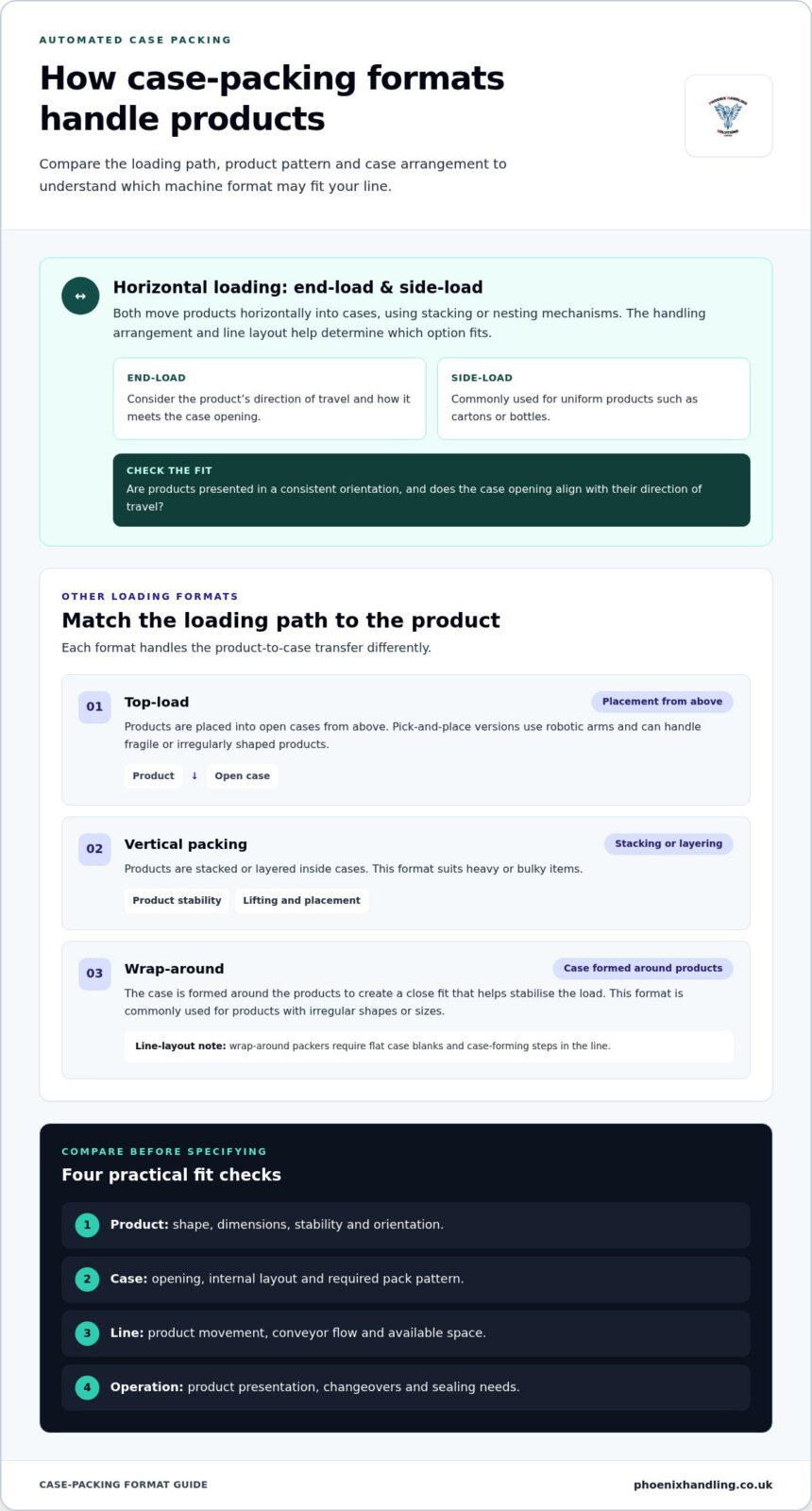
Horizontal end-load and side-load case packers
Automatic case-packing options include horizontal end-load and side-load machines, top-load systems and wrap-around packers. The right arrangement depends on product movement, case access, the required pack pattern and available line space.
Horizontal end-load and side-load machines push products into cases using stacking or nesting mechanisms. They suit products moving along a conveyor, allowing the machine to gather and load groups without stopping the entire flow. Side-loaders are commonly used for uniform products such as cartons or bottles. Assess whether products arrive in a consistent orientation and whether the case opening aligns with their direction of travel.
Top-load systems place products into open cases from above. Pick-and-place versions use robotic arms and can handle fragile or irregularly shaped products. Vertical packers stack or layer products inside cases and suit heavy or bulky items. Compare the loading path with product stability, since lifting and placement requirements affect how each group must be presented to the machine.
Wrap-around packers form a case around the products, creating a close fit that helps stabilise the load. This arrangement is commonly used for products with irregular shapes or sizes. Unlike systems that load into a pre-formed case, wrap-around packers require flat case blanks and case-forming steps in the line layout. Check how each format affects changeovers and sealing.
Case-packing arrangements vary in how cases and product groups are brought together, so assess the loading path against the line layout. Top-load machines, by contrast, place products down into a case already positioned for loading. Compare access for case supply, product transfer and discharge when assessing the arrangement. Robotic systems can accommodate a range of case sizes with minimal changeover time. To minimise disruption, match the loading direction and case presentation to the existing conveyor flow.
Machine footprint and utilities
An automatic case packer needs more than the space occupied by the machine itself. Include infeed and discharge conveyors, case storage, operator access and maintenance clearance in the layout. For a bottle line, map the route from product arrival through packing to the next process. This shows whether the machine fits without obstructing existing equipment or routine movement around the line.
Measure the available floor area and note the position of columns, doors, walkways and adjacent machinery. Then map product flow, case-blank replenishment and packed-case removal. The machine’s loading direction affects conveyor alignment, while access for cleaning, adjustments and fault diagnosis affects its final position. Plan these working zones alongside the machine instead of treating them as leftover space after installation.
Match utilities to the selected machine and its configuration. Record the available electrical supply and identify any compressed-air, vacuum or other connection requirements in the equipment specification. Map connection points against the proposed position, including cable and pipe routes. For an integrated line, assess the connections and control interfaces required by the packer, erector and conveyors.
Installation planning should also account for the route used to move equipment into the building. Check access through entrances and internal aisles, and consider how the machine will be positioned near existing production equipment. Include space for case-blank storage and finished cases at the discharge. These steps can reveal layout conflicts before they interrupt production or require changes to the line plan.
Assess return on investment against purchase, installation and integration, then include energy, packaging materials, staffing and regular servicing. Compare these factors with the expected effect on manual handling and line operation; avoid relying on maximum output alone. A well-matched footprint and utility plan supports practical integration. For the next stage of handling, review pallet wrapping machine options alongside the case discharge layout.
Phoenix Handling Solutions Limited: Pallet Wrapping Machines
After case packing, completed cases may need to be assembled and secured for handling. Phoenix Handling Solutions supplies palletising options including Bag Palletisers, Cobot Palletisers, Layer Palletisers and Robotic Palletisers. Pallet Wrapping Machines, Strapping Machines and Stretch Hooders can then secure finished loads, depending on the packaging process and load requirements.
Consider these systems when specifying a case packer alongside downstream palletising or load-securing equipment. Coordinating case discharge, pallet arrangement and the chosen securing method helps define an integrated end-of-line layout. Contact Phoenix Handling Solutions to discuss equipment for your production line.
Turn your line requirements into a practical plan
Before selecting an automatic case packer, turn production needs into clear design priorities. Record the products and case formats, required line flow, available installation space and handover to downstream equipment. This gives you a practical basis for assessing how a proposed system fits the wider operation.
At the end of the line, Phoenix Handling Solutions supplies Pallet Wrapping Machines, Strapping Machines and Stretch Hooders. The right load-securing method depends on the finished pallet and how it will be handled after packing. Considering these stages together helps you plan equipment interfaces and avoid treating case packing as an isolated purchase.
Discuss your production-line requirements and downstream handling needs with Phoenix Handling Solutions Limited. Contact Phoenix Handling Solutions Limited to take the next step towards a considered equipment plan.
Frequently Asked Questions
What is an automatic case packer and how does it work?
An automatic case packer coordinates product grouping, case presentation and loading through a controlled sequence. For example, sensors can signal product arrival while controls manage timing between the infeed and loading cycle. Operators use the HMI to set parameters and monitor performance. The selected mechanism transfers products into cases, while the wider line manages their onward movement.
What should you consider when selecting an automatic case packer for a production line?
Start with the products, case patterns and changeover frequency the line must accommodate. A facility switching between carton formats should assess adjustment tasks alongside throughput requirements. Check maintenance access, operator responsibilities and control compatibility, as well as connections to neighbouring equipment. Future product plans matter too: a machine selected for one fixed format may constrain later production changes.
How is an automatic case packer installed, integrated and commissioned?
Installation typically involves preparing the site, positioning the equipment, connecting services and testing the line. Confirm that product presentation, case supply and discharge align with adjacent machinery. During commissioning, trial the intended products and cases, then adjust settings to achieve the required arrangement. Operator instruction should cover controls, format changes and responses to interruptions, helping staff manage routine operation consistently.
What maintenance, safety requirements and risks apply to automatic case packers in the UK?
Plan preventive maintenance around operating conditions, with inspections for wear, loose components and sensor function. Moving mechanisms can create trapping or impact risks during adjustment or jam clearing. Guards, emergency stops and sensors help manage machine hazards, while site procedures should define how equipment is stopped before intervention. A risk assessment tailored to the installation should guide maintenance tasks and operating controls.