
A palletiser’s headline rate is not the same as the output your line can sustain. Effective palletising system throughput selection starts with production demand across the shift, not a machine’s maximum cycle rate. Specify equipment against peak speed alone and the line may wait for product, or build a queue that downstream handling cannot clear.
Product changes, planned breaks, stoppages, pallet patterns and conveyor availability all affect how many stable, completed pallets leave the line. Base your figures on the operating conditions the equipment will face, rather than an ideal cycle in isolation.
This checklist shows you how to turn production records and shift patterns into a realistic throughput requirement. It covers the data to gather, process and layout factors to assess, and how to compare bag, cobot, layer and robotic systems. The result is a practical basis for selecting equipment that supports sustained line output.
Key Takeaways
- Set a clear output target by counting completed, acceptable pallets over a defined operating period.
- Separate average demand from peak requirements so you do not specify equipment against the wrong production figure.
- Assess conveyors, pallet discharge and downstream handling alongside the palletiser to identify line constraints.
- Make palletising system throughput selection more reliable by comparing options under the same product, pattern and shift conditions.
- Use production records and line observations to create a brief for comparing bag, cobot, layer and robotic palletising approaches.
Palletising system throughput selection starts with the real production requirement
Palletising system throughput selection should begin with the number of complete, acceptable pallets production needs over a defined period. A machine’s cycle rate describes one part of its operation. It does not account for product supply, pallet changes, interruptions or rejected loads. Build a useful baseline around the products, shifts and production windows the system must support.
Start with recent production records rather than a target based on an assumed standard rate. Review representative shifts and product runs, including quieter periods and busier runs. This shows whether demand is steady or variable, and helps distinguish a recurring requirement from an occasional peak. Include known changes to the product mix or production schedule, but keep current operating data separate from forecasts.
The role and common configurations of this equipment are outlined in What is a Palletizer? For throughput planning, the key measure is not simply how quickly a unit can pick or place product. It is how many compliant pallets the process needs to complete within the relevant production window.
Which production figures belong in the baseline?
Build the baseline by product, rather than relying only on a site-wide total. Record units, cases or bags produced, the quantity placed on each pallet and the number of completed pallets. Add scheduled running time, breaks, planned stops and observed interruptions. Together, these figures show how much production time is available and where output may be lost.
Compare records across shifts, days and product runs. Note where output changes with the product or schedule, and distinguish recorded facts from estimates. If logs capture production in units but not completed pallets, use the known units-per-pallet figure to calculate an equivalent pallet count. Label it as calculated rather than directly recorded.
How should average and peak throughput be distinguished?
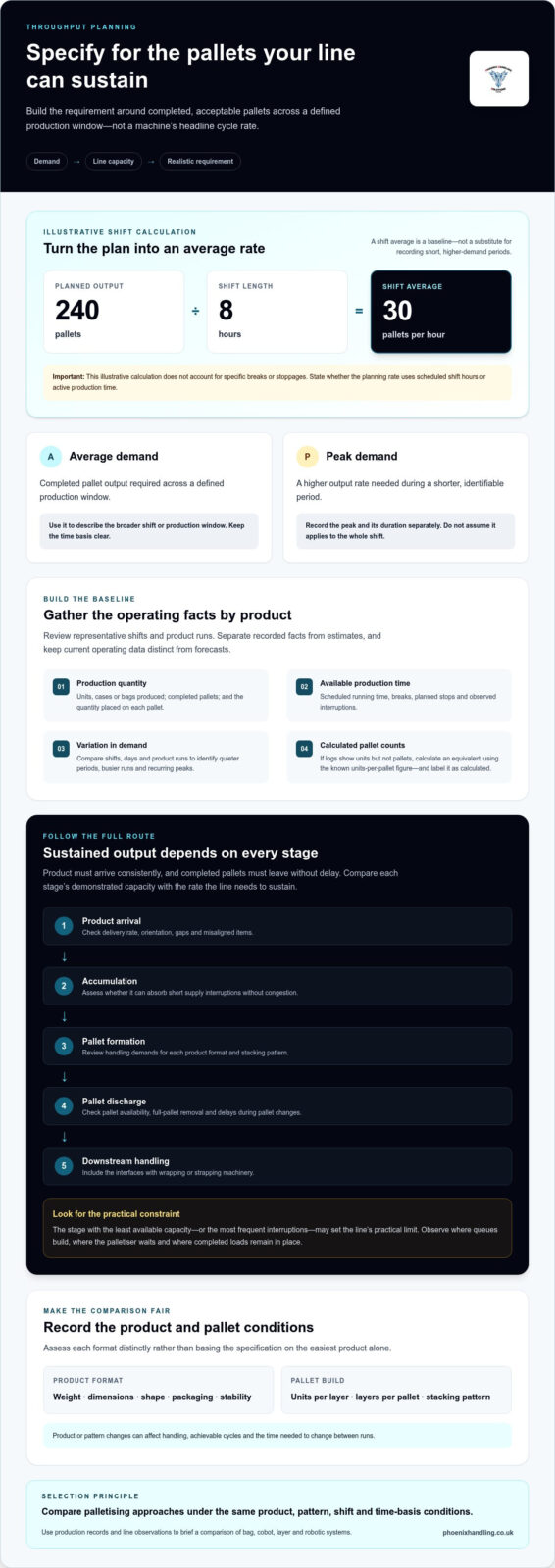
Average demand is the completed pallet output required across a defined production window; peak demand is the higher output rate needed during a shorter, identifiable period. Calculate both using consistent time units, such as pallets per hour, and state the window used. Keep short peaks separate from the average so an exceptional burst does not become the assumed rate for an entire shift.
For example, if a production plan calls for 240 pallets across an eight-hour shift, the shift average is 30 pallets per hour. If a particular product run needs a faster rate for a limited period, record that peak and its duration separately. This illustrative calculation does not account for specific breaks or stoppages. Include those in the baseline and explain whether the planning rate uses scheduled shift hours or active production time.
The right figure depends on the production question. Planning may be based on shift output, while equipment operation may need to meet a higher rate during available running time. Record both where useful and state the time basis for each. This gives you a practical starting point for assessing a palletising system against current demand and planned changes, rather than a universal throughput figure.
Throughput depends on the whole palletising line, not one machine rate
A palletiser can sustain its required output only when product reaches it consistently and completed pallets can leave without delay. Map the full route: product arrival, accumulation, pallet formation, pallet discharge, then any downstream wrapping or strapping. Record the operating rate and interruptions at each stage using the same time basis as your production requirement.
Compare the demonstrated capacity of each stage with the rate the line needs to sustain. The stage with the least available capacity, or the most frequent interruptions, may set the practical limit. It could be an infeed conveyor delivering product intermittently, too little space to accumulate product, or a discharge arrangement that delays pallet changes. A faster palletiser will not compensate for an infeed that is consistently inadequate or interrupted.
Where can a palletising line restrict sustained output?
Trace product movement from the preceding process to the completed pallet’s next destination. Check whether upstream conveyors deliver products at the required rate and orientation, and note gaps or misaligned items that interrupt handling. Assess whether accumulation can absorb short supply interruptions without creating congestion. Then review pallet availability, full-pallet removal and the interfaces with downstream equipment, including wrapping or strapping machinery.
Use operating observations as well as equipment rates. Note when product queues build, when the palletiser waits and where completed loads remain in place. These observations help distinguish a recurring capacity constraint from an isolated stoppage.
How do product and pallet conditions affect the cycle?
For each product format, document weight, dimensions, shape, packaging and stability. Record units per layer, layers per pallet and the required stacking pattern. Changes to the product or pattern can alter how items are handled and positioned, affecting achievable cycles and the time needed to change between runs.
Include actual pallet and load conditions in the assessment. A pattern that needs careful placement may have different operating demands from one that forms straightforward layers. If products vary, keep their requirements distinct rather than basing the specification on the easiest format alone.
Organise a practical line review as a simple capacity map:
- List each stage from product infeed to downstream handling.
- Record its observed output, waiting time and interruptions.
- Mark where product accumulates, runs short or blocks the next stage.
- Repeat the observations for relevant products, patterns and shift conditions.
This evidence makes palletising system throughput selection a system-level decision. It also clarifies whether the priority is product supply, accumulation, pallet handling or the palletiser itself. Phoenix Handling Solutions Limited supplies palletising machinery and conveyor systems that can form part of an integrated line. Explore palletising and conveyor system options in relation to the constraints you have identified.
Compare palletising system throughput on like-for-like operating conditions
A fair comparison holds the application constant. Use the same product formats, pallet patterns, shift assumptions, infeed conditions and downstream interfaces for each option. Otherwise, a difference in quoted output may reflect different test conditions rather than a meaningful difference between systems.
Compare completed, acceptable pallets over the relevant operating period, not just the palletiser’s fastest movement. Include changeovers, replenishment, interruptions and recovery after a stop. State which assumptions are measured, which are estimated and which remain unresolved. This gives operations and engineering teams a shared basis for assessing bag, cobot, layer and robotic palletising approaches.
What does a quoted cycle rate actually represent?
A cycle rate is meaningful only when its boundaries are defined. Establish whether a cycle covers product pick, movement to the pallet, placement and return, and whether it handles one item or a group. A cycle count alone cannot establish completed pallets per shift because the number of products per pallet, interruptions and operating time also matter.
Translate the quoted measure into a sustained output measure using the specified product and pattern. Record the test duration and whether the rate includes normal replenishment, product gaps and recovery from interruptions. If those conditions are absent, treat the figure as a component measure, not a forecast of shift output.
Which operating conditions make comparisons fair?
Keep product formats, pallet patterns and available running time consistent. If a line handles several products, include the planned product mix and changeover frequency instead of relying on a single-format trial. Also describe the available floor space, conveyor arrangement and downstream capacity, since these interfaces can affect the output achieved by the complete system.
Comparison framework
Technology: Bag palletisers. Conditions: Match the bag format, pallet pattern and infeed arrangement. Output measure: Acceptable pallets over the stated run or shift. Unresolved assumptions: Changeover duration and how product gaps are handled.
Technology: Cobot palletiser. Conditions: Use the same product, pattern and operating window as other options. Output measure: Completed pallets under those conditions. Unresolved assumptions: Replenishment, interruptions and any operator tasks included in the trial.
Technology: Layer or robotic palletiser. Conditions: Specify the product mix, pallet build and line interfaces. Output measure: Sustained acceptable pallets per hour or shift. Unresolved assumptions: Pattern changes, downstream capacity and recovery after stops.
Use this framework to separate confirmed performance from assumptions that need further evaluation. A like-for-like brief supports more reliable palletising system throughput selection and keeps the comparison focused on operational fit, not a headline rate in isolation. Phoenix Handling Solutions Limited supplies palletising machinery and conveyor systems for integrated handling requirements. Review palletising system options in the context of your line conditions.
Use this checklist to validate the throughput requirement before specifying equipment
Turn production records and line observations into a short specification brief that makes the required output traceable. Separate confirmed data from estimates and open assumptions. This lets you assess each figure against its evidence, rather than treating it as a fixed requirement before the operating conditions are understood.
What information should the throughput brief contain?
Capture representative products and operating conditions, including product formats, pallet configurations, product-mix changes, shift structure and the periods used to calculate output. Record known interruptions and line interfaces as well as the required rate. The brief should describe the real application, not just the desired machine capacity.
- Define the output measure. State whether the requirement is acceptable completed pallets per hour, per shift or over another defined production window. Identify the running-time basis used.
- List relevant product formats. Record dimensions, packaging and units per pallet for each representative product. Note expected changes in product mix and how often they occur.
- Specify pallet patterns. Document units per layer, layers per pallet and pattern variations. Mark any pattern details that are still being finalised.
- Describe operating windows. Include shift structure, scheduled hours, breaks and planned stops. Keep measured production variation by shift or run alongside the target output.
- Record demand conditions. State the normal required rate and any identified peak rate, with the duration and production context for each.
- Map the interfaces. Note conveyor infeed, accumulation, pallet supply, completed-pallet removal and downstream handling, such as wrapping or strapping.
- Label the evidence. Mark each entry as confirmed, estimated or an open assumption, and identify the record, observation or decision it depends on.
How can the requirement be validated against actual operation?
Check the calculations against production records from representative shifts and product runs. Then test the brief against normal demand, peak periods, product changeovers and foreseeable interruptions. This can reveal whether the target depends on uninterrupted supply, a particular pallet pattern or a downstream interface that has not yet been defined.
Keep unresolved points visible. For example, mark an estimated changeover duration as an assumption, and flag a layout measurement or interface decision that could alter available running time. If a trial is needed to resolve a cycle or handling question, state what it must establish—alternatively, automated machine simulation services from robotic system integrators such as RWC Inc. can model and validate line behaviour. This makes the basis of the requirement clear before equipment is specified.
A validated brief gives palletising system throughput selection a consistent basis across products, operating windows and line conditions. Use it to assess Phoenix Handling Solutions Limited’s bag, cobot, layer and robotic palletising options alongside conveyor and downstream handling requirements. Explore palletising system options for your operational requirements.
Turn the throughput checklist into a system-level palletising decision
A validated throughput brief gives the equipment decision a practical basis. Bring together sustained demand, any short-duration peak, product characteristics, pallet patterns and the available line layout. Keep confirmed operating data distinct from estimates, and state which assumptions could change the required output or system arrangement.
Use the operating profile to assess how different palletising approaches fit the application. Bag, cobot, layer and robotic palletisers should each be considered against the products, pattern requirements, expected throughput and available floor space. The brief keeps the comparison focused on the actual application rather than assuming one technology will suit every line.
How should the checklist inform the system approach?
Use the evidence to define what the system must handle and under which conditions. Product type and stability inform handling requirements; sustained and peak throughput inform capacity assessment; and floor space shapes the possible layout. If the product mix or operating schedule is expected to change, include those requirements in the brief so they form part of the evaluation.
A buying guide to palletising systems can help explain the differences between solution approaches. Use it alongside the throughput findings, not as a substitute for application data. The key question is how each approach fits the documented product, operating profile and layout constraints.
What should happen after the initial throughput assessment?
Convert the records and observations into a concise application brief that can be used consistently in system discussions. Include target output, operating windows, representative products and patterns, line layout, identified constraints and open assumptions. This gives the next stage a clear reference point and makes any changes to the requirement easier to trace.
Include relevant interfaces in the same brief. Conveyors, pallet wrapping machines and strapping machines can affect how a palletising system fits into the wider line, so note where product arrives and where completed pallets go next. Consider wrapping and strapping as part of the overall application, without treating a standalone machine rate as proof of complete-line output.
Guidance on palletising systems, pallet wrapping and strapping can help frame those equipment choices. Keep the final decision anchored to the conditions in the brief, including the available space and the confirmed capacity of connected processes.
Palletising system throughput selection is most useful when it ends with a clear, evidence-based application brief, not a single headline rate. Phoenix Handling Solutions Limited supplies bag, cobot, layer and robotic palletisers, along with conveyor systems and other packaging equipment. Discuss your application with Phoenix Handling Solutions Limited to assess throughput, product conditions and line layout together.
Make your throughput brief the basis for the next decision
A useful specification should remain practical after equipment selection. Keep the evidence and assumptions behind it together so production and engineering teams can revisit the requirement if product mix, shift patterns or line arrangements change. This makes palletising system throughput selection a decision that can be reviewed against operational needs, rather than a figure that quickly loses context.
Use the brief to set clear evaluation criteria and record why a particular system approach suits the application. That makes future adjustments easier to assess and helps maintain continuity between production planning and equipment decisions.
Phoenix Handling Solutions can help you assess your application against its palletising and integrated handling options. Start a palletising system discussion with Phoenix Handling Solutions and take the next step with a clear, evidence-based brief.
Frequently Asked Questions
How do you calculate palletising throughput?
Divide the number of acceptable completed pallets by the operating period used for the calculation. For example, 36 pallets completed during four hours of active production equates to an average of nine pallets per hour for that window. For palletising system throughput selection, state whether the period includes breaks or planned stops. Calculate different product runs separately where pallet quantities or patterns vary.
What is the difference between cycle rate and system throughput?
Cycle rate measures how often a defined machine movement or sequence occurs; system throughput measures acceptable output from the line over time. Set clear start and end points for the measurement. For example, decide whether the count ends when a pallet is formed or only after it has cleared the palletising area. Consistent boundaries make trial results and production records easier to compare.
Can a palletising system meet peak demand as well as average production?
Assess the system against both requirements, but record each separately. Note how long a peak lasts, how often it occurs and which products are involved. If a peak is brief, production planning may be able to manage it through scheduling or accumulation. If it recurs throughout a run, it may need to influence the operating requirement. This distinction helps avoid sizing around an exceptional event.
How many pallets per hour should a palletising system handle?
There is no universal pallets-per-hour figure suitable for every operation. Derive the target from the required finished-pallet quantity and the production time available for the relevant product run. For mixed output, calculate each format using its own units-per-pallet figure, then account for the planned sequence. State whether the rate is an average target or a peak requirement so every system is assessed on the same basis.
Does changing pallet patterns affect palletising throughput?
Yes. Pattern changes can affect the handling sequence and the time between production runs. A change may involve different layer arrangements, pallet dimensions or product orientations, each of which can alter how the system places product. Record how often patterns change and whether the change coincides with a product changeover. This helps distinguish a steady single-pattern rate from output across the actual production schedule.
What production data should I collect before assessing palletising throughput?
Collect shift output reports, production schedules and records of completed pallets, then compare them with observations from the line. Include product formats, pallet configurations and the timing of product changes. Clarify how rejected or incomplete pallets are recorded so the baseline reflects acceptable output. Mark figures derived from estimates separately from values taken directly from logs.