
When comparing the types of stretch wrappers, start with one practical question: what moves around the pallet? The pallet may rotate, the film carriage may travel around a stationary load, or a ring may carry the film around it. That operating principle affects how the wrapper handles different loads and fits into a packaging line.
Turntable, rotary-arm and robotic wrappers are easier to compare once you follow that movement. This guide explains how the main designs apply film, what to consider about load stability and floor space, and how to narrow down the options for your operation.
We’ll look at turntable wrappers, where the pallet rotates; rotary-arm wrappers, which wrap a stationary pallet; and mobile robotic wrappers, which travel around the load. We’ll also cover orbital and ring-straddle designs, automation levels and practical checks for planning a wrapping station.
Key Takeaways
- Compare the types of stretch wrappers by identifying what moves during wrapping: the pallet, the film carriage or the wrapping structure.
- Turntable and rotary-arm designs handle pallet movement differently, which can affect their suitability for particular loads and layouts.
- Orbital and ring-straddle wrappers offer other ways to apply film. Consider how the load is presented and how each design fits the line.
- Match wrapper type to load characteristics, wrapping frequency, workflow and available floor space before comparing machine specifications.
- Plan how the wrapper connects with upstream product flow and downstream handling, as well as how it will be loaded and unloaded.
What is a stretch wrapper and how does it wrap a pallet?
A stretch wrapper applies stretch film around a unitised pallet load to help hold products together for storage or transport. The film contributes to load containment, but wrapping alone does not guarantee that goods will remain undamaged or secure in every handling condition.
The Stretch wrap is drawn from a roll and laid around the load in overlapping passes. The machine design determines how those passes are made, while the load and application determine the wrapping pattern and settings required.
The types of stretch wrappers are easiest to understand by tracking what moves: the pallet, the film carriage or another part of the wrapping mechanism. That distinction explains how the machine applies film. The load’s shape, stability and handling requirements determine what containment the wrapping process needs to provide.
How does machine stretch wrapping work?
The film is dispensed from a carriage or other feed point as the machine and load move relative to one another. Successive passes overlap to cover the load. Film tension draws the wrap around the products, while the number and placement of passes contribute to containment. Settings and film choice should suit the load’s shape, stability and handling requirements.
A tall load and a compact load, for example, may need different wrapping patterns to cover their surfaces appropriately. The aim is a consistent wrap suited to the product, not simply the greatest possible film tension. Excessive or poorly distributed tension can affect the load, so the film and wrapping pattern need to work together.
What separates hand wrapping from machine wrapping?
With hand wrapping, an operator guides the film around the pallet and controls its application during the task. The result can depend on how the operator moves, applies tension and overlaps each pass. Machine wrapping uses a powered or mechanically guided process to apply film according to set parameters, helping make the wrapping pattern more repeatable from load to load.
That repeatability may help an operation standardise wrapping, although the practical effect depends on load variation, workflow and how the equipment is used. Machine wrapping also changes how people interact with the task. It does not remove the need for suitable operating procedures or attention to load stability.
Before comparing machine layouts, consider the finished unit: whether products shift easily, whether pallets are built consistently, and how wrapped loads will be moved. These details help explain why a wrapping pattern that suits one load may not suit another. They also provide useful context for comparing machine designs.
How the main types of stretch wrappers move the load and film
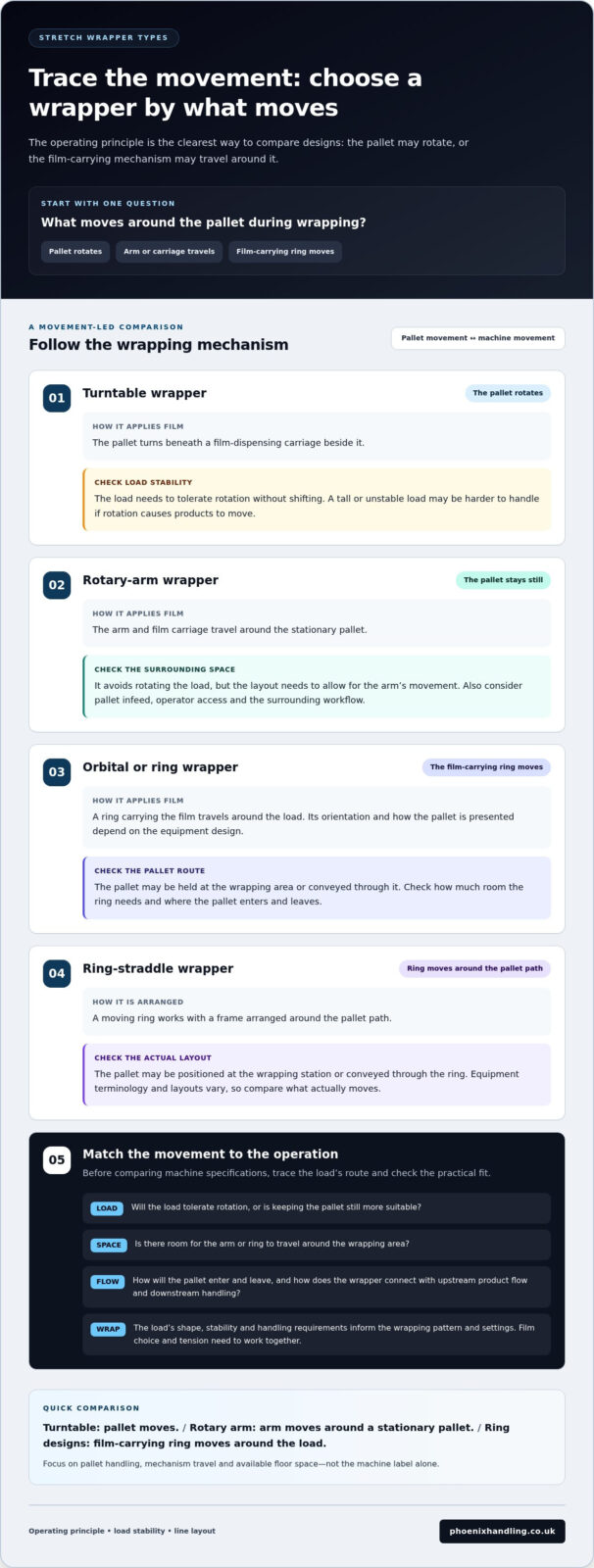
The operating principle is the clearest way to distinguish the main types of stretch wrappers. Does the pallet rotate, does a film carriage travel around it, or does a ring carry the film around the load? Manufacturers may use different labels for similar arrangements, so focus on the movement and pallet handling rather than the name alone.
In brief, a turntable rotates the pallet beneath a dispensing carriage; rotary-arm, orbital and ring designs move the wrapping mechanism around a pallet that is generally held still or conveyed through the wrapping area. This difference affects how a load is presented to the machine and how the wrapper fits into the available floor space.
Turntable and rotary-arm stretch wrappers
A turntable wrapper rotates the pallet while a film carriage dispenses film beside it. The load needs to tolerate that rotation without shifting. A rotary-arm wrapper keeps the pallet stationary and moves the arm and film carriage around it. This can be practical where rotating a particular load is unsuitable, provided the layout allows for the arm’s movement.
A tall or unstable load, for example, may be harder to handle if rotation causes products to move. A stationary-pallet design avoids that rotation, but needs space for the arm’s travel. Load shape is only one consideration: pallet infeed, operator access and the surrounding workflow also affect which movement is practical.
Orbital, ring and ring-straddle wrappers
Orbital or ring designs use a film-carrying ring that travels around the load. The ring’s orientation and the way the pallet is presented depend on the equipment design. Ring-straddle wrappers also use a moving ring, with a frame arranged around the pallet path. The pallet may be positioned at the wrapping station or conveyed through the ring. Terminology and layouts vary, so compare the actual movement rather than relying on the label.
Look at where the pallet enters and leaves, whether it moves during wrapping, and how much space the ring or arm needs. An industry overview of types of stretch wrappers provides further context on wrapper categories and applications. For this comparison, the key distinction remains the movement of the pallet and film-carrying mechanism.
Film construction is a separate consideration from wrapper layout. Film type and settings need to suit the load and application; the dedicated film guide can cover material selection in more detail. To compare machine designs, first map the load’s route through the wrapping area and identify which component needs to move around it.
Phoenix Handling Solutions Limited supplies pallet wrapping machinery and related packaging systems. Consider how the wrapper fits with product flow before and after wrapping. View pallet wrapping machinery as part of that wider line-planning process.
Stretch wrapper types compared: operation, layout and trade-offs
Compare the types of stretch wrappers by looking at pallet movement, the wrapping mechanism and the space needed around the wrapping zone. These design features are separate from automation level: turntable or ring describes how wrapping happens, while semi-automatic or automatic describes how much of the process involves an operator.
The table summarises typical arrangements. Machine layouts vary, and throughput and suitability depend on the configuration, load and application.
| Design | Pallet movement | Wrapping mechanism | Layout and typical operating context |
|---|---|---|---|
| Turntable | Rotates during wrapping | Film carriage dispenses film as the pallet turns | Requires room for the turntable and pallet rotation; suited to loads that can be rotated as part of the wrapping cycle. |
| Rotary arm | Usually stationary during wrapping | Arm and film carriage travel around the pallet | Needs clearance for arm movement; may suit operations where rotating the load is impractical. |
| Orbital | Held stationary or positioned through the wrapping area, depending on design | A film-carrying ring moves around the load | Layout depends on ring orientation and how the load is presented; consider access around the wrapping zone. |
| Ring-straddle | Stationary at the wrapping point or conveyed through the frame | A ring travels around the load within a straddle structure | Can be arranged around a pallet path; infeed, outfeed and frame clearance shape line integration. |
Semi-automatic versus automatic stretch wrappers
On a semi-automatic wrapper, an operator commonly positions the pallet, attaches or prepares the film and starts the cycle. Depending on the machine, the operator may also finish the wrap and arrange removal. Automatic systems can transfer pallets through the wrapping cycle using conveyors, with more of the process coordinated as part of a packaging line. The division of tasks varies by configuration.
Automation does not determine the wrapping mechanism. Classify a machine by how its pallet and film move, then separately consider how loading, cycle initiation and unloading are handled. Capacity depends on the machine configuration, so compare the intended workflow rather than relying on a generic throughput figure.
Which operating trade-offs should the comparison show?
First consider whether the load can rotate without products shifting. Then assess clearance: a turntable needs space for pallet rotation, while an arm or ring needs room for its travel and supporting frame. Include operator access, guarding and the routes used to bring pallets in and take wrapped loads away.
For a standalone station, manual positioning may fit the existing workflow. A conveyorised arrangement can connect wrapping with upstream packing and downstream handling, but its infeed and outfeed need to align with the wider line. No configuration is universally best. The practical fit depends on load stability, handling frequency, layout and the required level of integration.
How to match a stretch wrapper type to your operation
Wrapper selection depends on load handling, throughput and layout. Use these factors to narrow down the machine type before comparing detailed specifications. The aim is to find a wrapping arrangement that fits the pallet’s movement and the way loads pass through your operation, not to select a design by name alone.
Start with the pallet and load
Record pallet dimensions, the full load profile, stability and any overhang. Note whether products sit evenly on the pallet or extend beyond its edges, as this affects how the load can be handled during wrapping. Consider whether rotation is practical: if products may shift as the pallet turns, a design that keeps the load stationary may be more appropriate.
Unusual shapes or variable loads need application-specific consideration. They do not automatically require a particular wrapper type, and no general machine category guarantees suitability. Use representative loads to clarify what the wrapping mechanism needs to accommodate.
Map the wrapper to workflow and floor space
Establish whether pallets arrive individually for an operator to position or move through a continuous packaging line. Then map the space needed for loading, wrapping and unloading. Include the travel area for a turntable, arm or ring, along with access for people and pallet-handling equipment.
Choose an automation level to suit the workflow, not a volume assumption alone. A standalone station may fit a process where pallets are presented one at a time; conveyor integration may be relevant when wrapping needs to connect with upstream packing and downstream handling. The available infeed and outfeed routes also affect the arrangement.
Use this simple sequence to narrow the options:
Stationary pallet? Consider a wrapper whose mechanism travels around the load, subject to space and application requirements.
Pallet can rotate? Consider a turntable arrangement if the load and handling process suit rotation.
Continuous line? Assess how either movement principle could connect with conveyor infeed and outfeed.
This is a screening tool, not a specification. A stationary pallet points towards a moving arm or ring; a pallet that can rotate may suit a turntable. If the workflow is integrated, assess how the selected arrangement fits the full line rather than viewing the wrapper in isolation.
Before comparing configurations, gather practical details: the usual pallet and load profiles, how loads reach the wrapping point, whether they can rotate, and the floor space available around the station. These observations turn a broad choice between the types of stretch wrappers into a focused discussion about movement and line fit.
Review pallet wrapping layout considerations around load handling, throughput and available floor space.
Where Phoenix Handling fits into stretch wrapper planning
A wrapper sits between the point where a pallet is formed and the point where the wrapped load is stored, moved or despatched. Its design needs to fit both the load’s route and the space around the wrapping station. The types of stretch wrappers under consideration may handle pallets differently, but each must work within the wider packaging process.
Consider the wrapper as part of the packaging line
Start by mapping how pallets reach the wrapper and leave it. A standalone station may suit a process where loads are brought to the machine individually and moved away after wrapping. In a connected line, conveyors or other handling equipment may bring loads to the wrapping point and transfer them onwards. Not every operation needs a fully automated line; the arrangement should reflect the existing workflow and intended level of automation.
Allow for the wrapper’s operating movement as well as its loading and unloading positions. A turntable needs room for pallet rotation, while a moving arm or ring needs clearance around its path. Infeed and outfeed routes can affect where the machine fits, how loads queue and whether operators can access the station. Consider these together rather than treating floor space as a single footprint measurement.
Phoenix Handling Solutions Limited supplies pallet wrapping machinery and related packaging and handling systems to manufacturers and distributors across the United Kingdom. Its wider equipment range includes conveyor systems, which may be relevant when planning how pallets move between wrapping and other stages of a line. A wrapper can also operate as a standalone station.
Plan the next step around operating requirements
Before narrowing down the options, document the information that describes the real operating conditions:
- Load profile: pallet dimensions, load height, overhang and stability.
- Process flow: how loads arrive, who positions them and how wrapped pallets leave.
- Throughput: wrapping frequency and how it varies across the working day.
- Available space: room for loading, wrapping movement, unloading and any conveyor connection.
These details help distinguish a machine for an individual wrapping point from one intended to form part of a broader packaging arrangement. They also provide context for whether a standard machine or a custom-engineered system suits the project requirements. Phoenix Handling Solutions Limited supplies both standard and custom-engineered equipment, and provides equipment servicing and spare parts.
Use the documented load, process flow, throughput and floor space to guide your planning, then consider how the wrapper will connect with upstream and downstream handling. Explore Phoenix Handling Solutions Limited’s pallet wrapping machines.
Turn your wrapping requirements into a practical plan
Before settling on a machine design, build a short operating brief based on the pallets your team handles. Record a representative load, its route through the work area and any points where wrapping interrupts or complicates handling. Include variations in load profile or workflow so the decision reflects normal operating conditions, not just an ideal example.
This brief gives the types of stretch wrappers a practical context and helps separate essential requirements from preferences. Note how the load must be handled, how the wrapper fits the process and what space is available. Those details support a focused discussion about machine configuration without requiring a full procurement assessment at the outset.
Phoenix Handling Solutions Limited supplies pallet wrapping and other packaging machinery, with equipment specified around product type, throughput and available floor space. Explore Phoenix Handling Solutions Limited’s pallet wrapping machines and discuss a wrapping arrangement suited to your operation.
Frequently Asked Questions
What are the main types of stretch wrappers?
The main types of stretch wrappers are turntable, rotary-arm, orbital and ring-straddle machines. They differ in how the pallet is positioned and how the film-carrying mechanism moves. A turntable rotates the pallet, while an arm or ring travels around the load in other designs. Names can vary between manufacturers, so compare the machine’s movement and pallet handling arrangement rather than relying on its label alone.
What is the difference between a turntable wrapper and a rotary-arm wrapper?
A turntable wrapper rotates the pallet during the wrapping cycle, while a rotary-arm wrapper keeps the pallet still as an arm carries the film around it. This matters if a load could shift during rotation or if the wrapping area has limited clearance for an arm’s movement. A stable, regularly formed load may suit a turntable, while a load that should remain stationary may favour another arrangement.
How does an orbital stretch wrapper work?
An orbital stretch wrapper carries film around a load using a moving ring or similar wrapping mechanism. The load may remain stationary or travel through the wrapping area, depending on the machine layout. This arrangement can wrap products presented in orientations different from a conventional upright pallet load. Check how the item is held and conveyed, particularly if it is long or has exposed edges that need careful handling during wrapping.
What is the difference between a semi-automatic and an automatic stretch wrapper?
A semi-automatic wrapper usually requires an operator to position the pallet and start or finish parts of the cycle. An automatic system can coordinate more of these tasks, often as part of a conveyorised line. Automation level is separate from wrapper design: it describes operator involvement, not whether the pallet rotates or a ring moves. The appropriate arrangement depends on the wider workflow and how loads are presented to the machine.
Can a stretch wrapper handle different pallet sizes?
Some wrappers can accommodate variation in pallet dimensions, but the usable range depends on the machine configuration and its settings. Consider both the pallet base and the full load profile, including changes in height, width or overhang. A line handling two common pallet formats, for instance, may need a suitable changeover approach. Defining the range of loads the process must handle helps clarify the application requirements before specifying equipment.
Is stretch wrapping the same as stretch hooding?
No. Stretch wrapping applies film from a roll around a load in overlapping layers, whereas stretch hooding places a stretchable film hood over the pallet. The hood is drawn down around the load rather than wound around it in successive passes. Both methods are used to unitise pallet loads, but they use different machinery and film formats. The suitable method depends on the load, handling process and packaging requirements.