The fastest pallet wrapper is not necessarily the right one for your operation. An industrial pallet wrapping machine supplier UK businesses can rely on should match the equipment to the loads being wrapped, available floor space and packaging-line demands, rather than focusing on a headline throughput figure alone.
Before comparing proposals, define what the machine needs to handle. Pallet dimensions, load stability, wrapping frequency, film requirements and the level of automation all affect suitability. So do practical constraints such as conveyor interfaces, operator access and space around the equipment. If these details are missing, it can be difficult to tell whether a proposal fits day-to-day requirements.
This guide provides a practical framework for setting those requirements. It explains how load characteristics, machine functions, film and line integration interact, then covers equipment support, spares and servicing. Phoenix Handling Solutions supplies standard and custom-engineered pallet wrapping equipment, as well as conveyor systems and wider packaging machinery that can be considered as part of a line. The aim is to help you assess the whole operating requirement, not choose on throughput alone.
Key Takeaways
- Build your specification from real operating data, including pallet dimensions, load weights, height variation and wrapping frequency.
- Map floor space, operator workflow and conveyor interfaces before narrowing down machine options.
- Compare proposals on load range, film control and operator input as well as stated throughput. Check how each performs against your actual requirements.
- An industrial pallet wrapping machine supplier UK businesses can work with should relate its recommendation to documented load, line and space requirements.
- Consider standard and custom-engineered equipment alongside spares and servicing to assess the solution across its working life.
What an Industrial Pallet Wrapping Machine Supplier UK Should Help You Solve
An industrial pallet wrapping machine applies stretch film around a palletised load to help hold items together for handling, storage and transport. The equipment controls aspects of film application and the wrapping cycle. For an overview of the material and common application methods, see Stretch Wrap.
The machine performs the wrapping task; the supplier helps match equipment to the operation. An industrial pallet wrapping machine supplier UK businesses can work with should connect its recommendation to the loads, working pattern and available space. That means considering what needs wrapping, how pallets move through the process and what the equipment needs to interface with, rather than treating a wrapper as a standalone purchase.
When does machine wrapping make operational sense?
Recurring pallet volumes and repeatable wrapping tasks can make machine application worth assessing. A machine can give operators a more controlled process than manual application, where the result may vary between people and shifts. However, automation is not automatically the right answer for every operation. Consider the frequency and regularity of the work, the mix of loads, current working practices and the route pallets take through the building. A machine also needs a suitable position and a workable process for presenting and removing each pallet.
Which business outcomes should the specification support?
Start with outcomes that can be described and assessed in your operation. These might include consistent film application across defined load types, load stability suited to the intended handling process, and output that supports the packaging line. Include operator workflow and safe access in the assessment, but treat them as requirements to address in the design, not automatic results of buying a machine.
Make each requirement specific enough to compare. “Improve efficiency” is difficult to assess on its own. A clearer brief identifies the pallets to be wrapped, the required wrapping pattern, when pallets arrive at the wrapping point and how much operator input the process can accommodate. Include variations such as different pallet footprints or load heights instead of relying on a single typical pallet.
- Load consistency: Define the load types and wrapping results required for routine handling.
- Packaging throughput: State the output the process needs to support and describe the operating pattern behind that target.
- Film application: Identify the required coverage and the need for controlled, repeatable film use across the load mix.
- Operator workflow: Describe how pallets are presented, handled and removed, including the access needed around the equipment.
These objectives give a supplier a practical basis for discussing suitability. Phoenix Handling Solutions designs and supplies standard and custom-engineered pallet wrapping machinery for business operations. Its recommendations relate equipment options to the documented process, helping ensure the specification addresses operating requirements rather than relying on broad claims about productivity or performance.
Specify an Industrial Pallet Wrapping Machine Around Loads and Line Requirements
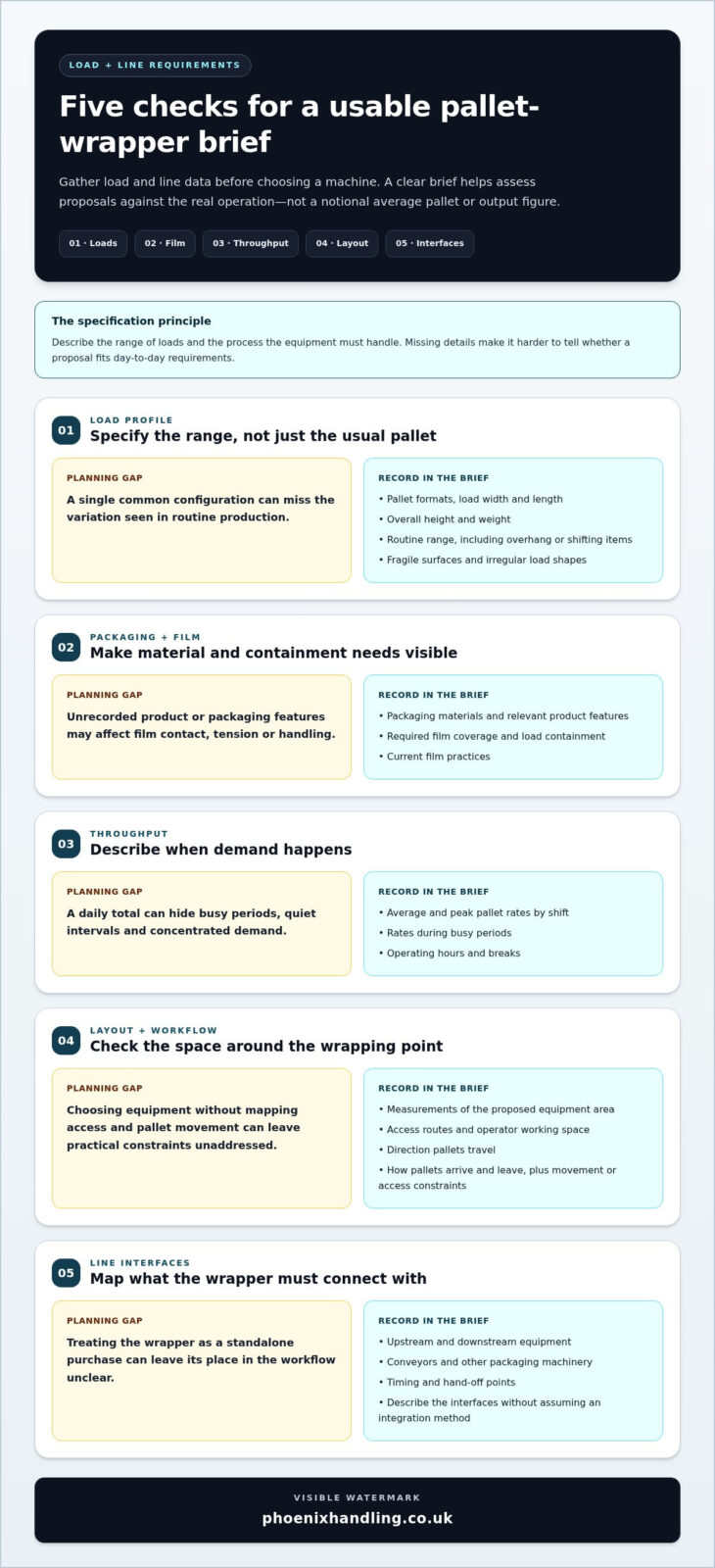
Machine selection is more reliable when the operating brief describes the pallets and process the equipment must handle. Gather load and line data before choosing a machine, because those details define the working limits a proposed wrapper must meet. An industrial pallet wrapping machine supplier UK businesses work with can then assess the brief against the real operation, rather than a notional average pallet or output figure.
- Document the load profile. Record pallet formats, load width and length, overall height and weight. Include the range seen in routine production, not just the most common configuration. Note any product overhang, shifting items, fragile surfaces or irregular load shapes.
- Describe packaging and film constraints. Identify packaging materials or product features that could affect film contact, tension or handling. Record coverage and load-containment requirements, along with current film practices. This helps distinguish a consistent, straightforward load from one that needs more careful assessment.
- Measure throughput by operating period. Set out average and peak pallet rates by shift and busy period, as well as operating hours and breaks. A daily total can hide short periods of concentrated demand or quiet intervals, so it may not show the capacity the machine needs to support.
- Map the layout and workflow. Measure the proposed equipment area and note access routes, operator working space and the direction pallets travel. Include how pallets arrive at and leave the wrapping point, along with practical constraints that could affect movement or access.
- Record line interfaces. Map upstream and downstream equipment, including conveyors and other packaging machinery. Describe the timing and hand-off points without assuming a particular integration method. This shows where the wrapper needs to fit into the existing workflow.
How should the pallet and load profile be recorded?
Use actual production data from representative shifts and product types. A simple load register can pair each pallet format with its dimensions, total height, weight and packaging variation. Add notes on stability, overhang, fragile goods or uneven shapes where relevant. If a load changes with the season or order, record that variation too. The goal is to capture the full operating range the equipment may need to accommodate.
Which throughput and layout details affect machine fit?
Separate typical output from peak demand, then note when each occurs and how it relates to upstream supply and downstream collection. On a layout plan, mark the machine footprint, access routes and operator area alongside conveyor positions and neighbouring equipment. This helps identify constraints before assessing a proposal and gives you a practical basis for discussing standard or custom-engineered options.
Phoenix Handling Solutions supplies pallet wrapping machinery and conveyor systems for business operations. A documented brief gives the project discussion a clear starting point. Explore pallet wrapping and conveyor equipment in relation to the line requirements you have recorded.
Compare Industrial Pallet Wrapping Machine Proposals on More Than Speed
A proposal’s headline pallet rate is useful only if it reflects the loads and operating pattern the machine will face. Read throughput claims alongside their operating conditions, because stated capacity may not represent performance across your load mix, shift pattern or line workflow. Compare every proposal against the brief you have assembled, and record its assumptions as well as its stated capabilities.
A comparison table can make differences easier to see. Give each proposal a column and use consistent rows for the following:
- Required output: Compare the stated rate with your average and peak requirements. Note the operating conditions used for the quoted figure.
- Load range: Record which pallet formats, dimensions, heights, weights and load variations the proposal addresses.
- Film control: Note the film application controls described, as well as the assumed film specification and compatibility conditions.
- Operator input: Compare the tasks operators complete, such as presenting loads, attaching film or managing the cycle.
- Interfaces: Record how the proposal accounts for conveyor connections and coordination with upstream or downstream processes.
This comparison separates stated machine capability from suitability for your operation. If one proposal quotes a higher rate, establish whether the figure applies to a particular load, cycle or operating arrangement. A fair comparison depends on understanding those conditions, not simply ranking machines by their maximum stated speed.
How do film control and load containment affect the comparison?
Compare the film application controls with the containment required for each load type. Record the film specification assumed in each proposal, including any stated compatibility conditions, so the comparison reflects the materials your operation intends to use. A claim of lower film consumption needs to be assessed under comparable load and operating conditions. Without that comparison, treat it as an assumption in the proposal rather than a confirmed saving.
How much automation and line integration does the operation need?
Match operator involvement to the workflow and the level of automation the process requires. A semi-automatic machine involves operator tasks at the wrapping point; an automatic pallet wrapper can form part of a more integrated process. Compare how each proposal handles conveyor interfaces and coordination with adjacent equipment. The machine type alone does not establish fit; layout and hand-offs matter too.
Check that each proposal describes the required load result instead of relying on general statements about stability or transport performance. Film application, load characteristics and handling conditions all influence the outcome, so a quoted rate or feature list should not be treated as a guarantee of load containment. The industrial pallet wrapping machine supplier UK you select should relate its recommendation to your documented operating requirements and explain the basis for its proposal.
Phoenix Handling Solutions supplies pallet wrapping machinery alongside conveyor systems, so equipment proposals can be considered in the context of packaging-line requirements. Use your comparison to identify where each option aligns with the process and which assumptions need to be resolved before proceeding. For an overview of the types of stretch wrappers and how their machine designs work, compare what moves around the pallet and how each design fits your load and line requirements.
Assess a UK Industrial Pallet Wrapping Machine Supplier’s Project and Support Fit
A suitable supplier connects the proposed equipment to your operating brief, rather than presenting only a machine category or headline capacity. The recommendation should make sense against the recorded load range, throughput, available floor space and line interfaces. This gives your team a basis for understanding why a particular configuration is being considered and whether it addresses the project’s constraints.
What indicates a technically relevant supplier?
Look for a clear explanation of how the documented requirements inform the recommendation. A technically relevant proposal makes its assumptions visible, including the loads and operating pattern used to assess suitability. It should also explain how process interfaces and space constraints influence the equipment choice. This is more useful than an unsupported performance claim because it lets you compare the proposal with the actual brief.
Standard equipment may suit a process whose requirements align with an established configuration. Custom-engineered machinery can be considered when particular loads, throughput demands or layout constraints call for a tailored solution. Bespoke design is not automatically better. The key question is how closely each option fits the operation and what specific requirement any additional engineering addresses.
Phoenix Handling Solutions supplies both standard and custom-engineered packaging machinery. As an industrial pallet wrapping machine supplier UK businesses can consider, Phoenix relates equipment options to product, throughput and floor-space requirements. Conveyor systems are also relevant where the wrapper forms part of a wider packaging line.
How should servicing and spares factor into the decision?
Assess lifecycle support alongside the initial machinery specification. Equipment servicing and access to spare parts are practical considerations when planning for packaging operations over time. Your maintenance planning can take account of the equipment’s role in the line, internal responsibilities and the parts or service support needed for continued operation. Compare the details set out for each proposal rather than relying on general support statements.
Use the same project criteria to assess each supplier:
- Specification fit: Does the recommendation address your documented loads, output needs and floor-space constraints?
- Technical rationale: Are the assumptions, process interfaces and design constraints explained clearly?
- Equipment approach: Is a standard configuration suitable, or does custom engineering address a specific requirement?
- Lifecycle considerations: Are servicing and spare parts included in the discussion of ongoing equipment needs?
Phoenix Handling Solutions provides servicing and spare parts for packaging and handling equipment, alongside its machinery supply. Reviewing lifecycle support at the same time as equipment suitability keeps ongoing operational needs in view, rather than leaving them until after the machine has been selected.
Explore Phoenix’s packaging machinery range to consider pallet wrapping equipment alongside the wider requirements of your packaging operation.
Move from an Industrial Pallet Wrapping Machine Brief to a Suitable Solution
A useful project brief turns operating information into a basis for equipment decisions. It should make clear what the wrapper needs to handle, where it will operate and how it fits into the packaging process. With those points documented, an industrial pallet wrapping machine supplier UK businesses approach can assess the requirement against the operation, rather than starting with a machine feature or headline output figure.
Use this sequence to move from initial information to a defined next step:
- Gather operating data. Record representative pallet formats, load dimensions and weights, packaging types and variation. Note average and peak output by shift, together with the operating pattern that creates those requirements.
- Document site constraints. Capture available floor space, access routes and operator working areas. Include practical limits on where the equipment can sit and how pallets move through the area.
- Map the packaging process. Identify existing conveyor or machinery interfaces, upstream supply and downstream collection. State the outcome the project needs to support, such as repeatable film application across a defined load range.
- Compare proposals and set next steps. Use consistent criteria for output, load suitability, film controls, operator input and interfaces. Record assumptions or open points, then agree what information or decisions are needed to progress the preferred option.
What information should be ready for a supplier discussion?
Bring a representative picture of the operation, not just details for its most common pallet. Include dimensions, load weights, packaging materials and relevant variation, such as different heights or irregular shapes. Summarise output by shift and peak period, operating hours, the proposed machine area and access constraints. A basic line sketch can show conveyor positions and adjacent packaging equipment. Add a short statement of the intended result so equipment options can be considered against a clear process need.
Separate fixed requirements from preferences. For example, distinguish a restricted installation area from a preferred machine position, or a required output from a target with some flexibility. This makes trade-offs easier to discuss and gives the comparison a practical basis. Keep a record of decisions and assumptions as proposals develop, particularly where load variation or line interfaces affect the equipment configuration.
How can Phoenix support the equipment-selection process?
Phoenix Handling Solutions designs and supplies pallet wrapping and broader packaging machinery for business operations. Standard and custom-engineered equipment can be assessed against the project brief, with the right approach depending on the loads, process requirements and space constraints. Where line planning calls for it, conveyor systems can be considered alongside the wrapping equipment. This frames the decision in relation to the wider packaging operation without assuming every project needs a bespoke solution.
Consider ongoing equipment needs, including servicing and spare parts, as part of the project discussion. The next step is a focused conversation using the information you have assembled. Discuss your industrial pallet wrapping requirement with Phoenix and outline the loads, throughput, layout constraints and line interfaces the proposed equipment must address.
Put Your Wrapping Requirements into Action
A well-defined requirement gives the equipment discussion a practical starting point. Before selecting a machine, agree internally what a suitable result means: which loads need wrapping, what output the process must support and which constraints the equipment must work within. This gives operations, engineering and procurement a shared basis for assessing proposals.
The right industrial pallet wrapping machine supplier UK businesses choose should relate its recommendation to those documented priorities, not rely on broad performance claims. Keep the brief available as the project progresses so any changes to loads, workflow or layout can be assessed against the original requirement.
Phoenix Handling Solutions supplies pallet wrapping machines and other packaging machinery, with standard and custom-engineered equipment for business requirements. Servicing and spare parts are also relevant when planning for the equipment’s ongoing role in your operation.
Share your pallet wrapping project brief with Phoenix Handling Solutions to discuss equipment suited to your operational requirements. A clear brief gives the conversation a practical starting point.
Frequently Asked Questions
Is an industrial pallet wrapping machine suitable for a low-volume operation?
It can be, if the wrapping task is frequent or physically demanding enough to justify a machine, even at modest output. Compare the time and consistency required for manual wrapping with the space, operator involvement and upkeep a machine would introduce. A business with occasional, varied pallets may prefer a manual process, while a regular dispatch operation may benefit from more controlled application. The right choice depends on the whole task, not volume alone.
Can one pallet wrapping machine handle more than one pallet size?
Some machines can wrap different pallet sizes, but suitability depends on the equipment’s operating range and the dimensions and shapes of the loads. A narrow range of standard pallets is different from a mix that includes unusually wide, tall or unstable loads. Check how changes between formats are managed, including any adjustments operators need to make. If products overhang the pallet or have irregular profiles, include examples in the assessment rather than assuming the machine will accommodate them.
Does stretch wrapping replace pallet strapping?
Not in every application. Stretch film holds items together by applying tension around the load, while straps provide restraint at selected points. The appropriate method depends on the product, load shape, handling conditions and packaging specification. Some loads may use one method; others may require both. For example, a load with distinct layers could need additional restraint that film alone may not provide. Assess the finished load and handling requirements before removing an existing strapping step.
Can stretch wrapping make a pallet load waterproof?
No. Stretch film can cover parts of a pallet and help shield goods from dust or light moisture, but a wrapped load should not be treated as waterproof. Gaps, exposed top surfaces, punctures and film damage can allow water in, and wrapping does not control humidity or condensation inside the load. If moisture protection is critical, specify the storage and transport exposure and assess packaging designed for that requirement, rather than relying on stretch film alone.
What is the difference between a pallet wrapping machine and a stretch hooder?
A pallet wrapping machine applies stretch film around a load, commonly by rotating the pallet or moving a film delivery system around it. A stretch hooder places a tubular film hood over the pallet and stretches it to fit. The methods differ in film format, application and equipment arrangement. The suitable option depends on the required load coverage, packaging process and line layout. Compare them against the same load and operating requirements.
How can a business assess pallet stability after wrapping?
Inspect representative wrapped loads for movement, leaning, loose layers, film tears and excessive overhang, then assess them under handling conditions similar to normal operations. Visual inspection is useful but does not quantify load rigidity. For a more objective assessment, a competent test provider can use a relevant method such as EUMOS 40509:2020 to evaluate palletised-load stability. Record the load configuration and test conditions so the results relate to the loads actually being dispatched.
Can pallet wrapping equipment be used for export loads?
Yes, pallet wrapping equipment can prepare loads for export, but the wrapping method alone does not establish export suitability. Consider the destination, transport route, handling stages, product characteristics and any packaging requirements set by the customer or applicable market rules. Loads passing through several handling points may need a different containment approach from those moving directly to a nearby distribution centre. The wrapping specification should support the full journey, not just the point where the pallet leaves the line.