The best-known robot brand isn’t automatically the best fit for a palletising line. When comparing palletising robot brands in the UK, start with the load and application: robotic palletising systems cover a wide reference payload range of 3-300 kg, but the right platform depends on the product, reach and required handling method.
Payload is a sensible starting point: a robot must handle the product reliably. But assess the robot and gripper together, alongside the pallet pattern, line rate and available floor space. A nominal payload figure alone cannot show whether a system suits your products and operating conditions.
This guide explains how robot platforms, payload capacity and gripping options relate to different products and palletising applications. It also compares collaborative, industrial and heavy-duty systems, helping you assess which approach fits your production requirements.
Key Takeaways
- Compare robot platforms by reach, payload and repeatability, rather than relying on brand or robot type alone.
- Distinguish collaborative, industrial and heavy-duty options by the load, required cycle rate and available working space.
- Assess payload with the gripper included, and consider how the product, case format and pallet pattern affect handling.
- Use representative product and packaging samples to identify gripping or stacking issues before settling on a system design.
Representative robot platforms and payload ranges
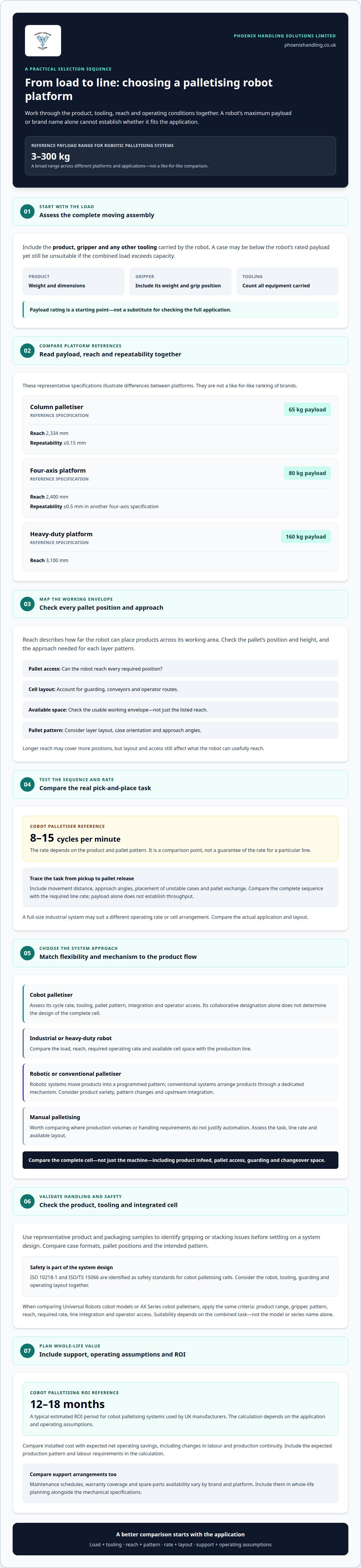
Robotic palletising systems cover a reference payload range of 3-300 kg. That span includes different platform designs and applications, so maximum payload alone won’t identify the right machine. When comparing palletising robot brands in the UK, assess the load, reach, required pattern and end-of-arm tooling together. The gripper contributes to the handled load and must be included when assessing payload capacity. This gives a more useful starting point than brand recognition.
Representative specifications show how platforms differ. A column palletiser is listed with a reach of 2,334 mm, a payload of 65 kg and repeatability of ±0.15 mm. A four-axis platform is listed with a 2,400 mm reach and 80 kg payload; another four-axis specification gives repeatability of ±0.5 mm. A heavy-duty platform is listed with a reach of 3,100 mm and a payload of 160 kg. These are reference examples, not a like-for-like ranking of brands.
Reach describes how far the robot can place products across its working area. Assess the pallet’s position and height, along with the approach required for each layer pattern. Longer reach may cover more positions, but cell layout, guarding and floor space also affect the usable working envelope. The robot needs to access every required pallet position without obstructing conveyors or operator routes.
Allow for the complete moving assembly when assessing payload. Include the product, gripper and any other tooling carried by the robot. A case may weigh less than the robot’s rated payload and still be unsuitable if the combined load exceeds capacity. Product dimensions and grip position matter too. A higher-duty rating is not a substitute for assessing the application.
Reach, payload and cycle time interact. A robot’s listed payload does not establish how quickly it can build a particular pallet. The pattern may require longer movements, different approach angles or careful placement of unstable cases. Map the sequence from product pickup to pallet release, then compare it with the required line rate. This gives a more useful throughput assessment than comparing maximum payload figures alone.
Maintenance, warranty terms and spare-parts availability vary by brand and platform. Compare the stated maintenance schedule, warranty coverage and arrangements for obtaining replacement parts as part of whole-life planning. In comparing palletising robot brands in the UK, these support arrangements help distinguish equipment options beyond their mechanical specifications.
For ROI, compare the system’s installed cost with the net operating savings it is expected to deliver, including changes in labour and production continuity. A typical ROI period estimated for cobot palletising systems used by UK manufacturers is 12-18 months. The calculation depends on the application and operating assumptions, so include the expected production pattern and labour requirements.
Cobot, industrial and heavy-duty palletising options
Cobot, industrial and heavy-duty systems suit different production conditions. Compare their operating rate, integration requirements and cell layout with the flow of products through your line.
Cobot and full-size palletiser options
A cobot palletiser may achieve 8-15 cycles per minute, depending on the product and pallet pattern. That figure provides a useful comparison point, but the required rate depends on the actual pick-and-place sequence. Assess the gripper, case orientation and pallet exchange alongside the robot platform. A full-size industrial system may suit a line needing a different operating rate or cell arrangement.
For manufacturers, the decision also involves integration and operator access. Consider how the system fits with conveyors, pallet positions and guarding, then compare its working area with the available floor space. Tooling affects both the load and how the product is handled. A cobot’s collaborative designation alone does not determine how to arrange a complete palletising cell.
Robotic and conventional palletisers
Robotic palletisers use a robot to move products into a programmed pattern; conventional palletisers arrange products through a dedicated mechanism. Compare the product range and pattern changes involved. A line handling varied cases may need more flexibility than one repeating a fixed arrangement. Integration with upstream equipment also influences the system design.
Manual palletising is still worth comparing where production volumes or handling requirements do not justify automation. Assess the task, line rate and available layout before deciding. For automated systems, compare the complete cell, not just the machine: include product infeed, pallet access, guarding and the space needed for changeovers.
Comparing Universal Robots cobot models
Compare Universal Robots cobot models against the reach and payload needed for the complete handling task, including tooling. Then assess product weight, case dimensions, pallet positions and the intended pattern. A model suited to one case format may not suit another if the gripper or movement path changes. Consider integration with the existing line and whether the planned rate suits the application.
AX Series cobot palletisers
Assess AX Series cobot palletisers using the same application criteria: product range, gripper, pattern, reach and required cycle rate. Compare these with the production layout and operator access. Suitability depends on the combined task, not the series name. Review how the palletising sequence handles each case type and whether tooling needs to change between products.
Safety design is part of the comparison, not a final add-on. ISO 10218-1 and ISO/TS 15066 are identified as safety standards for cobot palletising cells. Consider the robot, tooling, guarding and operating layout as an integrated system. A faster cycle may increase output, but it must still fit the product sequence and cell design.
Matching robot choice to the product and application
Product behaviour, line layout and changeover requirements all affect whether a robot suits a palletising application. Assess them together, from the incoming conveyors to the completed pallet.
Product weight, dimensions and stability
Product weight and dimensions affect gripping and placement. Assess the heaviest and lightest cases, their dimensions and how securely each can be gripped. For example, a soft-sided case may respond differently to gripping pressure than a rigid carton. Include the gripper in your payload assessment: the robot carries the tooling as well as the product.
Case stability affects the pallet pattern: uneven or compressible cases can shift during stacking. Representative samples of every case type, pallet and layer material can help identify handling and stacking issues before a system is built. Review the samples against the intended pattern and product orientation, then assess whether the gripper can maintain control from pickup through placement.
For conveyor integration, map the product’s arrival position against the robot’s pickup point and pallet locations. Include the cell footprint, access for pallet changes and operator routes. Installation and commissioning typically involve integrating the conveyors, robot, tooling and controls, then testing the handling sequence with representative products and pallet materials.
Product variation, changeovers and downtime
Product variation may require different gripping pressure, tooling or programmed positions. If a case drops or sits skewed, check its presentation, the grip and the placement sequence. For example, a change in case dimensions may leave the gripper poorly aligned even when the robot’s programmed path has not changed. Consistent product presentation helps keep cycles reliable.
Consider changeovers if the line handles several case types or pallet patterns. Assess which settings or tools must change between products and how those changes fit the production sequence. A technical review should cover the full product range, not just a typical case. This can reveal where a new format might interrupt the established pattern or require adjustments.
Downtime can result from interruptions to product infeed, gripper faults or a mismatch between the robot cycle and upstream conveyors. Commissioning should test the complete sequence, including product transfer, pallet placement and recovery after a stopped cycle. Clear fault procedures help operators identify whether an issue concerns product presentation, tooling or integration.
For a technical assessment of product samples, conveyors and pallet patterns, discuss your palletising application.
Phoenix Handling Solutions Limited: Robotic Palletisers
Phoenix Handling Solutions Limited designs and supplies robotic palletising systems for manufacturers and distributors across the UK. It is a practical next step when you need to match a robot platform and gripping arrangement to your product range, pallet pattern and production layout.
Share the product types, handling requirements and line constraints that shape your application. Phoenix Handling Solutions Limited supplies standard and custom-engineered equipment, including Robotic Palletisers, Cobot Palletisers and Layer Palletisers. If the wider packing line is part of the project, Pallet Wrapping Machines, Strapping Machines and Stretch Hooders can also be considered.
For a discussion about your palletising requirements, contact Phoenix Handling Solutions Limited.
Plan the next step for your palletising line
A considered approach to comparing palletising robot brands in the UK turns a specification exercise into a decision based on production priorities. Before procurement, define the operating requirements that cannot be compromised and note how planned product changes could affect the line.
This gives engineering, operations and procurement teams a shared basis for evaluating system integration and future production needs. It also makes the next discussion more practical: teams can focus on how the selected arrangement fits their process, rather than comparing brand names in isolation.
For projects involving end-of-line packaging, Phoenix Handling Solutions Limited also offers Pallet Wrapping Machines, Strapping Machines and Stretch Hooders. These options may be relevant when planning palletising and subsequent load preparation as connected parts of the production process.
Contact Phoenix Handling Solutions Limited to discuss your palletising requirements and define a suitable next step for your operation.
Frequently Asked Questions
Which palletising robot brands are available in the UK?
The options discussed here include Universal Robots cobot models and AX Series cobot palletisers, alongside different robotic platform types. This is not a complete catalogue of UK brands. Manufacturers and system integrators may supply different robot platforms, tooling and controls. For a practical comparison, distinguish the robot manufacturer from the integrator responsible for fitting the equipment into a complete production line.
How do leading palletising robot brands compare on payload, reach and speed?
Compare specifications using the same product, gripper and pallet pattern, rather than treating catalogue figures as interchangeable. A useful assessment records the required load, working envelope and cycle rate for the actual task. Ask how quoted speed relates to the complete pick-and-place sequence, including product presentation and pallet handling. This makes the comparison relevant to your line, not just the robot model.
Which UK suppliers offer palletising robots, integration and after-sales support?
Phoenix Handling Solutions Limited supplies robotic, layer and cobot palletisers and can integrate automation into existing production lines. Its support includes spare parts and servicing for supplied machinery and many other makes and models. This is relevant if your project needs more than a standalone robot, or if existing packaging equipment needs support alongside a new palletising installation.
What palletising robot options suit small factories and limited floor space?
A cobot palletiser may be worth assessing where floor space is restricted, but the complete cell determines whether it fits. Include the infeed, pallet locations, guarding, operator access and space to remove completed pallets. A layer palletiser is another option. The right choice depends on product handling, the required pallet pattern and the layout around the line.