The strap is only one part of a reliable banding cycle. A banding machine feeds material from a roll or coil, applies tension around the items and secures the band before cutting off the excess. Plastic bands are commonly sealed by heat or friction welding, while steel bands may use metal seals.
Choosing the right band material and size helps secure the load without damaging the goods or compromising the seal. Machine settings and configuration also determine how well the system handles different pack dimensions, materials and production requirements.
This guide explains how a banding machine works and what to consider when selecting band material and size. It also covers tension and machine configuration, helping you identify specifications that suit your operation.
Key Takeaways
- Match the band’s material and dimensions to the load, pack size and handling conditions.
- Understand how semi-automatic, automatic and fully automated systems differ in operator involvement and production-line integration.
- Consider tension settings and machine configuration to suit the band and protect packaged goods.
- Assess the products being secured and the wider packaging process when deciding which equipment is appropriate.
How Does a Banding Machine Work?
A banding machine draws material from a roll or coil, guides it around the items, applies tension and seals the band. It then cuts off the excess, usually with an integrated cutter. Plastic strapping is commonly joined by heat sealing or friction welding, while steel bands may use metal seals. For example, a carton passes through the cycle and leaves secured by a closed band.
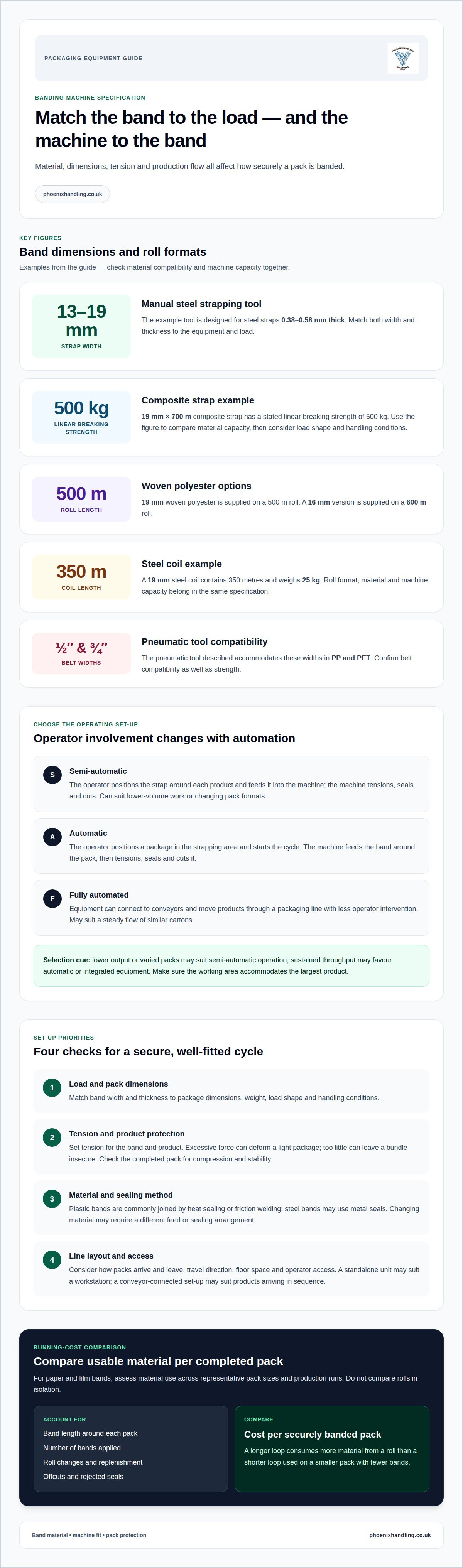
With a semi-automatic strapping machine, an operator positions the strap around each product and feeds it into the machine. The machine then tensions, seals and cuts the strap. This setup can suit lower-volume work or changing pack formats, where manual handling remains practical. One example is a small batch of cartons in different sizes.
Automatic strapping machines reduce manual steps. An operator positions a package in the strapping area and starts the cycle using a control or trigger. The machine feeds the band around the pack, then tensions, seals and cuts it. Fully automated equipment can connect to conveyors, moving products through a packaging line with less operator intervention. This setup may suit a steady flow of similar cartons.
Consider production volume and product size together when choosing a machine. Lower output or varied packs may suit semi-automatic operation, while sustained throughput may favour automatic or integrated equipment. The working area must accommodate the largest product, and the tension setting must suit the load and packaging.
“Banding” and “strapping” often describe the same process: securing products with a tensioned band. Banding can also refer to narrower material used to group lighter items, while strapping commonly secures cartons or larger loads. Risks include pinch points, hot sealing parts and recoil from tensioned strap. In the UK, assess guarding, access, emergency stopping and isolation in relation to the equipment and workplace risks. Keep guards in place and never reach into the strapping area during a cycle.
Choosing banding material and size
Choose band material according to the load, its dimensions and handling conditions. To compare running costs for paper and film bands, consider material used per pack, band length, roll replacement frequency and waste. Compare costs per completed pack, not just per roll.
Selecting suitable band dimensions
Start with the package dimensions and weight, then match band width and thickness to the load and machine capacity. A manual steel strapping tool, for example, is designed for straps 13-19 mm wide and 0.38-0.58 mm thick. Pneumatic equipment may accept specific PP or PET widths, so belt compatibility matters as much as strength.
Consider the material’s stated performance as well. A 19 mm × 700 m composite strap has a linear breaking strength of 500 kg. That figure helps compare material capacity, but the band must also suit the load shape and handling conditions. Include roll length in the specification: a 19 mm woven polyester strap comes on a 500 m roll, while a 16 mm version comes on a 600 m roll.
Paper and film band running costs
For paper and film, estimate material use from the band length around each pack and the number of bands applied. Include roll changes, offcuts and rejected seals, as these affect usable output. A longer band loop consumes more material from each roll than a shorter loop used to secure a smaller pack with fewer bands.
Compare material use across representative pack sizes and production runs. The roll format also affects replenishment frequency: for example, woven polyester options include 500 m and 600 m rolls. The relevant running-cost measure is the amount of usable material consumed for each securely banded pack.
Keep material compatibility central to the specification. PP and PET belt widths of 1/2 inch and 3/4 inch are accommodated by the pneumatic tool described for those materials, while a 19 mm steel coil contains 350 metres and weighs 25 kg. These examples show why width, material, roll format and machine capacity should be assessed together. Reviewing strapping machine options alongside material dimensions can help align the equipment with the packaging task.
Customising banding machines
Configure the equipment for the packaging task rather than expecting one setup to suit every product. Start with the pack dimensions, band material and line arrangement. A compact carton and a palletised load require different access and handling. These details help determine the working area, strap route and position of the unit in the process.
Tension is a key operating setting. Adjust it to suit the band’s flexibility and strength so it holds the load without damaging the goods or strap. Excessive force can deform a light package, while too little can leave a bundle insecure. Set the machine for the material and product being processed, then assess the completed pack for compression and stability.
Material compatibility also affects machine configuration. Plastic and steel strapping use different sealing methods, so changing material may require more than replacing a roll. Specify the material and its dimensions together, then match them to the feed and sealing arrangement. This gives you a practical basis for selecting a banding machine for the intended packaging task.
Line layout determines how products reach the strapping position and move onwards. A standalone unit may suit a workstation where an operator presents each pack. A conveyor-connected setup may suit a process where products arrive in sequence. Consider travel direction, floor space and operator access to make sure the equipment fits the existing packaging flow.
Decide how much of the cycle to automate. Manual loading may suit varied products, while repeatable presentation can support integration with a production line. Describe representative packs, including the smallest and largest formats, along with the chosen material and layout. These details help align the working area, feed path and controls with the production task.
Treat tension as a product-specific setting, not a fixed default. If the band’s flexibility or strength changes, reassess the setting and check that the completed pack is secure without excessive compression. The band must hold the goods without damaging them or the band itself. This balance makes tension selection an important part of configuring the machine for each packaging task.
What materials and products can a banding machine wrap?
Banding holds items together without covering every surface. For example, a band can keep a bundle of printed leaflets together while leaving their faces visible. Cartons, individual products and grouped components can also be banded if the strap path suits their shape.
Paper bands can suit light-duty grouping, such as folded boxes or product cartons prepared for handling. Plastic materials, including polypropylene (PP) and polyester (PET), are used to secure packages and bundled goods. The right option depends on the load’s weight, shape, surface and handling route, as well as the machine’s sealing method.
Rigid, heavy loads may call for steel strapping, while woven or composite materials may suit other load requirements. Examples include securing timber packs or bundled construction materials for movement. The strap must suit the load and its contact points. Sharp edges, uneven surfaces and fragile contents all affect its placement and tension.
Product shape determines whether a band can be applied consistently. A flat carton offers a clear route around its sides, while long products such as pipes or mouldings may need bands at intervals to keep the bundle stable. Loose or irregular items can shift during handling, so the band path should restrain the group without crushing individual products.
Before selecting a material, consider whether the objective is to group, close or stabilise the product. A band around a retail carton may keep components together, while a strap around a larger bundle helps maintain a single handling unit. The machine’s working area and strap route must accommodate the product. Discuss packaging equipment requirements for your product mix and handling process.
Banding machines cut off excess strap after sealing, usually with an integrated cutting mechanism. This leaves the finished band without a loose end. When assessing equipment for a product mix, consider how the cutter works with the sealing process and intended band path. The cutting stage matters alongside strap choice: the material must suit the load, and the excess length is removed after sealing.
Phoenix Handling Solutions Limited
Phoenix Handling Solutions Limited designs and supplies packaging machinery for manufacturers and distributors across the United Kingdom. The company can help match strapping equipment to the product dimensions, band material and packaging-line layout in your specification.
If banding is part of a wider end-of-line process, consider how it works alongside pallet wrapping, stretch hooding or bag palletising. The right configuration depends on the products handled, packaging sequence and required level of automation. Phoenix Handling Solutions supplies standard and custom-engineered equipment for different production requirements.
Contact Phoenix Handling Solutions Limited to discuss the packaging task, materials and line requirements you need the equipment to accommodate.
Take the next step towards a workable packaging line
Plan the packaging process as a connected operation. A banding machine needs to suit the product and how packs arrive, move onwards and are handled between stages. Considering these interfaces early can reveal practical constraints before integrating the equipment.
Prepare a project brief covering representative pack types, the intended packaging sequence and layout requirements. Then define how the banding machine will fit alongside other end-of-line processes, so your equipment choices reflect the wider production environment.
Discuss your packaging requirements with Phoenix Handling Solutions Limited. A clear brief gives you a practical starting point for planning the next stage of your operation.
Frequently Asked Questions
What is a banding machine and how does it work?
A banding machine applies a tensioned strip around a product or group of items to hold them together. For example, it can secure flat cartons without covering their faces, keeping labels and product surfaces accessible. The finished pack depends on choosing a band path that holds the items in position without obstructing inspection, labelling or the next handling stage.
What types of banding machines are available?
The main types are semi-automatic, automatic and fully automated machines. A semi-automatic unit suits work where an operator presents each pack and manages part of the cycle. An automatic machine performs more of the strapping sequence once a pack is positioned. Fully automated equipment can form part of a connected line, with conveyors moving products to and from the strapping point.