
Automation is a systems decision, not simply a machine purchase. Warehouse automation uses robots, conveyors and automated storage and retrieval systems to handle tasks such as sorting, picking, packing and inventory management with less manual intervention. The warehouse automation challenges and solutions you face depend on how these systems fit your operation, existing software and the goods being moved.
Faster, more consistent material handling can be valuable, but investment decisions also need to account for integration, operational continuity and the work employees will continue to perform. The right level of automation depends on your processes, layout and demand, not on technology alone.
This article explains how to assess automation costs and potential returns, plan integration with legacy systems, and determine where automated guided vehicles (AGVs) may suit warehouse transport. It also outlines practical system-selection factors to help you compare options with your facility’s requirements.
Key Takeaways
- Map warehouse processes and prepare reliable operational data before selecting an automation level.
- Plan connections between existing software and equipment, with staged testing to manage integration risk.
- Assess investment against labour savings, fewer errors and efficiency gains to understand potential returns.
- Evaluate AGVs against warehouse routes, goods movement and working conditions to judge where they fit.
1. What is Warehouse Automation?
Warehouse automation combines robots, conveyors and automated storage and retrieval systems. Working with specialist providers such as Defend Autonomous Robotics Trading, facilities deploy autonomous equipment to handle tasks such as sorting, picking, packing and inventory management with less manual intervention. Benefits include streamlined processes, reduced repetitive handling and more consistent stock movement. Drawbacks include investment, integration demands and reliance on accurate operating data. Automated equipment can also change employees’ daily tasks, requiring training and clear procedures. Some systems can operate 24 hours a day, seven days a week.
Start by mapping existing processes, from goods-in and storage to order dispatch. Identify bottlenecks, handling requirements and operational targets, such as improving picking accuracy. Prepare data too: stock records, product identifiers, locations and order information need consistent formats. For example, recording a location differently across systems can disrupt retrieval instructions. Use this operational picture to specify equipment, workflows and system connections before deployment.
Digitalisation adds operational data to the physical movement of goods. Internet of Things (IoT) devices can provide real-time information about inventory levels, equipment status and environmental conditions. Managers can compare demand across date ranges and make informed inventory decisions. For example, stock movement data can show where replenishment needs attention. Warehouse automation challenges and solutions therefore include deciding which data will support a practical operational decision, rather than collecting information without a clear purpose.
Build data protection and cybersecurity into the implementation plan. Access controls, secure system connections and defined user permissions help protect operational and customer information. The General Data Protection Regulation (GDPR) is relevant when handling customer information. Identify which systems hold that information and how it moves between warehouse software and connected equipment. Test normal workflows and exceptions, such as a rejected order or unavailable location. These checks help ensure records remain accurate and processes continue safely when systems exchange data.
How Is Automation Integrated with Legacy Systems?
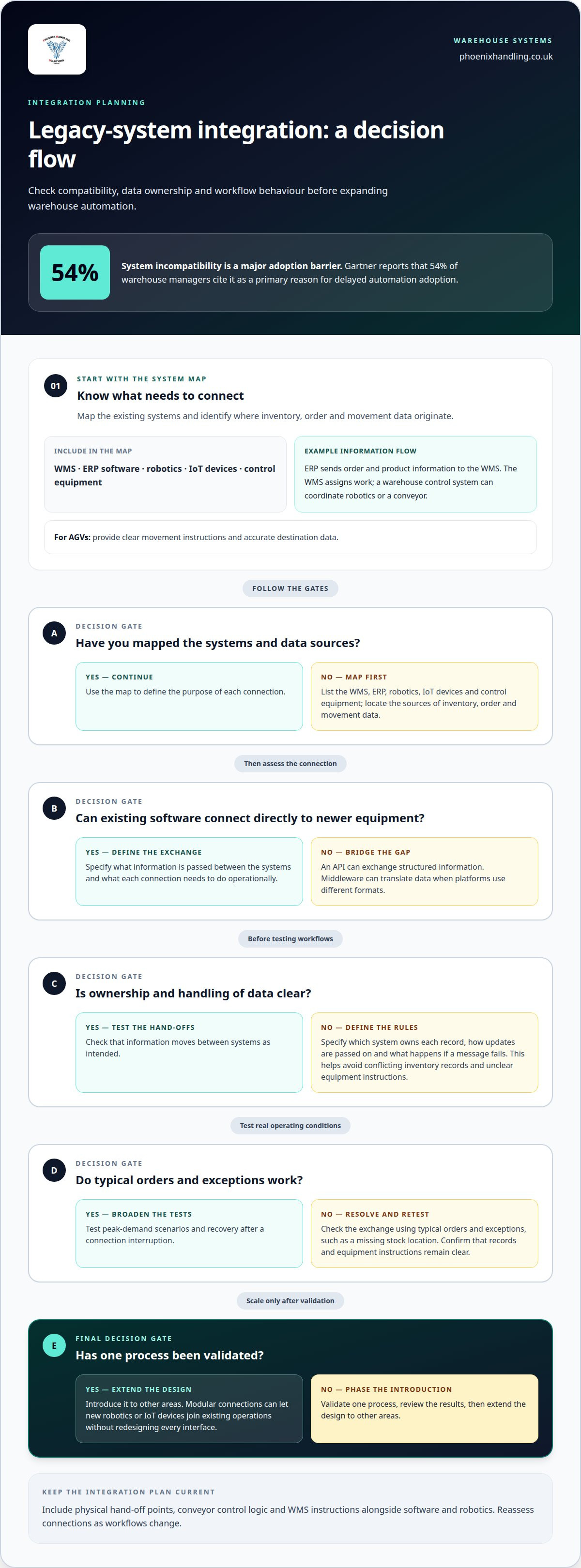
Integration should begin with a map of existing warehouse systems, including the warehouse management system (WMS), enterprise resource planning (ERP) software, robotics, IoT devices and control equipment. This shows where inventory, order and movement data originate. Gartner reports that 54% of warehouse managers cite system incompatibility as a primary reason for delayed automation adoption. Compatibility therefore needs assessing before equipment is selected.
Give each connection a clear operational purpose. For example, an ERP system can send order and product information to the WMS, which assigns work to warehouse equipment. A warehouse control system can then coordinate robotics or a conveyor with those tasks. AGVs need clear movement instructions and accurate destination data. Test these exchanges using typical orders and exceptions, such as a missing stock location.
Legacy software may not connect directly with newer equipment. An application programming interface (API) can let systems exchange structured information, while middleware can translate data when platforms use different formats. Specify which system owns each record, how updates are passed on and what happens if a message fails. This helps prevent conflicting inventory records and unclear equipment instructions.
Scalability involves more than adding machines. Modular connections can let new robotics or IoT devices join existing operations without redesigning every interface. Test integration across normal workflows, peak-demand scenarios and recovery after a connection interruption. A phased introduction can limit disruption: validate one process, review the results, then extend the design to other areas. Regular reassessment helps keep the system aligned with changing workflows.
Where goods transfer between automated processes, conveyor systems can be assessed alongside control logic, hand-off points and WMS instructions. This keeps physical movement within the same integration plan as software and robotics.
3. Upfront investment and return on investment
In the UK, warehouse automation has no single set cost. Investment depends on the processes being automated, required throughput, site layout, equipment, software integration and installation scope. A project focused on picking differs from one adding automated storage and retrieval, conveyor handling or robotics across several workflows. These factors determine the system specification and installation work.
Assess the full project, not just the equipment. Include installation, system integration, staff training and ongoing maintenance alongside machinery and software. For example, a picking project could require changes to order workflows and data connections, while an automated storage project could involve different site and handling requirements. The project scope determines which cost categories apply and how they affect the total.
McKinsey & Company reports that businesses implementing automation typically achieve payback within 18 to 36 months. This is a reported range, not a fixed outcome for every warehouse. Payback depends on how the system is used and the savings it produces, including reduced labour requirements, fewer handling errors and increased efficiency across the supply chain.
Calculate return on investment (ROI) by comparing annual net benefit with the initial investment. Express the result as a percentage: divide the annual net benefit by the initial investment, then multiply by 100. Estimate benefits from measurable operational changes, such as less manual travel during picking, fewer errors or improved use of storage space. Use current performance as the baseline, then model how each change affects operating costs and throughput.
A phased investment can limit the first deployment and provide operational insights before expansion. Start with a process that has a clear performance measure, such as picking time or stock accuracy. Compare results with the baseline, account for training and maintenance, then assess whether further automation supports demand and growth plans. Evaluate automated storage, retrieval and handling systems against the same business objectives, not as isolated purchases.
4. Automated guided vehicles
Automated guided vehicles (AGVs) move goods along defined warehouse routes, reducing repetitive transport between work areas. They can follow magnetic strips, wires, floor markers or sensors. A route from goods-in to storage, for example, can support regular pallet movements without employees repeatedly making the same journeys. AGVs suit predictable flows where paths and collection points remain consistent.
Autonomous mobile robots (AMRs) use onboard sensors to navigate warehouse environments alongside people. This differs from an AGV route based on installed guidance or marked paths. Choose between them based on how often routes change, how goods move and whether people share those routes. Assess load type, travel distance, traffic patterns and hand-off points before selecting either technology. For businesses exploring mobile robotics and automated systems, specialists such as EdNex Automation provide tailored industrial automation solutions to streamline material handling.
AGVs can move materials between storage, production and dispatch. Their value depends on the whole workflow: a vehicle waiting at a blocked hand-off point cannot improve throughput. Map recurring journeys, identify congestion and define where each load starts and ends. Then assess how vehicle movements interact with retrieval systems, employees and other equipment.
Compare AMRs, AGVs, conveyors and automated storage systems against route flexibility, load movement, site layout and throughput requirements. Conveyors support fixed, continuous transfers between points, while vehicles suit movement across routes. Automated storage and retrieval systems handle the placement and retrieval of stock. This comparison helps identify which technologies fit each process and where combined systems could improve material flow.
For example, a warehouse with stable pallet routes may favour AGVs, while changing destinations may make mobile robots more suitable. A fixed transfer between adjacent workstations may instead suit a conveyor. Discuss AGV requirements to assess vehicle movements, route conditions and their fit with your warehouse operations.
Phoenix Handling Solutions Limited
Phoenix Handling Solutions Limited helps manufacturers and distributors assess packaging and pallet-handling equipment as part of a wider warehouse automation plan. Its equipment range includes pallet wrapping machines, strapping machines, stretch hooders and bag palletisers. These systems may suit operations looking to automate packaging or palletising tasks alongside transport and storage changes.
Consider this equipment when manual packaging constrains a process or a warehouse project needs to account for preparing and moving finished pallets. The right configuration depends on the product, load, throughput and existing workflow. Matching equipment to these operating conditions keeps the automation plan practical and suited to the task.
For guidance on packaging and palletising equipment as part of your warehouse plans, contact Phoenix Handling Solutions.
Set the next stage of your automation plan
A practical approach to warehouse automation challenges and solutions starts with defining the operational change you need, then matching the project scope to that outcome. Treat each proposed system as part of the wider flow of goods and information, not as an isolated equipment decision. This clarifies priorities when investment, integration and future flexibility need to be considered together.
Before moving ahead, establish which operational measures will show whether the change is working. Clear measures support decisions about sequencing, deployment and later adjustments as requirements evolve. They also give employees a defined role in the transition, linking new processes with day-to-day warehouse work.
If you are assessing equipment for packaging, pallet handling or warehouse movement, discuss the operational requirements with Phoenix Handling Solutions Limited. A focused conversation can help shape a practical next step for your facility.
Frequently Asked Questions
What is Warehouse Automation?
Warehouse automation uses equipment and software to carry out or coordinate warehouse tasks with less manual handling. For example, a system can connect an order record to stock retrieval and movement to a packing area. Automation can cover one operation or connect processes across a facility, depending on workflow requirements, product handling and existing systems.
Can innovative warehouse logistics solutions be implemented in any business environment?
The suitable automation system depends on the operation. A facility handling varied cartons and changing order profiles has different requirements from one moving standard pallets along repeatable routes. Layout, product dimensions, workflow, existing software and expected demand all affect system selection. Match the project to these conditions rather than assuming one technology suits every warehouse.
How Do Professionals Maintain and Support Automated Systems?
Planned maintenance can combine scheduled visits, condition reports and recommended parts with equipment servicing. Phoenix Handling Solutions provides spare parts and support for equipment from many manufacturers. A practical maintenance plan uses operating demands and component condition to set service priorities. Remote diagnostics and PLC programming can also support fault investigation or system modifications where required.
How can the integration of artificial intelligence optimise warehouse logistics?
Artificial intelligence can analyse inventory, labour and equipment data to support planning as demand changes. For example, forecasting tools can inform replenishment decisions, while operational analysis can help identify where work is building up. AI supports decision-making, but its usefulness depends on relevant, reliable data and clear operational objectives. Warehouse managers remain responsible for applying insights to actual processes and constraints.
What Strategies Help Overcome Automation Challenges?
Set a clear operational objective, involve employees in planning and introduce changes in manageable stages. A pilot process can reveal workflow issues before wider deployment, while training helps staff operate and maintain unfamiliar equipment. Plan for interruptions too: maintenance scheduling and suitable redundancy in critical systems can support continuity. Review performance against the original objective, then adjust processes before extending automation.