The most automated packaging system isn’t automatically the right one. Choosing a packaging automation supplier in the UK means matching equipment to your products, pack formats, production pattern and existing line, rather than choosing the highest output rate on paper.
That decision involves more than comparing machines. Relevant experience, project scope, integration with existing equipment and how performance will be assessed all affect whether a system suits your operation. Consider automated and robotic options in context: what task they will perform and how they fit into the wider process.
This guide explains how to assess a supplier’s relevant experience, define a project’s scope and evaluate integration support. It also shows how to compare manual, semi-automatic, automatic and robotic systems against your production needs, so you can build a practical shortlist and decide based on overall fit.
Key Takeaways
- Look for relevant installation experience and case studies that show how equipment performs in comparable operations.
- Set out the product, pack format, output target and site constraints to make project scope and supplier proposals easier to assess.
- Review how new machinery will interface with existing equipment, including transfers, controls, operator training and ongoing support.
- Match manual, automatic or robotic systems to the production task and wider line, rather than selecting on headline output alone.
1. Customer case studies and installation experience
Look for projects involving products, packaging formats and production conditions similar to yours. Ask how the supplier handled machinery selection, installation, commissioning and handover. Case studies are most useful when they explain the original constraint, the equipment installed and the outcome, rather than showing machinery without its operating context.
For example, Den Berk Délice operates six Packaging Automation machines across its sites. A UK-based DIY distribution company cut costs by over 60% after the proposed installation of semi-automatic pallet wrappers. A case study also describes Walkers Transport reducing pallet damage in transit after moving from manual to semi-automatic pallet wrapping. These examples illustrate different measures of performance, so assess results against the issue your own operation needs to address.
Business size alone is a poor measure of project suitability. Consider whether the supplier has delivered work for operations with comparable line complexity, product variation and available technical resource. A single pallet-wrapping installation has different interfaces from a multi-machine line. In either case, look for clear responsibilities, commissioning evidence and an explanation of how the installation fitted the site.
A company’s history provides context, but not proof of the specialist knowledge your project needs or who will support it. Consider the experience of the people responsible for design, controls, installation and commissioning. Ask for examples involving similar machinery and applications, including changes to an existing process.
Request a case study or customer reference that matches your product, pack and operational challenge. Ask what changed after commissioning, how the result was measured and what issues arose during installation. For pallet handling, useful evidence might cover load stability or damage in transit. For a wider system, look for documented performance across connected equipment, not just one machine’s output. This makes the supplier’s experience relevant to your needs, rather than simply counting installations.
2. What does a packaging automation project usually include?
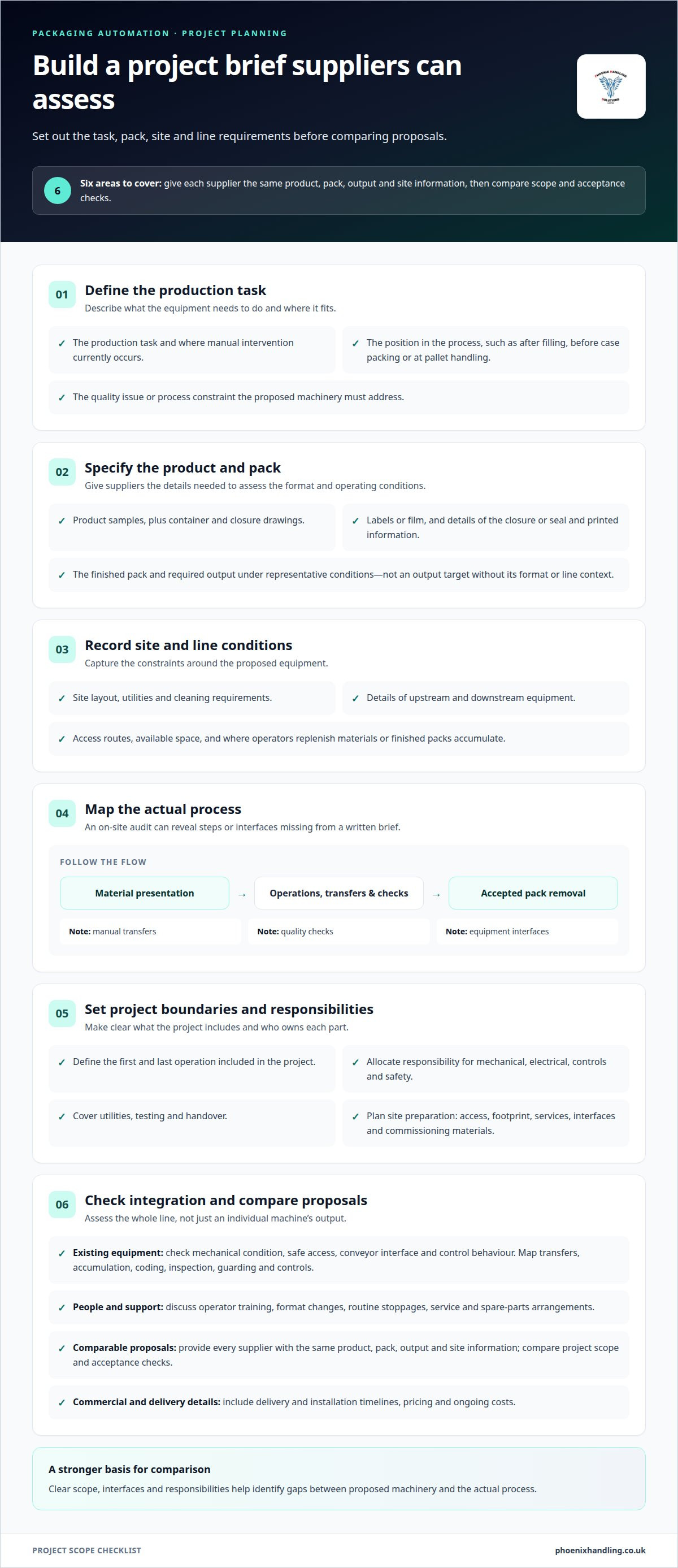
A useful project brief describes the production task and where manual intervention currently occurs. Include the product, container or pouch, closure or seal, label or printed information, and route for finished packs. Explain, for example, whether the equipment sits after filling, before case packing or at pallet handling. State the quality issue or process constraint the proposed machinery must address. When choosing a packaging automation supplier in the UK, this context helps shape a relevant technical proposal.
Include product samples, container and closure drawings, labels or film, target output, site layout, utilities, cleaning requirements and details of upstream and downstream equipment. These details help assess the product, pack format and operating conditions. Define the finished pack and required output under representative conditions, rather than giving a target without its format or line context.
An on-site audit can map each operation, from material presentation to removal of the accepted pack. It should record manual transfers, quality checks, access routes and equipment interfaces. A walk-through can also reveal space limits or handling steps missing from a written brief. Note, for instance, where operators replenish materials and where finished packs accumulate.
Set the project boundaries before comparing proposals: define the first and last operation, then allocate responsibility for mechanical, electrical, controls, safety, utilities, testing and handover. Site preparation should cover access, footprint, services, interfaces and commissioning materials. A UK-based supplier can be advantageous for arranging site visits, demonstrations or engineer support. Include delivery and installation timelines, pricing and ongoing costs in proposals, without relying on headline output alone.
To reduce selection risks, give each supplier the same product, pack, output and site information, then compare scope and acceptance checks. Unclear interfaces, utilities or responsibilities can create gaps between the proposed machinery and the actual process. A consistent brief supports choosing a packaging automation supplier in the UK on comparable requirements. Define these boundaries early, and the packaging machinery project scope can be assessed against them.
3. Can existing packaging machines be integrated with new equipment?
Existing machinery can often remain in a line when its mechanical condition, safe access, conveyor interface and control behaviour suit the proposed equipment. Integration planning should map transfers, accumulation, coding, inspection, guarding and controls. A sealer, for example, must pass packs in the required format and coordinate with upstream and downstream equipment. The supplier should assess these interfaces as part of the line, not in isolation.
Local technical support matters during installation, commissioning and later fault-finding. Discuss how operators will be trained to run equipment, manage format changes and respond to routine stoppages. In choosing a packaging automation supplier in the UK, include support for control faults affecting more than one machine. Define service and spare-parts arrangements alongside the equipment scope, including how parts are identified and sourced.
For machinery in the UK, assess the conformity documentation supplied for each machine and how safety is addressed across the integrated line. Consider guarding, safe access and control behaviour where new equipment connects to existing machinery. Include responsibility for assessing changed interfaces and shared operating areas in the project scope.
Maintenance planning should account for cleaning access, changeover tasks and parts subject to wear. For sealing equipment, record format changes, cleaning steps and maintenance tasks that could affect production. Review warranty terms, exclusions and responsibility for faults involving connected machines before agreeing the scope. Clear maintenance instructions also help site staff carry out routine tasks consistently.
When choosing a packaging automation supplier in the UK, assess how after-sales support works in practice, from reporting a fault through diagnosis to parts and repair. Distinguish planned servicing from breakdown support, and clarify which tasks remain with site staff. Training and parts information should cover the supplied equipment and its interfaces, helping keep the line maintainable as formats or production needs change.
4. Automated packaging and robotic systems
Choose automation to suit the operation that constrains production, not the machine with the highest stated rate. A robotic system may handle repetitive packing or palletising, while conveyors move products between operations. The right arrangement depends on product and pack characteristics, required output, available space and variation across shifts or product formats.
Start by mapping the complete process, including material replenishment, packing, labelling, inspection, accumulation and finished-pack removal. A machine’s stated rate does not establish the output of the whole line. Transfers, stoppages and replenishment can limit production, so assess performance across each connected operation.
Robotic palletising can suit processes with different product patterns if the required loads, placement and available floor space align with the system design. Assess the products, pallet arrangement, infeed and discharge routes, and operator access to the cell. For a fixed, repetitive task, a dedicated automatic machine may be more appropriate. Match the level of automation to the work.
For systems involving coding, labelling or inspection, define how equipment shares the selected format. Specify recipe ownership and the information passed between machines, including coder messages, label or film versions and inspection targets. This helps prevent a format change at one operation from leaving another incorrectly set.
Agree acceptance conditions before equipment enters production. Define representative products and formats, the required finished pack, output conditions and the evidence recorded during trials, commissioning and handover. Review performance across the line, including accumulation, stop states and replenishment, rather than relying on an individual machine’s rate. Consider how the proposal could adapt to future growth or new products.
For a project involving robotic palletising, conveyors or automated material movement, discuss your packaging automation requirements in relation to the full production flow.
Phoenix Handling Solutions Limited: Pick & Pack De Palletisers
Phoenix Handling Solutions supplies Pick & Pack De Palletisers for operations assessing automated product handling and pack movement. These systems may suit production flows that include depalletising or pick-and-pack tasks. The right equipment depends on the product, packaging format, required output and connections with surrounding machinery.
For end-of-line requirements, Phoenix Handling Solutions also supplies Pallet Wrapping Machines, Strapping Machines and Stretch Hooders. These equipment categories address different pallet-securing and packaging needs. Assess them against the load, process and line arrangement. A defined project scope helps identify suitable machinery and how it connects with upstream and downstream operations.
If your assessment points to pick-and-pack depalletising or pallet packaging equipment, contact Phoenix Handling Solutions Limited to discuss your requirements.
Turn your packaging requirement into a practical next step
Before committing to a system, consider how the production task may change as formats, volumes or product ranges develop. Planning for those changes can help avoid a design focused too narrowly on today’s output. Set out your operational priorities to shape the next project discussion.
Phoenix Handling Solutions supplies Pallet Wrapping Machines, Strapping Machines and Stretch Hooders for businesses assessing pallet packaging requirements. These options offer different ways to secure and protect pallet loads. The right fit depends on the load, packaging materials and process requirements.
For a considered next step in choosing a packaging automation supplier in the UK, contact Phoenix Handling Solutions Limited to discuss your packaging requirements and equipment options. A clear brief gives the conversation a useful starting point and helps keep the project focused on operational needs.
Frequently Asked Questions
Who is this guide for?
This guide is for UK manufacturers and distributors assessing packaging or material-handling automation. It is relevant if you are planning a new line, replacing a machine or addressing a production constraint. Food and beverage, paper and packaging, logistics, general manufacturing and FMCG operations may each have different product-handling needs, whether managing lines internally or collaborating with contract packing specialists such as Simplepack Ltd. Use your product range, process requirements and planned changes to decide which considerations matter most.
Can existing packaging machines be integrated with new equipment?
Yes, existing machines can often be integrated if their condition, interfaces and control behaviour suit the proposed line. For example, a new conveyor may need to coordinate pack transfers with an existing case-packing machine. Phoenix Handling Solutions can integrate new equipment into existing production lines during specification and services equipment from most major brands, including machinery it did not originally supply.
Does the right supplier always have the biggest range?
No. A broad catalogue doesn’t show whether a supplier understands your product, operating conditions or project boundaries. A more focused supplier may be a better fit if its machinery suits your task and it can support the required line interfaces. Compare recommendations against your production priorities, not catalogue size alone, and consider whether one supplier can cover the equipment involved.
What does a packaging automation project usually include?
A project can cover machinery specification, line interfaces, installation, commissioning and handover, with scope shaped by the production task. For example, a pallet-handling project might involve a wrapping machine connected to the existing conveyor route. Clarify responsibility for mechanical, electrical and controls work, then align testing and handover records with the agreed finished-pack requirements.
What types of packaging automation systems are available for UK manufacturers?
Options include case packers and erectors, shrink packers, palletisers, de-palletisers, pallet wrapping and strapping machines, conveyors and automated guided vehicles. The right category depends on what the line must handle. A manufacturer moving finished cases to palletising has different needs from one automating product depalletising. Match the system to product type, pack format, available space and production task.
Which UK packaging automation suppliers offer installation, training and after-sales support?
Phoenix Handling Solutions supplies packaging and material-handling machinery, with installation, commissioning and operator training included. Its after-sales support includes servicing, maintenance contracts and spare parts across the UK and Ireland. The company also services equipment from most major brands, including machinery it did not originally supply. This can suit manufacturers seeking support for new equipment and existing machines across their operations.