
More stretch film won’t make an unstable pallet stable. Improving pallet load stability for logistics starts with a sound pallet, a balanced load within capacity, and restraint that prevents products shifting during handling and transport.
Film plays an important role, but it cannot compensate for damaged pallet components, poor load arrangement or movement between product layers. Stability depends on how the pallet, products, packaging and securing method work together, as well as the demands of the warehouse and supply-chain route.
This guide explains what makes a pallet load stable, what commonly causes instability, and how pallet design and capacity affect safer handling. It also covers practical steps for arranging and securing loads, choosing a suitable stacking height, and accounting for the equipment and transport conditions each pallet will encounter.
Key Takeaways
- Match the pallet type and condition to the load’s weight, shape and handling demands.
- Set stacking height and load arrangement around packaging strength, pallet capacity and the equipment used in transit.
- Use suitable restraint and stability testing to identify movement risks across handling and transport.
- Account for relevant customer, insurance and safety requirements when setting palletising procedures.
1- What Is a Stable Pallet Load?
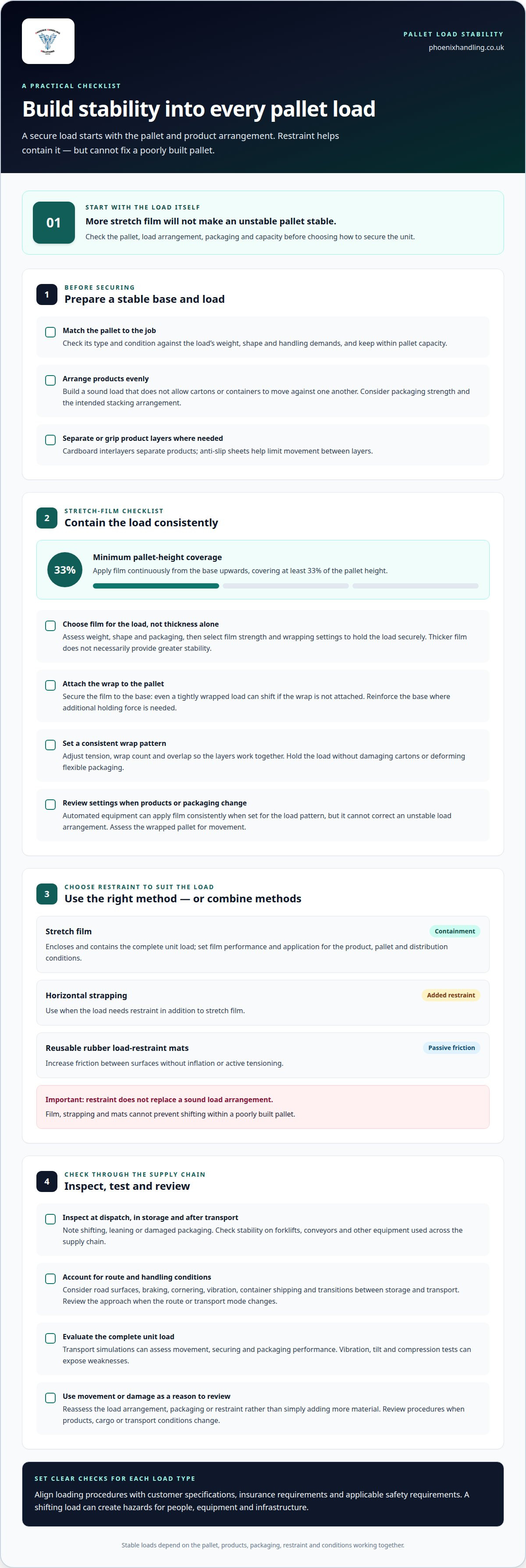
To improve load containment, select stretch film for the product, pallet and distribution conditions, then adjust tension, overlap and reinforcement. Stretch wrapping contains a load, strapping adds restraint, and reusable load-restraint mats increase friction without active tensioning. None can prevent shifting within a poorly built pallet.
- Match film performance to the load rather than choosing by thickness alone. Thicker stretch film does not necessarily provide greater stability; optimised thinner film can offer effective containment with less material. Assess the load’s weight, shape and packaging, then select film strength and wrapping settings to hold it securely.
- Apply the film continuously from the pallet base upwards, covering at least 33% of the pallet height. Secure the film to the base, since a tightly wrapped load can still shift if the wrap is not attached to the pallet. Reinforce the base where the load needs additional holding force.
- Set film tension, wrap count and overlap for a consistent pattern. The layers need enough overlap to work together, while tension must hold the load without damaging cartons or deforming flexible packaging. Reassess the settings whenever products or packaging change.
- Use stretch film to enclose and contain a complete unit load, and horizontal strapping when added restraint is needed. Reusable rubber load-restraint mats provide passive friction between surfaces without inflation or active tensioning. Cardboard interlayer sheets separate products, while anti-slip sheets help limit movement between layers.
- For repeatable application, set automated wrapping equipment to suit the load pattern and film requirements, then assess the wrapped pallet for movement. Hand wrapping can make it difficult to apply enough overlap near the pallet base. A machine applies film consistently, but cannot correct an unstable load arrangement.
Looking to Improve Your Pallet Stability?
UK logistics teams should inspect loads during handling, adapt stabilisation to route conditions, and test complete unit loads. Record movement or damage during storage and transport, then review packing procedures when products, cargo or transport modes change.
-
Assess Loads During Handling and Transport
Inspect pallet integrity at dispatch, during warehouse storage and after transport, noting any shifting, leaning or damaged packaging. Check whether loads remain stable on forklifts, conveyors and other equipment used across the supply chain. Treat recurring movement as a reason to review the load arrangement, packaging or restraint, rather than simply adding more material.
-
Adapt Stabilisation to Transport Conditions
Match load restraint to the route and handling conditions. Consider road surfaces, braking, cornering, vibration, container shipping and transitions between storage and transport. A pallet passing through several handling stages faces different forces from one moved directly to a nearby storage area. For dedicated freight movements across the UK, coordinating with road transport providers such as evolvehaulage.co.uk helps ensure cargo securing measures reflect actual journey conditions. Review these factors whenever the route or transport mode changes.
-
Test Unit Loads
Evaluate the complete unit load under conditions that reflect its intended handling and transport. Transport simulations can assess product movement, load securing and packaging performance; vibration, tilt and compression tests can expose weaknesses. Review packing and loading procedures alongside test results, then adjust them for new cargo or changing supply-chain conditions.
-
Improve Stackability and Transport Efficiency
Arrange loads to support stable stacking and make efficient use of transport space. Improved stackability can increase the number of products carried in a shipment, but unstable loads should not be stacked simply to increase capacity. Assess load integrity, packaging strength and handling conditions together before changing stacking arrangements or shipment configurations.
Standards, customer specifications, insurance and safety requirements
Unstable pallet loads can shift or collapse, creating hazards for warehouse staff, transport crews, equipment and infrastructure. Reduce these risks by aligning packaging and loading procedures with customer specifications, insurance requirements and applicable safety requirements.
- Set a documented stability standard for each load type. Define how packaging must protect the product, how products should be arranged, and what restraint is required before loading. Apply the same criteria to comparable loads, then review them when products, packaging or transport conditions change. Clear procedures help warehouse teams identify unstable pallets before handling or distribution.
- Turn customer and insurance specifications into practical loading checks. For example, record packaging condition, load configuration and acceptable restraint requirements in the relevant work instructions. Confirm each pallet meets those requirements before dispatch. Failing to comply with customer specifications, industry standards, insurance requirements and safety regulations can create liability.
- Include workplace hazards in pallet stability procedures. A shifting load can strike a person, obstruct a warehouse route or damage a forklift, conveyor or racking. Keep unstable pallets out of routine movement until they are secure. During loading, distribute products evenly and avoid arrangements that allow cartons or containers to move against one another.
- Use relevant test methods to assess complete loads against expected handling forces. The International Safe Transit Association provides standardised test procedures for packaged products and unitised loads, including tests that evaluate stability under horizontal impacts. Use test outcomes to review packaging and loading procedures, then record adjustments so teams can apply the same controls to future loads.
Pallet design and load capacity
Improving pallet load stability for logistics starts with the pallet’s design and limits. Set load height and weight distribution according to the product, packaging, pallet capacity, handling equipment and transport requirements.
-
Assess Pallet Design and Load Capacity
Choose a pallet suited to the load’s weight, shape and intended use. Before loading, inspect it for broken deck boards, missing blocks, moisture and other structural defects. A compromised pallet can undermine the unit load, even when products are arranged carefully.
Match the design to handling needs. Standardised Euro pallets, also known as EPAL or EUR pallets, measure 800 × 1200 mm. Block pallets offer four-way entry, while stringer pallets offer two-way entry. Select a format that suits access requirements and the equipment handling the shipment.
Consider pallet capacity alongside the limits of packaging, racking, forklifts and conveyors. The weakest component constrains the complete load. For exports, include applicable pallet treatment requirements in the design decision. Improving pallet load stability for logistics means matching the entire unit to its operating conditions.
-
Set Load Height and Weight Distribution
Set stacking height for the specific product and shipment, not a universal target. Packaging strength, pallet capacity, handling equipment and transport conditions determine a suitable height. Excessive height can increase instability, particularly when upper layers lack support.
Build even layers, placing heavier products below lighter goods. Keep the load centred and within the pallet footprint. Avoid overhang, which can leave cartons unsupported and interfere with racking or conveyor handling. For beverage products, distribute weight evenly to maintain balance during movement.
Use a repeatable case pattern that fits the pallet dimensions. A 48 × 40-inch pallet can help teams repeat established patterns and control overhang. Reassess the arrangement when product dimensions or packaging change. Improving pallet load stability for logistics depends on maintaining a pattern suited to the actual load, rather than reusing settings designed for different goods.
For packaging operations requiring consistent pallet restraint, explore pallet wrapping equipment suited to your load and handling requirements.
Phoenix Handling Solutions Limited
Phoenix Handling Solutions designs and supplies packaging machinery to support stable, repeatable pallet loads. Its equipment includes pallet wrapping machines, strapping machines, stretch hooders and bag palletisers, selected to suit the packaging process and load requirements.
Turn to Phoenix Handling Solutions when manual load securing is inconsistent, product formats change, or operations need a different palletising or containment approach. Matching machinery to the pallet pattern, packaging and handling process can address stability issues as part of the wider packaging line.
Contact Phoenix Handling Solutions Limited to discuss the pallet load stability requirements in your operation.
Make Load Stability Part of Operational Change
A disciplined approach to improving pallet load stability for logistics treats each load configuration as an operational parameter, not a fixed setting. Product dimensions, packaging and distribution routes can change, so stability controls need to adapt. Build this review into process changes, including new product formats, altered packing patterns and revised handling routes.
Use feedback from warehouse and transport operations to identify recurring movement, damaged packaging or rework. These observations can help teams distinguish isolated handling issues from repeated weaknesses in load design or securing. Record changes, assess the resulting load performance, and update work instructions so improvements carry through each shift and shipment.
Where packaging equipment needs to support revised requirements, Phoenix Handling Solutions Limited can help assess suitable options for the operation. Contact Phoenix Handling Solutions Limited to discuss your pallet load stability requirements and plan a practical next step.
Frequently Asked Questions
What causes poor pallet stability?
Poor pallet stability often stems from a weak pallet or a load pattern that lets products move. Broken boards, missing blocks, moisture, excessive height and uneven layers can all weaken the unit load. Smooth cartons, plastic containers and shrink-wrapped packs may slide against one another. Inspect the packaging as well as the pallet, particularly after damp storage or rough handling.
What factors cause pallet loads to become unstable during transport?
Braking, cornering and vibration can shift products, especially when layers have little friction or the load is poorly balanced. Rough handling during transfers adds further movement. Moisture and humidity can affect packaging and pallet integrity, while temperature fluctuations can affect some loads, including beverages. Consider the entire route, from warehouse storage and forklift handling to road transport and any containerised sea transport.
How should goods be arranged and stacked to improve pallet load stability?
Build each layer evenly and consider interlocking patterns where product shape allows, as these may improve stability. Keep the load centred, place heavier goods below lighter ones, and avoid unsupported edges. Add interlayer sheets where cartons or products move between layers. Set stacking height according to packaging strength, pallet capacity and the handling equipment used.
How do corner boards, strapping and anti-slip sheets improve pallet stability?
Corner boards protect load edges and provide firmer support for vertical strapping, helping distribute restraint around cartons. Strapping adds horizontal or vertical reinforcement when film alone cannot hold the configuration securely. Anti-slip sheets increase friction between layers, limiting movement during handling and transport. These methods support a sound load arrangement, but cannot prevent movement within a poorly packed layer.
How can pallet stability be tested before dispatch?
Test a complete unit load using transport simulations that reveal movement and packaging weaknesses. Vibration, tilt and compression tests can represent different stresses during handling, storage and transport. Assess packaging and restraint together, then record where products shift, cartons deform or the load loses integrity. Repeat the assessment after changes to cargo, packing procedures or transport modes.
What UK and EU rules or standards apply to securing palletised loads for road transport?
Apply the relevant customer specifications, industry standards, insurance requirements and safety regulations for the load and route. The International Safe Transit Association provides standardised test procedures for packaged products and unitised loads, including horizontal-impact stability tests. These procedures help assess load performance; they are testing methods, not a substitute for applicable transport requirements. Record the criteria used for each shipment type.