
Yes, packaging can be automated, from individual tasks such as case forming and palletising to connected end-of-line operations. A business case for packaging automation depends on whether the expected gains in throughput, consistency, material use and staffing justify the equipment and integration required. The right level depends on production speed, product and packaging formats, available floor space and how work is organised.
Manual packaging can remain appropriate when volumes are low or products vary widely, so automation is a question of operational fit, not machinery alone. This article explains how to assess the case, identify processes suited to automation and weigh potential savings against the investment. It also covers fitting equipment into existing workflows and how production speed and staffing needs shape the choice between semi-automatic and integrated systems.
Key Takeaways
- Map repetitive packaging tasks and common errors to identify where reduced manual handling or more consistent output could matter most.
- Plan integration around product flow, existing logistics systems, staff training and the space available on the production floor.
- Use required case throughput and staffing patterns to judge whether a semi-automatic or more integrated system is the better fit.
- Build a cost-benefit case that weighs ongoing savings and operational improvements against the initial investment over time.
Can packaging be automated?
Yes. Automation can handle individual tasks, such as labelling, or connect several stages from packing to pallet handling. The practical benefit depends on which manual activities limit output, consistency or the movement of goods.
Labour efficiency and workforce safety
Packaging automation uses machinery to perform repetitive handling tasks with less operator intervention. This can free staff to manage exceptions, replenish materials or carry out quality checks instead of repeating the same packing action throughout a shift.
For example, staff may repeatedly lift filled cases or apply labels by hand. Automating these tasks can reduce manual handling and repetitive movements, although operators still need to oversee the process and maintain equipment. The efficiency gain depends on how well the machine matches product flow and staffing patterns.
Consistency and material use
Automation applies repeatable settings to tasks such as sealing, wrapping and strapping. This can make packs more consistent, which matters when variable seals or unstable loads lead to damaged goods or rejected shipments.
Consistent application can also reduce excess packaging material. For example, a wrapping process that applies film evenly may avoid unnecessary layers while still securing the load. Results depend on the packaging specification, product dimensions and machine settings, so assess material use alongside pack protection.
Manual and contract packaging comparisons
Manual packing relies on staff to perform each task, while automated equipment carries out defined operations within the production line. Contract packaging places packing work with an external provider; automation supports work carried out within the business.
Manual methods can suit variable products or short runs, where frequent changes make dedicated equipment less practical. Contract packaging moves packing activity off-site, while an automated line needs suitable space, integration and staff oversight. Compare the approaches against your volumes, product changes and control requirements.
For an automated line in the UK, assess applicable workplace safety, machinery and packaging requirements during design and integration. Safeguarding, operator access, maintenance and packaging materials all affect how the line should be specified.
UK grants and tax relief depend on current scheme criteria and business eligibility; financing depends on the terms available to the business. Build the core case around operational costs and output, and include external support only once eligibility and terms are established.
Integrating automation with existing processes
Packaging equipment should fit the production flow, not create another bottleneck. Integration planning considers production volume, future scalability, available floor space and connections with existing logistics systems. Map product movement from packing through sealing and dispatch to find where a machine can remove delays without disrupting upstream operations.
For example, conveyors can transfer packed cases between workstations, while automated guided vehicles can move loads through warehouse operations. The right arrangement depends on routes, load handling and how packaging connects with storage and dispatch. Allow space for routine access, material replenishment and maintenance, as well as the machine itself.
Data exchange matters too. An ERP system tailored to packaging can manage inventory, production schedules and order processing. Print-and-apply labellers can integrate with warehouse management systems to generate real-time shipping data. Before investing, define which system supplies each instruction, such as product identification or destination details.
Plan integration with production, warehouse, IT and maintenance teams. Each group understands different constraints, from changing product demand to system interfaces and service access. Technical experts can use these details to specify how equipment connects with existing processes. Semi-automatic and fully automatic solutions can also combine components to suit changing applications.
Include training in the installation plan. Operators need to understand controls, routine adjustments and how to respond safely to interruptions; maintenance staff need to know inspection and servicing requirements. Document responsibilities for replenishing packaging materials, clearing faults and escalating equipment issues. These arrangements support consistent operations and help limit avoidable downtime.
Assess how an interruption at one station affects the next. A sealer that stops can hold up case flow, so line design should account for accumulation, access and recovery procedures. Where product movement between packaging and storage is the main constraint, conveyor systems can form part of the integration discussion.
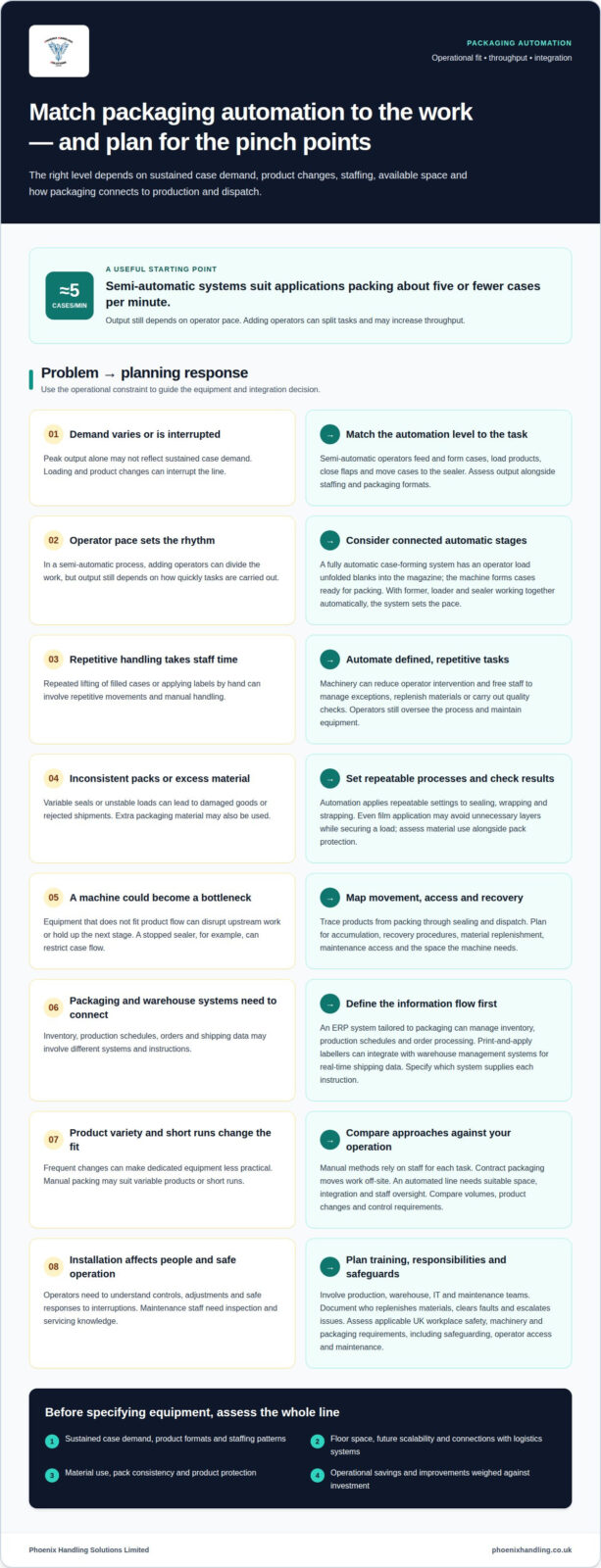
Choosing an automation level based on production speed and staffing
Match automation to sustained case demand, packaging formats and available staff. Machinery selected for peak output may still restrict production if loading or product changes interrupt the line.
Production speed and throughput
Throughput is the number of correctly packed cases a process completes over a set period. It matters because the packaging line must keep pace with production without compromising consistency.
Semi-automatic systems suit applications packing about five or fewer cases per minute. Operators feed and form cases, load products, close flaps and move cases to the sealer. Adding operators may increase throughput by splitting these tasks, but output still depends on operator pace.
In a fully automatic case-forming system, an operator loads unfolded blanks into the magazine, and the machine forms cases ready for packing. When the former, loader and sealer work together automatically, the system, rather than the operator, sets the pace. Consistent feeding at this stage also relies on carton blanks manufactured to exacting tolerances, where commercial packaging specialists such as printitza.co.za demonstrate how precision litho carton production prevents line stoppages and jams.
Productivity and operational control
Automation can improve productivity by controlling repeatable packaging processes and making output easier to monitor. This matters when production schedules call for a more predictable flow between packing, sealing and dispatch.
Compare cases completed, stoppage time, rejected shipments and staffing hours before and after installation. Use comparable shifts and product runs, and record packaging quality alongside output. These measures show whether higher speed also preserves control.
Product specifications guide machinery selection. Record case dimensions, product weight, packaging materials, required seals and expected product variation. For fragile goods, assess how packing and case handling protect the contents; for changing formats, account for the adjustments operators need to make. Where sensitive goods such as audio and event gear require reusable, heavy-duty transit protection rather than disposable automated cartons, suppliers such as proxdirect.com demonstrate how rugged flight cases safeguard delicate equipment through demanding handling.
Staffing affects the appropriate level of automation. If operators can reliably keep pace with a semi-automatic line, a more integrated system may not address the main constraint. If loading and sealing repeatedly limit output, automatic case forming and sealing can reduce reliance on manual timing.
Assessing automation needs and researching solutions
Start with the packaging operations that constrain manufacturing output, then match solutions to the products, packaging formats and workflow. Defining the challenge gives the investment case a measurable operational purpose.
Assessing packaging requirements
Assessing packaging requirements means documenting what the operation packs, how it is packed and where delays or errors occur. This matters because machinery must suit actual products and working conditions.
Record case dimensions, product variation, packaging materials, order patterns and current output. Then map each stage, from product handling and packing to sealing and dispatch. Note, for example, whether staff lose time changing formats, correcting damaged packs or moving finished cases. Include staff observations, as recurring issues during a shift can reveal where automation would streamline work.
Separate essential requirements from preferred improvements. A manufacturing site handling one stable format may prioritise consistent output, while frequent product changes place greater importance on flexibility. Include floor space, material supply and links to warehouse processes, as each can affect whether a proposed system fits existing operations.
Researching automation solutions
Researching solutions means comparing equipment and integration approaches against the requirements you have recorded. This matters because a technically capable machine may not resolve the actual production constraint.
Assess options against product compatibility, operating pace, format changes, staffing and maintenance needs. Compare semi-automatic and fully automatic arrangements where both suit the task, including their effects on upstream and downstream processes. Industry experts can help turn these requirements into a workable specification.
Build a cost-benefit analysis using current labour, packaging waste, errors, downtime and output as baselines. For a return-on-investment model, estimate packaging error reductions conservatively at 20-30%. Evaluate return over three to five years; appropriately sized end-of-line projects can have payback periods of 12-24 months, depending on the application.
Use the resulting assessment to create a clear investment case, with assumptions, operational benefits and integration needs recorded together. To develop a solution around your packaging requirements, discuss your automation needs.
Phoenix Handling Solutions Limited: Pick & Pack De Palletisers
Phoenix Handling Solutions Limited supplies Pick & Pack De Palletisers for operations automating depalletising and product handling. They can suit sites where manually unloading mixed or packed goods is a defined workflow constraint.
For end-of-line requirements, Pallet Wrapping Machines, Strapping Machines and Stretch Hooders handle different load-securing processes. The right equipment depends on the products, packaging formats, production flow and available space. Relating these details to the operational challenge helps identify where a machine fits into the wider automation plan.
If your assessment identifies a depalletising or load-securing requirement, contact Phoenix Handling Solutions Limited to discuss your operation and equipment needs.
Set a clear direction for your next investment
Define what a successful first phase must achieve, who will own the operating data and how any later expansion will be assessed. This makes the business case for packaging automation a working decision framework, rather than a one-off approval document. Production, maintenance and finance teams can use it to review performance and decide whether further investment remains justified.
Before proceeding, turn the preferred approach into a project brief. Set out the process to change, product and packaging requirements, site constraints, integration expectations and outcomes for assessing the system. A clear brief keeps procurement decisions connected to operational needs as production requirements evolve.
To discuss how packaging equipment could fit your operation, start a conversation with Phoenix Handling Solutions Limited. A defined next step can make the decision more manageable and support a considered path towards automation.
Frequently Asked Questions
What are the main benefits of packaging automation for UK businesses?
Packaging automation can support more consistent output, reduce repetitive manual tasks and help control material use. Manufacturing automation can lead to productivity increases of up to 30% and operational cost reductions of up to 25%. Automated processes can also reduce risks linked to repetitive movements and heavy lifting. The practical benefit depends on which packaging task is automated and how it connects with the wider operation.
How much does packaging automation cost in the UK?
The price depends on the project and is provided after a quote request. Key cost factors include the equipment required, production throughput, product and packaging formats, floor space and integration with existing operations. A standalone machine and a connected end-of-line system have different scopes. Include installation planning, staff training, maintenance and any changes to material or product flow in the investment assessment.
What is the typical ROI and payback period for packaging automation?
Appropriately sized end-of-line packaging automation projects can have payback periods of 12-24 months. Assess return over three to five years to account for ongoing operating savings and the investment period. Calculate net benefits using changes in labour requirements, packaging waste, errors and output, then compare them with the project investment. Product mix, operating schedules and integration requirements influence the result.
How can businesses calculate the business case for packaging automation?
Build the business case by comparing the current process with the proposed system over the same production period. Record labour hours, packaging material use, rejected or damaged shipments, downtime and completed orders. Estimate the changes attributable to automation, then subtract ongoing operating costs from expected savings. Compare the net benefit with the investment and document assumptions for finance and operations teams to review.
How much can packaging automation reduce labour costs and packaging waste?
There is no single reduction figure that applies to every packaging line. Labour savings depend on the tasks automated, shift patterns and staffing retained for supervision, replenishment and maintenance. Material savings depend on pack specifications and how consistently equipment applies packaging. Establish a baseline using labour hours and material consumed per completed order, then compare those measures after implementation.
What types of packaging automation are available for different production volumes?
Semi-automatic packaging systems suit applications packing about five or fewer cases per minute, with operators feeding, forming and loading cases. Higher-volume operations can consider automatic case forming and integrated packing and sealing, where machinery controls more of the sequence. The right configuration also depends on product dimensions, packaging formats, changeovers and staffing. Palletising and load-securing equipment can address later stages of the line.