The widest roll isn’t automatically the right one. Spiral stretch film is applied in overlapping turns around a load; the listed film is 250 mm wide, while a related option is 100 mm wide. The suitable width depends on the wrapping equipment and the area each pass needs to cover.
When selecting film, width matters, but machine movement and settings also affect how it is applied and how many layers build up. Choosing spiral stretch film means considering how the system moves around the load as well as the film width.
This guide explains spiral wrapping, how film width suits different applications, and how machine settings affect the finished wrap. It also covers practical selection factors to help you assess your load and wrapping process.
Key Takeaways
- Understand how spiral wrapping applies film around a load and how different machine designs move the load or film carriage.
- Match film width to the load’s dimensions and the coverage needed on each pass.
- See how overlap, wrap tension and machine settings affect film layers and load containment.
- Identify the specification and order factors that influence film cost, including roll dimensions and quantity.
What is spiral wrapping?
Spiral wrapping applies stretch film in a continuous, overlapping path around a load. As the wrapping system moves, the film travels around the pallet to help hold goods together during handling and storage. Spiral stretch film is designed for spiral wrapping equipment, including orbital stretch wrappers and spiral wrapping machines.
Machine designs differ in how the load and film move. On a turntable wrapper, the load rotates in front of the film roll. A rotating-arm machine keeps the pallet stationary while the arm travels around it. A ring wrapper also keeps the load stationary, moving its film carriage around the pallet instead.
For example, a pallet of cartons can be wrapped from the base upwards, with each pass overlapping the previous one. The film path and machine settings determine the coverage. Spiral stretch film can suit different wrapping arrangements, provided the roll is compatible with the equipment.
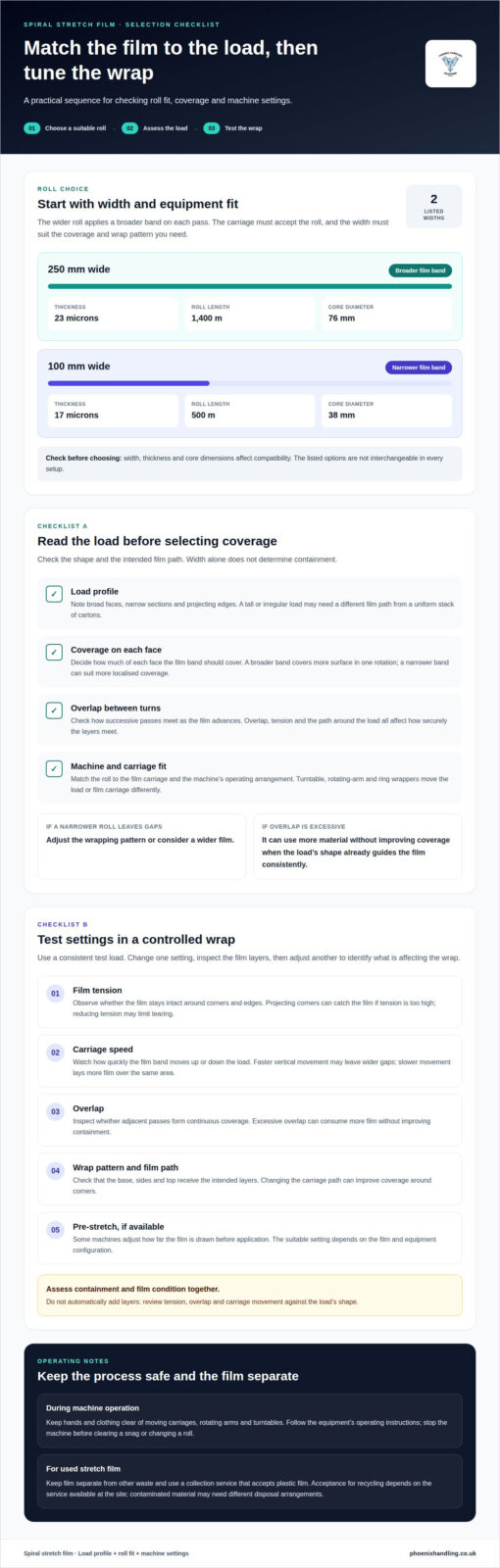
Available specifications include a 250 mm-wide roll, 23 microns thick, with a length of 1,400 m and a 76 mm internal-diameter core. A related 100 mm-wide option is 17 microns thick, 500 m long and has a 38 mm core. These dimensions affect carriage compatibility and the film band applied on each pass.
In the UK, acceptance of used stretch film for recycling depends on the collection service available at the site. Keep film separate from other waste and use a collection that accepts plastic film. Contaminated material may require different disposal arrangements.
During machine operation, keep hands and clothing clear of moving carriages, rotating arms and turntables. Follow the equipment’s operating instructions, and stop the machine before clearing a snag or changing a roll.
Spiral stretch film is designed for spiral wrapping. Roll width, thickness and core dimensions affect compatibility, so choose a roll that fits the film carriage and provides the coverage the load requires.
Film width and application
Film width affects the band of material applied to a load on each pass. A wider roll can cover more surface in one rotation, while a narrower roll lays a smaller band. The right choice depends on the load dimensions, wrapping pattern and machine’s film carriage.
A 250 mm-wide roll suits applications needing a broader film band. A 100 mm-wide roll provides a narrower band, which can be useful where the load or wrapping process calls for more localised coverage. These widths are not interchangeable in every setup. The film carriage must accept the roll, and the chosen width must suit the required wrap pattern.
Consider a pallet of uniform cartons and a load containing narrow, projecting products. The first may need consistent coverage across a broad face; the second may need controlled wrapping around its profile. Width alone does not determine containment. The overlap between turns, film tension and path around the load also affect how securely the layers meet.
Before selecting a roll, assess the following application details:
- Load profile: note broad faces, narrow sections and any projecting edges.
- Coverage: decide how much of each face the film band should cover.
- Wrap pattern: consider how successive turns overlap as the film advances.
- Equipment fit: match roll width to the wrapping machine’s carriage and operating arrangement.
If a narrower roll leaves gaps, adjust the wrapping pattern or consider a wider film. Conversely, excessive overlap can use more material without improving coverage when the load’s shape already guides the film consistently.
Match the width to the load and the machine, then assess the resulting wrap pattern. Spiral film options can help frame that specification choice.
Machine settings and film layers
Machine settings control how film is applied. Tension affects how tightly it is drawn, while carriage movement determines where each pass lands. On a pallet of cartons, consistent overlap helps create continuous coverage rather than isolated bands. Settings should suit the load’s shape and the film.
Overlap depends on the relationship between the load’s rotation and the film carriage’s vertical movement. If the carriage rises quickly, successive passes may leave wider gaps. Slower movement lays more film over the same area. Adjusting the wrapping pattern changes coverage, but excessive overlap can consume more film without improving containment.
The amount of film required depends on the pallet’s dimensions and profile, wrapping pattern, overlap and number of layers. A tall or irregular load may need a different film path from a uniform stack of cartons, so roll length alone cannot determine consumption.
Assess these settings during a controlled wrapping test:
- Film tension: observe whether the film stays intact around corners and edges.
- Carriage speed: watch how quickly the film band moves up or down the load.
- Overlap: inspect whether adjacent passes form continuous coverage.
- Wrap pattern: check whether the base, sides and top receive the intended layers.
For example, projecting corners can catch the film if tension is too high. Reducing tension may limit tearing, while changing the carriage path can improve corner coverage. Assess containment and film condition together rather than automatically adding layers.
Some machines also allow pre-stretch adjustment, changing how far the film is drawn before application. The suitable setting depends on the film and equipment configuration. Use a consistent test load to compare results: change one setting, inspect the layers, then adjust another. This helps identify whether tension, overlap or carriage movement is affecting the wrap.
How much does spiral stretch film cost in the UK?
The cost depends on the roll specification and quantity ordered. A price for this film depends on the case and is given after a quote request; the main factors are width, thickness, roll length, core size and order volume.
These details affect machine compatibility and how much film is available per roll. A wider roll may cover more of a load on each pass, while a longer roll may reduce how often operators change rolls. Neither feature alone determines the most suitable or economical format. Consumption also depends on the wrapping pattern and machine settings used for each load.
Order quantity changes the comparison. A product listing may show a carton quantity of 5 rolls and a pallet quantity of 360 rolls. These pack sizes represent different purchasing volumes, so compare the total required quantity against expected usage and available storage. A larger order should not be judged by roll count alone; the specification must match the wrapping equipment and application.
For a meaningful cost comparison, record the following for each option:
- Roll specification: note the width, thickness, length and core dimension.
- Pack format: distinguish individual rolls, cartons and pallet quantities.
- Application: consider the load profile and coverage required per wrap.
- Consumption: account for overlap, tension and the number of film layers.
Two rolls with different widths or lengths cannot be compared by price per roll alone. Usable coverage and machine compatibility matter too. A format that creates excess overlap may use more material per pallet, while unsuitable dimensions can interrupt the wrapping process.
To obtain a relevant price, submit a quote request with the required roll dimensions, pack quantity and application. This gives the specification and purchasing volume needed to assess the order. Request a quote for the film format suited to your wrapping process.
Phoenix Handling Solutions Limited: Spiral Stretch Film
Phoenix Handling Solutions Limited supplies spiral stretch film for load-wrapping applications. When selecting film, consider the load profile, required coverage, roll dimensions and wrapping machine. Together, these details help determine whether the format suits your process.
For wider packaging requirements, Phoenix Handling Solutions Limited also supplies pallet wrapping machines, strapping machines and stretch hooders. These options suit different packaging processes, so the right choice depends on how the load needs to be secured and handled.
Contact Phoenix Handling Solutions Limited to discuss your film or packaging requirements.
Set a clear specification for your next wrapping decision
Turn your wrapping requirements into a consistent specification for purchasing and production. Record load types, coverage needs, machine compatibility and expected operating patterns. This gives your team a shared basis for selecting film and reviewing requirements when products or packaging processes change.
If your needs extend beyond film, consider Pallet Wrapping Machines, Strapping Machines or Stretch Hooders. Each serves a different load-securing process, so the best fit depends on how goods move through your operation. A clear specification keeps the decision focused on actual handling needs rather than a single roll dimension.
For advice on matching spiral stretch film and packaging equipment to your application, contact Phoenix Handling Solutions Limited. A clear description of your loads and wrapping process is a practical place to start.
Frequently Asked Questions
What is spiral stretch film and how is it used?
Spiral stretch film is applied in successive turns around goods, usually as a load passes through an orbital wrapping process. The overlapping film helps hold packaged items together for handling and storage. For example, a manufacturer might wrap a pallet of cartons before moving it into a warehouse. The wrapping path and coverage depend on the load and equipment.
What types and thicknesses of spiral stretch film are available in the UK?
Listed options include a 250 mm-wide film at 23 microns and a 100 mm-wide film at 17 microns. These are distinct formats rather than a complete range of every film available in the UK. Select between them by considering carriage compatibility, the load’s profile and the coverage needed. Thickness describes the film material, whilst width affects the band applied on each pass.
What are the typical roll widths, lengths and weights of spiral stretch film?
Two listed formats are 250 mm wide and 1,400 m long, and 100 mm wide and 500 m long. Roll weight depends on the amount of film and the core, so width alone does not establish how heavy a roll will be. For manual handling or storage planning, use the stated roll weight for the exact format being ordered.
Where can businesses buy spiral stretch film in the UK?
Phoenix Handling Solutions Limited supplies spiral stretch film to UK businesses. To specify an order, provide the wrapping application and roll format required by the equipment. For example, a production site replacing its current stock can provide the width, core and roll length used on its wrapping line.
How do you apply spiral stretch film by hand or with a machine?
For manual wrapping, secure the film end to the load, circle the goods with controlled tension, overlap each pass, then secure the tail. With a machine, fit a compatible roll, set the wrapping path and tension, and run a test load. Check corners and edges for tears or uncovered areas before repeating the settings on further loads.
What is the difference between spiral stretch film and standard pallet stretch wrap?
The main distinction is the wrapping format and application, not necessarily a different base material. Spiral wrapping lays film in repeated turns around a load, often using orbital equipment. Standard pallet stretch wrap can refer to film applied through other pallet-wrapping patterns. For a pallet of uniform cartons, the wrapping method determines how the film travels and overlaps across each face.