
A robotic palletiser does more than lift boxes: it picks products from a conveyor and places them onto pallets in a planned stack pattern. The cell combines a robot with suitable gripping equipment, controls and safety measures, and can be configured around the products and production line. Some systems can operate 24/7 without breaks or shifts.
Reliable palletising depends on more than robot speed. Product size and weight, pack stability, throughput, available floor space and operator access all influence how a robotic palletiser should be designed.
This guide explains how robotic palletising works, how it can affect workplace safety and what happens before a system enters production. It also covers cell layout and gripper selection, so you can understand the practical decisions involved in specifying end-of-line automation.
Key Takeaways
- Understand how robotic palletising transfers products from a production line into planned pallet patterns, and where management information systems can support production visibility.
- Learn how cell design can reduce manual handling while keeping access, guarding and maintenance tasks in view.
- See what site surveys, factory testing and production handover involve before equipment enters service.
- Identify how product variation, pack stability and handling requirements influence gripper selection and troubleshooting.
- Compare the roles of conveyors, controls, guarding and pallet handling when planning a cell layout for your operation.
What Is Robotic Palletising?
A robotic palletiser uses a programmed robot and gripper to transfer products onto pallets in a defined pattern. Its position on a production line depends on product flow, control and data requirements, and available floor space.
Conveyor and Production-System Integration
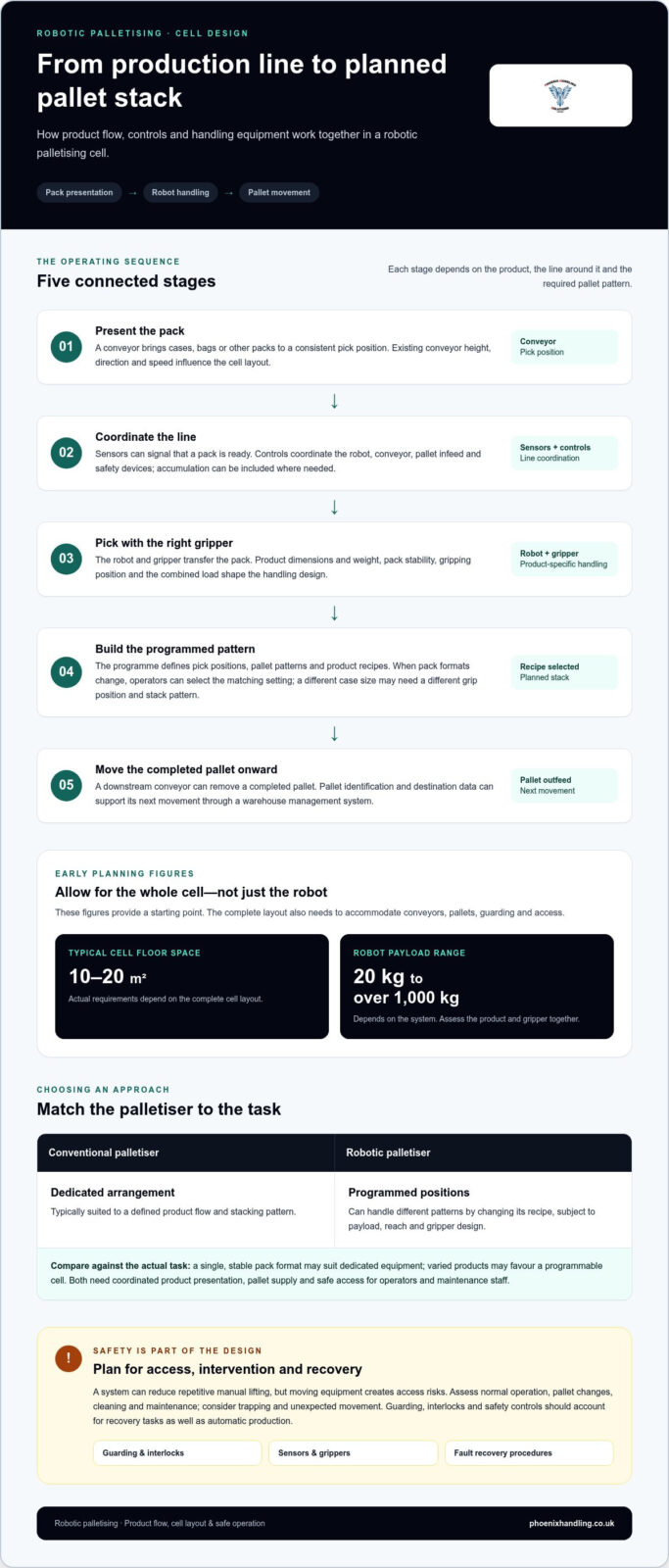
A conveyor presents cases, bags or other packs at a consistent pick position. Integration connects this transfer point to upstream production and downstream pallet movement, including accumulation where needed. For example, a sensor can signal that a pack is ready, while a downstream conveyor removes a completed pallet.
Designers map product flow from the packing machine to dispatch, identifying transfer points and potential bottlenecks. Existing conveyor height, direction and speed all affect the layout. The review also considers how the line responds when a pallet position is occupied, production pauses or pack formats change.
Controls Integration and Programming
Controls coordinate the robot, conveyor sensors, pallet infeed and safety devices. The programme defines pick positions, pallet patterns and product recipes, allowing operators to select the correct setting for each pack format. Changing case size, for example, may require a different gripping position and stacking pattern.
Management information systems can receive production status, completed pallet counts and cell fault information. A warehouse management system can use pallet identification and destination data to support the next movement. The integration design should define who owns each data field, how information is exchanged and what happens if a signal is unavailable.
In the UK, packaging automation suppliers and industrial robotics integrators provide these systems. Their work can include equipment selection, cell design and connections to existing production and warehouse controls. The required scope depends on the production line and the systems it needs to integrate with.
Robotic and Conventional Palletiser Comparison
A conventional palletiser typically uses dedicated mechanical arrangements for a defined product flow and stacking pattern. A robotic palletiser moves through programmed positions and can handle different patterns by changing its recipe, subject to payload, reach and gripper design. The right choice depends on product variation, line rate and available space.
Compare systems against the actual task, not the automation label. A single, stable pack format may suit dedicated equipment, while varied products may favour a programmable cell. Both need coordinated product presentation, pallet supply and safe access for operators and maintenance staff.
Floor Space, Payload and Integration Requirements
A typical robotic palletising cell requires 10-20 square metres of floor space. The robot’s payload range can run from 20 kg to over 1,000 kg, depending on the system. These figures frame early planning, but the complete layout must also allow for conveyors, pallets, guarding and access.
Assess product weight and dimensions alongside the gripper, since the robot must handle their combined load. Then map the existing conveyor route, pallet flow, utilities and control connections. This helps establish whether the cell will fit the production area and communicate with the factory’s management and warehouse systems.
Workplace safety benefits of robotic palletising
A palletising system can reduce repetitive manual lifting by moving packs mechanically, but it also introduces moving equipment and access risks. Key hazards include trapping, unexpected movement and faults during maintenance. Routine checks should cover guarding, interlocks, sensors, grippers and fault-recovery procedures.
Safety Risk Assessment and Standards
A risk assessment should examine the full task, including normal operation, pallet changes, cleaning and maintenance access. According to the UK Government, most injuries occur when operators or maintenance personnel enter a palletiser and become trapped between fixed and moving parts. Collaborative robot palletising cells should be assessed for the risks of their specific application.
The assessment should identify who can enter the cell, which hazards they may encounter and how the system prevents exposure. A collaborative label alone does not make every application safe. The specific robot, gripper, product and working space all affect risk.
Safety Systems and Architecture
The robotic automation safety architecture described for this project is designed with reference to ISO 10218, an international safety standard for industrial robots and robot systems, according to the International Organization for Standardization. The design should connect risk controls to the cell’s operating modes, access points and foreseeable interventions.
Physical guarding, interlocked access and safety controls can prevent hazardous movement when a person enters a protected area. Their arrangement should account for pallet replacement and recovery tasks, not only automatic production. HSE and Automate UK published joint guidance on collaborative robotics in 2026.
Automation changes the pattern of exposure rather than removing every workplace risk. Operators may handle fewer cases directly but still need safe procedures for clearing a jam, changing a pallet or responding to a stopped conveyor. Define who can carry out each task and how the system is isolated before anyone intervenes.
Maintenance planning matters because a worn gripper, misaligned sensor or damaged interlock can affect safe operation. Include checks of gripping surfaces and connections, confirm that guards and interlocks function, and document how to respond to faults. Maintenance staff also need to understand the cell’s operating modes and recovery sequence.
For applications using collaborative robots, assess the specific interaction between people and machinery. Product weight, sharp or unstable packs, robot movement and gripper contact surfaces all influence potential harm. Design the automation around the work performed, including how people replenish pallets and access nearby equipment.
Review safety controls during commissioning and after changes to products, recipes or cell layout. A changed pack or gripper can alter the robot’s movement and the way people interact with the system. A practical safety review should therefore cover production tasks and maintenance access together. For broader planning, explore end-of-line automation considerations alongside the cell’s risk controls.
What happens before the palletiser enters production?
Preparation begins with a site survey, followed by design, testing and installation planning. These steps match the cell to the actual products, line conditions and production priorities.
Product Weight, Dimensions and Stability
The site survey records the product range, pack formats, pallet types, required stack patterns and production rate. Weight, dimensions and stability shape the robot’s movement, gripping method and stacking recipe. A tall, compressible case, for example, may need different handling from a rigid bag with a stable base.
Representative products and pallets help test whether the proposed pattern stays stable. The team also reviews how packs arrive from the production line, including their orientation and spacing, since inconsistent presentation can affect picking reliability.
Adapting to Different Products
A cell handling several products needs defined recipes for each format. Recipes can set pick positions, layer arrangements and pallet patterns, so operators can select the correct programme when production changes. Preparing these patterns before installation reduces programming at the production facility.
When products arrive from multiple production lines, the design must account for their different rates, pack formats and conveyor routes. The integration plan determines how packs are identified and directed to the palletising position. It also defines what happens when a line pauses or a pallet position becomes unavailable.
Gripper and Product Variation Troubleshooting
Factory testing uses representative products and pallets wherever possible to reveal variation before despatch. If a pack slips, tilts or arrives out of position, troubleshoot systematically: check its dimensions, gripping contact, conveyor presentation and programmed pick point. A change in packaging material can also affect how securely the gripper holds the product.
Testing should cover the range of formats expected in normal operations, not just one ideal sample. Record which recipe and gripper setting suit each product, then use those settings during commissioning and operator training.
Where practical, the cell is pre-assembled and tested at the manufacturer’s facility before despatch. A Factory Acceptance Test checks the system against agreed criteria before shipment, using representative products and pallets wherever possible. This helps address layout or programme issues before the equipment reaches the production site.
Installation planning covers access, lifting arrangements, utilities, customer responsibilities, production shutdowns and the order of work. Agreeing these details in advance helps coordinate equipment delivery with the existing line and avoid unnecessary operational disruption.
Before handover, live product trials check cycle and throughput performance, pallet patterns, safety functions and fault recovery. Operator training and maintenance familiarisation complete the process, preparing staff to run recipes and respond to routine stoppages. These checks provide a practical basis for bringing the system into production.
Palletiser cell components and layout
A complete cell combines the robot with product infeed, pallet handling, controls and safety equipment. A typical robotic palletising cell requires 10-20 square metres, depending on its configuration.
Cell Layout and Robot Selection
Cell layout begins with the product’s route from the conveyor to the pallet. The design positions the robot, pallet locations, guarding and controls around that flow. Robot selection depends on payload, reach, cycle requirements and the space available for installation.
Map pallet loading and unloading routes before fixing equipment positions. For example, a cell with two pallet positions can allow one pallet to be collected while the robot works on the other. The layout must also account for operator and maintenance access, as well as pallet handling.
Robotic Palletiser Types
Robotic palletising systems can be configured in different ways to suit the products and handling requirements. A robot arm places individual products or groups according to programmed patterns; a layer system transfers a complete layer. A cobot is designed for collaborative applications, but its use still depends on the cell’s safety assessment.
Choose between these arrangements by comparing product formats, stacking patterns, line rate and available space. A varied product range may suit programmable recipes, while a stable, repeated format may suit layer handling. Payload and reach are also important selection factors.
A single-cell end-of-line layout brings product infeed, palletising and pallet discharge into one defined area. Typical components include an infeed conveyor, robot, end-of-arm gripper, pallet position, controls and guarding. Their arrangement determines how products enter and completed pallets leave the machine.
Conveyors must present packs within the robot’s working area and maintain a consistent pick position. Depending on the material-handling arrangement, pallets can enter at floor level or on a conveyor. The layout also needs room for empty pallets and completed loads without obstructing nearby operations.
Specify cell components as a connected system, not as separate machines. The robot’s reach must cover the product pick point and every pallet position. The gripper must suit the pack’s shape and surface, while the controls coordinate the robot and conveyor signals.
- Infeed conveyor: presents products in the correct orientation and position.
- Robot and gripper: pick and place products into the programmed stack pattern.
- Pallet handling: supplies empty pallets and moves completed loads away.
- Guarding and controls: define the protected area and coordinate cell functions.
Higher throughput may require changes to conveyor flow, pallet exchange or the number of working positions. Review these interfaces alongside the robot’s reach and planned patterns. A layout must fit the available floor area while allowing installation, routine handling and access to components.
End-of-arm tooling and gripper selection
The end-of-arm tool is the part of the robot that contacts and moves each product. Its design affects secure handling, cycle consistency and finished pallet stability. Assess the actual pack, including its dimensions, surface, rigidity and weight, before selecting a gripper. A tool suited to one case format may not work for another.
Vacuum and clamp grippers are common palletising options. Vacuum tooling uses suction to hold a product, while a clamp applies pressure to its sides. The right choice depends on how the pack responds to contact and whether its surfaces provide a suitable holding area. A sealed carton and a flexible bag, for example, present different gripping conditions.
Start selection with the product range and required stacking pattern. The design must account for the combined weight of the product and tooling, since both contribute to the robot’s payload. Consider how the tool approaches and releases the product, and how it avoids disturbing neighbouring packs during placement.
For mixed formats, the system can use one tool suited to several products or change tooling between production runs. The choice depends on how often formats change, whether the robot can reach each pick position and how the control system identifies the selected recipe. Make changeovers repeatable by matching the correct tool and programme to each product.
- Vacuum gripper: assess the available contact area and the pack’s surface.
- Clamp gripper: assess whether the sides tolerate the force needed for secure handling.
- Layer tooling: consider whether products can be collected and placed together as a stable group.
Trial representative packs to identify issues before production. If a case slips, first check the gripping contact and pack surface. If a bag deforms, review clamp pressure and contact position. If placement varies across a pallet, inspect the pick point, release position and programmed pattern. These checks help distinguish tooling issues from inconsistent product presentation.
Gripper selection also affects storage, transport and downstream handling. A stable pallet pattern can reduce pack movement as loads leave the cell, while a poorly matched tool can damage packaging or disrupt stacking. Include product samples, expected format changes and pallet patterns in the selection process, then test the tool through representative pick-and-place movements.
To discuss how tooling fits a palletising application, explore robotic palletising options for your line.
Phoenix Handling Solutions Limited: Pallet Wrapping Machines
Phoenix Handling Solutions Limited supplies end-of-line equipment for businesses reviewing palletising and load securing. Its Pallet Wrapping Machines, Strapping Machines and Stretch Hooders secure completed loads in different ways. A Bag Palletiser is relevant when bagged products need to be arranged on pallets.
Consider these options when planning what happens after products leave the palletising cell. The right equipment depends on the load, packaging format and how pallets move through your operation. Reviewing palletising alongside wrapping or strapping can help define the equipment needed across the end-of-line process.
Contact Phoenix Handling Solutions Limited or visit phoenixhandling.co.uk to discuss equipment suited to your operation.
Plan the next step for your end-of-line operation
Before specifying a robotic palletiser, bring production, engineering and warehouse teams together to agree what the cell must achieve. A shared understanding of product changes, pallet movements and operator access gives the project a practical starting point. It also helps separate the palletising requirements from those for securing and moving completed loads.
Phoenix Handling Solutions Limited supplies Pallet Wrapping Machines, Strapping Machines and Stretch Hooders for securing loads after palletising. These options can be part of a wider end-of-line discussion when you review how finished pallets are prepared for handling and dispatch. The right arrangement depends on your products, packaging and process.
Set out your production requirements and discuss how the equipment should fit your operation. Contact Phoenix Handling Solutions Limited to take the next step in planning your end-of-line equipment.
Frequently Asked Questions
What is this palletising system and how does it work?
A robotic palletiser uses a programmed arm to transfer products from a conveyor to a pallet. Its gripper picks each item and places it according to a stored pattern. For example, a recipe can change the arrangement between product runs. Sensors coordinate product arrival and pallet movement, while controls report faults or pauses that need operator attention.
How much does an automated palletising system cost in the UK?
The cost depends on the project scope, including robot specification, gripping equipment, conveyors, guarding, controls and integration. The price is provided after a quote request, with the configuration and installation requirements shaping the quotation. A system for one product format may need a different design from equipment handling several products or production lines.
What affects the price and return on investment?
Equipment scope, product variety, integration work and operating requirements influence the investment. Potential returns depend on the task being automated, including labour use, throughput, downtime and workplace safety. Reported project payback is 1 to 3 years through labour savings, increased throughput, reduced downtime and improved safety. Compare current operating costs with the expected production demand and system utilisation.
What products, loads and pallet patterns can these systems handle?
Robotic palletisers can handle products such as cases and bags, subject to the robot and gripper specification. Payload capabilities range from 20 kg to over 1,000 kg across systems. Suitability depends on pack dimensions, stability, pallet size and the intended load shape. Separate recipes can define different pick points and layer arrangements for mixed product formats.
How should I choose equipment for a production line?
Match the system to the required production rate, product formats, payload and pallet patterns. A robotic palletiser must also suit conveyor presentation, pallet exchange, available floor space and connections to existing controls. For example, a line that changes pack formats needs clear recipe selection and repeatable changeovers. Assess the complete cell, not just the robot.
What UK safety standards and regulations apply?
Safety planning should consider ISO 10218, the international standard for industrial robots and robot systems, according to the International Organization for Standardization. Collaborative applications are assessed against ISO 10218-1 and ISO/TS 15066. The assessment should cover access, trapping hazards, maintenance and fault recovery in the installed cell. Guarding and safety controls must reflect actual operator tasks.