A tighter strap doesn’t always make a more secure pallet. A pallet strapping machine must apply the strap along a suitable path and at a tension that restrains the load without crushing or damaging it. The right setup depends on how the goods behave, not simply on how firmly the strap can be pulled.
If you’re assessing strapping equipment, it helps to understand what happens at each stage and how strap choice affects load stability. This article explains the basic cycle, from feeding and tensioning the strap to joining and cutting it, and how polypropylene, polyester and steel suit different load requirements.
You’ll also see how semi-automatic and automatic machines, including horizontal, vertical and compression formats, differ in use. Product type, pallet dimensions, throughput and available floor space all influence the choice. We’ll outline the operational details that help shape a suitable system and explain how a pallet strapping machine can fit into a wider packaging or conveyor line. Phoenix Handling Solutions Limited supplies strapping machinery specified around these practical requirements.
Key Takeaways
- Understand how a pallet strapping machine feeds, tensions, joins and cuts the strap to restrain a unit load.
- Relate strap material and placement to the load’s weight, rigidity, shape and stability.
- Use pallet dimensions, throughput and operator involvement to assess which machine format may suit your process.
- Map where strapping sits between load formation and onward handling or dispatch, including its connection to conveyors and other packaging equipment.
- See how Phoenix Handling Solutions Limited specifies strapping machinery around product type, throughput and available floor space.
What is a pallet strapping machine, and what does it do?
A pallet strapping machine applies one or more bands of strap around a palletised load to help restrain the goods during handling and movement. It feeds the strap, tightens it to a set level, joins its ends and cuts away the excess. The resulting restraint depends on both the strap path and the way the load is arranged.
The machine is one part of the packaging system. Strapping material is the consumable band, commonly polypropylene, polyester or steel. A seal or welded joint holds the strap ends together, depending on the machine and strapping method. Separate components, such as corner boards or edge protectors, can sit between the strap and the goods to protect vulnerable edges or reduce direct contact. They aren’t the strap or part of every machine.
For this reason, specifying a pallet strapping machine starts with the load and the process, not the machine in isolation. A regular, rigid stack may allow a straightforward strap path. Goods that are uneven, fragile or liable to shift may need different strap placement or protection. The packaging line also affects how the pallet is presented to the machine and how much operator involvement is required.
What happens during a pallet strapping cycle?
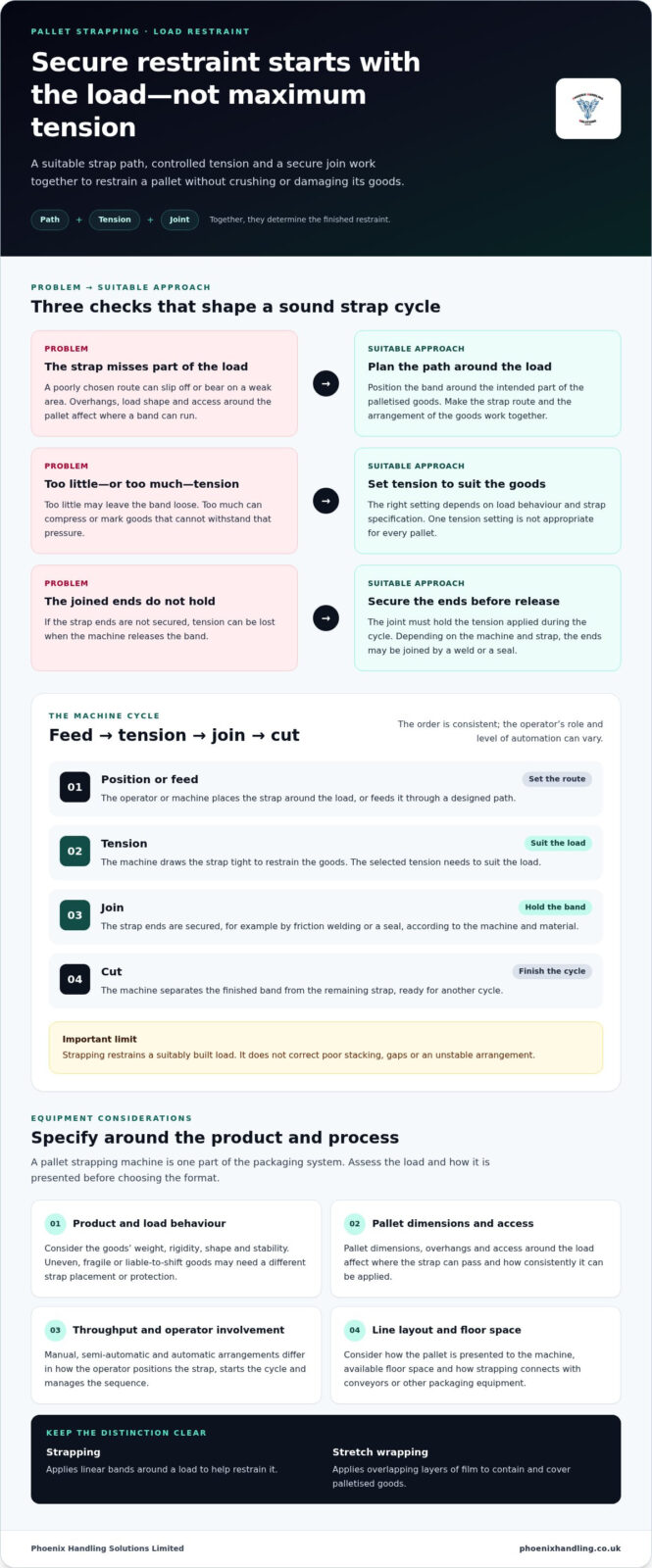
The basic sequence is consistent, although the operator’s role and the level of automation vary. The strap must pass around or through the intended path before it can be tightened and joined.
- Position or feed: The operator or machine places the strap around the load, or feeds it through a designed path.
- Tension: The machine draws the strap tight to restrain the load. Tension must suit the goods; one setting isn’t appropriate for every pallet.
- Join: The strap ends are secured, for example by a weld or a seal, according to the machine and material.
- Cut: The machine separates the finished band from the remaining strap, ready for another cycle.
Manual, semi-automatic and automatic arrangements manage these stages differently. An operator may position the strap or start the cycle, whilst an integrated system can handle more of the sequence as the pallet moves through the line. In every format, the strap restrains a suitably built load. It doesn’t correct poor stacking, gaps or an unstable arrangement.
How does pallet strapping differ from wrapping?
Strapping applies linear bands around a load. Stretch wrapping applies film around it, using overlapping layers to contain and cover the palletised goods. These are distinct packaging processes, with different consumables and machine functions. General information on strapping machines and strap applications provides further context on the equipment and joining methods used.
The processes may be used separately or as part of the same packaging line, depending on the load and handling requirements. Strapping doesn’t apply stretch film, and a wrapping machine doesn’t join strap. For a closer look at film-based systems and their place in end-of-line packaging, see this guide to industrial pallet wrapping machines.
How does a pallet strapping machine tension, join and cut the strap?
A pallet strapping machine completes a sequence of distinct operations: it feeds or positions the strap around the load, draws it to the selected tension, secures the ends and cuts away the excess. These steps handle the strap; the finished restraint is the closed band left around the palletised goods. A sound cycle depends on the strap following the intended path and the joined band holding its position.
The order matters. If the strap misses part of the load or passes over a vulnerable edge, correct tension alone won’t create a suitable restraint. If the ends aren’t joined securely, tension can be lost once the machine releases the strap. Interlake Mecalux provides further context on the pallet strapping definition, materials, and benefits, including how the packaging method relates to load handling.
How is strap fed and positioned around a pallet?
The strap path must pass around the intended part of the load, whether horizontally or vertically. In some arrangements, an operator positions the strap or guides it around the pallet; in others, the machine delivers it through a defined path. The load’s shape, overhangs and access around the pallet affect where a band can run and whether it can be applied consistently.
Consider a pallet with cartons set back from the edges. The planned path needs to restrain the assembled load without slipping off or bearing on a weak area. A machine cannot compensate for an unsuitable route, so the position of the strap and the arrangement of the goods need to work together.
How are strap tension and joining controlled?
Once positioned, the strap is pulled against the load before its ends are joined. Tension is a controlled application step, not a universal force: the suitable setting depends on load behaviour and the strap specification. Too little may leave the band loose; too much can compress or mark goods that can’t withstand that pressure.
Joining methods vary by machine and strap. Friction welding is one example used to bond strap ends; other systems secure them with a seal. The joint must hold the tension applied during the cycle, but the method shouldn’t be assumed from the machine category alone. The completed band, rather than the tensioning action by itself, provides the restraint.
After joining, the machine cuts the strap free so the finished band remains around the load and the machine is ready for the next cycle. This separates the consumable strap from the restraint it has formed. For practical specification, record the load’s dimensions and behaviour, the intended strap material and path, and the required operator involvement. Phoenix Handling Solutions supplies strapping machinery specified around operational requirements, including product type and throughput. Explore strapping machinery for your operation.
Which pallet loads and strapping materials need different approaches?
Strap selection depends on the combined behaviour of the packaging and its contents. A heavy load isn’t automatically a steel-strapping application, just as a light load isn’t automatically stable with any plastic strap. Consider the load’s weight, rigidity, shape and tendency to shift, then assess how a strap can restrain it without damaging the goods.
Load behaviour also guides strap placement. A compact, uniform stack presents a different restraint task from one with uneven layers, projecting items or gaps. The strap must engage the intended part of the load, and sensitive surfaces or exposed edges may call for protective components. There’s no reliable fixed number of straps for every pallet; the arrangement needs to reflect the actual load and packaging specification.
How do PP, PET and steel strapping differ?
Polypropylene (PP) is commonly used for light and medium-duty strapping. Polyester (PET) is a strong plastic strapping category and may suit heavier applications, but it isn’t a universal replacement for steel. Steel is used for demanding applications, with suitability depending on the load, strap path and handling process. Material choice should be assessed alongside the machine’s supported strap and joining method.
How do load shape and stability affect strap placement?
Regular, compact loads can offer consistent surfaces for a strap to restrain. Uneven shapes or variable layers can create gaps, protrusions or shifting points that affect the path and contact pressure. Fragile products and vulnerable edges may need protection where the band bears on the load. The pallet strapping machine and its settings should be selected around these conditions, not a generic load category.
Use the comparison below to organise the information needed for specification. It’s a starting point, not a substitute for assessing the complete load and packaging process.
| Load condition | Relevant consideration | Information to assess |
|---|---|---|
| Light or medium-duty goods | PP may be suitable, depending on load behaviour and strap requirements. | Load weight, dimensions and intended strap path. |
| Heavier or more demanding loads | Compare PET and steel against the application; neither material is right for every load. | Load rigidity, handling conditions and strap specification. |
| Compact, regular stack | Consistent geometry can make strap placement more straightforward. | Where the band should sit and which parts it needs to restrain. |
| Uneven or sensitive load | Variable layers, exposed edges or delicate surfaces can affect positioning and protection. | Overhangs, gaps, vulnerable areas and any protective components. |
Before choosing a strap or setting tension, record representative pallet dimensions, product characteristics, load weight and how the pallet is handled. Note whether the stack changes between products or batches. These details help distinguish a consistent application from one that needs flexibility in strap placement or machine settings.
Strap choice and machine settings must be matched to the packaging specification. Selecting material by strength alone can overlook load shape, product sensitivity and the restraint needed in transit. Phoenix Handling Solutions specifies packaging equipment around product type, throughput and available floor space, linking the strapping application to the wider process.
How does pallet strapping fit into a production or warehouse process?
Strapping sits within a sequence of pallet handling, rather than operating in isolation. Goods are formed into a unit load, the pallet moves to the strapping point, and the secured load then continues to another packaging stage, storage or dispatch. The route may be manual, or conveyors may move pallets between stages where the site layout and equipment support it.
Placement affects how the process works in practice. A pallet strapping machine needs room for the pallet to arrive and leave, for operators to carry out their tasks, and for strap material to be replenished. Access for routine operation and movement around the machine also needs to be considered. A layout that meets the required output on paper may still create a bottleneck if pallets queue or obstruct adjacent work areas.
What process details matter before integrating equipment?
Map the existing route and the demands placed on it before comparing machine formats. Record the range of pallet dimensions and products, including variations in load height or arrangement. Then use site operating data to describe current and required throughput, noting how often pallets arrive and whether an operator currently positions, transfers or checks each one.
A simple process map can make the information easier to use:
- Load formation: Record where products are stacked and how the completed pallet is presented for packaging.
- Arrival at strapping: Identify how pallets reach the work area and whether they arrive individually or in a sequence.
- Strapping activity: Note operator tasks, strap replenishment, pallet dwell time and any points where work accumulates.
- Exit and onward movement: Trace where pallets go next, such as to another packaging stage, storage or dispatch.
This map helps distinguish the machine’s cycle from the wider time required to prepare and move a pallet. It also shows where operator involvement, changing product formats or constrained floor space could affect the line’s flow.
Where does strapping sit alongside other packaging equipment?
A standalone machine may suit a process where pallets are brought to a dedicated station and removed afterwards. In a wider system, conveyors can transfer pallets between packaging stages where the route, floor space and equipment arrangement allow. The strapping point might follow load formation and precede wrapping or dispatch, but the actual sequence depends on the products and site process.
When comparing equipment, consider both the machine’s cycle and how pallets are fed into and removed from the strapping point. Phoenix Handling Solutions specifies packaging machinery around product type, throughput and available floor space, with conveyors and packaging automation also forming part of its wider offering.
Use your process map to develop a practical equipment specification. Review pallet strapping requirements with Phoenix Handling Solutions.
How can Phoenix Handling support a pallet strapping application?
Phoenix Handling Solutions Limited supplies strapping machines and packaging machinery to manufacturers and distributors across the United Kingdom. The aim is to match the equipment specification to the operation, rather than consider a pallet strapping machine separately from the products, handling requirements and space available around it.
That assessment can include how pallets are formed, how they move through the packaging area and what happens after strapping. A standalone machine may fit a dedicated station, whilst conveyors and other packaging equipment may be relevant where pallets need to travel between stages. These are integration considerations, not assumed parts of every system.
What information helps define the application?
A clear picture of the day-to-day process helps shape a useful equipment specification. Bring together details about the loads and the operating environment, including variations between products and shifts. Useful information includes:
- The products handled, pallet dimensions and typical load variation.
- The strap materials currently used or required for the application.
- Current and required throughput, supported by site operating data.
- Working patterns and the level of operator involvement in pallet handling and strapping.
- Available floor space, including the area needed for pallet movement and operator access.
- Existing packaging equipment, conveyor routes and the intended strapping point.
These details help distinguish the requirements of the load from those of the surrounding process. For example, a specification needs to account for both the pallet presented to the strapping station and the route it takes onwards. Product type, throughput and available floor space are central inputs to Phoenix’s project-specific equipment specification.
What support can follow equipment supply?
Equipment supply is one part of planning for an operational packaging line. Phoenix also provides equipment servicing and spare parts for packaging and handling equipment. These support options can be considered alongside the equipment specification and the needs of the wider operation.
For an initial discussion, it’s useful to have representative load details, process data and a simple layout or description of the packaging area. This gives the application context needed to discuss suitable strapping machinery and how it may relate to the wider line. Review pallet strapping machinery from Phoenix.
Turn your load requirements into a practical specification
The next step is to turn day-to-day operating information into a clear equipment brief. Note the products and pallet loads handled, how requirements vary, the expected throughput and the space available around the packaging line. This gives the specification a practical basis and helps keep the machine choice connected to the wider operation.
Phoenix Handling supplies strapping machines alongside packaging and material-handling machinery. Equipment specification can take account of product type, throughput and available floor space, with conveyors and other packaging equipment considered where they form part of the planned process. A well-defined brief gives these requirements a place in the discussion from the outset.
Set out your products, pallet dimensions, throughput and available floor space, then plan your pallet strapping application with Phoenix Handling.
Frequently Asked Questions
How many straps should be applied to a pallet?
There’s no fixed strap count that suits every pallet. The appropriate arrangement depends on the load’s dimensions, weight distribution, rigidity and handling conditions. A tall stack with uneven layers may need a different restraint pattern from a compact, uniform load. Assess representative pallets, including the variations handled in normal production, and check that the proposed arrangement holds the load without crushing or marking its contents.
Can pallet strapping damage cartons or products?
Yes. Excessive tension, a strap crossing a vulnerable edge or direct contact with a sensitive surface can crush cartons, leave marks or damage products. Review the finished load for indentation and distortion, particularly at corners and where the strap bears against packaging. Edge protection may help distribute contact, but it needs to suit the goods and strap path. Adjust the application if inspection shows damage.
What causes a pallet strap to become loose after application?
A strap can loosen if the load settles after strapping, the joint doesn’t hold, or the strap wasn’t tensioned appropriately for the load and material. Changes in carton shape or movement during handling can also reduce contact between strap and goods. Inspect the joint and strap path, then compare the packed pallet with its condition after handling. Recurring looseness may point to a mismatch in the packaging specification.
Can a pallet strapping machine work with different strap materials?
Some machines can handle more than one strap material, but compatibility depends on the machine’s design and specification. Feed, tensioning and joining requirements differ between polypropylene, polyester and steel, and strap dimensions also matter. Don’t assume a pallet strapping machine can switch materials without adjustment or component changes. Match the machine’s stated capabilities to the strap specification required for the application.
Does pallet strapping make an unstable load safe to transport?
No. Strapping can restrain a properly built load, but it can’t make an unstable stack safe simply by adding tension. If cartons are leaning, poorly interlocked or unevenly supported, correct the load formation before securing it. Check that the pallet itself is suitable and that products don’t shift under normal handling. A finished strap should support the load arrangement, not conceal a problem with it.
What is the difference between strapping and banding?
In packaging, “strapping” and “banding” are often used to describe the same practice: applying a tensioned strip around goods or a pallet load. Terminology can vary between suppliers and industries, so the word alone doesn’t identify the material, joining method or machine format. For a technical discussion, specify the strap material, dimensions, intended load and equipment requirements rather than relying on the label.
Can strapping be combined with stretch wrapping on one pallet?
Yes. Strapping and stretch wrapping can be used on the same pallet when the load and packaging process call for both. For example, bands may hold grouped items together whilst film contains smaller packages and covers the load. The order and settings should suit the goods, strap positions and line layout. Check that film application doesn’t interfere with strap joints, labels or any required handling access.